Myron May, the man who shot and wounded three people at the Florida State University library yesterday morning before police killed him, was mentally disturbed:
May’s Facebook page shows he posted mostly Bible verses and links to conspiracy theories about the government reading people’s minds. Records show May was licensed to practice law in Texas and New Mexico. According to a Las Cruces, New Mexico, police report last month, May was a subject of a harassment complaint after a former girlfriend called to report he came to her home uninvited and claimed police were bugging his house and car. Danielle Nixon told police May recently developed “a severe mental disorder.” “Myron began to ramble and handed her a piece to a car and asked her to keep it because this was a camera that police had put in his vehicle,” the report said. The report also said May recently quit his job and was on medication.
In the wake of this latest tragedy, Beth Elderkin wants to talk about how almost all such “active shooters” are male:
[T]here’s no way to deny that almost all active shooters of the past decade have been men. Even Paul Elam, founder of men’s-rights site A Voice For Men, called the FBI’s statistics “reasonable” in an interview with the Daily Dot. But does that mean masculinity is, or should be, part of the conversation? According to researchers, the answer is yes. An increasing number of sociologists, including [Michael] Rocque, who authored a study on school shootings in 2011, say gender should be treated as a key component in how we address active shootings and other violent acts. And we’re not just talking about mass shootings; FBI statistics show that in 2012, more than 80 percent of arrests for violent crimes were men.
Update from a reader:
So can we acknowledge now that male brains work differently from female ones? Obviously I don’t mean that it’s always for the better! But then couldn’t these differences also partially explain the lack of gender parity in certain professional fields? Testosterone is powerful stuff.
Tyler Lopez, meanwhile, blasts the NRA’s position on these incidents and how to stop them:
The gun lobby acknowledges the problem of mass-shooting incidents in the United States. Its solution calls for arming more people who could potentially stop a shooter and for rapid-response training focused on minimizing casualties. This is part of an increasingly pervasive, insidious gun culture that accepts mass shootings as inevitable. But by this logic, the first victims—friends, loved ones, children—are expendable. The first victims of a mass shooting are a mangled human sacrifice on the altar of Second Amendment rights.
Until a shooter pulls the trigger to begin his slaughter, he is merely a guy with a gun. The gun lobby insists that the government should allow people to carry firearms into all public places. (Gun advocates continued to push for expanded open-carry legislation the morning after the Tallahassee shooting.) After all, who are we to judge a man simply because he is proudly displaying a gun by his side? In this world, the first victim is merely an alarm for others to respond.
This is in response to this reader. The condition that worries the dads is called phimosis. Until my mid-twenties, I couldn’t see more than a dime-sized area of my glans when I pulled back my foreskin. I didn’t even realize my foreskin was supposed to retract until I stumbled upon information about the condition online.
I recommend the dads look at the archives of this forum. It contains many first-hand accounts of successfully overcoming phimosis with stretching exercises. After stretching my foreskin twice per day for a year, I was able to fully retract my foreskin when flaccid. My sensitivity decreased, but that was necessary. I was overly-sensitive, and now I’m able to retract to wash my glans every shower with soap and water, which any healthy uncircumcised man will tell you is simple and necessary. I don’t stretch now, years later, and my frenulum is still a bit tight when erect, but I was amazed by the improvement.
The forum is sometimes antagonistic to doctors, with the allegation that American doctors are too willing to circumcise in phimosis cases because they don’t know any better. Some extreme phimosis cases may need circumcision, but I recommend the dads do extensive research of their own before subjecting their son to a scalpel.
Another reader is pretty antagonistic toward American doctors:
America just doesn’t know how to deal with foreskins. We didn’t circumcise my son and his foreskin didn’t retract by age 5. We were told that it should by age 3, and the cure for a non-retracting foreskin was circumcision. No other advice was offered in England or America.
Then we moved to Bulgaria.
The doctor said we should pull the foreskin back to the point of gentle tension every day in the bath. Now, it’s a bit awkward for a mother to be handling her son’s penis, so I tried to get my son to do this himself, with so-so results. Not many months later, my son got an infection in his foreskin, from sloughed off skin cells trapped under the foreskin. He didn’t tell me in time, because he was an accident-prone kid and his solution to avoiding the doctor was to ignore the infection until he had a fever and was walking funny.
I checked on the web, consulted my home medical books, and called my American insurance company’s hotline. All the advice was to lop off that useless (and, it was hinted, disgusting) foreskin. But we were in Bulgaria, so we went to a Bulgarian hospital. The doctor was built like a weight lifter and had odd English. I explained my husband’s preference was to try to save the foreskin, if possible, expecting to be told it wasn’t. The doctor was absolutely horrified at the barbaric notion that anyone would consider removing a part of a man’s or a boy’s penis, especially for a trivial problem like a nonretracting foreskin with a treatable infection.
He forced the foreskin back, disinfected the infection, slathered antibiotic cream and told us to keep putting the cream on and that the foreskin now retracted. The procedure took under 5 minutes, cost $60 (10$ fee, 50$ tip) and solved the problem. That was years ago. My son remains intact.
I think it’s the cultural value that foreskins are useless at best and otherwise potential for disgusting reservoirs for grunge that makes the American and English solution to be lop it off at the slightest hint of any problem – and better yet, before there’s a problem.
And back Stateside:
I have been reading your circumcision thread and thought your readers may want a perspective from a female pediatrician who actually performs circumcisions on a regular basis.
My patient base is semi-rural, mostly white, blue collar, in the heart of Appalachia. They feel that their newborn sons are not “normal” if they are not clipped, and in fact that is sometimes the only question they ask when their son is just born – “Will he be circumcised?” Typically my partners and I will do a circumcision before the child leaves the hospital, but it can be done with local anesthesia up to two months of age in an office setting. There are different types of circumcision procedures that can be done and different doctors are trained on different procedures, but the basic principle is the same: the foreskin is loosened from the glans, a dorsal slit is performed and the foreskin is either placed in a clamp, or tied off around a plastic ring. There are pluses and minuses to each procedure, but it is mostly doctor preference regarding which one is done. And as I said, local anesthesia is given.
As part of my practice, I want my patients’ parents to make the right decision, and so I typically perform a thorough explanation of the risks and benefits of the procedure. But I do get frustrated that despite letting them know they don’t need the procedure, the parents feel it must be done.
Reading your readers stories, I am sad and a little disappointed because although I was not involved in these cases, I feel like the medical field have let them down. And I think the reason is because the majority of males in the US are circumcised, and that creates a bias and a misunderstanding of the true nature of the foreskin and the male sex organs. If you only see circumcised boys, you may not really know when the foreskin should protract, and you would view something that is completely normal as abnormal just because it is different.
First off, ALL males are born with a natural phimosis. With time the phimosis loosens. This can vary, but there is a key ingredient needed and that is TESTOSTERONE. That is why the doctors of the various readers gave them steroid cream, but that is just not as effective as your own production of testosterone. Now some mothers with uncircumcised boys are aggressive with “cleaning” and that traction will loosen the foreskin. Some boys are more playful, and that too will loosen foreskin, but a boy of age 3, 5, 7, 8 – even sometimes 14 – has very little testosterone flowing, so it is needed to mature the the male sex organ to function like it should. (As a side note, we recommend not pulling the foreskin down to clean, as that may cause it to rip from the glans but stick, swell and potentially cause loss of blood to the glans, which is bad.) Once the testosterone is flowing, the adolescent maleusually provides enough friction that any minor tightness will also loosen.
Obviously there are some exceptions to this rule, and a circumcision may need to be performed for medical reasons, but that is the exception. I would highly question any physician who tells you a prepubertal boy needs a circumcision if they are urinating with no problems. I also feel very sorry for the man that had a circumcision as an adult with just a local anesthetic that is cruel. No child or adolescent would get a circumcision out of the newborn period without general anesthesia, so why would we do that to an adult?
One more thing: I am surprised that nobody has mentioned circumcisions that had complications. Commonly I see penile adhesions where the foreskin has reattached itself to the glans of the penis, sometimes making it appear as though the child has never been circumcised. Unfortunately I actually had a mother re-circumcise her son due to this very issue, despite my explaining that this was completely unnecessary, as the boy was two and thus had no testosterone, and that it will get better with time. Unfortunately she became obsessed with it and insisted it be done. I will never forget that boy. (Interestingly enough, prepubertal girls have a similar condition in which the labia minor fuse together, because there is no estrogen blocking the opening of the vagina and even the urethra, but of course we would never perform procedures to separate that.)
So that’s my two cents, for what it’s worth. I found you a few years ago and have thoroughly enjoyed reading your blog.
And we never cease to enjoy these incredible contributions from readers. Update from another:
(Interestingly enough, prepubertal girls have a similar condition in which the labia minor fuse together, because there is no estrogen blocking the opening of the vagina and even the urethra, but of course we would never perform procedures to separate that.)
Actually, this is exactly what my daughter’s pediatrician recommended when she was less than a year old; we were told to put estrogen cream on it (don’t worry if your infant develops breasts, that’ll be temporary … never mind the people freaking out about exposing their children to tiny amounts of estrogenic compounds in BPA plastics and possible links to the obesity epidemic). And if that didn’t work, we were told surgery might be necessary. Thank god for the Internet. The problem went away on its own at about 18 months. Never caused any trouble.
Whoopi Goldberg, a diehard Polanski defender, is skeptical of the allegations against Bill Cosby:
Readers react to the disturbing story:
I certainly understand Barbara Bowman’s anger. I think the answer to her question, of course, has more than a little to do with race. In this country, accusing a black man of raping a white woman comes with the burden of our racism and history of oppression. And when that man is a beloved entertainer and symbol of American fatherhood? You are right that his accusers had and have absolutely nothing to gain and everything to lose. I just can’t imagine what these women have gone through emotionally.
Hannibal Buress, by virtue of his gender and race, made it possible for us to have this conversation at long last. That it took a man to legitimize their stories is most unfair. We owe Buress our gratitude nonetheless.
Another wonders why Cosby didn’t get his comeuppance sooner:
Ten years ago we still had more of a top-down media structure. “Going viral” was not a thing yet. YouTube hadn’t even started. Instead, shocking things generally had to pass through gatekeepers, whose incentives were basically not to piss off the wrong people. Rape accusations at the time were considered not appropriate for polite company unless it reinforced an existing narrative. I’m sure many media outlets heard of these accusations, but dismissed them because they weren’t “truthy” enough.
He said / she said, she said, she said, she said, she said, she said, she said, she said, she said, she said, she said, she said, she said, she said, she said.
But a couple readers share Whoopi’s skepticism:
You wrote, “Believing Bill Cosby does not require you to take one person’s word over another – it requires you take one person’s word over 15 others.”
I have no idea what Cosby did back in the day. It would seem highly risky for a black man in the ’60s and ’70s to force himself on a white woman, but people have done risky things before. It was a long time ago, however, and it seems like too long a time to determine the truth of his or any other case without any real evidence.
The reason I’m writing this email however is to point out the problem with the “15 others” claim. The longer the time period, the more numerous the false claims/false memories. Did they get drunk and have sex with Cosby and regret it later and they have now over the years convinced themselves he must have slipped something into their drink 30 years ago? Did Cosby just hit on them years ago and grabbed a boob and they story grew in their mind? (Still bad, still inappropriate, but not as bad as rape). Did they have a sleazy experience with Cosby, believe that he could have raped somebody and embellish their story to help other victims?
Another:
If Bowman really wanted her story to come to light, she should not have settled and allowed the other assaulted women to testify in a trial. She accepted a settlement, and the reason to settle something like this is so the perpetrator can keep it as quiet as possible. She had a hand in keeping this quiet, and was financially rewarded for doing so. To complain about it now is disingenuous.
Update from a reader:
Cosby’s settlement was with Andrea Constand, not Barbara Bowman. She came forward to testify on behalf of Constand in a potential trial. That trial never took place because of the settlement, but Bowman has every right to speak up and is under no obligation to keep anything quiet.
Another adds:
As Bowman states in her Washington Post op-ed, “I have never received any money from Bill Cosby and have not asked for it.”
A torn reader rightfully falls on the side of the many female accusers:
I’ve been having a hard time dealing with the evidence that Bill Cosby is a rapist, but at the very minimum its helping me to understand why people sometimes defend and even excuse celebrities that are caught doing horrible things. Cosby was a fixture of my childhood. His public persona wasn’t just a source of humor for me, growing up, but also of comfort. I didn’t have an admirable father, so having someone like him as an example of what a father could be was meaningful to me. It’s not an exaggeration to say that he helped me through some hard periods.
Realizing that the real Cosby isn’t the same as the person I admired is hard. I’m feeling a profound sense of loss because that man I admired isn’t an admirable man. So what do I do with all of the positive experiences and, yes, values that I got from him? Is it still possible to admire the message while being disgusted with the messenger? Does the hypocrisy and evil negate the virtue?
Ultimately, I must side with the victims. If he hurt people (and I think he did), then he’s scum. And he’s a worse sort of scum for pretending to be a friendly, fatherly figure. I won’t make excuses and I won’t try to seek out some sort of false balance. But I also can’t do that without feeling hurt and without having to fight an urge to defend the man that I thought he was, even though that man was just an illusion.
Another update from a reader, who spreads the blame around:
I think NBC – who had a show in development with Cosby – is getting off awful lightly.
Yes, the accusations against Cosby slipped out of mainstream consciousness – but it was certainly no secret at NBC! For years, women have alleged that he used his position at the network in the 1980s to host private counseling sessions in which he drugged and raped them. These claims must’ve made at least some impression when they were aired in court just eight years ago.
Consider also that the claims against Cosby stretch into 2004(!) when Andrea Constand, a young employee at Cosby’s doting alma mater, says she was drugged and assaulted in his Philly mansion. Is it any mystery what Cosby had in store for the young female professionals that NBC was prepared to hand over to him? Do 67-year-old rapists not become 77-year-old rapists? Is this how cataract-eyed octogenarians find new verve for a career comeback?
The shameful truth is this: the only thing that stopped NBC from furnishing a serial rapist with a new crop of eager young professional women was a 90 second cell phone video of a stand-up routine. And that’s a scandal.
In the renaissance age of feminist, woman-focused journalism, how was that allowed to happen? Why did spaces like Vox, Gawker Inc. and Slate XX devote coverage to the sexism of The Amazing Spiderwoman, but let NBC announce a deal with a prolific rapist without a peep? Why was gamergate covered like the modern triangle shirtwaist fire, but the new Cosby show ignored entirely? Why dig so obsessively into nerdy, off-the-beaten-path subcultures when fucking NBC is setting Bill Cosby loose on a new group of subservient girls?
NBC, for their part, announced the cancellation of the Cosby project in the protective wake of Netflix’s announcement. They’re now attempting to quietly tip-toe away from this mess as the public descends on Cosby. They should not be allowed to.
Chris Picco singing Blackbird to his son, Lennon James Picco, who was delivered by emergency C-section at 24 weeks after Chris’ wife Ashley unexpectedly and tragically passed away in her sleep. Lennon’s lack of movement and brain activity was a constant concern for the doctors and nurses at Loma Linda University Children’s Hospital, where he received the absolute best care available. During the pregnancy, Ashley would often feel Lennon moving to music so Chris asked if he could bring his guitar into the NICU and play for Lennon, which he did for several hours during the last days of Lennon’s precious life. One day after filming this, Lennon went to sleep in his daddy’s arms.
A memorial fund has raised more than $100,000. Katy Waldman has mixed feelings about the Internet’s response to the story:
Why are we clicking and sharing (and giving)? Do we even understand what we see onscreen, or has Chris Picco’s tragedy just become another cheap portal to all the feels?
It’s hard to argue that the wave of financial support brought on by the video is somehow sinister. Sure, $100,000 is a lot of money and perhaps better spent elsewhere, but there are far more pernicious uses of a hundred grand than vastly improving the quality of life for a man who just lost his wife and newborn son. And while there may be some injustice in only the iPhone-documented and Facebook-approved tragedies attracting our dollars and attention—remember when the bullied bus driver received hundreds of thousands of dollars for her pain?—the solution to that injustice is pretty clearly not to declare that no one at all should get dollars or attention. (By the way: This is the same tension that many of us face when giving money to homeless people on the subway or street. Should I not give to this guy because I can’t give to everyone? I hope not.)
But it’s not really the strangers donating to Picco who are the bad guys here. It’s the voyeurs we’re truly worried about, the casual clickers ogling the wreckage before drifting on to another listicle. But what if a casual browser’s momentary engagement with Picco’s story isn’t gross, exploitative, or wrong? What if the small gleams of compassion and pity you feel for a dad you’ve never met only add to the store of compassion and pity in the world?
Update from a reader:
Katy Waldman may wonder why the Internet has responded to this story. I don’t. The Internet is made up of human beings.
I haven’t watched the video. I can’t watch the video. The headline is enough to make me cry. Because I too have sang to my son. I too held my son until he went to sleep.
Regardless, I know what is in that video – a very human story. A story not often told, but one that resonates with people. Every parent who sees that story knows the fear of losing their child. Every person who has been in love knows there could be a moment where they will need to give comfort and say goodbye. You are talking about core truths of the human experience that touch the deepest centers of our beings. The tragedy experienced by Chris Picco is something everyone can relate to at some level.
Worrying about what motivates the people watching this video kind of misses the point. What you have here is people reaching out, connecting to their loved ones, sharing something that touched them. Passing around a message of love and strength. Helping out if they can, in the way they can.
So what if some people are voyeurs? I am willing to bet that for every person who felt nothing and moved on to the next link there were many more who were left with a deeper appreciation of what they have and how easily it can all be lost. Some people probably even walked away grateful that they weren’t given that burden to bear. Do the reactions and understanding of the audience really matter? The story, and the truth behind it, is what matters.
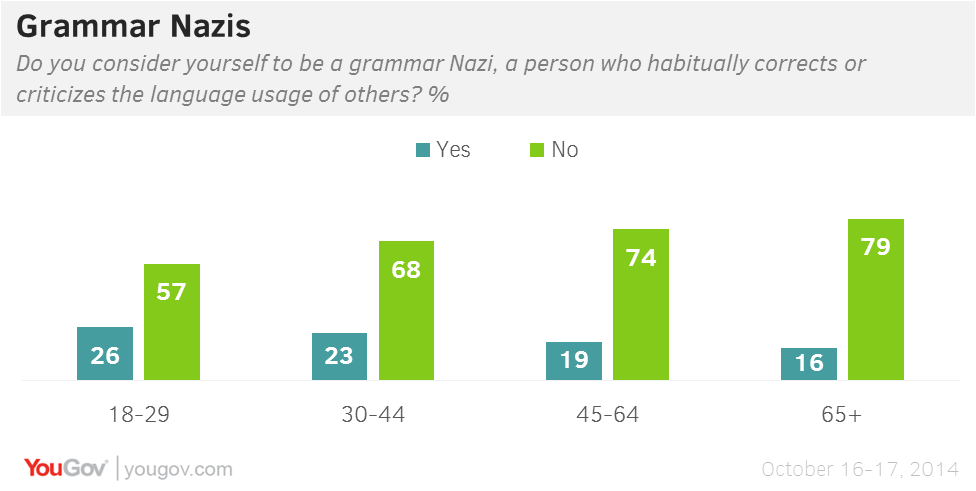
A recent survey tests Americans on our grammar, as well as our fascist tendencies:
Research conducted by YouGov in October shows that, when asked, 21% of Americans consider themselves to be what is colloquially known as a ‘grammar Nazi’, that is someone who habitually corrects or criticizes the language usage of others.
Younger Americans, especially under-30s (26%) are more likely than older American to admit to being grammar Nazis. Only 16% of over-65s say that they habitually correct and criticize the language usage of others. 70% deny being a grammar Nazi, while 9% are on the fence.
This finding is appropriate, as younger Americans were often better than older Americans at accurately identifying the correct grammatical form of particular sentences. When asked about the correct use of ‘it’s’ and ‘its’, 61% of Americans rightly identified the sentence ‘my oak tree loses its leaves in autumn’ as being correct, while 31% said that ‘my oak tree loses it’s leaves in autumn’ was correct, wrongly using the contraction of ‘it is’. 70% of under-30s identified the correct sentence, compared to 56% of over-65s.
Update from a reader:
Well, that’s just a poor survey design. There’s an immediate bias there: older Americans (especially the 70+, I imagine) are going to be less likely to ever identify themselves as any sort of Nazi, even if it’s a relatively benign term like Grammar Nazi.
As this reader attests:
I’m in the 45-64, and I will happily admit to being a habitual correcter of other people’s grammar, but I would answer “no” to that survey because I’d never call myself any sort of “Nazi“. You can call me a grammar pedant, a grammar nag, or a grammar obsessive, but “Nazi“? No thanks.
Reflecting on her experience working as a college administrator, June Thunderstorm questions diagnoses of ADHD, PTSD, and various allergies and phobias “that heavily credentialed people devise to shirk routine labor.” She scoffs that “there must have been at least six empathy-inducing acronyms for writing is hard, so I refresh my Facebook page all day instead“:
[N]ow, with ten years of graduate school under my belt, it’s become my job to guess how to grade papers that come with special slips marked “dyslexia”; those slips mean, basically, that I’m not supposed to judge the writing on the basis of syntax, grammar, or coherence. Of course, the dyslexic papers are always diverse—some have syntactic mix-ups that are clearly symptomatic of the disorder, some do not, some appear simply to be bad papers written by someone who did not read the book, and some are as good as the best papers in the non-dyslexic category. The non-dyslexic category involves a similar spread—a certain proportion have the syntactic mishaps that are the classic signature of dyslexia, most do not, some are terribly bad, and some are great.
What divides students with the special slip from everyone else is not always or only dyslexia.
Some students work the system—i.e., have parents who bestow on them a sense of entitlement and access to expensive special health services that it doesn’t even occur to ordinary people to ask for. Disability then turns into class power misrecognized. The rebranding of social and cultural capital via a class-encoded discourse of health allows the privileged student to get ahead with even less merit than before. After all, it is only when pain is the exception rather than the rule that it is noticed; only those who can imagine escaping their pain bother to complain about it, and only those who know the system can have the strength to manipulate it. …
You see, the assumption behind efforts to eradicate “ableism” seems to be that only some people—people with recognized disabilities, and not, for example, workers routinely in harm’s way—deserve protection from dust, paint, and lifting boxes. Only some people don’t like seeing themselves bleed. Only some people are damaged by inhaling trisodium phosphate. And only some people should get to have their papers graded easy.
Update from a reader:
As Disability Services Coordinator at a small regional university, I have about 120 students registered with my office for some form of disability accommodation, at an institution of about 4,000 students. That ratio is pretty static across the profession. About half of the registered students attest to some form of concentration disorder such as ADD, ADHD, or certain types of anxiety with varying triggers. Common accommodations for students who provide appropriate documentation include extended time testing, and a provision that ensures they can do their homework, quizzes, and tests in a quiet and distraction-free environment outside of the traditional classroom.
The accommodations they receive are emphatically NOT easier grading or anything of the sort, as June Thunderstorm seems to imply. If these students are receiving accommodations that include a wholly different grading scale in the environment of postsecondary education, those are unreasonable accommodations that fundamentally alter the academic rigor of the instruction and evaluation. No law, anywhere, requires relaxed academic standards for students with disabilities.
Disability accommodation is about creating access and opportunity, not about making things easier overall.
Look! We almost had a national food plan – it got to the white paper stage.
Another reader:
This is a topic in which I am extremely interested and see the many challenges. In my mind, it is a fact that we are harming our health, the planet, animals, and the economy with the current SAD (Standard American Diet). So many places to go with this it’s hard to be succinct. First off, I agree with Bittman, Pollan, et al on the goal they are trying to achieve, but I have issues with the means. Anything like a “National Food Policy” coming from Obama will be derided immediately as nanny-state-ism by half the country. But there are pieces I think he should address anyway:
The corn and soy subsidies have got to stop. Why is our gov’t subsidizing the thing that is making us sick and costing us billions in health care costs (maybe trillions if you factor in other costs to the economy)? And while we’re at it, I have ZERO problem with government taxing heavily sugar-laden “foods”.
Food safety: Get the pesticides and chemicals out of our food (and our personal care products, while you’re at it). Most of the 80,000 the chemicals used in the US today have not been suitably tested by the EPA and these are creating tremendous hidden health and environmental issues.
Regulations for meat producers for both food safety and animal rights should go forward. It SHOULD make meat more expensive and that’s OK. We should be eating much less meat anyway, so let the higher prices reduce consumption so it’s a win-win.
But secondly, maybe what these writers are really trying to achieve is this: get people talking about these issues to raise awareness. Maybe the government isn’t the sole answer to all these interrelated problems, but we can’t get the market to adjust unless people understand the problem and want to make changes.
Maybe Glenn Beck can help: I just read that he has health issues (an autoimmune disease) which he is treating with diet and lifestyle changes. Hopefully he’ll become a source for all his viewers on the benefits of healthy eating and lifestyle. We really need someone like him (i.e. from the other side of the aisle) to support this discussion to reach all those who say “keep your gov’t hands off my Big Gulp”.
Love, love, love that you have brought this issue to your website. Would love to see more.
Update from a reader with more:
In regard to your skepticism regarding the Pollan-Bittman reworking of national food policy, I would like to call to your attention an effort to actually do that, just not in a direction P-B would likely deem appropriate.
Rather than ever more micromanagement of the national diet, with longer lists of “bad” foods and shorter lists of “good” foods, my (small, non-profit, moms-in-sneakers) organization, Healthy Nation Coalition, is calling for a scaling back of the Dietary Guidelines for Americans so that they are focused on the acquisition of adequate essential nutritional (at one time the sole focus of federal dietary guidance). Rather than continue a (failed) effort to prevent chronic disease through avoiding foods (eggs, whole milk, butter, gasp, even meat) that are wholesome and nourishing and expanding the recommendations to include views on sustainability (despite the fact that, as far as I can tell, no farmers sit on the Dietary Guidelines Advisory Committee), we think it would be a good idea if federal dietary recommendations stuck to clear, science-based advice that the public could actually use.
Your reader asked: “The corn and soy subsidies have got to stop. Why is our gov’t subsidizing the thing that is making us sick and costing us billions in health care costs (maybe trillions if you factor in other costs to the economy)?” Easy answer: because these crops are grown primarily to beturned into meat at torture factories, and the government is devoted to heavily subsidizingAmerica’s extreme over-consumption of meat.
Subsidized fossil fuels are turned into artificial fertilizer; artificial fertilizer is turned into further-subsidized corn and soy; corn and soy are turned into meat – all in an extremely cruel, inefficient, and polluting process. We are eating fossil fuel products, and about half of the nitrogen in our bodies came from fossil fuels. It is outrageously unsustainable, but it is the only way to provide such vast quantities of cheap meat.
Mark Bittman, Michael Pollan, Ricardo Salvador and Olivier De Schutter recently argued for a “national food policy” that Obama should announce at the next State of the Union:
If a foreign power were to do such harm [from the food system], we’d regard it as a threat to national security, if not an act of war, and the government would formulate a comprehensive plan and marshal resources to combat it. … So when hundreds of thousands of annual deaths are preventable — as the deaths from the chronic diseases linked to the modern American way of eating surely are — preventing those needless deaths is a national priority.
A national food policy would do that, by investing resources to guarantee that: All Americans have access to healthful food; Farm policies are designed to support our public health and environmental objectives; Our food supply is free of toxic bacteria, chemicals and drugs; Production and marketing of our food are done transparently; The food industry pays a fair wage to those it employs; Food marketing sets children up for healthful lives by instilling in them a habit of eating real food; Animals are treated with compassion and attention to their well-being; The food system’s carbon footprint is reduced, and the amount of carbon sequestered on farmland is increased; The food system is sufficiently resilient to withstand the effects of climate change.
The good news, they tell us, is that “solutions are within reach”—and it’s here that this piece really start to get amazing. The authors acknowledge that many of the problems with America’s food economy are not market failures at all but “largely a result of government policies.” So the solution surely must be to get government meddling out of food and farm policy as much as possible, no?
Ha!
“We know that the government has the power to reshape the food system because it has already done so at least once—when President Richard Nixon rejiggered farm policy to boost production of corn and soy to drive down food prices,” they write. And because government can, it should, apparently. The authors are somehow able to see the corrosive effect of previous government overreach on our food system, but they feel confident that this time! they’ll get it right.
“As Obama begins the last two years of his administration facing an obstructionist Republican Congress, this is an area where he can act on his own—and his legacy may depend on him doing so,” they suggest, urging Obama to “announce an executive order establishing a national policy for food, health and well-being.”
The idea that cooking, eating, and enjoying nutritious foods is elitist is a silly and destructive one, and I’ve never been one to mock folks like Bittman and Pollan for their kale chips or food philosophies. But it doesn’t get much more elitist than thinking the U.S. food system as a whole would be better off by circumventing not just markets but also any Congressional debate. Just relax and let the top men take care of it…
Word awaits as to whether the Obama administration will join forces with Vogue in promoting the Pollan family’s quinoa burgers. Update from a reader:
I’m all for improving U.S. food policy, but like Elizabeth Nolan Brown, I’m skeptical. Grocery stores are fairly sensitive to customer demand, and I think if people change their food choices then the foods being sold to them will change. When I’ve wanted particular products at grocery stores, I’ve found managers have been willing to try to get me what I want.
I’d like to see every child take one or two years of nutrition, food safety, sanitation and food preparation instruction in school during the middle school years. It would give students some practical skills and indirectly help them exercise problem-solving skills. They can learn to prepare familiar and unfamiliar foods and learn how to shop and begin to learn menu planning and budgeting skills. Kids don’t need self-esteem as much as they need to know they can feed themselves and cope with daily life.
The other place where I’d like to see government muscle exercised is in the restaurant and fast food industry. I want the salt levels taken down significantly – I can always add salt – so I don’t have to cook a lot and can eat more takeout. Cooking isn’t real thrilling for me now that my spouse has died and I live alone. Being able to go to a restaurant without sending my blood pressure off the charts would be nice. I am eating out less than I was, and I do tell restaurant servers and managers that I’d prefer less salt. The response is often polite commiseration for the sake of being polite (indifference in a socially acceptable guise), but no change. I’m more willing to use government force on restaurants because the managers seem to be less responsive.
[I]t is possible everyone has their political calculus wrong with regards to the Chief Justice, just as we did the first time the Supreme Court looked at the ACA. Roberts, according to all accounts, did a last-minute 180 on Obamacare in 2012. We may never know why, but it seems likely it had something to do with preventing a backlash against the court. While such a backlash is less likely now—especially given the just-completed midterms that gave Republicans control of the whole Congress—Roberts is savvy enough to know how a ruling against the federal government in this case could be perceived. In a recent speech to the University of Nebraska College of Law, Roberts said that he didn’t want Americans to start to view the Supreme Court as a “political entity.” “I worry about people having that perception, because it’s not an accurate one about how we do our work. It’s important for us to make that as clear as we can to the public.” A 5-4 anti-Obamacare vote in King v. Burwell would accomplish the exact opposite: Eliminating the federal government’s subsidies, when there is such widespread agreement that Congress never, ever intended such a thing, would look like nothing but a political swipe.
I’m staggered that the Justices took the case. I tend to agree with Simon Malloy that a partisan SCOTUS ruling that struck down the heart of the Affordable Care Act on a technicality/typo would invite the greatest mobilization of liberal voters since 2008. But that might not stop the Court anyway. Noah Feldman suspects that, if SCOTUS “announces a fundamental constitutional right to marry, its liberal legacy will be so prominent that Roberts may have reason that he can kill Obamacare without tarnishing the court’s reputation too much”:
Imagine that, in the space of a few days at the end of June, the court decides a landmark case in favor of gay rights and then says that the IRS can’t give subsidies to citizens of states that have created their own health-insurance exchanges: What liberal critic would be able to say with a straight face that this was the most conservative activist court in history? The court would be activist, all right, but it would appear almost evenhandedly so.
Beutler lists off reasons Roberts may side with the government. Among them:
Chief Justice John Roberts himself is a business friendly justice. The Chamber of Commerce basically bats 1.000 with him. An adverse ruling would cause immense harm to powerful corporate interests like private insurance companies, hospitals, and other stakeholders, all of whom oppose the challenge.
Bill Gardner, on the other hand, bets that Roberts will agree with the challengers:
The constitutional outcome of a victory for the King plaintiffs would be a radically decentralized federalism. It would mean that increasing access to health care through the ACA would require political validation at the state as well as the federal level. This outcome would be consistent with the constitutional philosophy that Roberts and many other conservatives espouse. For this reason, if no other, I expect Roberts to vote for the King plaintiffs.
Earlier Dish on the case here and here. Update from a reader:
If it were based on a “typo”, why would Jonathan Gruber publicly state that the intention of that language was to force states to establish exchanges? Clearly there is more to this than your flippant dismissal indicates.
Charles Murray celebrates the contributions of stay-at-home wives:
[M]any of the important forms of social capital take more time than a person holding a full-time job can afford. Who has been the primary engine for creating America’s social capital throughout its history, making our civil society one of the sociological wonders of the world? People without full-time jobs. The overwhelming majority of those people have been wives.
Every aspect of family and community life gets an infusion of vitality and depth from wives who are not working full time. If you live in a place that you cherish because “it’s a great community,” think of the things you have in mind that make it a great community (scenery and restaurants don’t count), and then think about who bears the brunt of the load in making those things happen. If you live in a place that is not a community—it’s just a collection of unrelated people, living anonymously, without social capital—think of the reasons why it is not a community. One of the answers will be that no one has spare time for that kind of thing.
I’m not knocking the importance of stay-at-home moms for raising children. I just want us to realize that stay-at-home wives are one of the resources that have made America America. It is entirely understandable that some wives work full time, either for the fulfillment of a vocation or to make money–the same reasons men work full time. But when either partner in a marriage—and it will usually be the wife—chooses to devote full time to being a parent and neighbor instead, that choice should not just be accepted, but celebrated.
And stay-at-home husbands as well. The division of labor within marriage is important, but it doesn’t have to follow traditional gender lines. Catherine Rampell responds to Murray:
Among fathers, 16 percent say they’d ideally stay at home, if money were no object. Just 7 percent of them are actually abstaining from the labor force. Now look at mothers: 22 percent say they would ideally like to stay at home and not work, while 30 percent actually do so. …
[W]hat accounts for the divergence between stated work preferences and actual work arrangements? Let’s start with the barriers to taking part-time work: Some jobs are just not easy to divvy into part-time hours, either because of the nature of the work or the costs to the employer associated with hiring and managing more staff. Part-time jobs also tend to pay less on an hourly basis than their full-time equivalents and may not be remunerative enough to justify paying for child care. So, many parents who would ideally like to work part time instead choose full-time jobs that pay a little better. Or — more often for mothers than for fathers — they stay out of the workforce altogether, which means they can provide child care themselves.
Fathers may feel relatively reluctant to drop out of the labor force — even when that is their preference, or when they prefer a part-time job but can’t find one – for two main reasons: A) They are still more likely to be in higher-paying careers than their children’s mothers are (a trend that may change as women obtain more education, as Tankersley suggested); and B) compared with women, men may feel greater social pressure to be breadwinners rather than homemakers, part of the so-called “masculine mystique.”
Update from a reader:
Rampell’s response to Murray’s piece only gets at part of the problem with his celebration of wives. Yes, the gendering of those who chose to stay-at-home is near-sighted and problematic. But Mr. Murray is not talking about “wives” here; he’s talking about the noblesse oblige of women of a certain class who are freed from domestic labor and then in turn pursue civic pursuits. While Mrs. Murray’s social commitments are commendable (she’s no Real Housewife of Chevy Chase), where does she get the time to take on “half a dozen civic obligations” if she isn’t relying on the (most likely) underpaid work of domestic laborers who keep up her house? Not that I would want her or anyone chained to what was once called drudge work, but her free time seems to be displaced onto the back of someone that Mr. Murray is not mentioning. That someone cleans the Murray household (presumably a woman, since that is who typically performs paid domestic labor) is clearly not able to stay home and be a wife according to Mr. Murray’s definition.
Another:
I am not crazy about the “stay at home wife” terminology. It does ignore fathers who would like to stay home but do not, as well as the parents who need to work for financial reasons. However, as a “stay at home wife”, I disagree with the reader who said the civic participation occurs on the backs of hired help. Yes, that happens in some cases, but even the most cash-strapped “stay at home wives” volunteer their time in ways that benefit their community. I usually have 3-5 volunteer pursuits going at a time and I have no hired help to manage my home. We are wealthy enough to hire help but not wealthy enough for it not to be a trade off. Also, a number of women do not return to work when their kids go to college; they have a lot of time for civic pursuits.
In my experience, my volunteer civic pursuits are often treated as “cute” by men and women with careers, even if they require the same management skills as my former career did. Maybe what we need is less about celebrating “stay at homes wives” and more about respecting and valuing the contributions people make even when a paycheck is not involved.
 The Dish