Michael Sam Joins America’s Team

by Dish Staff

He snagged a spot on the Cowboys’ practice squad. Sam Laird approves:

Why the Cowboys are an ideal fit for Sam’s quest to build an NFL career is simple: They suck, especially on defense. If Sam is going to work his way from a practice squad to a regular 53-man roster, Dallas is as good a place as any to do so. Their defensive line is full of holes, and the loss of highly touted rookie DeMarcus Lawrence for at least six weeks creates another. Lawrence’s replacement, Jack Crawford, is no great shakes either, having been cut by the lowly Oakland Raiders just last week.

Other reasons to cheer the news:

You don’t get much more #America than Dallas, a red state where the steak is rare, the whiskey’s strong and the dudes sure as hell don’t kiss other dudes. The Cowboys are even nicknamed “America’s Team,” for crying out loud. … [H]aving America’s first gay NFL player in the middle of conservative Texas, on America’s Team, amid the league’s brightest media spotlight is pretty amazing.

Jay Caspian Kang also sees the logic of the move:

In many ways, Dallas is a perfect fit—the team has enough problems to be too worried about a practice-squad player. Aside from the on-field problems—and there are many—owner Jerry Jones has become a big-tent circus unto himself, with an alleged tampering scandal involving Adrian Peterson, of the Vikings, and a set of leaked photos—which are, frankly, bizarre—that showed Jones cavorting with two younger women. The Cowboys are a big-tent show, and if Sam indeed has a circus around him, it shouldn’t be more than a sideshow.

But Scott Shackford points out that Sam could get cut again:

Whether he eventually gets elevated to the roster and actually take to the field of a game, or even lasts on the practice squad, is a whole other question. For those who want to read the technical analysis of how Sam does and doesn’t fit in NFL play with only minor emphasis on Sam’s pioneering identity, ESPN’s Kevin Seifert has some explanations here.

Recent Dish on Sam losing his spot on the Rams here. Update from a reader:

While the Dallas Cowboys marketing team has done a great job of trying to brand them as “America’s Team,” the rest of the country hasn’t seen fit to go along with it. The most recent polling data seems to indicate they are the most hated team in the league.

Another:

In your post, Sam Laird writes, “You don’t get much more #America than Dallas, a red state where the steak is rare, the whiskey’s strong and the dudes sure as hell don’t kiss other dudes.” Gracefully, I would like to protest. As a resident of Dallas I like rare steaks and strong whiskey. But, I sure as hell like to kiss other dudes. There’s a saying of what Texas is really like: “Nothing but steers and queers.”
Celebrities: They Sext Like Us, Ctd

by Dish Staff

The photo leak scandal wages on. Alyssa Rosenberg raises an eyebrow at some of the advice these celebrities have received:

The theft and release of the photos are callous enough. These periodic violations suggest a sense of extreme entitlement to famous people’s bodies, a contempt for the idea that people in public life have the right to define any zone of privacy and a sense of glee about the possibility of exposing famous individuals as human and vulnerable.

But the response to these sorts of leaks comes with its own sort of cruelty. Rather than casting a jaundiced eye at large corporations that fail to keep their clients’ data safe or railing against the impulse to pry into other people’s intimate lives, we see sentiments such as the one expressed by New York Times technology columnist Nick Bilton. “Put together a list of tips for celebs after latest leaks: 1. Don’t take nude selfies 2. Don’t take nude selfies 3. Don’t take nude selfies,” Bilton tweeted on Monday.

As tech reporter Kashmir Hill pointed out in Forbes, this kind of response is the digital equivalent of abstinence-only sex education, which is divorced from the realities and expectations of contemporary relationships. And it shares a smug moralism with that sort of thinking: Anyone who experiences a bad outcome from bowing to a partner’s request (much less acting for his or her own pleasure) deserves it and ought to be held up as a cautionary lesson for everyone else.

Amanda Hess compares the controversy to one of an earlier era:

…BuzzFeed‘s Anne Helen Petersen has proposed that Lawrence should counter the incident by laughing off the violation and acting as if she’s so devoid of hangups that it’s impossible for anyone to truly embarrass her. Petersen—author of the forthcoming Hollywood history Scandals of Classic Hollywood—advises Lawrence to hew to the example of Marilyn Monroe, who was affronted with a similar “scandal” when topless photographs she had posed for pre-stardom in exchange for a flat $50 fee were later republished without her consent in a 1952 pinup calendar.

Petersen notes that, in the face of the puritanical Hollywood climate of the early 1950s, Monroe was able to overcome the potential stigma of the photos by not “denouncing the images” but instead taking “control” of the narrative by facing them with her trademark sexy giggle and wink. Monroe told the press that she was “not ashamed” of the photos and had “done nothing wrong.” Then, she flipped the incident into a self-deprecating joke: “I’ve only autographed a few copies of it, mostly for sick people,” she told the the Saturday Evening Post. “On one I wrote, ‘This might not be my best angle.’ ” By laughing it off, Monroe contributed to “what came to be known as thePlayboy philosophy,’ that sex is only dirty when suppressed,” Petersen writes. …

What Petersen doesn’t mention is that Monroe never agreed to be the face of Playboy’s ostensible revolution—in 1953, Hugh Hefner bought photos of Monroe from that same old nude shoot and published them in his magazine’s first issue without her consent, and without paying her a dime. (With his Playboy fortune, Hefner later bought the funeral plot next to Monroe’s crypt, ensuring that they’d be laid side by side forever—again, not her call.) Similarly, Lawrence never agreed to share these images of her “beautiful body” with the world. Why would anyone want her to shrug that off?

Update from a dissenting reader:

Alyssa Rosenberg calling the advice to “just say no” to sexting the same as abstinence-only education is laughable. A better example is unsafe sex, which (at least in my book) is poor judgement and not the result of some act of shaming by society. Really, nobody is telling these narcissists celebrities to not Instagram, Tweet, etc. Just use some reasonable judgment. Be aware that you’re going to be a target for this kind of thing. I mean, is your life really going to start to suck if you can’t take nude pics on your telephone?  ’80s me is puzzled.

Putting Women In A Light Box

by Dish Staff

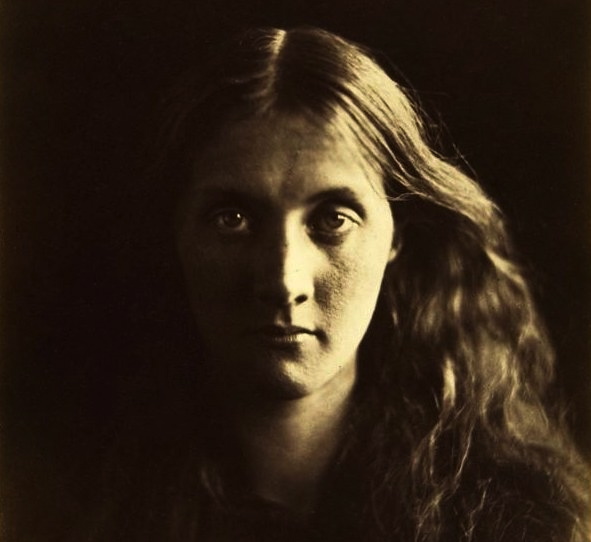
Cameron_julia_jackson

Alex Heimbach suggests that books such as Women Photographers: From Julia Margaret Cameron to Cindy Sherman perpetuate a “gender ghetto”:

The book collects the work of 55 practitioners, from pioneers of the form to contemporary photojournalists. [Author Boris] Friedwald also includes short bios of each artist as part of his goal to present “the variety and diversity of women who took – and take – photographs. Their life stories, their way of looking at things, and their pictures.” Sounds admirable enough. Yet it’s impossible to imagine an equivalent book titled Men Photographers: From Eugène Atget to Jeff Wall. Male photographers, like male painters, male writers, and male politicians, are the default. The implication, intentional or not, is that no matter how talented, female photographers are women first and artists second.

Ideally, endeavors like Friedwald’s serve to illuminate lesser-known artists, who may have been discounted because of their gender (or race or sexual orientation or class). But more often such exercises become a form of de facto segregation, whether it’s a BuzzFeed quiz on how many of the “Greatest Books by Women” you’ve read or a Wikipedia editor isolating female novelists in their own category. These projects are often undertaken in a spirit of celebration, but their thoughtlessness generally renders them pointless at best and misogynistic at worst.

(Photo: Julia Jackson by Julia Margaret Cameron, 1867, via Wikimedia Commons) Update from a reader:

Lovely post.  What your readers may not know is that Julia Jackson was the mother of Virginia Woolf, one of four children from her second marriage.  Julia died in 1895 at the age of 49, when Woolf was 13, precipitating the first of Woolf’s terrible battles with what was probably a severe a bipolar disorder.  Before she became the perfect “angel in the house” Victorian wife to two husbands and the mother of seven, Julia was famous for her beauty and frequently photographed by her illustrious and pioneering aunt, Julia Margaret Cameron.  Needless to say, Woolf, author of A Room of One’s Own, would have been the first to object to relegating the work of women to a separate (but equal?) category.

The Passing Of A Pigeon

by Dish Staff

The last passenger pigeon died 100 years ago yesterday. Elizabeth Kolbert mulls over the mystery of the bird’s extinction:

In his recent book “Lost Animals: Extinction and the Photographic Record,”MarthaErrol Fuller, a British author, argues that an “additional factor” must have been at work in the species’ extinction, because “in a land as vast as the United States there can be no mopping-up hunting for a species as small as a pigeon.” (Fuller’s book contains a grainy and not particularly flattering photo of Martha standing in her cage in Cincinnati.)
Some have argued that the “additional factor” was deforestation; by this account, it’s no coincidence that the passenger pigeon went extinct right about the same time that land clearing in the eastern U.S. reached its maximum extent. Others speculate that the passenger pigeon was one of those animals that require great densities to survive.

She adds that, whatever the answer, “the mystery should give us pause” because “species that seem today to be doing fine may be sensitive to change in ways that are difficult to foresee.” Carl Zimmer is on the same page:

[David Blockstein, a senior scientist at the National Council for Science,] sees many lessons in its disappearance that apply to protecting threatened species today.

It’s a mistake to assume that a species with a big population is immune to extinction, for example. “The endangered species category is really all based on numbers, rather than biology,” he explains. Even a species with billions of members may have a biological Achilles’ heel that makes it vulnerable to human pressure.

To appreciate a species’ true risk, we have to understand not just its biology, but also our own technological advances. In the 1800s, the new technology included the telegraph and trains. Now it includes global positioning systems, cell phones, and huge fishing vessels. “We have factory ships that can vacuum up the ocean,” says Blockstein.

Mark Fischetti highlights efforts to resurrect the species:

The hundredth anniversary of Martha’s death is a sad occasion but it is also marked by an intriguing possibility. Ben Novak, a researcher at the University of California, Santa Cruz, is trying to use genetics to bring them back from the dead. As a recent article by my colleague David Biello explains, Novak has sequenced the genomes of 32 birds that are preserved at various museums and labs and is inserting edited version of those genomes into living band-tailed pigeons, a close relative.

If he succeeds—and that’s a big if—Martha’s newly created kin could one day darken the skies again.

Update from a reader:

Just last week I heard Joel Greenberg, author of A Feathered River Across the Sky, speak about extinction at the Field Museum in Chicago.  I have no idea why anyone would be confused about the factors that combined to lead to the extinction of what was once the most numerous vertebrate on the planet.  Its forests were indeed diminished, but human predation did the species in (as we probably did in prehistoric megafauna across the Americas and Eurasia).  And to relate it to our contemporary world:

The passenger pigeon went extinct in part due to … lack of government regulations for hunting.  They were hunted relentlessly (and hunters used technology like telegraphs to locate the flocks), because they were so numerous.  They laid one egg a year per nesting pair, but were not allowed time off from hunting to breed, and so billions became zero.  Their extinction, along with the near-extinction of the American bison (aka buffalo) was one of the leading causes of laws regulating hunting and habitat in the US.

The Guardian review of Greenberg’s excellent book is here.

(Photo: The last passenger pigeon, Martha, named after George Washington’s wife, died in her cage at the Cincinnati Zoo in 1914. From Wikimedia Commons)

Michael Sam Loses His Spot

by Dish Staff

Sam was cut from the Rams over the weekend. Eric Edholm examines the situation:

Sam was unclaimed by the other 31 NFL teams and remains a free agent, with no teams offering a practice squad spot — despite those rosters increasing this season from eight to 10 players per team — with nearly every slot around the league believed to be filled. Does this mean Sam’s NFL shot has passed him by? Not necessarily. He had three sacks in the preseason, none of them gifts, and didn’t play poorly otherwise. Sam put some decent tape out there to be considered. But he is what he is: a left defensive end who likely can’t hold up for three downs in the NFL and has little to no special teams value. Still, there are teams that value pass-rush specialists, and it’s surprising that he hasn’t been brought in, even for a look.

Michelle Garcia somewhat blames bigotry:

Did the Rams cut Michael Sam out of sheer homophobia? I doubt it. But it was homophobic reasons that got him to such a precarious position in the first place.

While the Rams were able to at least push this dream of having an out player a little further, and he was given a platform to show the entire league that he has potential for the pros, at the end of the day, the Rams did not have any use for him — they already had a nearly-full slate of defensive linemen, minus the one spot that undrafted rookie Ethan Westbrooks now has. And when 31 other teams had the chance to pick Sam up, it seems none of them needed him (and according to Outsportsat least six teams could probably use his talents right now).

Update from a reader along those lines:

I’ve been an avid football fan for years and I’m also very sympathetic to Michael Sam. I can say with a fairly high degree of certainty that he wasn’t cut because of homophobia. Furthermore, I don’t think his personal situation had much of an impact on his status.

Michael Sam’s biggest problem is that he is best-suited to a 4-3 defensive scheme. Over half the teams in the NFL rely on a 3-4 defense, where Sam really doesn’t have the skill set to perform well. Furthermore, he does not excel in special teams. Players who aren’t stars and aren’t sure-fire starters need to also perform well in special team play. Very few teams can afford the luxury of putting a guy on their roster who doesn’t fit their defensive scheme and who doesn’t play special teams. I suspect when teams start to suffer injuries and start needing bodies on their rosters, then you’ll see Sam picked up by another team.

Another sports fan from the inbox:

This is most keyed-into-the-NFL reality reaction I’ve seen to the Michael Sam story. The writer, Rick Telander, was in an NFL camp after his college days at NU and got cut.  He knows whereof he writes.

Cyd Zeigler is confident that the Rams’ cutting of Sam was “just a hiccup”:

Many in the LGBT community are lashing out at the NFL today, claiming homophobia. It’s understandable. Gay men have been told for decades they’re not good enough to play football, they’re not welcome in the locker rooms. Some of those messages have even reverberated in 2014. While the Rams’ decision wasn’t based on homophobia, it’s hard not to afford gay men a little foot-stomping at this latest rejection.

You know who isn’t lashing out? Michael Sam. He knew this was always a possibility, part of the cold business that is the NFL. A coach is your mentor and father-figure one day. The next afternoon he gives you a pink slip. Sam understands this is not the end, but rather another opportunity to prove his doubters wrong, earn his spot at the very top of his profession and take his rightful place in history.

Regardless of what happens to Sam, Scott Shackford expects a gay NFL player soon:

Even if Sam isn’t ultimately the first out player, I give it a year, tops. The media may have gotten weird about him, but polls and public reaction to Sam show that an athlete’s homosexuality isn’t the big deal it would have been, say, a decade ago.

Where The Drivers Drive You Away

by Dish Staff

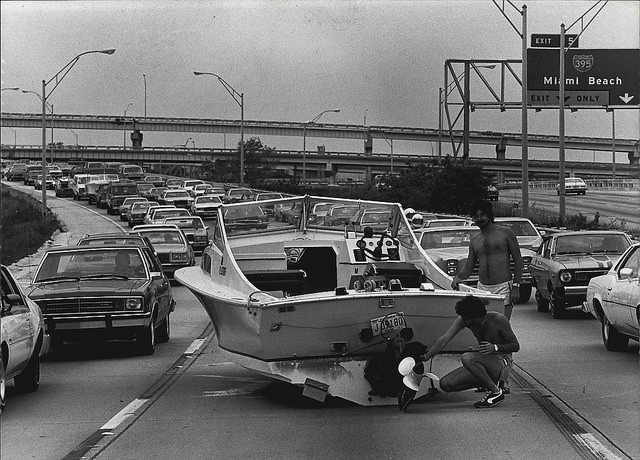
dish_trafficinmiami

Brian Palmer determined the worst places to drive in the US:

No. 5: Baltimore. Baltimoreans just can’t keep from running into each other. They were outside the top 10 in fatalities, DWI deaths, and pedestrian strikes, but their rate of collision couldn’t keep them out of the top five overall.

No. 4: Tampa, Fla. Tampa doesn’t do any single thing terribly, but it is consistently poor:

18th worst in years between accidents, fifth in traffic fatalities, tied for 11th in DWI fatalities, and 10th in pedestrian strikes. If the city had managed to get outside the bottom half in any individual category, Tampa residents might have avoided this distinction.

No. 3: Hialeah. The drivers of Hialeah [Florida] get into a middling number of accidents, ranking 11th among the 39 candidates. But when they hit someone, they really mean it. The city finished third for fatalities. They also have a terrifying tendency to hit pedestrians.

No. 2: Philadelphia. Drivers in the city of brotherly love enjoy a good love tap behind the wheel. Second-places finishes in collisions and pedestrian strikes overwhelm their semi-respectable 16th-place ranking in DWI deaths.

No. 1: Miami. And it’s not even close. First in automotive fatalities, first in pedestrian strikes, first in the obscenity-laced tirades of their fellow drivers.

So basically avoid Florida. Update from a reader:

Finally an article that supports what I have been saying for years: Miami has the worst drivers. I’ve driven in Thailand, Taiwan and China, to name a few of the most stressful ones in Asia, as well as Paris, Barcelona and Madrid in a right-hand drive car, and Chicago, Philadelphia and Los Angeles. But Miami is by far the worst. How on earth some of the drivers get their licenses I will never know – perhaps they don’t.

Last year I was stopped in a parking, and in the 10 minutes I was there, I witnessed three fender benders and saw two people nearly knocked over. And no, none of them were due to the weather. Seems to me the major element is the combination of laid back island mindset mixed with American hustle and a whole lot of FU.

Another notes:

I am not defending Florida drivers here; I live in the middle of the state, and was surprised not to see Orlando on the list. But this is a reprint of a year-old article based on data from at least the year before that. And if you link to the Allstate survey that prompted the reprint (which we’ll discredit because it doesn’t fit the desired conclusion), it ranks three Massachusetts cities in the top four (the other city being Washington, D.C.). But, hey, nobody ever misses a chance to take a shot at Florida.

At least it’s refreshing to have a city-comparison post on the Dish where Andrew isn’t talking shit about NYC.

(Photo of boat blocking traffic on I-95 in Miami via Flickr user That Hartford Guy)

Faces Of The Day

by Dish Staff

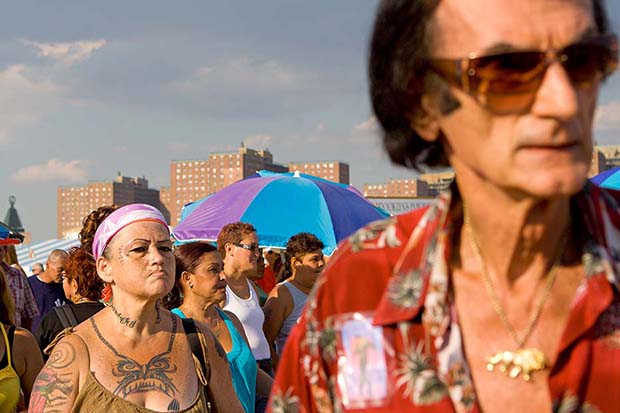
dish_fotdmonsep1

Photographer Laura Glabman emails us the background on the above pic:

That party took place exactly 5 years ago, Labor Day weekend on the boardwalk at Coney Island in 2009. I happened to be walking by this group of partiers and I wound up staying for two hours photographing them. By the time I left they were hugging and kissing me goodbye. These people loved the camera and they loved to dance. I took about 300 photographs that day and I really enjoyed how uninhibited they were and how much fun they were having. The late afternoon light was perfect and so was the music.

See more work from the series here. Update from a reader:

I know that guy! His name’s Tony Ferrante, he cuts my hair at New Street Barbershop right near Wall Street. He was on “America’s Got Talent” and every summer he goes to Coney Island every weekend to dance on the boardwalk. He’s like 78 but he still LOVES dancing and is in good shape. There are a couple of videos of him on Youtube, and the audition tape is especially tight. Here he is just chilling on the boardwalk.

I don’t know if he uses e-mail but, the next time I go there, I will show him that he was on the Dish.

(Hat tip: Jenna Garrett)

Dogs vs Cats: The Great Debate, Ctd

by Dish Staff

Henri Cole cites Rilke’s thoughts on the age-old divide:

Look at the dogs: their confident and admiring attitude is such that some of them appear to have renounced the oldest traditions of dogdom in order to worship our own customs and even our foibles. It is just this which renders them tragic and sublime. Their choice to accept us forces them to dwell, so to speak, at the limits of their real natures, which they continually transcend with their human gazes and melancholy snouts.

But what is the demeanor of cats?—Cats are cats, briefly put, and their world is the world of cats through and through. They look at us, you say? But can you ever really know if they deign to hold your insignificant image for even a moment at the back of their retinas. Fixating on us, might they in fact be magically erasing us from their already full pupils? It is true that some of us let ourselves be taken in by their insistent and electric caresses. But these people should remember the strange, abrupt manner in which their favorite animal, distracted, turns off these effusions, which they’d presumed to be reciprocal. Even the privileged few, allowed close to cats, are rejected and disavowed many times.

Montaigne’s take:

“When I play with my cat”, he wrote, “who knows if I am not a pastime to her more than she is to me?”

He borrowed her point of view in relation to him just as readily as he occupied his own in relation to her. And, as he watched his dog twitching in sleep, he imagined the dog creating a disembodied hare to chase in its dreams – “a hare without fur or bones”, just as real in the dog’s mind as Montaigne’s own images of Paris or Rome were when he dreamed about those cities. The dog had its inner world, as Montaigne did, furnished with things that interested him.

Meanwhile, Jessica Love ponders why dogs are “so good at reading our nonverbal cues—so much better, even, than chimpanzees and bonobos, to whom we’re more closely related”:

Researchers now believe that dogs’ ability likely evolved during domestication, probably due to selective breeding. There’s some disagreement about whether our own ancestors were selecting for communicative skills specifically (perhaps to create better hunters, retrievers, or herders), or whether this prowess was merely a by-product of selecting for something else, like tameness.

But though the sensitivity dogs exhibit is truly impressive, it nonetheless falls short of what humans—even very young ones—are capable of. Infants will communicate information to their adults when they know that it is of interest to the caregivers; dogs will only do so if they are the ones interested. Young children also pick up on information conveyed to a third party; dogs, not so much. And a brand new study finds that two-year-old humans are much better than dogs at gauging from a situation whether a communicative signal is unintentional (and thus ignorable).

Meanwhile, the cat—mere feet away from a tuna treat, and despite the best efforts of an insistent pointing hand—does nothing.

Thoughts from Andrew and Dish readers here.

Should ISIS Be Censored?

by Dish Staff

E.W. argues against Twitter and YouTube’s decisions to scrub the video of James Foley’s murder:

Censorship proponents are of the mind that the ISIS video constitutes propaganda and that its dissemination furthers ISIS’s aims. It is true that extremist groups have been known to use social media as a means to circumvent the checks media organisations employ to stop the spread of propaganda. But the video isn’t only propaganda. And since when has that label been sufficient grounds for censorship anyway?  The amount of online content that could be wiped from social media if this reasoning was applied uniformly would be staggering. …

Twitter is not television. No one is being forced to view the footage. Evening news shows can decline to show the video because not all their viewers might be comfortable seeing it. But people have to be able to access it on their own if they wish. It’s completely understandable that family members don’t want footage of a loved one’s death to spread, but it’s not clear that that’s their decision to make.

Earlier this week, J.M. Berger noted that support for ISIS on Twitter had been falling since the revelation that the group had massacred some 700 people in the Syrian province of Deir Ezzor:

Negative hashtag references to the Islamic State, using the derogatory Arabic acronym Daash, soared from Aug. 8 to Aug. 18, increasing by 44 percent. When hashtags referring to Daash along with a reference to the massacre specifically were included in the count, the total soared by 85 percent. The surge in negative sentiment toward IS took place concurrently with airstrikes on the self-proclaimed caliphate by both the United States and the Assad regime and during the period during which Iraqi Prime Minister Nouri al-Maliki stepped down, which IS has claimed as a victory. In other words, IS not only managed to completely erase all the goodwill it might have accrued from battling jihadists’ hated enemies, but it added considerable negatives on top of that.

Meanwhile, Keating takes a closer look at ISIS’s video capabilities:

The availability of laptops, editing software, and HD cameras has made it much easier to produce sophisticated-looking videos. The Internet has also made it simple for terror groups to promote them. But as Berger notes, these propaganda videos aren’t new. Rather, they’re part of a tradition of jihadi filmmaking dating back at least to Afghanistan in the 1980s and Bosnia in the 1990s. “Typically productions that jihadi organizations would put out would be, if not quite cutting edge, pretty close to the standards of the day with professional cameras and professional editing. Jihadi media has progressed at the same speed as the rest of the media,” he says. (This has been true of their print efforts as well.) …

But Jarret Brachman, who consults on international terrorism for the U.S. government and is author of the book Global Jihadism: Theory and Practice, says the content of ISIS’s videos is less important than its ability to promote them. “What I think really matters is the informal use of social media—Instagram, Twitter, and Ask.fm being chief among them—not only by IS’ formal media outlets but by this global following of informal advocates, surrogates, and cheerleaders,” he told me via e-mail.

Update from a reader:

As someone who knew Jim in grad school, I say yes, the video—a snuff film—should be censored. I am devastated. I cannot unsee stills of his final moments. Him on his knees in orange, his masked executioner in black, against a barren landscape. It was impossible to be online Tuesday without seeing those images. I recognized Jim instantly, before the media had confirmed that it was him. It’s one thing to see a person, any person, in this situation and think, Oh my god, that’s so horrible. It’s another thing to know that person and really feel the horror.

No One’s Watching The Skies

by Dish Staff

Mark Jacobson mulls over the decline of UFO culture:

It is true that very little beyond a shadow of a doubt forensic proof of alien presence has come to light over the years, but there are a number of subsidiary reasons for the seeming twilight of the UFO moment. With voracious proliferation of vampires, New World Order conspiracies, and the unprecedented rise of evangelical Christianity, the simple flying disc from far, far away has become a quaint, almost nostalgic specter. The saucer may have been the post-war generation’s signifier of the strange, but even versions of the unknown outlive their usefulness.

The end of the era may have commenced with William Gibson’s Neuromancer, which located the drama of the unknown inside the claustrophobic cyberspace accessible to the common keyboardist. Instead of the far-flung wonder to the universe, much of what falls under the rubric of contemporary ufology has become deeply interiorized, resigned to the viscous psych-sexual abduction phenomena described and popularized by people like Budd Hopkins, Whitley Strieber, and John Mack.

Update from a reader:

While it may seem as if the UFO community is dying, there’s still a lot of interest in UFOs. I write for the weird news section of HuffPost, which does a lot of UFO stories. In fact, HuffPost is the only major news website with its own full-time UFO reporter, Lee Speigel. Those stories attract a lot of attention, and Lee gets a lot of deserved credit for focusing on the science and not the “woo woo” part of the UFO community.