The Elusiveness Of Hitler’s Evil

In an afterword for the new edition of his Explaining Hitler, Ron Rosenbaum reflects on one of the central puzzles driving examinations of Hitler’s life – “why that innocent infant evolved into a genocidal monster”:

[S]omething or some things made Hitler want to do what he did. It wasn’t a concatenation of Adolf Hitler, Kinderbildimpersonal, external forces, a kind of collective determinism. It required his impassioned personal desire for extermination, even at the potential cost of defeat for Germany. It required him to choose evil. It required free will.

It required Hitler to make a continuous series of choices, the ultimate source of which may always be shrouded in mystery. We will likely never know, for instance — barring some discovery in a “lost safe-deposit box” — what went on between Hitler and the alleged hypnotist, Dr. Forster, said to have treated him at the time of the World War I German surrender and instilled in him a will to avenge the (baseless) “stab-in-the-back” myth of German defeat. We have only Ernst Weiss’s fascinating novelistic speculation (The Eyewitness) to go on, and it can’t be counted as proof, although it may be the unsolved Hitler mystery I’d most like an answer to. In fact, we lack proof, and the most salient clues might be lost in the mists of history. We just may never know with certainty what made Hitler Hitler. And worse, we may never know why we don’t know: whether it’s because of a missing piece of biographical evidence, or an inability to evaluate the evidence we have. It’s beyond frustrating not knowing whether we might.

Update from a reader:

Long-time reader and subscriber.  Your post on “why that innocent infant evolved into a genocidal monster” I would highly recommend reading Robert G. L. Waite’s The Psychopathic God, which does a pretty good job of showing how documented accounts of his childhood history correlate to his compulsions later in life.

I read this at university as a student of central European history in the 19th and 20th century. Our professor warned us that psycho-history was scorned in academic historian circles but offered it as a perspective.

Interestingly, I later connected his work with that of the Swiss-German psychologist Alice Miller who wrote extensively about parental child abuse. In her work For Your Own Good she covers very similar ground as Waite, but as a trained psychoanalyst.

My belief is that sociopaths and psychopaths are largely made by their environment, but imagine there’s a bell curve with some individuals at one tail coming through trauma to lead relatively normal lives and others, at the other tail becoming “exceptional” monsters. Hitler arrived on the world stage in a time, place and context that would celebrate and willingly participate in his monstrosity.

So, I don’t find Hitler as monster so puzzling. Parents create them every day, but only rarely do they get to act out there pathologies in such a world-historical way.

(Image of Adolf Hitler as an infant, 1889–1890, via Wikimedia Commons)

Teaching To The Text

Meredith Broussard argues that standardized tests measure “specific knowledge contained in specific sets of books: the textbooks created by the test makers”:

All of this has to do with the economics of testing. Across the nation, standardized tests come from one of three companies: CTB McGraw Hill, Houghton Mifflin Harcourt, or Pearson. These corporations write the tests, grade the tests, and publish the books that students use to prepare for the tests. Houghton Mifflin has a 38 percent market share, according to its press materials. In 2013, the company brought in $1.38 billion in revenue.

Put simply, any teacher who wants his or her students to pass the tests has to give out books from the Big Three publishers. If you look at a textbook from one of these companies and look at the standardized tests written by the same company, even a third grader can see that many of the questions on the test are similar to the questions in the book. In fact, Pearson came under fire last year for using a passage on a standardized test that was taken verbatim from a Pearson textbook.

Jarvis DeBerry adds:

If standardized tests are going to be based on textbooks that school systems can’t afford, [Broussard] writes, then you can guarantee that poor school districts are going to fail. She points out that in the 2012-13 school year, a school in Southwest Philadelphia used a reading curriculum by Houghton Mifflin called the Elements of Literature. The textbook paired with that curriculum costs $114.75. The school’s entire textbook budget per child? $30.30.

Update from a reader:

So we’ve gone from “teaching to the test” to “teaching to the text?” What’s the difference? None, actually! And what’s wrong with either of them? Why would you NOT want to test for the success of what you’ve taught or trained students to do? It’s absurd that this would even be a question.

Would you give a test in physics for a class in English? Well, maybe if you wanted to test the student on the reading of physics, but in order to do that you have to be able to understand physics. Reading is for one of two things – pleasure or gaining knowledge – and in order to comprehend one of the key elements is background knowledge.

Background knowledge, or rather the lack of it, is the root of the reading problem. If a child from an impoverished area has never heard of let alone seen about painting a fence, how can they even understand the concept?

Standardized testing is a problem. Personally, I believe it should never be used in measurement for evaluating. It should be a tool to decide what is missing and what needs to be the next step. Politicians and corporations are responsible for the evaluating turn. The tests are written for recall and regurgitation. They do not show what a student is capable of accomplishing.

The Common Core has been assailed for many different reasons. The #1 we’ve seen is parents not understanding the questions. Louis C.K. made a big deal because of a math problem his daughter had that he couldn’t understand. He said there was no answer. There was an answer, but he was looking for 2+2=4 and the question asked why the student had solved the question incorrectly. No one tried to even identify the multiple problem solving steps that had to be in play. Well, at least the adults didn’t; all they did was bitch because they actually felt stupid – well, ignorant actually. A 4th grader would be trained to answer the problem; the first step they have to take is to solve the stated question correctly; they then work back to see what the other student did incorrectly. This, in itself, is invaluable.

Education has this problem of reinventing the wheel. It usually comes from the insistence of outside influences. Influences that have no idea of what they speak. Something interesting has been quietly happening in schools around the country. Teachers & principals are re-finding John Dewey’s Progressive Education. They are also being incredibly successful, not only with the kids but also doing better & better on the standardized tests.

Oh, if you look closely at Common Core, you can discover that most of it is based on John Dewey. Here is a link to Wiki. If you just look at the bullet points at the beginning, you can get an idea of what it’s about – Progressive Education.

What The Hell Just Happened Over The Skies Of Ukraine? Ctd

A reader adds:

Reading the coverage and the collection of tweets on your blog, I think it’s worth pointing out that whatever the rebels and anyone else might say, the rebels themselves were touting that they had the Buk system less than three weeks ago!

Another:

After reading this remarkable post on the Guardian site, I discovered a report from only hours ago on the ITAR-TASS site about a Ukrainian military craft being downed by rebels (an An-26 mentioned above). It’s too early to conclude anything, of course, but the evidence so far sure seems to point to a fuck up of horrible dimensions on the part of the rebels.

But another urges caution:

I got home from work early and am a bit of an airplane nut, so I turned on the TV to see if there was anything on about the Malaysian Airlines flight.  I’m flipping through channels and I see wall-to-wall coverage of this crash.  Why?  I’ve been watching an ABC News Special Report and you have Ray Kelly talking about terrorism, you have Richard Clarke talking about terrorism, you have (the normally more composed) Martha Raddtz talking about how this is the scariest time in the world that she can recall.

What the hell are these people talking about???

The only story here is that a passenger plan may have been shot down IN THE MIDDLE OF A MILITARY CONFLICT where there were warnings for commercial flights not to pass through the area.  There is NO suggestion of “terrorism.”  There is NO connection to anything occurring in Israel/Gaza, Syria, Yemen, or Iraq. There is NO connection to ISIS.  So why is the media treating these current events as if they are all connected and that the connection is that they all pose an immediate threat to the United States?

There is an interesting story here, particularly for ramifications for Russia’s relations with the EU and how the Ukraine situation is handled in the future.  But this is not going to cause the U.S. to become involved in World War III with the Russians.  Though it’s hard to think that the U.S. media doesn’t want that.

The hysteria is completely out of control and incredibly irresponsible.  I’m not sure there is anything that can be done about this, but covering these kind of events as if they were 9/11 all over again is going to cause the same post-9/11 mistakes and overreach to be made all over again.

We are tracking the coverage and will post credible updates as soon as we get them. Update from a reader, who responds to the most recent one above:

Terrorism doesn’t begin and end with 9-11 and the Middle East or threats to the United States. I guess I understand how many Americans don’t know about much of the past 50 years of activity of ETA, IRA, Red Army Faction/Baader-Meinhof Group terrorism throughout the world. Even that leaves out terrorism by states such as bombing of Venezuelan commercial airline flights by the CIA. Many people around the globe took to America’s post-9/11 propaganda technique of calling their military opponents “terrorists.” This isn’t anything new.

Another reason this is being called “terrorism” is because the Ukrainian government has called these Russian special forces troops masquerading as separatists “terrorists” from the beginning of the conflict. When Ukraine announced the downing this morning, they immediately called it an act of terror. The only difference between these Russian special forces troops and IS (ISIS) and Al-Qaeda besides affiliations is probably suicide missions. IS is no more deadly than when Russian forces were operating in Chechnya. As was previously reported, these same guys in Ukraine have been doing the same thing for years in Georgia and elsewhere. For a good idea on just what types of scheming Russia is doing to regain some territory lost after the fall of communism check out this Foreign Affairs article. Estonia dealt with the exact same pre-op setup with Russians claiming mistreatment of Russian Estonians and fake protest rallies. Most of the protesters in that situation were undercover Estonian security operatives. Estonia never allowed things to progress to a Crimea or Georgia level.

Another:

If this video posted by the Ukrainian security services isn’t a fake, it is a smoking gun:

It’s in Russian, but essentially you have rebel commanders bragging about shooting down a plane, happily acknowledging it is a civilian one, and subsequently discovering it is Malay.

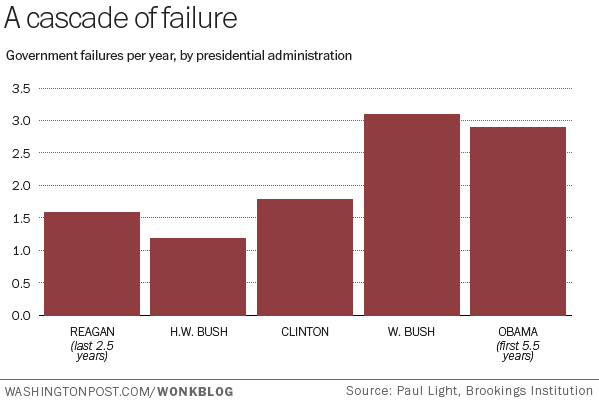
An Era Of Government Failure

We’re living through it:

government failure

Ingraham and Hamburger unpack Paul Light’s study:

Two factors complicate the failure rate under Obama. The first is that many of the missteps under Obama had their roots in the Bush administration. That administration “could have fixed the information technology systems that led to the healthcare.gov and veterans breakdowns, but didn’t. They could have fixed the civil service system that led to the problems in the Secret Service and the General Services Administration, but didn’t. And of course they could have fixed some of the policy problems that led to the 2008 financial collapse and the West, Texas fertilizer plant explosion, but didn’t.”

The other factor is the level of fierce Congressional opposition Obama has faced in office.

Light writes that political polarization is “a grand contributor” to the rise in government failure. But he notes that Democratic contributions mostly take the form of neglect and omission – they ignored “the slow decimation of government capacity, and refused to embrace the need for bold thinking on how to improve its performance.”

Republican contributions to government failure, on the other hand, have been “very deliberate.”

On the same general topic, Leonhardt gleans insights from Peter Schuck’s Why Government Fails So Often: And How It Can Do Better. One part of the solution:

Rigorous evaluation, randomized trials and social impact bonds will never stir the political passion that calls for universal health insurance or lower taxes do. If anything, measurement and accountability are destined to provoke more opposition – from interest groups that have something to lose – than support. (This opposition often takes the form of, “Measurement is hard,” as if that were a reason to skip it.)

But in a divided country, where Congress only rarely passes far-reaching legislation, a more effective government may be the best way for both sides to get more of what they want: a government that is limited enough to protect individual freedom and ambitious enough to improve people’s lives.

Update from a reader:

Honestly, what the fuck is that study supposed to mean? The government failed “2-3” times per year under Bush and Obama? If there was ever a study that meant nothing, that was entirely dependent on starting assumptions, this is it. You could quite easily say the government failed zero times, because we maintain the constitutional form and have not fallen into Somalia-style anarchy; or you could say it failed hundreds of thousands of times a year, because, e.g,, the passport office fucked up my application.

A quick glance at his methodology shows the study is really looking at popular media characterizations of stories they claim represent government failure, but even then, it’s subjective to the point of meaninglessness.

Paying For The Chill

Iced coffee was already more expensive than hot coffee back in 2012, but prices keep climbing. Gabrielle Sierra explains why the cold brew can cost as much as a cocktail:

Iced coffee costs come from all sides, with the most obvious also being the easiest to overlook: the ice. “People think ice is free,” says Michael Pollack of Brooklyn Roasting Company, where a 24 oz iced coffee is currently $4.50. “Ice is a fortune. If you think we go through coffee fast, double that for ice. We actually store ten gallon refrigerator boxes of ice, because our needs are so tremendous.”

But the rising cost of beans – more of which are needed for cold coffee than hot – is also to blame:

In May, the New York Times went into detail about a coffee fungus that attacked fields in Central America, leaving less product to purchase. And fungus isn’t the only way mother nature is striking back at coffee lovers. According to Forbes.com, “The price of Arabica coffee beans has surged almost 100% from a level of 106 cents per pound to around 220 cents in mid April, due to tight supply as a result of prolonged drought in Brazil, followed by recent floods.”

And no doubt baristas are able to get away with charging more for iced coffee during the hot summer months. So if you need to save money on the surging price of coffee, you could always join the half of the world population that prefers the instant kind:

Americans have proved pretty exceptional in their utter disinterest in warming up to the most convenient method of coffee-making. “The U.S. is entirely unique in its aversion to instant coffee,” [industry analyist Dana] LaMendola said. “Even in Europe, where fresh coffee is preferred, instant coffee is still seen as acceptable for at home and on the go consumption. In the U.S. the view is just much more negative,” she said.

Instant coffee sales in the U.S. have barely budged since 2008, and even fell marginally last year to just over $960 million. While that might sound like a lot, it’s actually a paltry fraction of the $30-plus billion U.S. coffee market. Instant coffee accounts for a smaller percentage of all retail brewed coffee by volume in North America (barely 10 percent) than in any other region. By comparison, it accounts for over 60 percent in Asia Pacific, over 50 percent in Eastern Europe, over 40 percent in the Middle East and Africa, over 30 percent in Latin America, and over 25 percent in Western Europe. …

Americans might like their coffee fast, but that doesn’t mean they want it instant.

Update from a reader who has his own method for homemade iced coffee:

It’s a lot easier than you might think.  Here’s what I do:

1) Buy whole coffee beans and grind them yourself, in a fairly coarse ground.  I like to use the big grinder in the grocery store (usually in the bulk coffee area), and use the “French press” setting.

2) Get a big glass pitcher (I use a big, tall “margarita pitcher” that cost @ $8 at Walmart).  Put anywhere from 1.5 to 2 cups of ground coffee into the pitcher.  Fill it with cold water, give it a stir.  Cover the top with something like aluminum foil or plastic wrap.

How long to “brew?”  I find that if you let the coffee sit in the grounds for longer than, say, 18 hours, you start getting a lot more bitterness than you’d probably like.  I generally make my coffee in the morning, let it sit in the fridge all day, and then strain it in the evening.

3) I use a fine mesh metal strainer and a big plastic pitcher (“dollar store” of your choice).  Put the strainer over the plastic pitcher, and pour out the contents of the glass brew pitcher.  I use a big metal spoon to stir things around before I pour, and to scoop out the grounds into the strainer.

4) Once the brew has worked it’s way through the strainer, I then pour it, a little at a time, through a Melitta Ready Set Joe cone drip filter.  I set the filter on a couple of big, tall, wide-mouth glasses (about 16-20 oz. each).  I let the strained brew work its way through the paper filter, down into the glass.  When one glass is almost full, I move the drip filter onto the other glass.  The full glass is then emptied, via a cheap plastic funnel, into a heavy glass milk jug from the local dairy down the road.  I hold a couple of these back during the summer, rather than returning them to the grocery store for deposit.  Both the jugs and the little plastic caps hold up well through repeated trips in the dishwasher.

It should be noted that steps #3 and #4 take up most of an evening – but I don’t stand there watching the coffee, either.  I might start step #3 at 7:00, and start step #4 by 7:30 or 7:45.  That last step really goes slowly, but I just enjoy the evening with my family, and every 15-20 minutes, I go into the kitchen to pour more brew out of the plastic straining pitcher, into the cone filter.  By the time I top off the cone filter for the last time, it’s time for bed, and I just leave that last one sitting on the counter overnight, and add it to the jug in the morning.

I “brew” this coffee maybe 2-3 times a week, depending on how often my wife decides to help herself to a cup.  Every morning, I take my 24oz. Tervis tumbler … pour in a cup of lowfat milk … and top it with my iced coffee.  The milk is a good source of calcium, and I find that I only need a very small amount of sweetener, if any at all.

Honestly, I’ve never done any kind of “cost analysis” on this.  I can say that a big bag of bulk ground coffee will fill up three, maybe four pitchers.  Figure that bag of ground coffee costs $9, that’s $2.25.  And I make that three times a week … and each “jug” will last me three or four mornings.  Cost of a cup of milk?  Maybe 25 cents?  Not counting the cost of refrigeration, I’m still beating the hell out of Starbucks, don’t you think?

One last thing:  I don’t use ice; rather, I fill up a Tovolo King Cube mold with my brew, and float one huge cube in my tumbler each morning.  The supersized cube lasts two, three hours… and as the morning goes by, my coffee drink gets a little stronger, not weaker.  ;)

That’s what I do.  There are, of course, dozens of web pages, YouTube videos etc. that offer up their own methods for doing something like this.  Bottom line:  Make it yourself at home.  You’ll get a better product than any instant or canned option, and it’s really good.

Another:

That iced coffee method from a fellow reader was some serious Rube Goldberg shit. Here is a similar method in spirit, but ultimately much easier way to make good iced coffee at home.

1) Purchase a French Press – they’re reasonably priced and versatile since they obviously make excellent hot coffee (so you can use it in the winter).

2) Using coarse ground beans, put about 50% more than you’d use for making hot coffee in the press; the specific amount will depend in the size of the press and your preferences but indeed more coffee is necessary to prevent a weak final product. Then pour cold water over the grinds. Still thoroughly with a wooden spoon (the grinds will float in a thick, kind of gross slurry until heartily stirred). I do this not much later than 10:00pm. It takes about 2 minutes at most.

3) Cover the coffee and put the French Press in fridge without pressing the coffee, allowing it to cold brew overnight.

4) Take it out in the morning and press the coffee – done! Cold, very tasty iced coffee. I’ve found generally similar results with somewhat varied brewing times, but a minimum of 8 hours seems necessary.

While I appreciate the other reader’s resourcefulness, I think the purchase of French Press is more than justified by the savings in time and effort. Hope this is modestly helpful.

P.S. I’m a subscriber, just in case you’re curious.

Hey Baby

Straight guys often try to charm the ladies with a form of baby talk:

In an article soon to be published in the journal Evolution & Human Behavior, [psychologist Juan David] Leongómez and his colleagues discovered that when (heterosexual) men, for instance, are asked to flirt with a beautiful woman, two noticeable things begin to happen to their voices. First, their voices get deeper … or rather their voices achieve a deeper minimal octave than under comparison conditions. And second, men’s voices become more sing-songy or pitch-variable when speaking to a pretty woman, sort of like, well, how you’d speak to a baby.

It isn’t quite as pronounced as such prosodic “infant-directed speech” (and it’s probably unwise, I hasten to add, for a man to speak to any woman as if she were a puppy), but nonetheless, the investigators found these male voice adjustments during verbal courtship to be an empirically demonstrable effect. What this means is that not only do men’s voices get deeper when they’re chatting up some lovely woman, but they also get higher compared to when their speech is directed at another male or to an unattractive female listener. This effect appeared in both of the language samples tested – native male English and Czech speakers – and even after controlling for the unscripted content of the men’s speech.

What the researchers found about how straight women talk to men:

Interestingly, this so-called paralinguistic courtship modulation effect didn’t occur in women’s voices when they believed that they were speaking to a good-looking man, but it did occur when they were speaking to an attractive woman. That’s to say, when (heterosexual) women thought that they were communicating with an especially pretty member of the same sex, they began to stress their pitch modulation. The reason for this isn’t entirely clear, but it could be, as the authors suggest, that these female speakers’ intended audience is in fact desirable male mates, such that women are attempting to enhance their vocal appeal relative to these highly desirable female competitors. “Pfft. She’s not all that,” in other words. “Check out my natural speaking range.”

Update from a female reader:

I skimmed the post and got to the end and read the ridiculous conclusion of why heterosexual women’s modulation changes while speaking to other attractive heterosexual women, and I scrolled back-up and knew that the study was written by a man. So a heterosexual woman when speaking with an attractive man doesn’t find it necessary to change her voice modulation to attract him but she’s so competitive with other attractive women for a male’s attention that she changes her voice modulation for her? That makes no sense. When I go out with my friends, especially if I haven’t seen them in awhile, I always up the make-up. I wear eye-shadow for my girlfriends. I am not alone. I saw a dear friend this weekend, and after we hugged she said, “I curled my hair for you.” So maybe these women are more focused on what the women think of them, and not focused on knocking them off as competitors.

Also, your post on the plague and after is why I read you religiously, and why even when you piss me off I will continue to read you.

… she says in a baby voice.

Papers, Please

After visiting McAllen, Texas, to participate in a vigil, Jose Antonio Vargas realized that, “for an undocumented immigrant like me, getting out of a border town in Texas—by plane or by land—won’t be easy. It might, in fact, be impossible”:

[S]ince outing myself in the New York Times Magazine in June 2011, and writing a cover story for TIME a year later, I’ve been the most privileged undocumented immigrant in the country. The visibility, frankly, has protected me. While hundreds of thousands of immigrants have been detained and deported in the past three years, I produced and directed a documentary film, “Documented,” which was shown in theaters and aired on CNN less than two weeks ago. I founded a media and culture campaign, Define American, to elevate how we talk about immigration and citizenship in a changing America. And I’ve been traveling non-stop for three years, visiting more than 40 states.

Of course, I can only travel within the United States and, for identification, when I fly I use a valid passport that was issued by my native country, the Philippines. But each flight is a gamble. My passport lacks a visa. If TSA agents discover this, they can contact CBP, which, in turn, can detain me. But so far, I haven’t had any problems, either because I look the way I do (“You’re not brown and you don’t look like a Jose Antonio Vargas,” an immigration advocate once told me), or talk the way I do—or because, as a security agent at John F. Kennedy International Airport who recognized me said without a hint of irony, “You seem so American.”

I might not be so lucky here in the valley. I am not sure if my passport will be enough to let me fly out of McAllen-Miller International Airport, and I am not sure if my visibility will continue to protect me—not here, not at the border.

And today, just as he predicted, Vargas was detained:

A TSA agent checked Vargas’ Philippines passport and compared it to his ticket, according to a video of the exchange as well as sources familiar with the exchange. Satisfied, the agent initialed the ticket and cleared Vargas for travel. At that point, a Border Patrol agent took the passport from the TSA.

“Do you have your visa?” he asked.

“No, there’s no visa,” Vargas replied.

The agent asked Vargas a few more questions, then placed him in handcuffs and escorted him to the McAllen Border Patrol station for further questioning, according to the source. The station is not a detention center.

Dara Lind explains why the Pulitzer Prize winning journalist won’t necessarily be deported:

The government has “prosecutorial discretion” to determine what to do with unauthorized immigrants. That means it can decide whether or not to put Vargas into deportation proceedings in immigration court. The Obama administration has said, repeatedly, that its focus is on deporting unauthorized immigrants who fit its administration “priorities”: convicted criminals, “recent border crossers,” and people who have been deported and returned to the US. 98 percent of all people deported last year fit into one of those priorities. Vargas doesn’t meet any of those criteria.

Charles Cooke is sympathetic to Vargas but thinks the authorities had no alternative:

[T]his is a horribly sticky situation. Without question – and through no initial fault of his own – Vargas has found himself in a veritable nightmare. As he tells the story, he was brought here at a young age and told that he had legitimate papers, only later to discover that those papers had been forged. From that point on, his options were severely limited.

Conservatives who ask, “but why didn’t he just apply for legal status?” are rather missing the point. Under current law, he is unable to do so without leaving the country in which he has built his life. (Or marrying a U.S. citizen.) Because he did not have a petition filed before 2001, he didn’t qualify for relief under Section 245(i); because he is too old, he doesn’t qualify for the deferred action policy that President Obama illegally put into place in 2012. He’s genuinely stuck. Moreover, there really is no “home” for him to “go” to. This is it. If I had my way, he would be among those to whom some form of amnesty was extended. Those who have known nothing else should not be sent abroad.

Still, this is really not the point. The law that I would like doesn’t yet exist. And, knowing this better than anyone, Vargas willingly placed himself in this position. What were those charged with enforcing the rules supposed to do, exactly? Slip him under the desk?

Update:

Your Home Will Be Destroyed In One Minute

Adam Taylor passes along the above video of an Israeli “roof knock”:

“Knocking the roof” is the Israeli military practice of warning the residents of a building they are targeting that they should get out. Warnings can come via a phone call or a warning missile: In this case, the occupant of the house, Samir Nofal, received both, Watania reports. The practice has become one of the most controversial aspects of the current conflict. … When a specific building is due to be targeted, Israel may call an occupant, or fire a small missile at the building. That’s the final warning: Get out now, or you will die.

The Israel Defense Force (IDF) is open about this tactic. It recently released this video which includes a transcript of a phone call and a video of a “knock on the roof.” Despite the IDF’s apparent confidence in the tactic, critics see flaws. The phone calls show how much of Gaza’s communication networks are in Israeli control, for example, while others say that the “warnings” are not always followed up with an attack: A worrying tactic that might be considered psychological warfare.

Eyal Weizman calls the IDF’s warning shots an abuse of international law:

Israeli military lawyers argue that if residents are warned, and do not evacuate, then they can be considered legitimate collateral damage. Under this interpretation of the law, the civilian victims become human shields. This is a gross misuse of international law.  It is illegal to fire at civilians, even if the intention is to warn them. It is ridiculous to ask them to understand, in the commotion and chaos of war, that being shot at is a warning – and it is outrageous to claim that this is undertaken to save their lives.

International law should protect civilians. In Gaza, it is being abused in order to enable attacks where attacks should not be undertaken at all.

Update from a reader:

Quick note regarding the video about IDF “roof knocks” that you posted this afternoon; I am not invested in either side of the tragic conflict in any way, but it is worth mentioning that the video you posted has been edited. Watch the tree and the smoke at the 1:14 mark. I thought it worth pointing out.

Another is more skeptical:

That video is likely pure propaganda.  Watch the smoke start to billow out of the side window around the 1:11 mark.  Notice the bush gently swaying? Then a complete reset at the 1:16 mark.  Smoke is gone.  The lighting has even changed.  By the time the building goes, I’m not even sure any more that the entire thing wasn’t staged.

The View From Your Obamacare, Ctd

A reader revives the thread with a new perspective:

For three days straight, a crew of two men has performed significant physical labor around our residence – drilling through brick and mortar, removing debris, and so much more. The President Obama Visits Boston To Talk About Health Caretoll on these guys’ bodies is beyond comprehension to a sedentary writer-type, who obsessively exercises to keep limber and burn calories and maintain a semblance of muscle tone.

For three days, one of the men complained regularly about his back pain. (Which certainly wouldn’t have been helped by carrying away our cast iron wood stove, lifting it onto the truck, off-loading it at the shop.) With a groan, he sat down to write up the final invoice. By now fully aware of his problem, I murmured sympathetically. He replied, “I had an MRI done a couple of years ago. It’s a disk. I need surgery.” I cranked up the sympathy. “I can’t afford it,” he continued matter-of-factly, “on my income. Not until I get my health insurance.”

I very nearly said something like, “Isn’t it great that it’s actually possible through the Affordable Care Act?” and was tempted to explain that next enrollment period comes up later this year.

I’m fairly well informed on the process; my husband’s workplace arranged for him to become a certified ACA advisor. All winter long he came home from the office with heart-warming news of how real, uninsured people were at least accessing what was previously unobtainable.

But, stifled solely by the crewman’s demographic characteristics, I said not a word. I could just tell this was not a fellow who would look favorably on Obamacare. And I didn’t want to introduce controversy or politics into what had been a pleasant temporary relationship.

Shortly before leaving, he spotted the framed photograph of me standing with President Obama, taken when he was a little-known candidate roaming through my First-in-the-Nation primary state. And his recognition prompted a rude comment that made me wish he’d had been as reticent about the president as I had been about the ACA.

When he and his cohort departed, I started to cry. Our entire exchange represented everything most depressing about perceptions of Obama and the intent of the law he – and the Congress, even if only a portion of it – brought into being. For the good of people like the man who needs back surgery to continue in his job, but can’t afford it. And who, until recently, wouldn’t have had a hope of getting insured.

Most of the time I do Know Hope. I’m hard-wired that way. But today there’s a terrible disconnect in my optimism.

Update from a reader:

Allow me to bring your reader’s experience with a temporary worker in her home a bit closer to home. As a small business owner with a long-standing (since age 17) preexisting condition who has had to buy my own insurance, the ACA has been a godsend. We went from our premium costing nearly $2,000 a month for our family of four to $1,100/month with much better coverage. And now I’m about to enter a job transition where I might not have an income for a few months. The ACA has made that much easier. A major health crisis would be horrible obviously, but one happening if I didn’t have insurance, it’d be financially devastating. I now can know we are covered and can afford to be even in job transitions.

But my sister doesn’t see this. She complains constantly about Obama and the ACA – complaints that more often than not have no basis in fact. She works several part-time jobs and her income, just above minimum wage, is volatile. She refuses to even look for an insurance plan on our state’s very good exchange. I am fairly certain she would find one, with subsidies, that would cost her under $100/month for silver plan coverage, barely $30 for bronze, coverage that could make her life healthier and more financially secure. She has several pre-existing conditions herself and current health issues she really should take care of now.

And it breaks my heart she refuses to do so out of some misplaced anger based on “Fox News” lies. The Fox News Republicans have done a great disservice to this nation in so many ways.

(Photo by Yoon S. Byun/The Boston Globe via Getty Images)

The War Over The Core, Ctd

The country’s second-largest teachers’ union has withdrawn qualified its support for the Common Core:

After years of battling conservative groups opposed to Common Core, supporters of the testing standards discovered Friday morning that one of their most avid allies, the American Federation of Teachers, is bailing on them too. … [The AFT’s] decision to distance itself from its once-avid support for the Common Core marks a major – and, some say, even potentially lethal – blow to the standards, which the White House has emphasized as its key priority in education. The real danger is not that the Common Core will be thrown out entirely, but that state policy directors in charge of implementing the standards will be cowed by what they see as a groundswell of anger from teachers, said Michael Brickman, the national policy director at Fordham Institute, which supports the standards.

Update from a reader and a “lead author of the math standards” who objects to characterizing the AFT’s move as a “withdrawal of support”:

The Time article you cited was from last Friday; the union actually adopted its resolutions over the following weekend. Here is the actual result:

What does the resolution actually do? It says that the AFT will “continue to support the promise” of the common standards, “provided that a set of essential conditions, structures, and resources” is in place. Among other measures, the AFT will advocate that states create independent boards of teachers to monitor the implementation of the standards, and will support teachers’ having input into the “continuing development, implementation, evaluation, and as necessary, revision of the CCSS.”

One could say, then, that the AFT qualified its support. But one can’t accurately say that the union withdrew its support.

Fair point. The resolution in question reads, “[T]he AFT believes in the promise and potential of the Common Core State Standards (CCSS) but is deeply disappointed in the manner in which they have been implemented” – far from a blanket condemnation.

Meanwhile, on Sunday, the AFT passed another resolution that stopped just short of calling for Education Secretary Arne Duncan to resign:

[The resolution] calls for Obama to set up and implement an “improvement plan” for Duncan to hold him accountable for his job performance. It says the plan should, among other things, require Duncan to enact specific school funding equity recommendations in a report issued by a congressionally charged bipartisan Equity and Excellence Commission, and end the “test and punish” accountability systems of No Child Left Behind and Race to the Top. If an accountability plan is not put in place and Duncan does not “improve,” then he should resign, the AFT resolution says.

The country’s largest teachers’ union, the NEA, called for Duncan to resign earlier this month. Stephanie Simon considers the significance of these recent events:

[P]olicy analysts see this weekend’s moves as an escalation – a stark signal that union opposition has switched into high gear, potentially threatening an initiative that both conservatives and liberals have supported for years and that has become one of President Barack Obama’s key education priorities. Advocates of national standards have been working for more than two decades toward their goal “and now that it’s coming close to implementation, it’s all blowing up,” said David Menefee-Libey, a political scientist at Pomona College.

Meanwhile, Stephanie Grace sees former standards supporter Bobby Jindal’s reversal on the Common Core as emblematic of Republicans’ acceptance of a new political reality:

As anger [over the Common Core] grew, Jindal gradually ratcheted up his professed concern until he finally renounced his earlier position this spring. From there, he was off and running, trumpeting his defiance in speeches to GOP groups, declaring on Twitter that Louisiana wouldn’t be “bullied by fed govt.”, and issuing rhetorically loaded statements like this: “Let’s face it: centralized planning didn’t work in Russia, it’s not working with our health care system, and it won’t work in education.”

And after he failed to convince the Louisiana Legislature to follow his lead, Jindal went unilateral, announcing in mid-June that “we want out of Common Core,” and ordering his staff to invalidate the contract being used to pay the multi-state testing consortium called PARCC. The move set off chaos in schools, which suddenly didn’t know which tests they’d be using in the new year, and open warfare with Jindal’s longtime allies in reform, including the state’s top business leaders, a media-savvy education superintendent and a state education board that’s now mulling a lawsuit – all of whom accuse him of playing politics at students’ expense.

Despite the ostentatious flip-flop, Jindal’s underlying agenda hasn’t changed; he’s still fixated on positioning himself for national GOP prominence, just as he’s always been. The landscape, though, has shifted dramatically, and potential candidates eyeing the party’s 2016 presidential nomination – from Jindal to U.S. Sens. Ted Cruz to Marco Rubio – are recalibrating accordingly.

All of the Dish’s coverage of the Common Core is compiled here.