Who Killed The RomCom? Ctd

Readers join the thread:

I am a former studio film executive. A romantic comedy is one of the most, if not the most, difficult script to write. When a good one comes along, and it happens very rarely, the studios go into a feeding frenzy. A good romantic comedy is cheap to make and its return on investment ratio is much higher than most genres. If you are a young screenwriter with no connections writing on spec, throw away your action script and write a good, original romantic comedy. You probably will not succeed at it – the premise is that they are really hard to write well – but if you do, you will have suitors.

Another sighs:

Your post on the supposedly insidious effect the growth of the Chinese film market has had on the American romantic comedy would be a great piece of alarmist culture-bait if only it had a shred of truth to it. The simple fact is that the Chinese market embraced an enormous romcom hit, Finding Mr. Right [trailer above], only two years ago. It was atop the box office for four weeks in China and made well over $80 million – a hit by anyone’s standards.

The film is no masterpiece, but then many of the romantic comedies so lamented by the writers you quote weren’t such great shakes either.

Ironically, the movie explicitly references Sleepless in Seattle as it dealt with birth tourism – the trend of wealthy Chinese women to have their children in the U.S. to secure a coveted American passport. It also touched on issues of materialism and corruption in Chinese in a lighthearted but pretty direct fashion.

Part of the problem with the explosion of online film blogging is that many of the people writing about movies don’t have much knowledge of actual industry practices, especially foreign-market practices. That leads to writing that basically relies on cultural stereotypes (“Oh, the Chinese, they don’t laugh at the same things we do – they’re foreign.”) or what the writers pick up on a jaunt or two to an international film festival. Nor do they really wish for the return of such middlebrow, middle-class genres like the romantic comedy (or the straight drama – which has almost entirely migrated to cable television), they’re much more compelled by art house fare and the chance to denounce tentpole pictures like the latest Transformers movie).

No, what’s really killed the romantic comedy is the death of general audience film critic in the mode of Roger Ebert or Pauline Kael (who was never a fan of the romcom form, but certainly of many of the performers in the films themselves), which is tied to the crisis in print publishing. There are no more tastemakers for those audiences, so they’ve scattered. What’s left is a critical wasteland where virtually anyone can assert anything without fear of being read critically. Want to prompt some mouse clicks? Here’s a piece on how those Chinese don’t like romance – or laughter.

Update from a reader:

Your reader’s response to O’Brien’s article misses the point of the argument. It is not that Chinese dislike romance or comedy, rather that there is a translation problem. The more reliant on word play and cultural specific jokes don’t play well. If a New York RomCom was to make an Eliot Spitzer joke, Americans, more or less, would understand the joke and Chinese would probably have problems with it. This of course works both ways; Americans could not understand a joke that used Xi Jinping from a Chinese movie (if that was aloud). O’Brien isn’t arguing that foreign people don’t laugh, rather that the nuance of language, its subtle gibes, its turn of the phrases, its reference points are hard to translate, while big thing goes boom is an easy translation. No one has ever gone to see a Michael Bay film because of the dialogue … in fact language that is lost in translation probably makes them better films.


A Deep Sea Delicacy

3797640892_217b339c03_z

Food trendsetters, Franz Lidz observes, are looking past sea urchins’ spiny exterior:

In the brave new world of fine dining, the roe of the humble urchin—a shellfish once cursed as a pest to lobstermen, mocked as “whore’s eggs” and routinely smashed with hammers or tossed overboard as unsalable “bycatch”—is a prized and slurpily lascivious delicacy. Unlike caviar, which is the eggs of fish, the roe of the urchin is its wobbly gonads. Every year more than 100,000 tons of them slide down discerning throats, mainly in France and Japan, where the chunks of salty, grainy custard are known as uni and believed to be an uplifting tonic, if not an aphrodisiac. The Japanese exchange urchins as gifts during New Year celebrations.

Lidz profiles Roderick Sloan, who harvests the creatures off the coast of Norway. According to one chef, Sloan’s plunder tastes “like you’re making out with the sea.” Updates from several readers:

My wife eats sea urchins every year when we go to Greece.  Her uncle collects them from the ocean in front of her father’s house there.  Just a little lemon and olive oil goes into the sea urchin and then you scoop it out with fresh bread.

But my sea urchin story has nothing to do with eating them.  My wife used to have warts on the bottom of her foot.

She didn’t deal with them quickly and picked at them (which you are not supposed to do) and when she finally did nothing worked to get rid of them.  She tried the acid pads, she greecewent to the doctor and got them frozen she even tried something where they infected her foot with yeast.  I wanted her to deal with it because I got them a couple of time on my foot from her.  (I dealt with them quickly using the acid pads from the drug store and got rid of them).  Her doctor told her that surgery would be the only way to get rid of them and that she would be on crutches for months they were in so deep.

Well, one day in Greece she stepped on a sea urchin.  Like I said, they live in the ocean right below the house in Greece where we swim in the afternoons.  It was painful and many a spike had to be tweezed out of her foot. Still, we couldn’t get all of them out (they break off when you try to pull them out with the tweezers). A month later she noticed that the warts were gone.  She told her doctor who was equally amazed. I don’t know how or why but stepping on a sea urchin killed off the warts on her foot!

The attached photo is of the cove were we swim in the afternoons where my wife stepped on the sea urchin.  Look for the house that is closest to where I took the photo – a white blob with a red door facing the camera – then look to the left and slightly up the hill: that’s my father-in-law’s house.  It’s our P-town.

A less happy story:

Years ago I spent six months in Cairo, Egypt, having been hired by an Egyptian family to help with the rehabilitation of their brain-injured son. We spent the hot month of August  at a villa on the Mediterranean coast just west of Alexandria. They knew my fondness for seafood (I’m from North Carolina), so one morning they brought me a tray of freshly caught sea urchins with some cut lemons. After they showed me which part of the strange interior to eat, I consumed the entire tray.

Almost exactly one month later, I came down with a raging case of hepatitis A and spent the next month in bed. My employer (my Egyptian patient’s father) told me that I must have eaten some bad street food in Cairo. I quickly thought back and remembered the sea urchins. I later learned that raw sewage was being released into the sea at Alexandria. I never told the family that in their effort to give me a treat, they had unwittingly fed me the contaminated urchins and nearly destroyed my liver!

Meanwhile, another recommends for stepping on urchins:

Have someone urinate on the wound. No really. It softens the spines and allows you to pull them out. I guess you can use vinegar if you’re not into golden showers, but on a beach far from civilization, it might be the only option.

(Top photo of sea urchin served at the Hungry Cat, a restaurant in Santa Barbara, via Roger Braunstein)

Liberating The Latin Mass

Seven years ago this month, Pope Benedict issued the document Summorum Pontificum, clarifying the legitimacy of the old Latin Mass and giving support to those who remained attached to older rite. Michael Brendan Daugherty praises him as a “brave pope” for doing so, a man who did a “great service for culture and the arts, for the whole world — even for nonbelievers”:

Why does it matter to nonbelievers? Because beauty matters to everyone. In 1971, Agatha Christie, not a Catholic, was so appalled at the disappearance of the traditional Mass and the effect this would have on English culture that she signed a petition to Pope Paul VI to keep it alive in England. It read, in part:

The rite in question, in its magnificent Latin text, has also inspired a host of priceless achievements in the arts — not only mystical works, but works by poets, philosophers, musicians, architects, painters and sculptors in all countries and epochs. Thus, it belongs to universal culture as well as to churchmen and formal Christians. [Traditio]

Because of Benedict’s intervention, my own parish in Norwalk, Conn., is treated not only to Gregorian chant, but to Renaissance-era motets, and Masses composed by Morales and Monteverdi. It is an aesthetic high crime that so much of the modern church continues to force saccharine and theologically insipid hymns like “Here I am, Lord” on its people, while leaving William Byrd’s Ave Verum Corpus in a dusty attic.

Also remarking on the anniversary of the Summorum Pontificum, Nicholas Frankovich offers an analogy for understanding what draws traditionalist Catholics to the Latin Mass:

Catholicism lacks as yet a taxonomy that would do justice to the sensibility of the Catholic whose receptors for tradition are especially keen. Contemporary Judaism, with its three main branches—Orthodox (thesis), Reform (antithesis), and Conservative (synthesis)—offers a reasonable model, although, as with any analogy, it will break down if pressed too hard. It will serve its purpose if handled gingerly.

Fifty years ago, in the eyes of many of their Conservative and Reform coreligionists, Orthodox Jews were dinosaurs, eccentric holdouts incapable of adapting to modernity; today, in New York City, the percentage of Jewish children who are Orthodox has been estimated at about 60 percent. When I consider the large young families filling out the pews at traditional Latin Masses I have attended in recent years, and when I read reports of newly ordained priests electing to say their first Masses according to the old missal, I wonder whether the Catholic Church in America may be on the same course but lagging by a few generations.

Update from a reader:

You picked the wrong hymn with which to condemn more modern worship. “Here I Am Lord” is theologically demanding, and – at least sung as I’ve heard it by a thousand hearty Methodists at our annual conference – far from saccharine. (The YouTube version you linked to is ethereal in the worst sense – here’s a much better one.) Catholics, in a poll, picked it as their favorite hymn; Methodists placed it second behind “Amazing Grace.” What’s funny about Michael Brendan Daugherty picking on it is that there are indeed a lot of vapid modern hymns; he managed to pick the meatiest and most musically powerful one to ridicule. Lovers of the Latin Mass can sometimes come off as whiny about other possibilities. Subolesco!

(Video: performance of Ave Verum Corpus by William Byrd)

Tipping Stereotypes

A reader proves exceptional to the rule on lesbian tippers:

I’m sure this will resonate with any member of a group perceived as being bad tippers, but my partner and I – and most of our lesbian friends – strenuously overtip.  (All current or former attorneys, and most former servers.)  It’s not just to make up for the cheapness of our cohort, but SF is an expensive town in which to eke a living serving drinks.

(BTW, any mention of San Francisco’s Lexington?  All lesbian, all of the time.)

Another veers from the thread:

I promise you that lousy tipping isn’t a lesbian thing; it’s a woman thing.

I waited tables for several years in a half-dozen restaurants (none catering to a gay clientele).  If four guys walked in for lunch, at least two would fight for the check and the “winner” would tip 15-25%, guaranteed.  With four women, it’s separate checks and you’d get stiffed by at least two of them, also guaranteed.

(By the way, keep up the great work, Team Dish … my $4.20/month is the best bargain in my life.)

Another reader:

I had to laugh when reading this thread. I waited tables for a good chunk of my twenties and ran across two stereotypes: one about women and the other about African-Americans. I was told by a black fellow waiter that “black folks don’t tip.” On that one I discovered that in general, they just expected more for their money. If I had a table of African-Americans and I took good care of them, I would be tipped very well. In fact my best, most insanely generous tips came from them.

I can’t say the same about white women. All of my waiting horror stories had to do with them. Horrible tippers, generally a pain to deal with. The exception there was if the woman had waited tables, but otherwise I would go way out of my way to avoid a table of women. (And for the record, I’m a white woman.)

Update from a reader:

As opposed as I am to stereotyping in general, I can’t disagree with your other readers on white women. I waited tables at various – mostly upscale – restaurants in three states during the bulk of my twenties. The worst experience I ever had was a table of ten white women at a fancy restaurant in Richmond, maybe ten or twelve years ago.

They hit all the marks – separate checks, high-maintenance, etc. But the worst was that they wouldn’t leave. We closed at 10pm, and after working my usual double-shift I was very ready to get off my feet. I was one of the first people cut, but obviously I can’t leave while a table is still sitting. If they had already paid, I perhaps could have bribed the closing busser to wrap things up but I’m not leaving when my biggest table of the night hasn’t closed their check out. After finishing my sidework – and helping several others with theirs – I eventually took to leaning on the wall next to the kitchen entrance, about ten feet from the table, maintaining a thin veneer of patience while they chatted away. As it closed in on midnight, they finally decided to leave brusquely after expressing visible irritation with the time it took me to run ten different checks.

I think I walked away with five percent. Complete waste of a shift. People who have never had that sort of experience just. don’t. get it.

Another:

For a couple of years in the ’90s, when I was in high school and college, I delivered pizzas for a regional chain in the South. For the first year, I worked for the store in the “nice” section of town, where most of the clientele were middle- and upper-middle-class. The tip money was ok, I guess. I was 17 years old at the time, and had no experience by which to judge. The following year, I was transferred to the store on the other side of town, which was solidly working-class. Being young and prejudiced and coming from a middle-class family myself, I was disappointed and expected to see a big decline in my tip income.

I couldn’t have been more wrong. The working-class folks were much more generous tippers than the middle class and well-off pizza buyers I had become used to. My nightly income increased by around 50% or more. Not only that, but they tended to be more welcoming than the wealthier clientele. On the nice part of town, people would greet you on their doorstep, quickly make the transaction, and then return indoors, locking the door behind them. The working-class people would often be waiting for you on the porch, relaxing and drinking a beer. The experience reversed my class prejudices and has stuck with me for all of my adult life.

And another:

What’s the difference between a Canadian and a canoe?
Canoes tip.

Regards,
A Canadian

One more:

I am a white woman and am attending a professional conference in a major North American city. I should be in bed right now because of the 8 AM annual business meeting (yes, on a Saturday!) but just read all the posts criticizing my gender and race for tipping. I just came back from dinner with two women friends. Let me tell you how it went:

1. We did ask for separate checks. Do you know why? Because it is a fucking business dinner, and we all work for different employers, and this is going on our individual expense accounts so we need it to be on our individual credit cards.

2. Each of us on our individual checks tipped 20%. Do you know why? LIKE THE WAITERS, WE WORK FOR A LIVING.

Your commenter who mentioned “high maintenance” non-tippers has a point. Years ago, I was an employee of an upscale store. I worked for commission, not tips, so I tried to provide the best customer service I could so they’d buy more. That being said, I could always predict how a customer was going to treat me by just taking a few moments to observe her. If it was a Birkin bag and it was 2:00 in the afternoon, she was probably going to be horrible. If it was a Hugo Boss suit at 7:00 in the evening, she was probably going to be lovely.

Maybe these waiters could use 30 seconds of observation to try to do the same. If you’re pouring wine and they’re comparing yoga studios and one-upping each other on how great their Hampton rental is, you might prepare to get stiffed. If you’re pouring wine and they’re comparing budget processes and one-upping each other on how awful their management committee is, you might prepare not to get stiffed. As noted above, we ALSO work for a living and we ALSO have clients and customers and we know that excellent service is (pun intended) table stakes. Our customers expect it from us, and we expect it from waitstaff. And when we get it, we recognize it.

And when waitstaff treats us like crap?

We still tip 20%. Because, again, we also work for a living. And frankly, the awful service might not be the waiter’s fault, but the kitchen’s (although that is rare and you can usually tell). However, be it your fault or the sous chef’s, we will tell everyone we know in real life (and everyone we don’t know on OpenTable) that the restaurant has awful service and to definitely go someplace else. As businesswomen we understand that revenue is something, but reputation is EVERYTHING. So congratulations – you have our tip; you just lose the future ones from the customers we are now ensuring you don’t get. And businesswomen can provide or negate a heck of a lot more restaurant business than people think. Trust me.

“Obama’s Katrina”

That ridiculous comparison, courtesy of Rick Perry, is the latest meme from the far right. The Texas governor on Wednesday insisted that Obama visit the border as a show of leadership, but the president declined, saying he wasn’t interested in photo-ops and didn’t need to be there in person to understand what was going on. But Charles Pierce urges Obama to go, calling his refusal “politically idiotic and morally obtuse”:

There is a massive and growing humanitarian crisis on our southern border. The president can’t be drinking a beer and shooting pool in Colorado, while laughing off the offer of a joint, while we’re rounding up unaccompanied refugee children and sticking them in Army camps. He wasn’t elected to be fundraiser-in-chief. He wasn’t elected even to be the leader of the Democratic party; that’s an honorific that comes with the day job. He was elected to lead the whole country, and it does the country no good to have him up there at a press conference, even telling the truth about the inexcusable dereliction of duty in the Congress and talking airily about how he wouldn’t participate in “theater.” That’s every bit as tone-deaf as anything his predecessor ever said on any subject.

Kilgore agrees:

I’m reminded of an anecdote about former Sen. Chuck Robb … encountering a constituent while campaigning in a grocery store who was beside herself with agony over some obnoxious decision by her local government.

Robb responded by saying something along the lines of: “Your problem, as I understand it, is not within the jurisdiction of the federal government. However, my staff can direct you to the proper authority should you wish.” Some wag contrasted this with how Bill Clinton would have handled it: by hugging her, crying with her, and generally making her feel noticed. Clinton wouldn’t have been able to do anything about the local zoning board or whoever it was, but the constituent would have felt immensely better—a feeling that could easily be projected via media coverage. Instead, Robb basically wrote her a memo.

On occasion just showing up in a messy situation is more important than having a solution or being “right.”

Aaron Blake adds that a firsthand look would probably be more instructive for the president than he thinks:

Obama seemed dismissive Wednesday night of the idea that being on the ground and seeing the situation firsthand would give him any additional insights. “Nothing has taken place down there that I’m not intimately aware of,” he said. But just hours earlier, Obama was talking up the importance of hearing directly from average people who were struggling. In fact, he visited Denver expressly to visit people who had written him letters — something he said in a speech Wednesday morning was as important to his job as his daily national security briefing. We at The Fix are very data-driven, and we prefer numbers to anecdotes. But we also recognize that being on the ground lends perspective that you can’t get through other means — no matter how good your staff or your information is. Obama might not think that visiting the border is a good use of his time, but it’s hard to see how it’s not without some informational value.

Noah Gordon, on the other hand, makes the case against dashing to the border:

A visit can be useful for boosting a region’s battered morale, for shaking hands and airing anodyne messages of support for victims. This is not one of those situations. Rebuilding homes, or supporting the troops, is universally popular, and it’s easy to strike a pose of resolve in the wake of a storm. How to adjust immigration policy is more divisive and complicated. Does Obama embrace the illegal migrants whom Speaker John Boehner wants to dispatch the National Guard to stop? Or stand in the doorway, hands on hips, reminding these children there’s likely no safe haven here? Does he hand out water bottles or Notices to Appear? …

Besides, this isn’t the aspect of immigration policy the administration wants to trumpet, but the part it wants to sweep under the rug. Obama’s balancing act now requires asking Congress for $3.7 billion to pay for the removal (and humane treatment) of some illegal immigrants while using executive action—over the head of a House speaker who is suing him for doing so—to make overall deportation policy more lenient. Obama’s decision not to visit the border is a gamble, but it may still be a smarter bet than making the trip.

And Waldman rolls his eyes, saying the border crisis is the “exact opposite” of Obama’s Katrina:

In that case, it was Bush’s failure of competence and his inability to go beyond photo ops that resulted in so much destruction. In this case, the president’s critics are actually demanding a photo op, while refusing to take any immediate practical steps to address the problem.

Update from a reader:

Another factor in the president’s refusal to do photo ops at the Texas border is that the people most interested in the photo would probably be Central Americans – either those whose children have fled, or those who may be thinking of heading north. And this kind of photo sends the wrong message – unless the president is actually pushing toddlers back into the Rio Grande in person.

Another:

If President Obama were to visit the border to witness the situation there firsthand, the very people criticizing him for not going would be the first to criticize him for being there in person and seeking to turn the migrants/refugees into Democrats. It doesn’t matter what Obama does; conservatives will find a way to demonize him in their loudest voices.

The Revenge Doctrine, Ctd

Funeral of a five-year-old child in Gaza

J.J. Goldberg reveals that the official story of what happened after those three Israeli yeshiva students were kidnapped is more hasbara than fact:

Once the boys’ disappearance was known, troops began a massive, 18-day search-and-rescue operation, entering thousands of homes, arresting and interrogating hundreds of individuals, racing against the clock. Only on July 1, after the boys’ bodies were found, did the truth come out: The government had known almost from the beginning that the boys were dead. It maintained the fiction that it hoped to find them alive as a pretext to dismantle Hamas’ West Bank operations.

What more do you need to know about the bigotry, callousness and hubris of Netanyahu? Well, this, maybe:

It was clear from the beginning that the kidnappers weren’t acting on orders from Hamas leadership in Gaza or Damascus. Hamas’ Hebron branch — more a crime family than a clandestine organization — had a history of acting without the leaders’ knowledge, sometimes against their interests. Yet Netanyahu repeatedly insisted Hamas was responsible for the crime and would pay for it.

So Netanyahu knew that the kidnapping wasn’t by Hamas proper, insisted that it was anyway, withheld the truth about the boys’ deaths in order to sustain a massive process of collective punishment of Palestinians in the West Bank, and then unleashed yet another brutal, lop-sided pulverization of Gaza. This is not a rational regime; and it is not a civilized government. J.J. Goldberg notes the Israeli military’s profound ambivalence about where Netanyahu is taking the country, along with the religious fanatics and racist haters who propel him forward.

And yes, yes, and yes again to the notion that Hamas should not be firing rockets into Israel at all, let alone at civilians directly, even though they have incurred no casualties and have bounced off the Iron Dome when they encroached too far into Israel proper. But in this instance, there is no equivalence. One side deliberately and deceptively instigated absolutely unjustified collective punishment of an entire population, and pre-meditatedly whipped up nationalistic and racist elements to back them up. They then went on to bombard Gaza – and many civilians – into another submission – after a period of relative calm and peace. The result is another disproportionate slaughter: around 100 Palestinians dead so far, and no Israelis. If you see nothing wrong with this, your moral compass is out of whack.

Meanwhile,  Obama and other world leaders have offered to broker a ceasefire, but Netanyahu has made it clear he’s not interested. An unnamed Israeli official tells Raphael Ahren that the goal of the bombardment this time is to permanently dismantle Hamas’s ability to strike Israel (didn’t they say the same thing last time?):

“It is quite possible that Hamas would agree to an immediate ceasefire — we’re hitting them hard, they want the situation to cool down,” the senior official told The Times of Israel, speaking on condition of anonymity. Brokering a ceasefire with Hamas would have been possible a week or a two ago, but an agreement that would leave in place the group’s offensive capacities not what Israel wants, the official said.

“Today, we’re not interested in a Band-Aid. We don’t want to give Hamas just a timeout to rest, regroup and recharge batteries, and then next week or in two weeks they start again to shoot rockets at Israel. Such a quick-fix solution is not something we’re interested in.” While refusing to discuss concrete steps the Israel Defense Forces plan to take in the coming hours and days, the official said that the government is discussing a ground invasion of Gaza “very seriously.”

Robert Naiman wants more US pressure on Israel to end the escalation:

The United States government has many levers on Netanyahu. Of course the U.S. gives Netanyahu billions of U.S. taxpayers’ dollars a year, but while it would be politically difficult (to put it mildly) to cut off U.S. military aid – the Obama Administration could not bring itself to cut off military aid to the Egyptian military coup, even when clearly required to do so by U.S. law – the Administration has many other, more subtle levers on Netanyahu that it could deploy without giving AIPAC, the ADL and their allies a convenient target for counterattack. The Administration could raise the volume of its public criticism of Netanyahu. The Administration could let it be known that it might refrain from vetoing a U.N. resolution that condemned Netanyahu. The Administration could “leak” that it is deepening efforts to engage Hamas politically, then issue a non-denial denial when these efforts are criticized. The Administration knows full well that it has all these levers and more. All it lacks is sufficient public political pressure to use them to force an end to the killing.

Au contraire. Most of the political pressure will come from those defending this latest slaughter built on a knowingly false pretext. Know despair.

Update from a reader:

I’m an American currently spending the month in West Jerusalem with my family.  Look: I’m no fan of Netanyahu or the current right-wing coalition here. I’m still trying to understand the implications of the government’s withholding of the information that the three teenagers were likely killed immediately after abduction. But when you say that the rocket fire from Gaza has caused “no casualties” in Israel, this is untrue. For example:

Following a barrage of rocket fire targeting southern Israeli cities, a rocket launched from Gaza hit a fuel tank near a gas station in Ashdod, causing severe damage and a fire. One person was critically injured by the strike, while seven other Israelis were lightly injured, according to Magen David Adom.

Granted the level of casualties is far lower than what we’re seeing on the Palestinian side, but it’s not “no casualties” on the Israeli side.

And when you say that rockets “bounced off the Iron Dome”, you are wrong both figuratively and literally.  Iron Dome only intercepts rockets bound for populated areas; all the rest it lets go. It has an astonishing 90% success rate at interceptions, but even so that means 10% are getting through to cause damage.

Even when the rockets fall harmlessly, they trigger sirens and send thousands of civilians running for cover.  We see relatively few rockets launched toward Jerusalem, but I’ve had to drop everything and run with my family to shelter several times in the past week.  It’s nerve-wracking.  I can’t imagine how bad life is for civilians in Gaza right now.

(Photo: A Palestinian man sits next to the body of five-year-old Abdallah Abu Ghazal killed in an Israeli air strike, during his funeral at a mosque in Beit Lahiya, in the northern Gaza Strip, on July 10, 2014. By Ashraf Amra/Anadolu Agency/Getty Images.)

Unquestionable Right, Unbearable Stunt

Last week, after Target asked customers not to bring guns into its stores, Waldman commented that “just as there’s a culture of guns, and cultures where guns are plentiful, there are also tens of millions of Americans for whom an absence of guns is a cultural value”:

Despite what some extreme gun advocates believe, no right is unlimited, whether it’s your right to own a gun or your right to practice your religion or your right to freedom of speech. But beyond the legal limits, there are also the limits we all respect in order to have a society where we can get along despite our differences. My neighbor has a First Amendment right to write pornographic “Hunger Games” fan fiction, but if he hands his manuscripts to my kids he’s just being a creepy dirtbag, First Amendment or not. And depending on the laws of your state, you may have a legal right to take your rifle down to the Piggly Wiggly. But that doesn’t mean that doing so doesn’t make you a jerk.

Barton Hinkle is sort of on the same page. Though staunchly pro-gun rights, he argues that the antics of the open carry movement are bad for the cause:

Gun-rights advocates who delight in making suburban mothers nervous are practicing libertarian brutalism. They resemble those abortion-rights supporters who think it’s funny to wear a shirt that says, “Why did the fetus cross the road? Because they moved the dumpster.” Feeling put-upon, they have an urge to lash out at the other side, to rub the other side’s nose in the dirt and teach it a lesson. But lashing out rarely achieves much. Often such brutalism does nothing but generate resentment. Having a given right means never having to show consideration for how others feel about it, if you don’t want to. But advocates for individual rights should want to. We make a more persuasive case for liberty when we show such consideration. If, as one of the Carytown gun-toters put it, they wish to raise awareness about “responsible gun ownership,” then behaving responsibly would be a good place to start.

Update from a reader, one of several skeptical of Hinkle’s quote:

You quote Barton Hinkle as saying at reason.com that those who flaunt open-carry are like “those abortion-rights supporters who think it’s funny to wear a shirt that says, ‘Why did the fetus cross the road? Because they moved the dumpster.'” That didn’t pass the smell test for me – sounded sort of like “welfare queen driving a Cadillac” apocrypha. A Google search on that phrase doesn’t bring up anything except standard-issue “dead-baby” jokes (not using “fetus”), and certainly no T-shirts. What is Hinkle’s source for this? Because I can’t imagine anyone buying or wearing such a shirt, and I was surprised you quoted it unquestioningly. I’d comment at reason.com, but that’s predictably turned into a 2nd Amendment slugfest.

Mental Health Break

One reason many Americans can’t take the World Cup too seriously:

Update from a reader:

I appreciated today’s MHB because I think Neymar is the perfect example. Here is Neymar and his various dives. Here is Neymar and his real injury. When a player is acting, he rolls around on the ground and makes a spectacle of himself. When he is truly hurt, he lies still and tries to minimize the pain.

But another reader points to a video compilation “from the American sport with just as much flopping as soccer”:

Readers Hate Sponsored Content

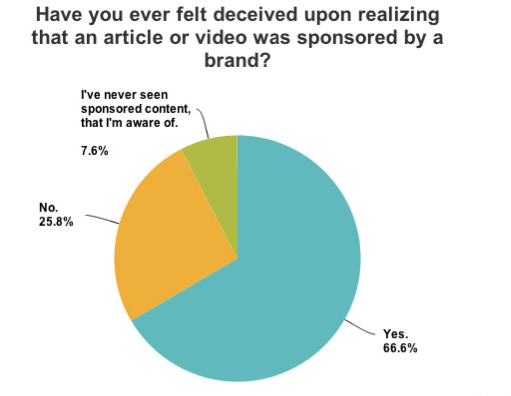
That’s the good news as the journalism industry morphs into a branch of public relations. A new study has followed up on Tony Haile’s evidence that no one reads the damn stuff anyway. Its findings?

Two-thirds of readers have felt deceived upon realizing that an article or video was sponsored by a brand.
54 percent of readers don’t trust sponsored content.
59 percent of readers believe a news site loses credibility if it runs articles sponsored by a brand.
As education level increases, so does mistrust of sponsored content.

So I’m not alone among the consumers of journalism; I’m just almost alone in being a journalist who is publicly prepared to call this ethical swamp what it is. When asked if they would prefer old-fashioned, honest banner ads rather than this morphing of advertising, journalism and PR, the answer is overwhelming: by almost 2 -1 readers preferred traditional advertising.

But the core legal and political question is whether there is active deception going on, in violation of FCC rules. On that level, today’s media machers have some ‘splaining to do:

Screen Shot 2014-07-10 at 12.43.39 PM

When an industry is engaged in the wholesale deception of its consumers, the public interest is involved. At the very least, it seems to me, we should have Congressional hearings on whether this level of deception can be defended under the law.

Update from a reader:

“But the core legal and political question is whether there is active deception going on, in violation of FCC rules. On that level, today’s media machers have some ‘splaining to do”

Not so fast! The FCC, which regulates radio, TV, and common carriers, does not involve itself with online advertising. Those of us in the Radio/TV industry are familiar with the “sponsorship identification rule,” which requires that advertisers and their related content be identified in those media. There were some serious fines levied recently for this ($44,000 to a Chicago radio station for 11 instances of playing a “news” show that didn’t identify that the content was sponsored, and not actual news). Historically, the practice of payola led to these regulations, to prevent disc jockeys from accepting money to play records and thereby popularize them – a deceptive form of advertising.

Who Killed The RomCom? Ctd

Megan Garber has her own theory about why the genre is struggling:

[T]he truth is that romantic comedies are, as works of art and pieces of culture, terrible. They are usually some ungodly, unsexy combination of: stale, trite, silly, and formulaic. They are often offensively anti-feminist. The generous reading of all this is that recent films and their creators became victims, essentially, of the innovator’s dilemma: They got too good at obeying their own, once-successful formulas – and failed to see beyond them.

The less generous reading is that film executives and creators failed to see the culture changing around them. The rom-com industrial complex – the cultural institution charged with capturing romance as a kind of ritual – failed to recognize the evolution of romance itself.

Meanwhile, a reader who writes about box-office trends offers some context, while another offers a few recommendations:

Romantic comedies aren’t weak because the male 18-24 audience dominates the box office. Indeed, the headline over the last year has been the collapse of that group among US moviegoers. Moviegoing is skewing older and a bit more female.

The need to capture a worldwide audience is one reason many genres don’t get fuller attention, but romcoms can be made relatively inexpensively, and several female-oriented films over the last few months have been considerable successes. Remember that there’s a lag of around two years between when films are greenlit and when they hit the screen. So romcoms might come back in the US. Yes, many American comedies don’t translate internationally, but a Pretty Woman would likely be just as big today as it was in 1990 (much bigger, with inflation).

Update from a reader:

I adore the movies and go as often as I can (but not to the multiplexes, which seem to be increasingly dumbed down). I prefer smaller indy films, and there are excellent indy rom coms which are neither trite nor anti-feminist. In the last month I’ve seen two excellent indy rom coms…. The Lunchbox and In a World Where…

The Lunchbox refutes the lie that romcoms cannot bridge cultures. It’s is an Indian film about a uniquely Indian system but which spoke beautifully and intelligently to longing in an unfulfilled life. I, a working American mother, related very much to the young Indian housewife at the center of the story, and her neighbor reminded me a great deal of my Puerto Rican mother-in-law. And all without innuendo about sex. The closest this film came to nudity was the heroine removing her jewelry in the evening.

In a World Where…, written, directed, starring and produced by Lake Bell, includes many romcom cliches including mistaken identity, the overlooked love interest, etc., but as a humorous side plot in this tale of a woman fighting to make it in a male-dominated industry.

If the big studios only took the time and effort to make movies that were not so dumbed down in the way they have every movie Kate Hudson and Jennifer Anniston ever starred in, maybe they could draw me back to the multiplex.