Good News For Gay Parents

A major Australian study has found that the children of same-sex couples are better off than most:

Researchers from the University of Melbourne surveyed 315 same-sex parents with a total of 500 children. About 80 percent of the children have female parents, while 18 percent have male parents. The children raised by same-sex partners scored an average of 6 percent higher than the general population on measures of general health and family cohesion. They were equivalent to those from the general population on measures of temperament and mood, behavior, mental health and self-esteem.

Researcher Simon Crouch posits that “the structure of same-sex parent families, particularly in relation to work and home duties, plays an important part in how well families get along”:

Same-sex parents, for instance, are more likely to share child care and work responsibilities more equitably than heterosexual-parent families. It is liberating for parents to take on roles that suit their skills rather than defaulting to gender stereotypes, where mum is the primary care giver and dad the primary breadwinner. Our research suggests that abandoning such gender stereotypes might be beneficial to child health.

But stigmatization remains a concern:

According to the study, about two-thirds of children with same-sex parents experienced some form of stigma because of their parents’ sexual orientation. Despite these kids’ higher marks in physical health and social well-being, the stigma associated with their family structure was linked to lower scores on a number of scales. Crouch said stigmas ranged from subtle issues such as sending letters home from school addressed to a “Mr.” and “Mrs.” to more harmful problems such as bullying at school. The greater the stigma a same-sex family faces, the greater the impact on a child’s social and emotional well-being, Crouch said.

Mark Joseph Stern argues that stigma isn’t a gay-parenting problem; it’s an anti-gay-parenting problem:

A study last year by researchers at University of Nebraska-Lincoln and University of Pretoria in South Africa took a deeper dive into the effect of stigma on gay families, finding that:

The children were not upset that their parents are gay. In fact, most of them embraced it. The negativity that children with gay parents experience is rarely the result of having gay parents. Instead, it’s the cultural stigma that causes all the problems. Any concerns they had were the result of how they would be treated in the public sphere. Research constantly shows that children with gay parents are normal, healthy, well-adjusted people. It’s the social scrutiny and stigmatization that children have to negotiate and contend with.

As that quote suggests, the study only confirmed what previous research had borne out: Gay parents don’t disadvantage their children – but conservatives’ smear campaigns against gay parents do.

German Lopez notes some caveats in the study:

The findings are based on reports from the parents who agreed to the survey, which could skew the results. The survey also focused on Australian same-sex parents, so there may be social and cultural factors at play that wouldn’t apply perfectly to America’s gay and lesbian parents. And the study doesn’t compare same-sex parents directly with opposite-sex parents; it instead compares same-sex parents and their children to the general population.

Update from a reader:

German Lopez’s caveat goes further than you may suspect. While it’s true beyond doubt that the study shows that same-sex parenting doesn’t hurt, and that’s important to get on the record, the data can’t say anything useful about whether or not it’s better. For that, you’d need to compare same-sex adoptive parents to opposite-sex adoptive parents, not same-sex parents to the general population.

It comes down to basic experiment design. You want to remove as many confounding factors as possible. Adoptive parents spend a lot of time and money on the process, have gone through a vetting process, and manifestly WANT to be parents. The general population contains a lot of willing parents, to be sure – but it also contains a lot of accidental parents, people with “buyers’ remorse”, and few of them went through any vetting process more discriminating than the mother’s choice of partner.

An interesting result, but more study is needed.

The Denisovans’ Legacy

Tibetans are more capable than most other people of living at extreme altitudes thanks to a mutation in a gene called EPAS1, which allows them to cope with the oxygen-poor air of the 4,000-meter-high Tibetan Plateau. Now, geneticists have identified the same mutation in the Denisovans, an extinct group of humans with whom our ancestors may have interbred some 30,000-40,000 years ago:

To date, this is still “strongest instance of natural selection documented in a human A Phuwa villager stands for a portrait a few miles from thepopulation”—the EPAS1 mutation is found in 87 percent of Tibetans and just 9 percent of Han Chinese, even though the two groups have been separated for less than 3,000 years. But when the team sequenced EPAS1 in 40 more Tibetans and 40 Han Chinese, they noticed that the Tibetan version is incredibly different to those in other people. It was so different that it couldn’t have gradually arisen in the Tibetan lineage. Instead, it looked like it was inherited from a different group of people. By searching other complete genomes, the team finally found the source: the Denisovans! …

This discovery is all the more astonishing because we still have absolutely no idea what the Denisovans looked like. The only fossils that we have are a finger bone, a toe, and two teeth. Just by sequencing DNA from these fragments, scientists divined the existence of this previously unknown group of humans, deciphered their entire genome, and showed how their genes live on in modern people. Denisovan DNA makes up 5 to 7 percent of the genomes of people from the Pacific islands of Melanesia. Much tinier proportions live on in East Asians. And now, we know that some very useful Denisovan DNA lives on in Tibetans.

But Catherine Brahic deflates some of the excitement, noting that the findings are not conclusive:

The Tibetan EPAS1 probably got there by interbreeding, but more evidence is needed to confirm which archaic humans were the source, says David Reich of Harvard Medical School in Boston. “There is no proof in the paper that the origin of the [DNA] is Denisovan.” He says it could just as easily have come from Neanderthals, whose EPAS1 looks similar to the Tibetans’. That might make more sense as they were common on mainland Asia, whereas the Denisovan heartland seems to have been in South-East Asia.

It is still unclear how the modified EPAS1 gene helps Tibetans survive 4000 metres above sea level. It seems to cut the number of red blood cells, which carry oxygen, being made. That is odd: most people make more of these cells when they travel to high altitudes, to carry more oxygen. But they thicken the blood, possibly making strokes more likely. Nielsen thinks that, by thinning the blood, the Tibetan gene may help lower this risk.

Regardless, Boer Deng concludes, genetic discoveries such as these should require us to rethink our definition of “humans”:

Denisovans and Neanderthals are called extinct human “species”—a term that used to demark a clear line between two organisms incapable of interbreeding to produce fertile offspring. But the definition is no longer so clear. We know that these hominin cousins did couple with our Homo sapiens ancestors—and some of us have inherited from them valuable modern traits. How we define “humans” past and present is a subject to contemplate—as fitting for scientists as for pilgrims to think about on their journeys across Tibetan plains.

Update from a reader, who bolsters the fact that “the genetic results of the last few years demonstrate pretty clearly that Denisovans and Neanderthals are us”:

See, for example, my take (“Denisovans are us“,  “Neanderthals are us– More evidence“,  “Neanderthals are us?”), Jerry Coyne’s (“How many species of humans were there?“, and John Hawks’ (“Naming archaic human populations“, “The ‘braided stream’ at year-end“, “Is the Biological Species Concept a ‘minority view’?“) . I’m a zoologist who studies lizards, Coyne is a geneticist whose most important work has been on the nature and origin of species, and Hawks is a paleoanthropologist who studies both bones and genes, and we all came to the same conclusion.

Hawks, who studies the issue most closely, states simply, “Ancient human populations like the Neandertals and Denisovans were not separate biological species.” Here’s how I put it: “The current work tends to confirm the conclusion that archaic humans (Neanderthals and Denisovans) were part of a group of interbreeding populations in nature that included the immediate ancestors of modern humans, and thus were members of the species Homo sapiens.”

That Neanderthals and Densiovans were human can, I think, not be doubted, because they are, under any point of view, fellow members with us of the genus Homo, and thus men in the generic sense (in both the vernacular and technical senses of generic).

But are they members of the same species as us, Homo sapiens? There are, regrettably, quite a few historical instances where two peoples (both of course undoubted modern H. sapiens) met, and one people quickly disappeared, with relatively little gene flow having occurred. That Denisovans and Neanderthals contributed “only” several percent to our genomes before disappearing is no bar to their having been the same species as us moderns; it is, in fact, strong evidence of all of us (modern, Denisovan, Neanderthal) being the same species.

(Photo: A Phuwa villager stands for a portrait a few miles from the Chinese border. Hidden in the rain shadow of the Himalaya in one of the most remote corners of Nepal lies Mustang, or the former Kingdom of Lo. Hemmed in by the world’s highest mountain range to the south and an occupied and shuttered Tibet to the north, this tiny Tibetan kingdom has remained virtually unchanged since the 15th century. Today, Mustang is arguably the best-preserved example of traditional Tibetan life left in the world. By Taylor Weidman/LightRocket via Getty Images)

A Plankton Of Action, Ctd

A few readers push back on this post:

As co-author of a marine science book who gives frequent public talks, I get asked about the iron sulfide engineering idea a lot. The downward flux issue is real, but there’s another major problem with the idea that’s even easier to articulate: what happens when those uber-blooms of plankton die off? Even assuming the carbon sequestration worked perfectly, you’ve now filled large swaths of the Southern Ocean with countless tons of dead plant matter. Bacteria will bloom to decompose it, creating enormous anoxic “dead zones” where pelagic fish and other organisms our species enjoys eating/admiring cannot live. Similar phenomena can be observed near major fertilizer runoff sites. The whole point of averting climate change is to prevent the ocean from turning into a sludgy toxic mess! This idea’s side effects are the very problems it means to combat.

Another is on the same page:

You ended your post about Victor Smetacek saying, “Further experiments, however, were halted due to protests from environmentalists.” But you did a disservice to them in not bothering to explain in part why they complained. As was noted in Scientific American:

A similar cruise and experiment in 2009 failed despite dumping even more iron fertilizer over an even larger area of the Southern Ocean. The eddy chosen for that experiment lacked enough silicon to prompt these particular diatoms to grow. Instead, the experiment yielded bloom of algae, which was readily and rapidly eaten by microscopic grazers. As a result, the CO2 in the algal bloom returned to the atmosphere.

In fact, these iron-seeding experiments could backfire by producing toxic algal blooms or oxygen-depleted “dead zones,” such as the one created in the over-fertilized waters at the mouth of the Mississippi River. At present, scientists have no way to ensure that the desired species of silica-shelled diatoms bloom. In short, Smetacek says, the type of bloom—and therefore the ability to sequester CO2—”cannot be controlled at this stage”.

This could be a great way to sink carbon, but we’ve gotten ourselves into problems before assuming a fix will be fine without paying attention to what might go wrong and I can’t blame people for urging caution in going forward here.

Update from a reader:

Not to pile on, but one more issue: Scaling. Thus far, we have data on ocean iron fertilization (OIF) only on a single-trial basis. We have to rely on models to extrapolate from the data at the global scale. However, here is a paper from Nature which makes several assumptions extremely favorable to OIF.

Briefly, I will highlight the favorable assumptions: It assumes a high (RCP 8.5) emissions scenario (thus relative impacts are maximized), continuous fertilization from 2020-2100, instantaneous deployment at full scale, and a full release of iron limitation from all phytoplankton south of 40° latitude.

The sum of this wildly optimistic model? A net loss of -.15°C (Table 2). Even under a low-emissions scenario (or low-sensitivity scenario favored by skeptics) OIF’s maximum potential is to buy us an extra decade at an unknown ecological price.

Brazil Goes Bust

2014 FIFA World Cup Brazil

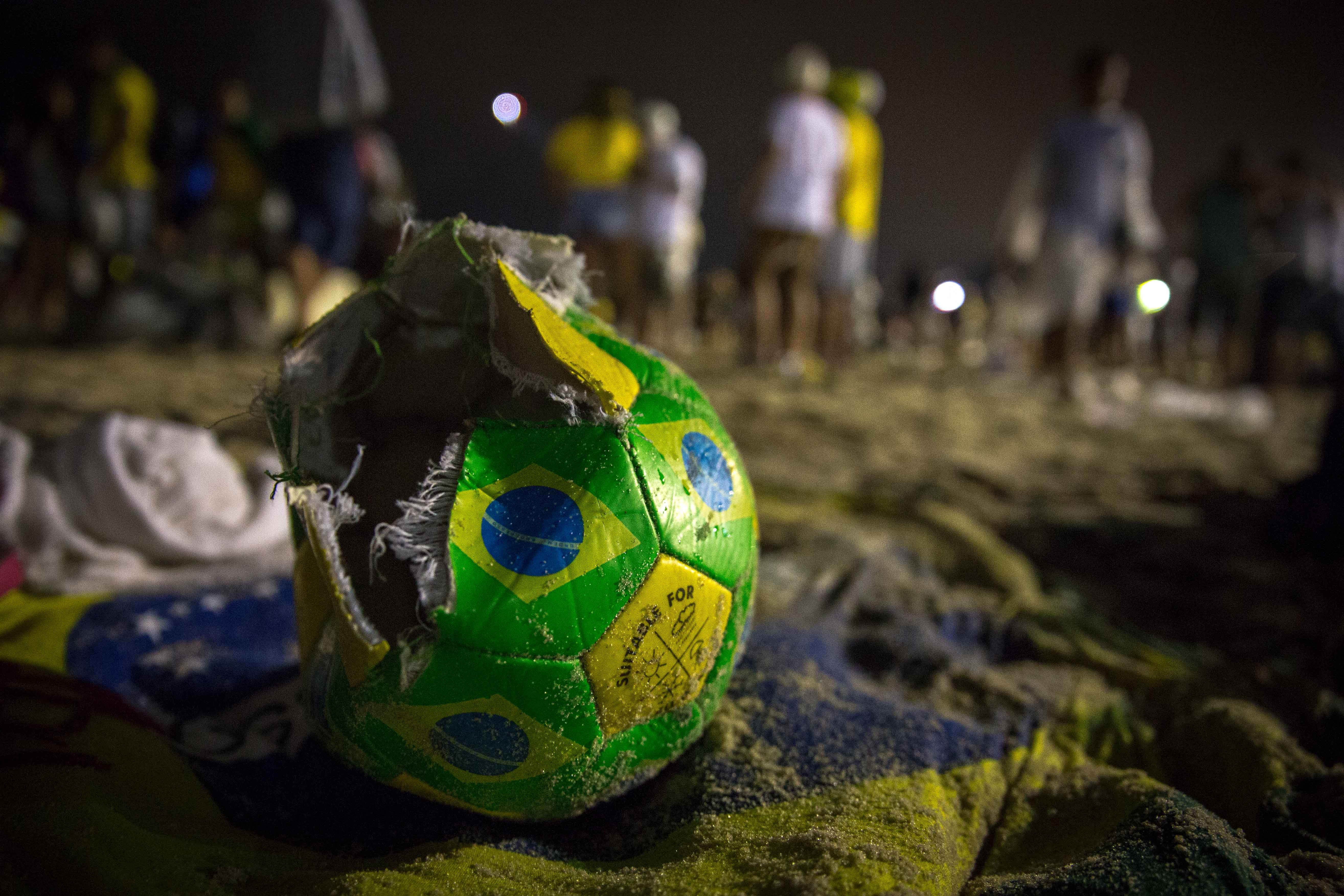
Nate Silver calls Brazil’s utter humiliation in yesterday’s 7-1 loss to Germany the “most shocking result in World Cup history.” Michael Goodman wonders if it will lead to unrest:

The immediate question is whether Brazil’s exit will serve as a flashpoint for an immediate revival of the previous protests, or in an even uglier scenario, like riots. The overwhelming police presence makes this unlikely, at least for now. It may not be pretty, it may not be humanitarian, it may not even be legal — but it has been brutally efficient. When the teams and the tourists and the cameras leave again, that’s a different story. There’s every reason to believe the lead-up to Rio 2016 will be similar to what Brazil experienced before the World Cup unless, of course, the government has a super-secret plan to boost the economy, increase employment, and more aggressively address persistent inequality.

Both Brazil the country and Brazil the team are likely in for a turbulent few years. Had the team won the World Cup, they might have avoided that fate with a confirmed soccer philosophy and break from social unrest. But the honeymoon wouldn’t have lasted very long. For Brazil, the problems run a good deal deeper than just losing a soccer match.

Keating eyes the country’s upcoming elections:

If Brazil had won the tournament, it could have changed the political significance of the entire event. If the country had made a dignified exit in the late rounds, it probably wouldn’t have had that much of an impact either way. But a defeat this humiliating is going to remind a lot of voters of why they were upset about the World Cup in the first place. Anti-Dilma chants were reportedly already being heard at the stadium today.

As Francisco Fonseca, a political scientist at Sao Paulo’s Getulio Vargas Foundation, told the L.A. Times on June 28, “if there were some kind of catastrophe, or chaos, that embarrassed Brazil in front of the world, that would clearly have negative consequences for the government in the election.”

Jesse Singal provides a psychoanalysis of the crushed Brazilian fan:

The problem is that soccer dominance is an important part of Brazil’s sports identity, and this loss cut to the core of it. As Eric Simons, author of The Secret Lives of Sports Fans, explained in an email, “If you’re Brazilian, your identity is based on self-concept that you’re always the best soccer team in the world, and you know that everyone else knows it, so you’re proud.” So the pain of losing isn’t, in this case, that of an underdog happy to be there, and for the Brazilians to lose in this manner is to collide violently against all sorts of national expectations and self-conceptions.

“What happens when your pride, self-concept, and identity are suddenly obliterated in front of the entire world?” said Simons. “I don’t know. I don’t know if anyone does; this is, in sports, something of an unprecedented self-esteem catastrophe. Has anyone that good, with that much expectation, [ever] lost that badly before, with so many people watching?” The answer to that question may be no, which would mean we’re in somewhat uncharted sports-trauma territory.

Update from a reader:

While there were some rumblings of riots yesterday, I think Brazilians deserve a little more credit. The idea of conflating a historically bad result in a crucial World Cup game with the protests about the country’s economic and management issues undermines the voters’ intelligence. Given the looming inflation, underwhelming GDP, exorbitant taxation, and horrible mismanagement of taxpayer money, Ms. Rousseff will have a hard reelection campaign regardless of how well Brazil performed in the World Cup. What we witnessed yesterday was the triumph of planning, discipline, and hard work over the notion that the home team was predestined to win. Germany gave Brazil a master class yesterday; it is up to Brazil now to learn from this lesson, both on and off the field.

Now if Argentina beats Brazil soundly on the consolation match on Saturday, all bets are off …

(Photo by Steffen Stubager/Anadolu Agency/Getty Images)

One Reason Why Buzzfeed Is An Embarrassment To Journalism

It runs articles by third parties attacking other newspapers’ integrity – yes integrity –  for money.  Update from a reader:

I think that BuzzFeed article is especially problematic because it’s actually just impossible to tell (likely purposefully impossible) exactly what a “Community Brand Publisher” is.

When you go to the site, the article disclaimer says: “This post was created by a Community Brand Publisher, which means it is not sponsored and has not been vetted or endorsed by BuzzFeed’s editorial staff.” While the “not sponsored” is likely meant to be read “not sponsored … by BuzzFeed’s editorial staff”, it could also be taken to mean that the article is not “sponsored content.” That reading would suggest that BuzzFeed had not been paid to run it, though it seems that they have. This is further confused by their use of the term “Community Brand Publisher”… the BuzzFeed “Community” is open to anyone and makes no mention of any payment, but I can’t determine what exactly a “Community Brand Publisher” is. Searching the term on Buzzfeed gives no results, and searching on Google seems to return a bunch of posts by these “Community Brand Publishers”, rather than any real definition of what that means.

It seems like Buzzfeed (through the use of the word “Community” and the lack of explanation of what that means) is trying to confuse their readers as much as possible while covering their asses (being able to say “well look, we clearly noted that it was a Community Brand Publisher, not someone from the Community”). An embarrassment to journalism indeed.

The Bias Against Black Dogs, Ctd

A reader writes:

It really is true that it is more work to appreciate the features of a black dog.  For instance, in this photo of my dog, you can barely see his eyes:

10176247_10152351667344189_1085738088_n

Or his body. Or his feet.

Another can relate:

I volunteered at a shelter and noticed this problem too. I adopted a black-haired, medium-sized, young adult, mixed-breed dog who turned out to be essentially perfect. I find that with a decent camera and some experience, experimentation, and digital editing, one can make great photos of black-haired dogs. Here’s one I took of my dog, which I think proves the point:

Kitchen Portrait-2

Another reader:

We recently adopted a rather large black dog. Sonny is beautiful, but there are problems.

First, Sonny is impossible to see at night. That means he sometimes gets stuck at the back door, begging to be allowed back in the house. And sometimes, in the middle of the night, I get tripped up on my way to the bathroom.

Second, having a black dog muddies my standing as a yellow dog Democrat. In years past, when asked about my politics, I just pointed to my pooch. Can’t do that now.

Another has a suggestion for photo-taking:

As you can see, black dogs can be photographed wonderfully, and tools like Instagram help:

unnamed-insta

Another has more tips:

First, there’s the Black Dog Project if you want to see some great photographs of black dogs. The photographer, Fred Levy, photographs them against dark backgrounds to highlight the difficulties they face in being adopted.

Secondly, there’s a few things that you can do when taking photographs of black dogs to make them turn out better. This is really good for shelter workers, but also just for regular dog owners who want better photos of their pooches. Black dogs can seem scary and ominous, but if you play with the dog for a few minutes and get it into a light pant, they start to look like they are smiling, and their eyes come alive. The dog goes from scary to friendly in an instant. Washing them and giving their coat a good brush will help them shine and create really nice highlights that also make them turn out less like a dark blob in a photo.

Finally, I’d be remiss to not include a photo of my own black pup:

puptraits

Another has a different recommendation:

The best barbecue joint I have ever been to in my life is in Urbana, Illinois, home of the University of Illinois, called Black Dog Smoke and Ale House. It proudly displays several signs about this exact issue of adoption, donates to the Humane Society of Champaign (a no-kill shelter), and the owners have their own adopted black dogs. And their food is out of this world. If you ever find yourself lost in the cornfields of Illinois, worth the time.

More readers share their pup pics:

I knew about the bias against black cats in shelters, but I didn’t realize it extended to dogs. He is hard to spot in the laundry basket, though:

IMG_0943 (1)

Another:

It breaks my heart to think that people might be biased against dogs based simply on the color of their coats.  Makes about as much sense as being biased against people based on the color of their skin.  Not saying that the effect isn’t real, just that it’s stupid.

My evidence?  Take a look at these two adorable mutts that rule over our house: Chloe on the left and Chip on the right:

chip

Never a better pair of “pound puppies” to be found!

Another:

I couldn’t help but write you after reading your post today on the bias against black dogs; it’s an issue I think about daily.  I have two dogs, both rescues; one is a beagle/border collie mix (mainly white with charcoal markings), and the other is a black lab/doberman/german shepherd mix.  Every evening, weather permitting, I take them on a long walk throughout the neighborhood, and whenever anyone stops to talk, or pet the dogs, the white beagle mix is “the little one,” and Moxie is “the black one.”  I find it fascinating.  The only exception to this is small children; teens, adults, and the elderly all toe the invisible “little/black” line.

Both of my dogs are extremely friendly, well-Moxiebehaved on walks, and love to meet new people. I absolutely understand why strangers would be apprehensive of my larger dog, as she is about 125 pounds, but no one, not ever, in four years of walks, has called her “the big one.” My neighborhood is fairly diverse, but regardless of the ethnicity of the person we meet, she is always the Black Dog.  It makes me a little sad, not just because it happens, but because it is apparently such a widespread bias.


Interestingly, the colors/sizes split along gender lines, too.  Both of my dogs are female, but strangers always assume the mostly white dog is a girl, and the black dog is a boy (even though she sports a hot pink collar and matching leash).

Like all proud dog owners, I can’t resist talking about my dog without forcing you to look at sending at least one picture along.  Look at that face!

I can’t close without telling you how much I enjoy The Dish, and how meaningful it is to me in my daily life.  I’m a founding member, and I can say without a doubt that my membership is one of the most rewarding purchases I’ve made, and I plan on renewing into perpetuity. Thanks again!

One more:

Our black dog is Chaucer, born in Oxfordshire, who has traveled with us through 10 countries on our (USAF) military career. We are now in S. Korea for another year on assignment. He has flown over the Atlantic and Pacific and is a love. Koreans are afraid of large dogs and people have been known to run screaming when they see us on our walks. The younger folks stop and ask if they can have their picture taken with him. As you can see, he is very photogenic; please, please, PLEASE add my gorgeous boy to your black dog thread. You will make him very happy!

20080413-DSC_2091

Good Luck Finding A Lesbian Bar In Portland, Ctd

A reader is bound to get some heat for this email:

Good luck finding a lesbian bar in Boston too. There are a few lesbian theme nights around the city, but they seem to travel around and disappear, or at least drop off my radar. As a long-time bartender in the city, I can say two things about lesbians:

1) They don’t tip (at least not to male bartenders)

2) Lesbians cause fights. Lots of them.

In gay bars (male), the bartenders don’t want lesbian patrons for reason number one and the owners don’t want them for reason number two.

In a city like Boston, in the event of a fight, a bar is supposed to call the police when somebody is assaulted. That call results in a hearing at city hall where the most likely result is a fine or suspension of license. The fine is usually based on your daily sales – three-day suspension or a fine equal to three-days sales, that kind of thing. Plus you need to factor in the attorney fees for the guy you need to hire to represent you. It’s just not worth it.

Gay men typically don’t get into fist fights. But I’ve seen some nasty lesbian fights at Randolph Country Club in Randolph, MA. From my experience, the ladies have nobody to blame but themselves for the lack of bars.

Another reader points to an interview with Jean, a former employee at Phase 1, “Washington, DC’s (and some might argue the country’s) oldest lesbian bar.” She has some insight into the tipping stereotype:

What has Phase meant to you over the years?
Home. It’s always been home. I’m always in awe of the fact that it’s still open. There’s only one lesbian bar that’s been open longer and it’s in Chicago – I think it may have actually closed by now. Lesbians are not real supportive so I’ve always been pleased that Allen and his partner Chris (who recently passed) kept it open no matter what.

Is there such a thing as a profitable lesbian bar?
I doubt it. Interestingly, when Tracks first opened in the early 80’s that was supposed to be a lesbian bar. And actually Zeigfeld’s was supposed to be and they just evolved into other things because you just can’t count on women to bring in the money. So the Phase has ebbed and flowed over the years and there was a point in the mid-80’s where we would have 300-350 women come through here in a night. It was intense, it was awesome and it was packed. But once lesbian nights started, people had choice and that made a difference.

Now Angela brought in energy that hadn’t been here in a long long time. But it gets frustrating even with all the people she’s bringing in here. Women are notoriously bad tippers. This generation is better but with older women you’re talking about a generation who had to make it on their own and had lower paying jobs than men, especially in the working class and whatnot.  You never do get a lot of the lawyers coming in here…

Update from a reader:

It’s funny what working in the hospitality industry can do to even the most politically correct liberals. Once your income is dependent on tipping, it’s impossible not to start stereotyping certain groups even if it’s unfair to the outliers. And I’ll back up the male bartender from Boston; in over 10 years in the business, lesbians were by far my least lucrative demographic (beating out Europeans, Southerners, and old people).

Another:

Hmm. I’m genuinely trying to open another lesbian bar in the District – I have a lawyer, an application for a liquor license, the works – so this discussion is fascinating. Stereotypes aside. Thanks for having it. I’ll let you know how it goes.

Legalization Takes The Initiative

In order to “understand how important and effective the initiative process has been for advancing marijuana reform,” Jon Walker recommends looking “at two states recently in the news for the issue, New York and Oregon”:

New York is actually more liberal than Oregon, according to Gallup, and voted heavily for Barack Obama in 2012. Obama carried New York with 63.4 percent of the votes but won only 54.4 percent in Oregon. The people of New York are also arguably as supportive, or even more supportive, of marijuana reform as the people of Oregon. A Quinnipiac poll from February found 57 percent of New York voters support legally possessing small amounts of marijuana for personal use. The highest support any independent poll found for legalization in Oregon was 54 percent.

Yet this year New York is finally only getting a watered down medical marijuana law while Oregon has had medical marijuana since 1998 — and will likely fully legalize marijuana for adults this November.

The less liberal Oregon is effectively 16 years ahead of New York for the simple reason that it provides an initiative process for getting around reluctant politicians. It was a citizen initiative, ballot measure 67, that got medical marijuana legalized in Oregon back in 1998, and it is another initiative that will likely lead to the state legalizing adult use this year.

Update from a reader:

Walker conflates support for marijuana and political orientation. As you’ve noted often, this is not purely a left-right issue. One of Oregon’s most famous initiatives was the landmark Death with Dignity law that legalized doctor-assisted suicide. Like marijuana, that issue, often cast as liberal, had more complex support and opposition from both sides (but a substantial and durable majority).

There are conservatives who support marijuana legalization, and this gets to the second point: West Coast liberals are not the same as those in New York and Massachusetts. You could over-interpret this, but left-coast liberalism is more libertarian. The pioneer spirit lives out here, and so-called nanny-state liberalism is less prevalent. Oregon’s flavor of liberalism exhibits itself in our extremely broad free-speech constitutional provision – the one that makes strip clubs dens of free speech, not sin and depravity (legally-speaking). It’s why we’ve had medical marijuana so long and why we will almost certainly join libertarian-liberal western states Washington and Colorado soon.

Like conservatism, liberalism isn’t a monolith.

Meanwhile, Washington state will be begin selling legal marijuana tomorrow. But there likely won’t be enough to go around:

Pot regulators, business owners and analysts say pot could sell out in Washington within hours or days at the few shops slated to open on Tuesday. That is largely because of limited harvests by licensed growers and processors, or because they failed to clear regulatory hurdles to get their product to market. Washington is also grappling with a backlog of hundreds of would-be growers who still need to be screened by overwhelmed investigators with the state Liquor Control Board, agency spokesman Brian Smith said.

Recent Dish on Washington’s woes here.

The Bias Against Black Dogs

A sad fact:

Black dogs get euthanized at higher rates. They linger at pounds and adoption agencies for black-dogslonger than light-colored dogs, and they are less likely to find a home. Marika Bell, director of behavior and rehoming for the Humane Society of Washington, D.C., says the organization has been tracking animals that have stayed at their shelters the longest since March 2013. They found that three characteristics put a pet at risk of becoming one of these so-called “hidden gems”: medium size, an age of 2-3 years, and an ebony coat.

What kind of nefarious psychological quirk would prevent someone from adopting a dog based on fur color?

Animal welfare experts believe the discrimination arises from a pack of factors. The mythology around black dogs is grim. (The Grim, from Harry Potter, is a “large, black, spectral dog that haunts churchyards” and augurs death.) A 2013 study by Penn State psychologists revealed that people find images of black dogs scarier than photos of yellow or brown dogs—respondents rated the dark-furred animals less adoptable, less friendly, and more intimidating. And while the association between obsidian and evil is more explicit for cats, dogs have to contend with a culture, post-Samuel Johnson and Winston Churchill, that symbolizes depression as a coal-colored hound.

Update from a reader:

Maybe people are swayed by mythology against adopting black dogs, but I’ve always felt like there was a much simpler explanation.  This is a picture of my two dogs (well, sadly, the yellow one is no longer with us):

December 21 008 2

Who did you notice first? Who do you spend more time looking at?  The yellow one.  It’s true of every single picture I have of the two of them together.  The lighter-colored dog, even when she’s off to the side of the picture, is the one who becomes the focal point – to the point where frequently people don’t even notice that the black dog is even there until he’s pointed out.

The fact is is that the human eye is kind of lazy.  We’re drawn to lighter-colored objects that aren’t as difficult to focus on, where the contours are easier to make out and the features easier to identify.  It’s not necessarily prejudice; it’s an unfortunate quirk of biology.  And it’s not just our eyes; cameras have difficulty with dark subjects as well.  So, when it comes to a web page filled with pictures of dogs in need of adopting, it’s easy for your eye to just skim right over the black lab mix and on to the yellow hound mix or the white greyhound.  When you go to visit the shelter, you’re more likely to notice the light-colored dog than the dark colored one, and so you’re more likely to take the light-colored dog home.

Still, I support promoting awareness of the phenomenon, because there are a lot of awesome black dogs out there who need homes.  It was my husband who spotted our black dog on the web page of the same rescue we had gotten the yellow one from.  He had languished in foster care for quite a while, despite being young and healthy.  He’s been with us for almost six years and he is one of the best dogs I have ever had in my life.  It’s a shame to think that the laziness of the human eye could have prevented him from coming to live with us.

(Image via Petfinder. Shena, an adult pit bull mix, is available for adoption from Rebound Hounds Res-Q in New York)

The Con Of “Spirituality”

Jeff Sharlet, author of the new collection Radiant Truths, address that idea in an interview:

Every piece collected here touches on transcendence, but not all are explicitly religious. Reading, I was reminded of friends who say “I’m spiritual, not religious.” You’ve written elsewhere that you’re averse to the word “spiritual,” in the sense that you don’t like seeing your books filed in the Spirituality section of libraries and bookstores. Why is that?

Because I’m a curmudgeon. Here’s this word that millions of people find lovely and liberating — an alternative to all that seems calcified about religion, and what do I do? I complain. I think that in nine out of ten cases “spirituality” is a con — not a con by the person invoking it, but a con on that person. It offers the illusion of individual choice, as if our beliefs, or our rejection of belief, could be formed in some pure Ayn Randian void. For better and worse we make our beliefs and live our beliefs together. That’s what you get with the word “religion,” which means to tie, to bind. You may not want to be bound! I don’t. But we are. We’re caught up in a great, complicated web of belief and ritual and custom. That’s what I’m interested in, not the delusion that I’m some kind of island.

Update from a reader:

I guess I get what Mr. Sharlet means, but some of us don’t see the matter as being one of spirituality “vs.” religion. In the way that I look at it, faith has to be the deepest activity of “religion.”

Faith is that eternal ongoing journey for we mortal beings toward “Truth.” Spirituality can be another way of saying that, without getting bogged down in human prejudices toward particular religions. (If one thinks there might be other conscious life forms “out there” in our vast universe, does one assume they all have the “right” religion, or does one wonder how they approach their own journeys toward the ineffable Light?).

I get what Mr. Sharlet means about human responsibility via practical, proven means of association – aka religion. But religion has also had a lot to answer for over the centuries. Who are the very people who have broken the fundamental and basic promises to God that religious people say they are trying to keep? Often they’re the people who are merely “religious.” They are people who haven’t believed in their own connections to their Creator enough. They tend to be the people who worry about everyone else’s actions first, rather than seeing their challenge as being one of overcoming their own egos -fighting their own spiritual battles with the help of the Grace of God.

Religion can be a great thing if one doesn’t forget the faith that is supposed to live at the core of it. It can be a great thing if it unites the world’s peoples without dividing them. Some of us don’t think this is an impossible dream; it just requires the will to act on these ideals. For this reason, some of us think that focusing on what the various religions might have in common is a good thing: Faith, love, serving humankind (“even” in the form of one’s family and friends), actions that lead toward peace, justice, unity … even, God willing, a big dose of humility now and then.

So I guess while I think that the world would be, on the whole, in trouble without the good that religion (practiced the way it should) imparts, I have no problem discussing the deeper aspects of our relationship to our Creator, and how one lives one’s life, in terms of faith and spirituality – spirituality being another way of talking about “faith” in my view. In my own life, I think I’ve sensed the “Holy Spirit,” aka Love, active in a wide variety of religions; even if those religions might have added some goofy “man-made” ideas. This is why there can be so much confusion with religion – the Holy Spirit doesn’t “care” about man-made boundaries. It “blows” where it will, just as our physical sun shines down on “high” and “low” alike, or on the “good” and the “evil”.