Bad Omens For Obamacare

Many small ones have popped up recently. First up, Adrianna McIntyre explains why ACA enrollees might have to switch plans next year:

The federal subsidies used to offset the cost of insurance are based on income, but they’re also pegged to the second-cheapest silver plan on each state exchange, which is called the “benchmark plan.” When people choose something cheaper than the benchmark plan (the cheapest silver plan, or one of the bronze plans), they will spend less money out of their own pocket on the insurance premium. If a person chooses a plan that’s more expensive than the benchmark plan, he’s responsible for the extra cost.

But annual changes to insurance premiums aren’t uniform across plans. That means the “benchmark plan” can change from year to year — with financial consequences for those with subsidies. These consequences will be most acutely felt by low-income enrollees.

Speaking of subsidies, Sarah Kliff wonders how states will pay for the upkeep of their exchanges when the federal money runs out next year:

The Affordable Care Act provided federal grant funding for states to get their new web portals up and running.  The Obama administration doled out $4.6 billion in grants to states launching their own marketplaces. But Obamacare also requires state exchanges to become self-sustaining by the start of 2015. That means every state exchange that will operate next year now needs to figure out how to pay their bills. …

“There won’t be any big pot of federal money,” says Elizabeth Carpenter, a director at health research firm Avalere. “When you think about being able to run an exchange without the federal backstop, it will take awhile to forecast and figure out what money is needed.”

Next, Adrianna McIntyre warns that the next ACA open enrollment period is at the worst time of year:

Open enrollment for 2015 will last from November through February. The Obama administration probably picked late fall for open enrollment because that is when Medicare and most employers permit insurance enrollment changes. But between Thanksgiving and Christmas, late fall is also incredibly stressful, both financially and emotionally.

According to a new study in Health Affairs, people’s capacity for decision-making is stretched especially thin during the lead up to the holiday season. And when people are stressed, behavioral economists have found that decision-making is done with a sort of tunnel vision: people focus only on their most pressing short-term problems, sidelining long-term issues.

Suderman digs into another new study, from Kaiser, that “suggest[s] the potential limitations of Obamacare’s coverage scheme”:

It’s not a precise instrument: More than 40 percent of exchange enrollees were already insured, suggesting that while Obamacare is expanding coverage to the uninsured, it’s also resulting in a fair amount of subsidized coverage going to people who already had coverage (the vast majority of exchange beneficiaries got subsidies). Digging a bit deeper into the survey also hints at the difficulty in measuring who, exactly, counts as previously uninsured. If someone had health insurance up until a month prior to getting new coverage under the law, should that person count as uninsured? Probably not. What about six months before? Or a year before? These questions are legitimately difficult to answer.

Kaiser’s survey finds that the majority of previously uninsured lacked coverage for two years, and that 45 percent reported not having coverage for five years. Which means that more than half of the previously uninsured were covered at some relatively recent point.

Jason Millman looks at other surveys that don’t bode well for Obamacare:

Just how much will people buying their own coverage shop around for a better deal on health insurance year-to-year? By creating a marketplace where plans have to compete for business under the same rules, Obamacare is supposed to facilitate the shopping experience. Some recent studies throw cold water on that idea, though.

Just 13 percent of seniors enrolled in Medicare’s prescription drug program changed plans during the annual enrollment period, according to an October 2013 Kaiser Family Foundation survey that reviewed the first five years of program enrollment. Those facing the highest premium increases were the most likely to switch plans — anywhere between two and four times of the average rate of all enrollees who switched plans. Still more than two-thirds of enrollees who faced the highest premium increases stuck with their plans.

And last but not least, Lanhee Chen argues that “data published in the Wall Street Journal suggest that [the possibility of an ACA death spiral] may not be so far-fetched after all”:

At its base, the data show that people insured through the law’s exchanges have higher rates of serious medical conditions. Of the enrollees who have seen a doctor or other health-care provider in the first quarter of this year, 27 percent have significant medical problems, including diabetes, cancer, heart trouble and psychiatric conditions. That rate is substantially higher than that for patients in nonexchange market plans over the same period. And it’s more than double the rate of those who were able to hold onto their existing individual market insurance plans after President Barack Obama was forced to allow them to keep them.

This outcome should not surprise anyone. The law’s one-size-fits-all regulatory regime, which requires insurers to offer coverage to all comers and prohibits pricing of coverage based on an applicant’s health status, was bound to increase the number of relatively sicker people purchasing insurance through the exchanges. Moreover, Obama’s executive action, which effectively allowed many people who had individual market plans to remain in them through at least 2016, bifurcated the insurance markets such that healthier people remained in the plans they already had, while relatively sicker patients were left to acquire coverage through the Affordable Care Act’s exchanges.

Some of the bad risk in the exchanges has been offset by the enrollment of relatively healthy people who acquired coverage because of the law’s generous subsidies. Yet the numbers make clear that the exchanges remain a haven for those who may consume more medical services than others.

Update from a reader:

I found a few of the “bad omens” really rather business as usual and left me scratching my head thinking but this is how free markets, even ones that have some controls in place work.

For example, the lead off that the benchmark plan could change from year to year. So frigging what, I say. Most of my adult life, I’ve had my insurance provided by my employer, the state. We are fortunate in having many insurance options (including several managed care options and a more traditional [and more expensive] health insurance option) … um, sort of like the ACA market place. Employee premium costs for these have ALWAYS been tied to a benchmark plan, with the state usually paying some percentage of the lowest cost plan (all plans have to meet a uniform set of benefits, by the way, again sort of like ACA). It has been the case for all the years I’ve gotten my insurance through my state employer that the cheapest plans change from year to year.

When I was young, and not a big consumer of healthcare, I changed plans almost every year to take the cheapest plan. Now that I have a family, I’m older and use more healthcare, and have developed relationships with my various doctors, I am willing to suck up some price increases (although competition among the various insurers who provide plans to the state really has appeared to minimize very much price fluctuation) to maintain the status quo. I probably would change insurance plans if, for me and my family, the costs of not switching started to outweigh the benefits. And, it seems to me, the marketplace will make it relatively easy to shop for a better price the next year. Whether people take advantage of this will be up to them.

Not sure, but is the Medicare demographic mentioned in Millman’s piece really going to be the same as people enrolled in ACA? I don’t know. It might depend too on how this is marketed to enrollees. Can we “force” people to shop for cheaper insurance plans. Oh, the threat to our liberty!

Oh, and really? People might be too stressed to buy insurance during November through February? Sorry, this seems sort of lame to me!
A Shocking Number Of Refugees

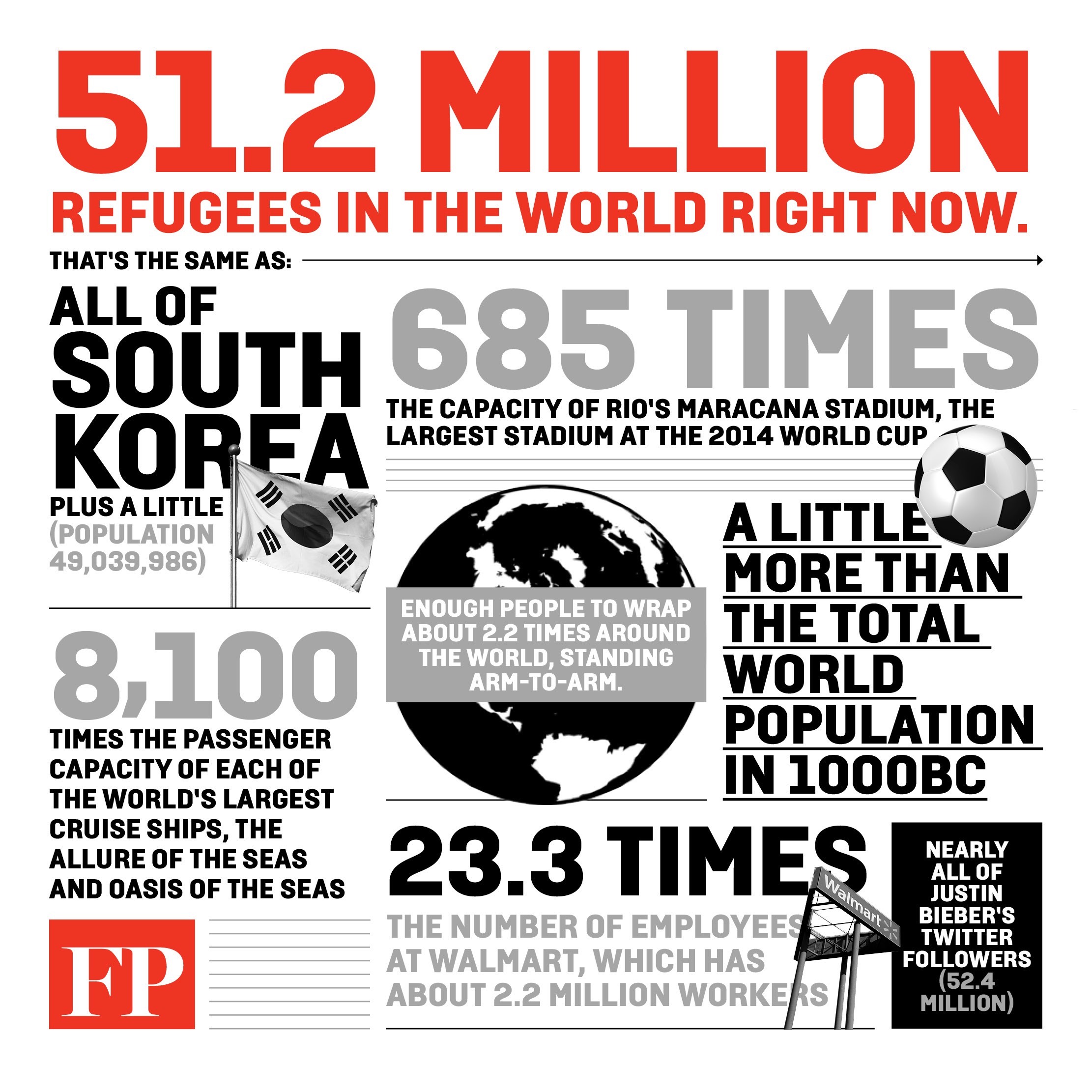
140620_refugeegraphicrevised

According to a recent report from the UN Refugee Agency, December was the first time since World War II that the number of displaced people climbed over 50 million:

The sharp increase in the total number of refugees was in large part the result of the ongoing Syrian civil war, which has forced 2.5 million to flee the country and resulted in 6.5 million internally displaced people. In total, there were some 51.2 million refugees in the world at the end of 2013, an increase of more than six million on the previous year. On its own, the figure 51.2 million can be somewhat difficult to conceptualize, a figure so large that it’s difficult to imagine the human toll of conflict.

Will Freeman delves into the report, which shows how Iraq is driving the number up even further:

In just over a week, refugees fleeing insurgents battling to create an Islamic state in Iraq have tripled from 500,000 to 1.5 million. The swift takeover of towns such as Mosul and Tikrit by the Iraq Islamic State in Iraq and Greater Syria (ISIS), also known as the Islamic State in Iraq and the Levant (ISIL), has displaced nearly 1 in 30 Iraqis. UNICEF, the United Nation’s children’s agency, recently upgraded the crisis to a level 3 humanitarian disaster— its most severe ranking. … The future is grim for Iraq’s latest wave of displaced people, as only 31 percent of the United Nation’s funding requests have been met. With terrorists continuing to fight their way towards Baghdad, the number of refugees will likely continue to rise.

To make matters worse, the record number of refugees are experiencing brutal temperatures:

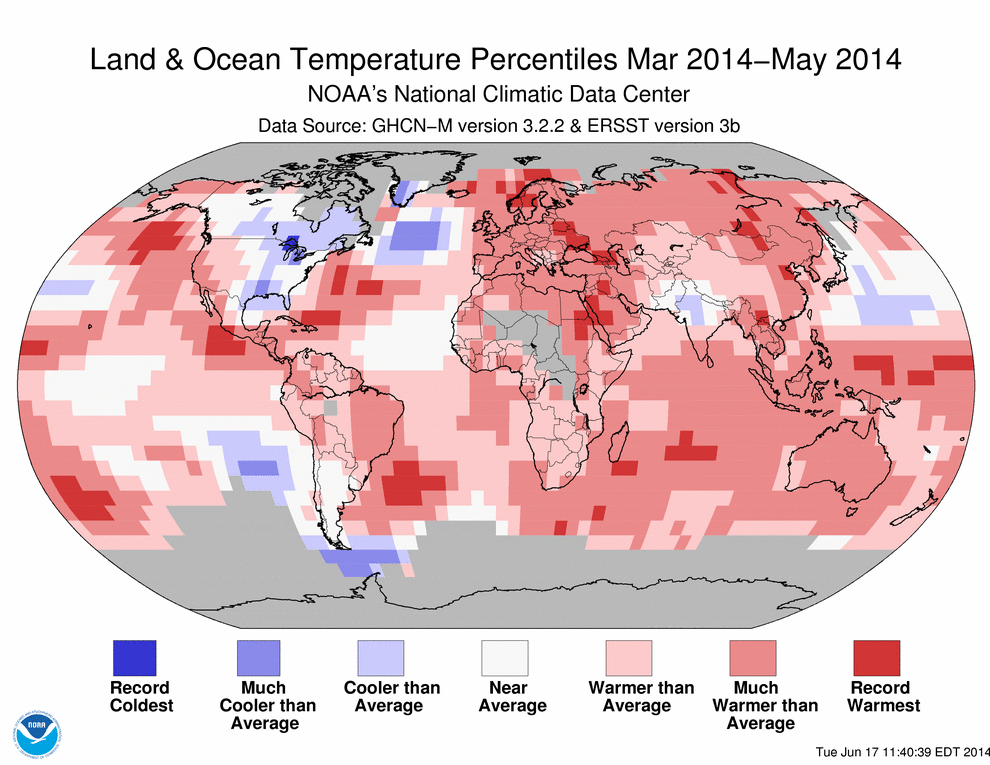
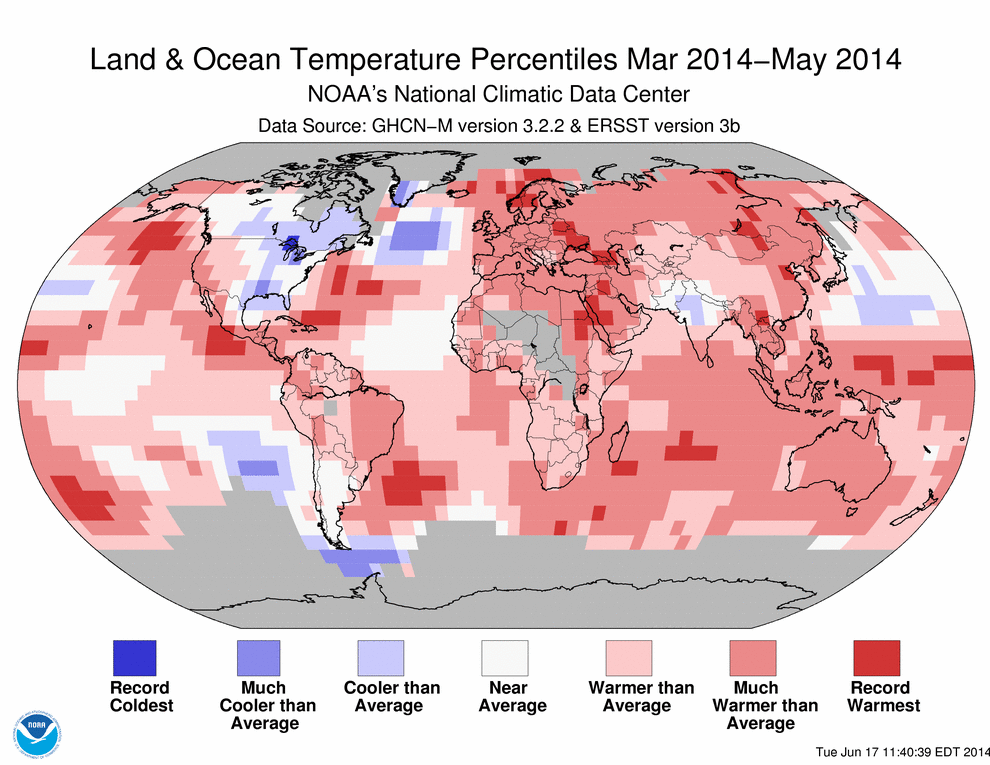
Temperatures have indeed been much hotter than average in the Middle East this year. According to the US National Oceanic and Atmospheric Administration, just about the entire region was classified as “Much Warmer Than Average” for the March-May period, while much of Iraq and bits of Syria saw record-high temperatures.

1403897449674704

Image: NOAA

In line with global warming’s habit of punishing the most vulnerable populations, other refugee-laden regions saw record heat too, such as the conflict-stressed area near the Golden Triangle, an opium-producing hotbed. Thailand’s border is riddled with refugee camps, where Burmese have sought shelter for decades, after fleeing the violently oppressive ruling junta.

I’ve been to one of those camps, and it was an abject, malarial place. Tens of thousands of people were cramped together in mud-pocked makeshift housing, with limited access to medical treatment, and totally exposed to the elements. Like the heat.

There are 16.7 million refugees in such situations, and 35 million more are displaced. And both trends, displaced people and rising temperatures, are only on track to worsen.

Previous Dish on the Iraqi refugee crisis here and here.

Update: Jay Ulfelder disputes a key talking point of the UN Refugee Agency report:

A lot of the news stories on this report’s release used phrases like “displaced persons highest since World War II,” so I assumed that the U.N. report included the data on which that statement would be based. It turns out, though, that the report only makes a vague (and arguably misleading) reference to “the post-World War II era.” In fact, the U.N. does not have data to make comparisons on numbers of displaced persons prior to 1989. With the data it does have, the most the UNHCR can say is this, from p. 5: “The 2013 levels of forcible displacement were the highest since at least 1989, the first year that comprehensive statistics on global forced displacement existed.” The picture also looks a little different from the press release if we adjust for increases in global population.

A Papered-Over Problem

Umbra Fisk looks into the limits of recycling:

Paper can indeed be recycled only a finite number of times before its fibers get too short and frayed to be recovered. And according to the EPA, that magic number is about five to seven trips through the paper mill. That means we must always turn to some amount of brand-new pulp – called virgin pulp in the biz – to fulfill our needs. According to estimates from a nonprofit and a paper industry group, if we tried to make all paper from 100-percent recycled content starting now, we’d run out of materials in just a few months.

And the process is far more preferable than this abomination, however kickass it looks:

(Top video: Inside a paper recycling plant.)

Sex With Benefits?

Jesse Singal breaks down the breaking news that casual sex may be beneficial “… if you like casual sex”:

[R]esearchers had a bunch of undergraduates take a survey that revealed whether they had so-called restricted or unrestricted “sociosexual orientations” — that is, whether or not they viewed casual sex in a positive light and had a tendency to seek it out. (How someone’s sociosexual orientation develops is complicated — it’s “determined by a combination of heritable factors, sociocultural learning, and past experiences,” the researchers write.) Then they tracked the participants’ sexual activity via self-reporting over the course of an academic year.

Undergrads who viewed casual sex in a positive light “typically reported higher well-being after having casual sex compared to not having casual sex” — “well-being” meaning higher self-esteem and lower depression and anxiety. Those with negative attutides toward casual sex reported a hit to their well-being, but this wasn’t statistically significant. (The researchers didn’t have a lot of data to work with because, unsurprisingly, people who don’t like casual sex don’t tend to have a lot of casual sex.) There were no identifiable gender differences.

Picking up on Isha Aran’s takeaway of “whatever floats your boat,” Amanda Hess challenges the study:

But whose boats are being floated here, exactly? [Researcher Zhana] Vrangalova told Pacific Standard that people who rate high on the sociosexual scale are generally “extroverted” and “impulsive” men who are more likely to be attractive, “physically strong,” and “more sexist, manipulative, coercive and narcissistic” than their peers. The people on college campuses who are the most likely to engage in casual sex—and to reap its benefits—are also dudes who are high in social status and low in character. For college students like them, ‘‘not all casual sex is bad.’’ But is that actually good news for anyone else?

It may be that attractive, manipulative, narcissistic, and sexist men are simply naturally inclined to enjoy no-strings-attached sex. Or it might be that only these men have acquired the status necessary to not suffer any social consequences for doing so.

Update from a reader:

As a younger man, I had many, many partners and tons of casual sex (but please, let’s not conflate “casual sex” with a one-night-stand with someone I just met – though that happened, too). I’m not extroverted nor impulsive (OK, maybe a tad impulsive), and definitely not sexist, manipulative, coercive nor narcissistic.  I can say, however, and without hesitation, that before I entered into a monogamous marriage, some of the very most joyful moments in my life were associated with casual sex experiences.

I struggled with that realization for a long while because I had inevitably absorbed some of the societal bullshit that makes us think that casual sex is automatically wrong.  After pondering on it for years, I came to the conclusion that experiencing joy through casual sex is A-OK. Again, I never manipulated, coerced, nor deceived, and I tried my very best to be considerate of everyone’s feelings.   At various times, these encounters were loving, healing, confusing, awkward, bittersweet, angry, sad – the whole human range of emotions. Further, those moments of joy often weren’t necessarily about the sex itself, but rather the situation around the encounter, the run-up to sex.  Had I not met and married my spouse, I would be happily living a life that involved lots of joyful casual sex and I wouldn’t feel a nit of guilt about it.

Fecal Matters

Our ancestors might have been less carnivorous than we think – or so suggests new research that examined the oldest known piece of hominid poop:

The poop comes from five separate soil samples taken from a known Neanderthal site in El Salt, Spain, and is believed to date back roughly 50,000 years. The find puts to shame the previous oldest hominid poop discovered in the Western Hemisphere, a 14,000-year-old piece of shit found in an Oregon cave (that particular fecal find is in dispute).

Some brave souls from MIT and the University of La Laguna (“samples were collected by hand,” the researchers said) analyzed the makeup of the samples and found that Neanderthals ate a diet dominated by meat, but definitely ate some plants, as well.

That’s because lead researcher Ainara Sistiaga and his team were able to identify, for the first time, the presence of metabolites such as 5B-stigmastanol and 5B-epistigmastanol, which are created when the body digests plant matter. The existence of those metabolites “unambiguously record the ingestion of plants,” Sistiaga writes…

But it’s possible Neanderthals didn’t eat their veggies directly:

Sistiaga said it was possible, though unlikely, that the fecal biomarkers she and her colleagues found were solely the result of Neanderthals eating the stomach contents of their prey. “In any case, this would represent another way to eat plants,” she said.

A few updates from readers:

This may be pedantic but please don’t refer to Neanderthals as our ancestors. We did not descend from Neanderthals. We share a common ancestor with them, and there is evidence for breeding between Homo Sapiens and Neanderthals, but that is different from calling Neanderthals our ancestors. With that line of thought, though, the diet of Neanderthals, a physically distinct and not-ancestral hominid, would not really have any pertinence towards what I ought to eat.

Another:

I need to correct that earlier comment from one of your other readers. Neanderthals are in your ancestral tree if you happen to have European or Asian ancestry. There was some interbreeding of Neanderthals with the populations of H. sapiens who left Africa. Between 1 and 4 percent of European and Asian genomes is Neanderthal. So, yes, they were our ancestors, unless you happen to of African origin with no European or Asian in your family tree …

Another attests:

According to my 23&me genetic profile, I’m 3.2% Neanderthal.

Your Moment Of Swimming Pig

Responding to our post on depressed animals starring Mr G and Jellybean, a reader sends the above video:

Want to see some serious inter-species animal heroics? Check this out.

And check out our long-running coverage of swimming pigs. Update from a reader:

I’m afraid you’ve been successfully pranked. The viral video was made by comedian Nathan fielder for his show Nathan for You. See here. I can highly recommend the show!

Do Animals Get Depressed? Ctd

The song in this video is fairly insufferable (you can mute it without losing anything), but the story certainly isn’t:

A reader recommended it:

You should link to the recent footage of a goat rescued from an animal hoarder who was inadvertently separated from his companion donkey and went into a depressive decline, refusing to eat or move although otherwise checking out as healthy. The rescuers examined the animal’s history and realized what the problem likely was. A volunteer drove 14 hours round trip to fetch the donkey to reunited it with the goat. There was an immediate improvement in the goat’s attitude toward life.

Another responds to the question at hand:

Oh my goodness yes!  Dogs can TOTALLY gets depressed My Dalmatian, for instance: we moved when he was two, and we thought the poor thing would never recover from the shock!  It got so bad that this normally voracious creature, who once sat stock still begging for someone’s lunch for twenty by-the-stopwatch minutes, actually stopped eating his dogfood altogether.  My brother even walked right by him with a full stack of hot pizzas and he didn’t even look up!  We finally had to give him doggie uppers we were so worried about him.

On that note:

I know you’re not a Michael Moore fan, but his short lived TV Show TV Nation did a “Pets on Prozac” segment. It’s a little sad and a little funny.

Another reader:

Of course animals can get depressed, sometimes severely so. Ask virtually any staffer at a large animal shelter if they have seen cats with Fatty Liver Syndrome. This awful, self-perpetuating disease occurs when a depressed cat will not eat and its body goes into starvation mode, forcing fat from their reserves to move to the liver to be converted to lipoproteins for survival. This overwhelms the liver and causes the body to shut down, yet it also has the effect of making the cat feel full, perpetuating the starvation.

This ironically comes as a direct result of improvements in adoption rates at large shelters.

In decades past, a shelter would typically euthanize dozens of animals in a day or a week. But as acceptance of spay and neuter surgery, keeping pets indoors, and other progressive policies took hold, many shelters were able to go “no-kill,” meaning that they did not euthanize healthy, adoptable animals. But an unintended result is that the average time spent in a shelter for, say a cat, went from a few days to often weeks or months. And for some cats, a shelter can be a very depressing place, with barking dogs, a constant parade of new people, cleaning chemicals, and so forth.

I ran the world’s largest cat-only adoption organization and sanctuary, and to combat this depression we utilized a whole host of techniques, including creating small free-roaming colonies, dramatically increasing the number of volunteers providing one-on-one petting and interactions, and sending cats out to long-term foster care. The consequences of depression, like Fatty Liver Syndrome, can be reversed if caught early. But it’s even more important to not let it happen in the first place.

Update from a reader, who points out that “Monty Python was all over this 40 years ago”:

Another:

You may have already seen this, but no discussion of dog sadness is complete without Allie Brosh’s story about moving with her dogs.

Defending The Drum Solo

Colin Fleming insists that its bad rap is unearned:

In jazz, unlike rock, the drum solo is afforded the utmost respect. The genre’s percussionists pore over the work of giants of the form like Art Blakey, and with good reason. Consider Blakey’s solo on “Bu’s Delight” from 1963, a mini-masterpiece of pacing, narrative, and sonic architecture. The cymbals, maintaining the beat from earlier in the track, provide a low-key intro, to which Blakey adds tom rolls that have this spooky, hoodoo vibe to them, something for Macbeth’s witches to dance to. The rolls coalesce into a riff that advances and then retreats, as though feeling out its environment, gaining more confidence in the process, and then giving in to pure and mighty blues funk, a soundtrack to kick up a jig under moonlight. This is the drum solo at its best.

But plenty of jazzers do indulge in the same excess that made so many rock drum solos the kind of thing that Animal skewered on The Muppets, bashing away like a furry Dionysius at the wine fair. Lightyear Entertainment’s recent album of Buddy Rich solos—just solos—illustrates this well. It’s a record meant to blow your mind once and then never be listened to again.

You can do so above. Update from a reader:

With the futbol ongoing in Brazil, I thought you needed more of a Latin tinge – so, live at the North Sea Jazz Festival in 2002, here are: Michel Camilo (Dominican) on piano, the great Horacio “El Negro” Hernandez (Cuban) on drums, and Anthony Jackson (U.S.A.!!) on bass:

28 Strangers vs 600,000 DCers

That’s the measure of this country’s commitment to democratic self-government. The duly elected officials of Washington DC have been moving ahead with plans to decriminalize possession of marijuana, reducing the current penalties from $1,000 and a one-year jail-sentence to a $25 civil fine and a 60-day jail sentence for public smoking. The latest public opinion polls put support for outright legalization in the District at 63 percent:

Washingtonians of every age, race and ethnicity — teenagers and seniors, blacks and whites — registered double-digit increases in support of legalization. Even among those who oppose legalization, nearly half support relaxing punishment for marijuana possession to a fine of $100 or less.

So you have close to unanimity of the city’s residents and voters behind the current proposal. But in America – unlike any other democratic country on the planet – the voters in Washington DC can simply be over-ruled by a handful of congressmen from other parts of the country on the House Appropriations Committee. And so this condescending douchebag from Maryland gets to preach to Washingtonians as if we were incapable of running our own lives:

“Congress has the authority to stop irresponsible actions by local officials, and I am glad we did for the health and safety of children throughout the District,” Representative Andy Harris, the Maryland Republican who proposed the provision, said in a statement.

It’s all for the children! But wait! The House Committee can only remove funding for implementing any such change in the law; it cannot actually change the law. And the only parts of the new law that require funding for enforcement are – yep! -the penalties:

Eliminating the previous criminal penalties … costs nothing. So by preventing funding for DC’s decriminalization law, House Republicans could end enforcement for the few penalties that remain. That would leave DC with decriminalization but no ability to enforce civil fines or jail time — something that looks very similar to outright legalization.

Somehow I doubt that an act of brazen contempt for democracy will lead to a triumph of democracy. The full House will have to vote on this at some point. But, in the last days of Prohibition, you never know.

Update from a reader on Twitter:

Boehner Pulls A Bachmann

The Speaker of the House of Representatives is going to sue Obama over his executive orders:

While Boehner has yet to announce the details of the forthcoming lawsuit, House Republicans have strongly opposed numerous unilateral decisions made by the Obama Administration, including halting deportations of immigrants who were brought to the country as children, postponing provisions of the Affordable Care Act and raising the minimum wage for federal contractors. In a letter to House members Wednesday, Boehner said he intends to bring legislation to the floor in July to “compel” Obama to follow his oath of office.

White House Press Secretary Josh Earnest didn’t say whether Obama and Boehner had discussed the lawsuit when the Speaker was at the White House Tuesday, and he criticized House Republicans for taking their opposition of the President into “a gear that I didn’t know previously existed.”

Never underestimate the cynicism of today’s GOP. Christopher Ingraham politely points to the above chart:

Back in February I analyzed the numbers on executive order frequency and found that Obama has actually been less likely to resort to the pen and phone than any president since Grover Cleveland. Just a few days ago, John Hudak at Brookings updated the chart through June 17 of this year and found that those numbers haven’t budged, at all. … As John Hudak writes, “claims that President Obama is issuing more than his predecessors is just flat wrong—and continues to be a talking point completely at odds with real data.”

Never underestimate the contempt for reality within today’s GOP. Here’s Beutler on Boehner’s nonsense:

[T]he fact that he hasn’t decided which laws the president isn’t faithfully executing, or which of those ill-executed laws merits legal action not to mention his indifference to executive overreach during the Bush yearsall pretty much give the game away. This really isn’t about the integrity of the legislature, and in a way, it really is about impeachment.

Waldman calls Boehner’s stunt “a kind of impeachment-lite”:

[M]y guess is that the suit will throw in every process complaint the Republicans have had over the last five years, because it’s mostly about Boehner’s right flank, both in Congress and in the Republican electorate. Even if the suit gets thrown out of court, Boehner will still be able to say to the eternally angry members to his right, “Hey, I’m the guy who sued Obama! I hate him as much as you do!”

How Philip Bump sees the suit:

This is generally being interpreted as Boehner expressing frustration about executive orders. That’s incorrect.

At least, that’s not the whole picture. This is, really, a fight about executive action. … In his letter to his peers, Boehner never mentions executive orders. “President Obama has circumvented the Congress through executive action,” he writes, without pointing to specific examples. The fight isn’t over executive orders; it’s over executive authority. That’s a much different — and much bigger — battle.

Arit John notes:

[While the lawsuit] could work out well for Republicans, Boehner may end up spend millions of taxpayer dollars — like the $2.3 million the GOP spent on its Defense of Marriage Act lawsuit — only to lose.

Never underestimate the profligacy of today’s GOP. Or their hypocrisy:

It’s irresistible to charge Republicans with hypocrisy, especially given the fact that they were unconcerned when the Bush administration pushed so vigorously at the limits of presidential power. Bush and his staff regularly ignored laws they preferred not to follow, often with the thinnest of justifications, whether it was claiming executive privilege to ignore congressional subpoenas or issuing 1,200 signing statements declaring the president’s intention to disregard certain parts of duly passed laws. (They pushed the limits of vice presidential power, too—Dick Cheney famously argued  that since the vice president is also president of the Senate, he was a member of both the executive and legislative branches, yet actually a member of neither and thus not subject to either’s legal constraints. Seriously, he actually believed that.)

And here’s more evidence that this is all just fodder for Fox News:

According to Erwin Chemerinsky, the dean of the University of California, Irvine Law School, the speaker of the House does not have the ability to sue the president in this situation, even if Congress says he does. Chemerinsky says “standing,” the doctrine that allows a person to file a lawsuit in federal court by demonstrating that real harm has been caused to them, is defined by the Constitution. As a result, even if Congress passes a law, or in this case a resolution, which only requires approval by the House, it will not be binding on federal courts, as the Constitution trumps any law, let alone a resolution, and does not give members of Congress the ability to sue if they cannot prove real harm.

But Charles Pierce takes the bait:

Let us have a debate, then. Let us compare what Boehner says the president has done—which, by the way, he has done less than almost all of his immediate predecessors—and then let’s compare everything his House hasn’t done because it doesn’t like the president, his party, his politics, or (sadly) his race. Let us determine who is “faithfully executing” the jobs for which they all get paid. Hell, let us determine who’s actually interested in governing the country, or is counsel for the plaintiff going to argue that, if the country elects a obstructionist Congress, and that Congress holds together, then the country need not necessarily be governed by anyone at all?

That would be an interesting point to be litigated — if, again, this were a serious legal action, and not the latest and most elaborate clown show staged by a threadbare political circus.

Update from a reader, who plays devil’s advocate:

In all fairness to Boehner and the Republicans (who absolutely don’t deserve the benefit of the doubt):

1. Comparing the number of executive orders of different presidents is completely irrelevant. The real issue is whether some of Obama’s executive orders exceed his constitutional authority, not how many he has issued or how many Reagan issued. This is a red herring.

2. Likewise, the expenditure issue is a red herring. So the House spent a couple of million dollars defending DOMA. As we liberals are fond of pointing out, that’s a trifling sum in the context of the annual expenditure of the federal government. And, at least, DOMA received a thorough and professional legal defense, so that when the Supreme Court ultimately struck it down, no one can say that was only because the defense was inadequate.

3. Even though there’s no question that Boehner’s motives here are ultra-partisan, the issues of constitutional authority are legitimate issues and there’s nothing wrong with a legal challenge. Let the Republicans spend some money on this; I wouldn’t begrudge them paying for it.

4. They probably do have a standing problem here, and the Supreme Court may well band over backwards to find such a problem in order to try to avoid dealing with this. At least some of the executive orders could be challenged by real plaintiffs with real standing, e.g., the federal contractor who objects to paying a higher minimum wage.

5. The smart legal strategy would probably be to identify those orders as to which there is a legitimate question as to whether they exceed the executive’s authority. Plainly, many of the orders that Republicans don’t like aren’t controversial in this respect, and loading a complaint up with all of these just damages the plaintiff’s credibility. On the other hand, including a few orders that the plaintiff knows it is likely to lose on may give political cover to the Supreme Court to reject other orders.

6. The inaction of Congress is not a legitimate excuse for the President acting through executive orders where same exceeds his constitutional authority. This argument, like the cost argument and the argument about number of orders, doesn’t address the bona fide balance of powers concern that lurks under the partisan surface, and the repetition of these arguments just makes Democrats look bad.

7. Along the same lines, since there actually is a bona fide constitutional issue here, allegations of racism in this debate are wildly inappropriate. No doubt, there is a not insignificant portion of the Republican base, and even of the Republicans in Congress, who are at least in part driven by racism when it comes to their opposition to Obama. But there’s a real legal issue here – and many people who are legitimately concerned about the growth of Executive power – and you can’t dismiss this simply by claiming racism or partisanship.