Dissent Of The Day

A reader writes:

Andrew, could you please stop referring to publishers who sell sponsored content as whores? It’s really offensive to whores.

Update from a reader:

This was meant as a joke, but our culture’s ease with the word “whore” and the ease with which sex workers are shamed is despicable. If you want to show someone is really worthless, say they’re a whore. Like the LGBT community, sex workers are a group whose existence challenges traditional sexual relations. Is the reason they are openly scorned that society feels they choose this, and maybe even that they profit? But even if you think that true (it’s not), we shouldn’t deplore a word that carries so much sexist hate.

Men can be whores just as much as women can. But point taken.

Naturally Nonsense

Brad Plumer considers the absurdity of labeling food as “all-natural”:

In a recent essay in PLOS Biology, [Cambridge geneticist Ottoline] Leyser argues that it’s time to kill this mistaken idea once and for all. Basically everything in modern agriculture is unnatural. “The cereal crops we eat bear little resemblance to their naturally selected ancestors, and the environments in which we grow them are equally highly manipulated and engineered by us,” she writes. “We have, over the last 10,000 years, bred out of our main food plants all kinds of survival strategies that natural selection put in.”

There’s more along these lines. “Agriculture is the invention of humans,” she adds. “It is the deliberate manipulation of plants (and animals) and the environment in which they grow to provide food for us. The imperative is not that we should stop interfering with nature, but that we should interfere in the best way possible to provide a reliable, sustainable, equitable supply of nutritious food.”

Roberto Ferdman provides a chart on the subject:

The list of lucrative food labels is long, and, at times, upsetting.

Food-labels

Many of these labels are pasted onto food packages for good reason. It’s imperative, after all, that consumers with celiac disease be able to tell which food items are gluten free, or that those with milk allergies be able to tell which are made without lactose.

But some are utterly meaningless. Take food labeled with the word “natural,” for instance. Actually, remember it, because it’s probably the most egregious example on supermarket shelves today. The food industry now sells almost $41 billion worth of food each year labeled with the word “natural,” according to data from Nielsen. And the “natural” means, well, nothing. The US Food and Drug Administration (FDA) doesn’t even have an official definition or delineation of what “natural” actually means.

Update from a reader, who passes along a classic Carlin skit on the subject:

Another reader takes issue with Ferdman’s reference to people with “milk allergies”:

Please, please don’t continue to spread the misconception that lactose intolerance has any relationship whatsoever to genuine allergy. It contributes to widespread misunderstanding of what allergies are, and, in particular, how serious genuine allergic reactions can be.

Lactose intolerance is a digestive disturbance. It is very unpleasant and uncomfortable – and definitely something to be avoided. I am afflicted myself and I know what I’m talking about here. But, accidental ingestion of lactose is not a life-threatening situation.

Genuine allergic reactions, on the other hand, can definitely be life-threatening. Every year there are reports of deaths due to genuine allergic reactions to accidental ingestion of peanuts or shellfish. Applying the term “allergy” to conditions that are nowhere near life-threatening trivializes the word and makes education of the public much more difficult.

Should Dinner Reservations Be For Sale? Ctd

A reader sides with Tyler Cowen on the question:

Once again, Chicago leads the way while New York sleeps – especially in the restaurant world. Consider Next Restaurant in the city’s Fulton Market District, run by famed chef Grant Achatz. You can only get a table by buying a ticket or by buying a subscription to the three different menus that the restaurant offers throughout the year.  I don’t know how many people are on the waiting list now, but when the restaurant opened in 2011, some 20,000 people signed up for the privilege of making a reservation. The restaurant (and its adjacent lounge, The Aviary) are hot, hot tickets, and prices can run nearly $500 a plate. This is not a reservation you miss.

Another is less enthusiastic:

I’m not sure how charging for reservations would fix the problem of customers showing up late and complaining about not being seated. My guess is that someone who has paid for a table is going to be even more pissed if he or she is not seated immediately, regardless of the time of the original reservation. (And is it really that hard for the person taking reservations to simply state that any party arriving more than five minutes late will lose the table, no exceptions?)

Anyway, here’s a compromise:

If I pay for a reservation and arrive late, I’m shit out of luck. But if I’m on time and the table isn’t ready (say, within five minutes), then the restaurant deducts the reservation fee from my bill. I’m sure guests arrive late all the time, but I’d also bet I’m not the only one who’s had a reservation at an expensive restaurant only to be told, “It’ll just be another five minutes” a dozen times before finally being seated.

Update from a reader:

“But if I’m on time and the table isn’t ready (say, within five minutes), then the restaurant deducts the reservation fee from my bill.” There is a corollary to this: If you linger too long after getting your check (say, five minutes), then the restaurant charges you enough extra for it to pay the reservation fee of the people you are keeping waiting.

Another interesting idea from a reader:

In my humble opinion, the best solution is the simplest and fairest one for those restaurants that want to charge for reservations and patrons somewhat wary of doing so. Have the reservation fee be a deposit that’s applied towards the cost of the bill. If the patrons no-show, that deposit is gone.

How To Get Away With Murder

6141545235_722f89fbde_z

Use a car:

According to a recent report by the League of American Bicyclists, barely one in five drivers who end bicyclists’ lives are charged with a crime. The low prosecution rate isn’t a secret and has inspired many to wonder whether plowing into a cyclist with a car is a low-risk way to commit homicide. …

Data on the official number of prosecutions in fatal bicycle collisions is sparse, and following up on prosecution is the least-covered point. A May 2014 report from the League of American Bicyclists reads, “We don’t know much about the consequences of most crashes that result in bicyclist fatality.” Based on incomplete data, the report estimates, “Nationally, 45 percent of fatal cyclist crashes had some indication of a potential enforcement action; 21 percent had evidence of a likely charge; [and] 12 percent resulted in a sentence.” Put another way, killing a cyclist with a car was effectively legal in more than seven of every eight cases.

Update from a reader:

I agree with the absurd situation regarding the law and driver vs biker. Sure, there are laws on the books in many places that supposedly protects bikers, such as the one here in Alabama (as well as many places else) that stipulates cars had to clear a certain distance from bikes while passing them on the road. Enforcing them, however, are a whole different matter.

My little brother was side swiped by a car a few years ago.

Luckily, he had just minor concussion from the accident. However, the driver was not charged with any wrong doing with regards to the incident, even though she was clearly at fault. Worse, she sued my family for supposed damage to her car, and we lost because we didn’t hire a lawyer. We were hit with a 1000 dollar judgment.

We ended up hiring a lawyer for a total of $750 (including court costs and subpoena costs), and had the case thrown out on a technicality on appeal (we mounted a pretty convincing appeal and everything, but in the end, the new judge still didn’t find our counterclaim sufficient).

In short, not only the laws, but also the enforcers and the judges, are pretty much against the bikers in most instances. We’re at a point where bikers getting mauled down by cars most likely won’t get any justice, in a criminal case, but might actually be found liable for damages in a civil case.

(Photo of Alvaro Olsen’s ghost bike by Scott Beale / Laughing Squid)

Marriage Equality Update: Utah And Indiana!

The Windsor decision continues to change the nation. From the 10th Circuit in Utah:

Last year the Court entertained the federal aspect of the issue in striking down § 3 of the Defense of Marriage Act (“DOMA”), United Supreme Court Hears Arguments On California's Prop 8 And Defense Of Marriage ActStates v. Windsor, 133 S. Ct. 2675 (2013), yet left open the question presented to us now in full bloom: May a State of the Union constitutionally deny a citizen the benefit or protection of the laws of the State based solely upon the sex of the person that citizen chooses to marry? Having heard and carefully considered the argument of the litigants, we conclude that, consistent with the United States Constitution, the State of Utah may not do so.

We hold that the Fourteenth Amendment protects the fundamental right to marry, establish a family, raise children, and enjoy the full protection of a state’s marital laws. A state may not deny the issuance of a marriage license to two persons, or refuse to recognize their marriage, based solely upon the sex of the persons in the marriage union. For the reasons stated in this opinion, we affirm.

The decision is stayed pending an appeal to SCOTUS (which could decline the case). But it’s the first ruling in favor of equality in a federal appeals court. And in Indiana – yes, Indiana! – marriages can begin as of now:

A federal judge ruled Wednesday that Indiana’s ban on gay marriage is unconstitutional. Indiana couples can start marrying immediately. The federal judge did not issue a stay on this ruling. Marion County Clerk Beth White said she is prepared to issue marriage licenses to same-sex couples in her office at the City-County Building in Downtown Indianapolis.

“The clerk’s office will be open until at least 4:30p.m. this evening to issue licenses. I will also conduct short, civil ceremonies on a first-come, first-serve basis for a voluntary $50 contribution to the Indiana Youth Group,” White said in a news release.

Not a single circuit court has upheld a state marriage ban, after Windsor. Congrats to Robbie Kaplan one more time. I wonder: Could they all fall without a SCOTUS ruling at all?

Update from a reader:

Two things, the first of which you’ve no doubt realized already:

1.   The lower court rulings of the last year have not only been unanimous in favor of marriage equality under the 14th Amendment; they have been unanimous in relying on LawrenceWindsor or both.  Not a single opinion affirming the right to marry relies in any substantive way on the Court’s ruling in Perry, if it even mentions the case, because Perry offers no such support. Windsor, building on Lawrence and Loving, was the bomb that burst the dam; Perry was a well-intended miss. Anybody – particularly any accomplished attorney who practices constitutional law – who touts Perry as the seminal legal breakthrough for marriage equality in this country is committing a fraud.

And as a constitutional lawyer myself, I can assure you that none of the attorneys who have argued for equality in federal court over the last year have said that about Perry in any of their cases.  One’s credibility as an advocate is too precious to come into court and say something so obviously wrong and stupid.

2.   One of the conditions that traditionally gets the Supreme Court’s attention in petitions for certiorari – that is, that persuades the Court to hear a case – is a split among lower courts in interpretations of federal law, whether it’s legislation or the Court’s own precedent.  As of this morning, that condition does not exist with respect to same-sex marriage, despite a very high number of lower court opinions on marriage equality in the year since Windsor.

Another condition for certiorari is the presence of an issue of pressing national importance.  Marriage equality qualifies there, of course, but public opinion is moving faster right now than the federal appellate process, and there is not one whit of evidence that support for marriage equality will do anything in the meantime but increase.  By the time the question gets back to the Court, if it ever does, equality in the minds of a big majority will be a done deal.  And when that case gets there, those lawyers will be arguing over whether Windsor compels a ruling in favor of equality. Nobody will mention Perry, unless the jurisdictional issue of standing is a problem.

We may look back in a decade or two and thank Justice Kennedy for keeping an even hand on the till, in Burkean fashion, as he kept the Court at a safe distance from a social and moral contest that a dramatic Court ruling would only have inflamed.  The issue of pressing national importance that gets the Court’s attention in a petition for cert is one that needs the Court’s resolution.  There is a long way to go, and some very conservative courts to hear from (the right-wing Fifth Circuit Court of Appeals will be an interesting indicator), but I’m not sure marriage equality will need much more than ceremonial resolution from the Court by the time it hears the question again.

Another:

One of your readers correctly wrote that the Supreme Court considers whether there is a split in the lower courts (general the courts of appeals) when deciding whether to take a case. However, the reader incorrectly states that there is no split and that therefore the Court might not hear a marriage equality case at all.

In fact, in 2006 the Eighth Circuit, which covers the area from the Dakotas to Arkansas, ruled that the federal Constitution does not require states to recognize same-sex marriage. As a result, there is already a split among the lower courts sufficient to attract Supreme Court review, in addition to the obvious issue of pressing national importance presented by the case – factors that, in combination, essentially require the Court to grant review. Utah might seek to delay Supreme Court review by asking the full Tenth Circuit to rehear the case before all twelve active judges, but I find that quite unlikely, not least because the Tenth Circuit is composed of seven Democratic appointees and five Republican appointees (one of whom, a very conservative Bush 43 appointee, joined the majority opinion).

And so this case is going back to the Supreme Court much faster than most people, including your reader, and, I think, the Court itself, expected. It will almost certainly be decided at the end of the next term a year from now. The only question is whether this Utah case, brought by a lesbian attorney and her clients, will beat Olson and Boies to the Supreme Court. Their case, brought undoubtedly to avenge their loss in Perry, is currently pending in the Fourth Circuit in an appeal from Virginia. It seems that now, like in 2013, Olson and Boies are racing to the Court to beat a pro bono attorney and her client to the prize. Given how they’ve spun their loss last year, one can only wonder what will happen if they win.

(Photo: Edie Windsor by Chip Somodevilla/Getty)

An Abrahamic Turducken

_75635371_floorplan

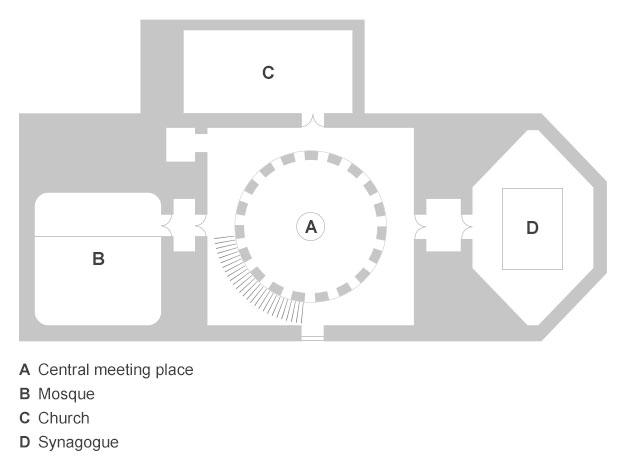
A design has been chosen for the House of One, a project that aims to bring a church, a mosque, and a synagogue under one roof in the heart of Berlin:

Each of the three areas in the House will be the same size, but of a different shape, architect Wilfried Kuehn points out. “Each of the singular spaces is designed according to the religious needs, the particularities of each faith,” he says. “There are for instance two levels in the mosque and the synagogue but there’s only one level in the church. There will be an organ in the church. There are places to wash feet in the mosque.” He and his team of architects researched designs for the three types of worshipping place and found more similarities than expected.

“What’s interesting is that when you go back a long time, they share a lot of architectural typologies. They are not so different,” Kuehn says. “It’s not necessary for instance for a mosque to have a minaret – it’s only a possibility and not a necessity. And a church doesn’t need a tower. This is about going back to the origins when these three faiths were close and shared a lot architecturally”.

Update from a reader:

While never a bad idea, it’s not as new as people seem to think. For example, in Ann Arbor, a Jewish synagogue and an Episcopal church have been sharing space for going on 30 years. Maybe a little easier for two faiths to share the same sanctuary when they have different days of worship, of course, but it’s not a new idea.

Another:

Check out the tri-faith campus in Omaha. It has run into a little bit of controversy that resulted from the anti Muslim people but I know that in the end common sense and good will will win out.

Another Bag-And-Forth, Ctd

Readers pile on Katherine Mangu-Ward for overstating the “yuck factor” for canvas grocery bags:

You know what’s gross? Not washing your reusable bags when you put things into them that leak. You know, like any vaguely hygienic person would do. Note that Reason failed to mention that washing bags essentially eliminates bacteria.

On the other hand, you know what isn’t gross?  Being able to bike down the side of the Anacostia and Potomac Rivers and not see huge accumulations of plastic bags.  Not having random bags blowing down the street in front of my house.  Not having a grocery bag full of other grocery bags that “I swear I’ll reuse these someday” that I then throw away.

Wash your damn reusable bags, people. But use them.

Another agrees – using a GIF:

As to Mangu-Ward’s imaginative anecdote regarding a “leaky package of chicken” – two comments:

1)

tumblr_mltm2fN8DO1qaw9gto4_250

2)

Where does she purchase her incredibly loosely packaged chicken and why wasn’t it placed flat on the bottom of the bag so it doesn’t move around? I’ve never had this leaky meat problem. If I did, I would just throw them in the washing machine.

Another reader lacking a leaky meat problem:

You know what’s gross? Clothes. Think about it: you put pieces of cloth on your body and sweat on them, or get food all over them. Then you take off your clothes, crumple them up, and toss them on the floor in the corner of your closet to fester. A week later, you go wear them again and stick your junk right against the same cloth. Ew.

Oh, what’s that? You can wash clothes? They even have “washing machines” that will wash clothes for you? That’s brilliant. I wonder what else you could wash in a washing machine …

Another dissents:

cartman-hippieI live in Austin, home of hippies who love these bag bans. When these people can’t even wash themselves, how can we expect them to wash the bags? And here in Austin, the bags from the most popular grocery store become useless when you wash them because the cardboard that makes the bag bottoms rigid is destroyed. I see the people in line next to me and they aren’t washing their bags – or their pits.

Update from a subscriber:

love hanging around your readers. They teach me things. But something they just crack me up. It’s like a really good Thanksgiving dinner with relatives you can actually stand and are even proud to be seen with.

The Picture Of Controversy

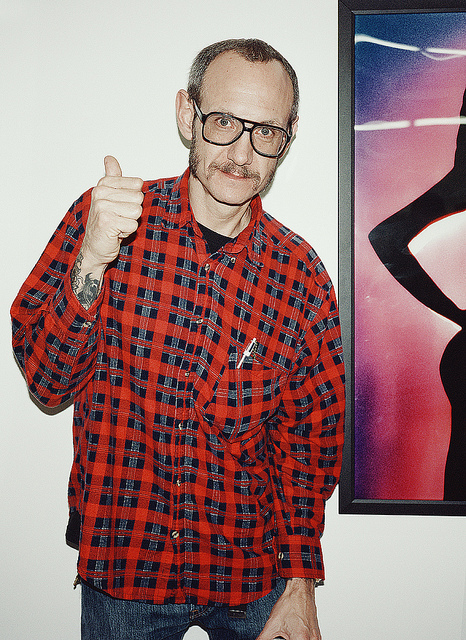
Early into his long profile of Terry Richardson, Benjamin Wallace sums up why the fashion photographer holds “a singular, controversial position” in his field:

He has cultivated a reputation of being a professional debauchee, a proud pervert dish_richardson who has, outside his commercial work, produced a series of extremely explicit images—often including himself naked and erect—that many find pornographic and misogynistic, and which can make viewers distinctly uncomfortable. In recent years, a number of the models in those images have indicated that they, too, weren’t altogether comfortable, filing lawsuits and, increasingly, speaking up in essays and interviews. Richardson has been called “the world’s most fucked up fashion photographer” by the website Jezebel, “fashion’s shameful secret” by the Guardian, and “America’s Next Top Scumbag” by Wonkette. Baron von Luxxury, a Los Angeles DJ, wrote a song called “Terry Richardson” with the lyrics “She’ll have a few more sedatives / I’ll have whatever comes next / And then I’ll burn the negatives.”
Callie Beusman rips Wallace to shreds for “consistently gloss[ing] over Richardson’s sketchy behavior.” Robyn Pennacchia shakes her head in disgust, and Mary Elizabeth Williams is also unsympathetic:

There are, to be fair, references to lawsuits “quietly settled” and some of the more vivid and troubling stories about the photographer, including Charlotte Waters’ account from earlier this year of a session in which “He also straddled me and started jerking off on my face. He told me to keep my eyes open super wide.” But the overwhelming image is of a man who grew up listening to his father banging Anjelica Huston in the next room and struggled with addiction, who now “meditates and attends AA meetings and exercises daily” but still “obviously misses the old Terry.” …

I find it more damning than anything else out there written about him, because it shows a man of deeply arrested maturity, a man who lives in “always the same clothing, always the same pose in front of the camera, always the same sandwich.” I don’t find understanding some of the reasons someone might be selfish and unfeeling toward vulnerable women any excuse at all; I just find it, if anything, more compelling evidence of the credibility of his accusers.

One of those accusers is Anna del Gaizo, who says she is bothered by “the fact that this man, who has announced with his actions that his desires, fantasies, and yes, his raging boner are more important than another human being’s state of mind or consequential distress, continues to be revered, hired, and supported by celebrities, professionals, and publications alike. And that’s really the problem here.” Tom Hawking, who finds Wallace’s profile “startlingly sympathetic,” doesn’t disagree:

The quality of Richardson’s art is beside the point. Throughout history, societies have been notably willing to indulge the whims of those it deems to be worthy artists, from the catankerous to the thoroughly unpleasant to the downright criminal. To an extent, this comes back to the good old question of art/artist separation. But … Richardson’s life and his art are so intertwined that it’s impossible to separate them. …

[W]e return [to] the fact that we’re talking about consent and exploitation, about a man coercing young women into situations they find threatening, and/or to do things they might be reluctant to do, or simply just don’t want to do. Richardson is a grown man in a position of power, and the accusation is that he has exploited this power to, in his own words, become “a powerful guy with his boner, dominating all these girls.” Sure, it’s perversely fascinating to know why this might be. But ultimately, the only really important question is how to stop it.

Related Dish on the conundrum of great art and its perverted purveyors here. Update from a reader:

Everybody acts like the Richardson situation is complicated, like it’s about whether or not its OK to explore sex in a passionate way, or if its OK to make art with strong sexual content. But I don’t think that’s what’s at issue here. It’s a pretty simple question of consent.

Richardson takes work situations and makes them sexual without explaining what’s going to happen upfront. He starts to shift things while the work is in progress, when the models are expected, by the conventions of their industry, to do what Richardson tells them to do. I assume it’s true that at least some women are glad to have an exciting experience, and to get really good photos from him. But it’s indisputably true that many, many other women feel pressured and uncomfortable, and in extreme cases, deeply violated by what he does.

If Richardson would fully disclose to the modeling agencies and models what he’s going to do, it would be ok. If Richardson said to a modeling agency, “Please send over an 18-year-old woman for a shoot, who is ok with my being naked during the shoot, and putting my penis in her mouth,” it would be better. If before the whole thing started, someone sat down with the young woman and said, “OK, this is what’s about to happen, we want to make sure you know about it ahead of time, and we want to be sure you’re ok with it,” then it would be a lot easier to defend.

But that’s not what he does. He takes young women who are desperate to break into the industry, starts doing a traditional shoot, and then transforms the whole thing into a porn shoot without any prior negotiation.

It’s not the sex that’s the problem. It’s ok to make porn movies, because the people who make porn movies all know what they’re doing, and go into the shoots. If someone goes to kink.com to shoot a movie, they know what they’re doing. But if, on the other hand, someone took a job as a lab technician at a pharma company, and found everything getting super freaky on their first day of work, with no prior warning or prior consent, that would be really wrong.

I’m uptight about sex, and I’m not exactly a sex positive person. But the sex life I have had has revolved mostly around BDSM, and consent is what makes BDSM possible. It’s not prudish to insist upon consent; it’s quite the opposite, because when you have clear communication and consent, the universe of what you can do expands enormously. Sexual freedom is predicated on the idea that adults can talk to one another about what they want, and ought to be free to participate or not, depending on how they feel about it. That’s what a sexually free world looks like.

Richardson acts like it’s his raw sensuality that causes all his problems. But there are lots of people making erotic images who manage to handle consent properly. It’s not like he wouldn’t be able to find collaborators in his projects who would be excited to work with him.

(Photo of Terry Richardson by Dave Tada)

The Trophy Wife Myth

A new study undercuts it:

To get to the bottom of the trophy wife myth, relationship inequality researcher Elizabeth McClintock analyzed attractiveness ratings, professions and socioeconomic backgrounds of couples from a nationally representative survey. McClintock combed the data for statistical correlations, looking for hints that successful men pair with attractive women.

She found, however, that attractive women weren’t necessarily pairing with rich guys – they were pairing with attractive guys. Like tends to attract like. The biggest statistical predictors of whether two people would get together were how similar they were in their educational background, race, attractiveness and religious views.

As Claire Hannum notes, a lot of previous research on the subject was flawed in a way that seems pretty obvious in retrospect:

In examining couples, [previous] researchers only looked at the women’s appearance and the men’s status and disregarded data on women’s status or men’s attractiveness. They were so certain they’d find a specific result (in this case, proof of exchange relationships) that the studies were skewed. More problematic to the skewed data is the fact that rich people are more likely to be good-looking, and vice-versa. …

Young women who marry these rich old dudes could easily have just as much status as their husbands, like the correlation between wealth and looks hints toward. By overlooking a full half of the equation and not even studying these ladies’ status level, researchers could have missed the fact that plenty of the supposed “trophy wife” marriages were actually matches rather than exchanges.

Jesse Singal observes, “McClintock’s study touches on some extremely important, fundamental questions about how we deal with gender in the social sciences”:

No one study can conclusively disprove the idea of beauty-status exchange, but this one certainly puts a sizable dent in it, and it offers a rather compelling-seeming reason as to how so many researchers could have come to believe this idea in the first place. …

Eli Finkel, a psychologist at Northwestern who studies relationships but who wasn’t involved in this study, expanded on this point in an email. “Scientists are humans, too, and we can be inadvertently blinded by their beliefs about how the world works,” he said. “The studies that only looked at men’s (but not women’s) income and only looked at women’s (but not men’s) attractiveness were problematic in that way, as was the peer review process that allowed flawed papers like that to be published. Fortunately, cases like that are the exception rather than the rule, and science tends to do a good job of ferretting them out. That’s what McClintock has done here.”

Update from a reader:

Too bad the episode of Tales From The Crypt that you featured didn’t include Danny Elfman’s great funny/scary intro. (It’s no wonder Tim Burton tapped him to do the songs for The Nightmare Before Christmas.) At 40 seconds into it, we get to hear the greatest squeaking door sound effect ever. I always wondered who created it, when, and in what other movies it’s been used. It never fails to make me giggle.

Listen for yourself:

When Orwell Was Propaganda

Nick Romeo recounts the CIA’s efforts to undermine the Soviet Union with literature:

Through a number of front organizations, including Bedford Publishing Company in New York City, the agency successfully purchased, printed, distributed, and even commissioned a number of books with the goal of promoting a “spiritual understanding of Western values.” This included novels by authors as diverse as George Orwell, Albert Camus, Vladimir Nabokov, and James Joyce; and as [Petra] Couvée and [Peter] Finn reveal, one book Bedford commissioned was a false memoir of a Soviet-U.S. double agent. By smuggling books to the Soviet Union in everything from food cans to Tampax boxes, Bedford got as many as one million books to Soviet readers over the course of 15 years. The CIA’s program for the dissemination of literature continued until the fall of the USSR.

Given its literary culture, some CIA staff probably realized the irony of a powerful and well-funded government agency using clandestine methods to distribute novels by George Orwell. The American government was trying to manipulate the culture of the Soviet Union to help Soviet citizens recognize the dangers of a powerful government manipulating their culture. (Unsurprisingly, they didn’t want anyone to know they were involved.)

Update from a reader:

Of course Orwell was a propagandist, working for the BBC during World War II. I have a book titled George Orwell: The War Broadcasts. Good stuff, too.