A Problem You Can’t Scrub Away

Illinois recently became the first state to ban microbeads  those little plastic bits of grit found in some personal hygiene products. Katherine Martinko explains the environmental rationale:

Microbeads give facial and body scrubs a grainy texture for exfoliation, but they are an ecological nightmare. Because they range in size from 0.0004 to 1.24 millimeters, they are too small to be filtered out by water treatment plants. They get flushed into waterways, ending up in lakes where they float, absorb toxins, and get eaten by marine animals because they resemble fish eggs. It takes a freshwater mussel 47 days to flush out ingested microbeads.

Martinko shows how the decision has repercussions far beyond the Land of Lincoln:

Illinois’s ban is important, but one more statewide ban is desperately needed, since that would create a “distribution nightmare” for companies and force them to come up with alternatives. The CBC quoted 5 Gyres associate director Stiv Wilson: “Effectively by winning two states, you win the entire North American region.” New York, Ohio, and California all have anti-microbead legislation in the works.

Meanwhile, researchers are working to develop eco-friendly alternatives to the plastic beads. Alexa Kurzius considers the prospects of polyhydroxyalkanoate (PHA), a “bioplastic” made with fermented bacteria:

[T]he majority of microplastics tend to float, which means they move readily from your shower drain, through wastewater treatment plants, and into waterways. “It’s like the saying from Finding Nemo,” explains [researcher Kirk] Havens. “All drains lead to the ocean.”

PHA, on the other hand, is denser than water, and thus sinks to the bottom. When it sinks, it’s buried with other sediment or consumed by salt or freshwater bacteria. This is an improvement over synthetic microplastics, which are more likely to be eaten by microorganisms that mistake the tiny pellets for food. But if bacteria consume PHA, they break the substance down into water, carbon dioxide, biomass, and naturally occurring small molecules after a few months. These substances are relatively harmless compared to longer-living man-made plastics like polyethylene.

Update from a reader:

Just wanted make a slight correction to the quote you provide from Martinko. Microbeads can be removed by water treatment plants. Coagulation/flocculation removes particles down to 0.01 microns and granulation media filtration removes particles down to 0.5 um. So, microbeads wouldn’t end up in your drinking water.

Wastewater treatment plants, however, do not have the same emphasis on particle removal so, yes, microbeads do end up in receiving water ways.

Have The Cheneys Finally Jumped The Shark?

In a video introducing their new 501(c)4, Dick and Liz provide what will surely be SNL’s opening skit this Saturday:

Update from a reader:

I took a look at the Cheney video on YouTube to read some of the comments. And what did I see? Comments have been disabled. Some things never change.

Their astonishing op-ed – a classic in the annals of non-self-awareness – has even prompted Fox’s Megyn Kelly to balk and Byron York’s jaw to drop. Waldman identifies one of many huge holes in the warmongering op-ed from the father-daughter team:

[T]he Cheneys’ op ed is silent on what they would do differently in Iraq today. The op-ed contains nothing even approaching a specific suggestion for what, other than to say that defeating terrorists “will require a strategy — not a fantasy. It will require sustained difficult military, intelligence and diplomatic efforts — not empty misleading rhetoric. It will require rebuilding America’s military capacity — reversing the Obama policies that have weakened our armed forces and reduced our ability to influence events around the world.”

So to recap: we need a strategy, and though they won’t tell us what that strategy might be, it should involve military, intelligence, and diplomatic efforts, and rebuilding the military. Apart from the absurd claim that the armed forces have been “weakened” (we’re still spending over $600 billion a year on the military even with the war in Iraq behind us and Afghanistan winding down), the Cheneys are about as clear on what we should do now as they were on how invading Iraq was supposed to spread peace and democracy across the Middle East.

They know nothing but the fumes of their own ideology and self-regard. Ed Morrissey comments that the Cheneys “are likely whistling into the wind here”:

There hasn’t been much polling on Iraq, but the PPP poll taken over the weekend shows that the neocon policy is even less popular than Obama’s leadership at the moment. Even with the looming disaster facing Baghdad and by extension American policy, and even with the threat that ISIS represents to the region and eventually to the US directly, only 20% want American troops back in Iraq. The majority want a diplomatic “mobilization” to deal with ISIS, which as I wrote yesterday would look pretty strange, since ISIS is an unapologetic terrorist organization.

Jason Zengerle calls the op-ed an opening for Liz Cheney’s next political campaign:

While Obama is the ostensible target of the Cheneys’ op-ed and new group, their real opponent isn’t Obama but Rand Paul and the school of foreign-policy thinking that Paul represents inside the GOP. Liz finally has the proxy war she’s been waiting for.

Even before Liz abandoned her Senate race, people in Wyoming were speculating that she wouldn’t stay in the statethat, win or lose, her family would move back to the home in the Virginia suburbs that they never bothered to sell. But six months later Liz is still in Wyoming (just witness that gorgeous mountain backdrop on the video she recorded for the Alliance for a Strong America) and it seems likely she’ll make another run for office there at some point. If she does, today will have marked the start of that long campaign.

Maybe she could just get a job at NBC for $600,000 a year. I hear the children of shameless nepotists are doing quite well in this economy. Allahpundit also detects a preemptive strike against the young senator from Kentucky:

Really, why would you even need to attack O on foreign policy at this point? His numbers are already in the toilet; Chuck Todd read his political obituary on the air just this morning. He’s the lamest of lame ducks.

The guy whom hawks are worried about is Paul, who could do a lot of damage to the interventionist cause by succeeding with a more dovish foreign policy agenda in the GOP primary. Remember, too, that the Cheneys have a history with Paul: He eagerly endorsed Enzi after Liz announced her primary challenge and offered to campaign personally for him in Wyoming in the name of squashing a famous hawk with the Cheney name. The Cheneys are going to repay the kindness next year by attacking him as a dangerously irresponsible appeaser who’ll build on Obama’s legacy of failure. That’s where the new group comes in, I think. By rolling it out now against Obama, they’re going to build goodwill among righties. Then they’ll put that goodwill to use next year in hammering Paul.

But Tim Mak points out that Paul has been pretty cagey about where he actually stands on Iraq:

Paul has dropped hints here and there about his Iraq stance. He told the Des Moines Register this month that he didn’t oppose helping arm the Iraqi military and said he “would not rule out air strikes.” In a Senate Foreign Relations Committee hearing last week, he said he was “not very excited about” the prospect of sending military service members back into Iraq. But he stopped short of endorsing military intervention in Iraq or ruling it out, and his on-the-fence position hasn’t been clarified.

Boarding a senators-only elevator Tuesday morning with fellow Republican Sen. John McCain, a hawk well known for his foreign policy views, Paul joked that he should just tell reporters he believes “whatever McCain says.”

Paul is not turning out to be a profile in courage, is he?

Why Aren’t Gay Men On The Pill? Ctd

The New York Times has produced a “Room for Debate” colloquium on Truvada, the daily pill to prevent HIV infection. They lead with the Michael Weinstein, who writes this sentence:

PrEP has failed to protect the majority of men in every clinical trial (study).

He links to an Indian summary of drug trials from 2011. That ignores the data since then:

A key Truvada study found more than 90 percent effectiveness in preventing HIV infection even among those not fully compliant with the one-pill-a-day regimen. Another study showed that “parti­ci­pants could re­duce their risk of HIV by 76 pe­r­cent tak­ing two doses per week, 96 pe­r­cent by tak­ing four doses per week, and 99 pe­r­cent by tak­ing se­ven doses per week.”

That’s a huge majority in all the most recent studies. Then we have Larry Kramer writing the following:

Truvada is a form of chemotherapy, and we have not faced up to the possible side effects that might come.

truvadaChemotherapy? He sounds like someone’s hysterical grandma from a Roz Chast cartoon. It’s one pill a day whose side effects have been documented as minimal for the vast majority and easily monitored for anyone else. You get your bloodwork every three months. The drug has been used in combination for several years and has no resemblance even slightly to chemotherapy in any form. Of course, with any drug, including aspirin, there are side effects. But they pale in comparison to the side-effects of the full anti-HIV cocktail – which is the real life alternative to this simple pill a day.

So where are these people coming from?

If they were deadly serious about reducing HIV infections, why wouldn’t they want every possible means of prevention? Why, in fact, continue to favor an approach that has already demonstrably failed, rather than try a new one that might work? One clue comes from a sentence like this from Weinstein:

What we do know is that this generation didn’t live through the holocaust of the ’80s and ’90s.

As if that’s a bad thing! It doesn’t seem to occur to him that sex without terror is a good thing, in fact, an extraordinarily good thing for a fully realized life. Or that adjusting your behavior when the cost-benefit analysis decisively shifts is a perfectly rational thing to do. The same blindspot is in Larry’s sentence:

There is already a lot of complacency among gay men that makes the lucky uninfected neglect or reject condom use.

Complacency? It doesn’t seem to occur to Larry that it’s not complacency, but rationality at work here. Adjusting your behavior when the cost-benefit analysis decisively shifts is a perfectly rational thing to do. The only people being complacent with HIV are those “mainly” using condoms, hoping for the best when they lapse from time to time, and not taking Truvada. Why would Kramer not support someone attempting to make his own body as immune to HIV as possible – with a safety net as well as protective gear?

What we’re seeing perhaps is the understandable trauma of an older generation cramping the options of a younger one, in a different time, with different – and much less terrible – problems. The obvious drawback is the possibility that fewer condoms means more other STDs. But the check-ups required for continued use of Truvada can be a warning sign for that; and one study has found no probability of such unintended consequences. Maybe they’ll occur and we can adjust. But right now, we have a lethal weapon in the fight to the most lethal STD there is, and we’re unconscionably failing to use it.

The long-running Dish thread on the male pill is here. Update from a reader:

Thanks for continuing to cover Truvada. I’m a 54-year-old gay man, HIV-negative, lived in San Francisco in the early ’80s (and have lived to tell about it). I don’t have unprotected sex (truth be told, I don’t have much sex, period, but that’s another story). But at my last doctor’s visit, I went on Truvada. My doctor was unfamiliar with it (my gay doctor!), but he was happy to prescribe it. He said it seemed “a bit like overkill, but when the alternative is a life-and-death condition, is there such a thing as overkill?” My health insurance covers it, and so far no side effects that I can tell.

My reasons for going on Truvada are mostly emotional (what a spectre of fear relieved!) and political. As part of the political aspect, I’ve begun telling people that I am taking Truvada. The stigma attached to it needs to be removed, and having more people on the drug will enlarge the medical track record as well as, eventually, bringing the price down.

When I told two women friends about it, and the very high prevention rate some tests show, she said, “Why aren’t they putting it in the drinking water?” The other, in response to the idea that if gay men won’t even always wear a condom, how can they be expected to take a pill daily, pointed out that women on birth control seem to handle taking a pill every day.

What Do You Do With A BA In English?

You will actually get hired more than most:

Defying all conventional wisdom and their parents’ warnings, most English majors also secure jobs, and not just at Starbucks. Last week, at the gathering of the Associated Departments of English, it was reported that English majors had 2 percent lower unemployment than the national rate, with an average starting salary of $40,800 and average mid-career salaries of $71,400. According to a 2013–14 study by PayScale.com, English ranks just above business administration as a “major that pays you back.”

But using numbers to dispute the fatalism over humanities is a bit like reading novels to cure consumption – at best it is a distraction before the next coughing fit. Besides, engineers and dentists still earn more than English majors. Rather than citing more statistics, we might ask why humanists keep simultaneously pursuing this field and lamenting its perpetual crisis. The answer is that crisis, which comes from the Greek word for “choice,” is what humanities do best.

Meanwhile, Pascal-Emmanuel Gobry wishes certain political reporters had studied the liberal arts rather than communications:

The expression “liberal education” is quite important. Today, when we think “liberal education”, we think “Would you like fries with that?” But as the common root with the word liberty suggests, liberal education is an education that helps make us free. Only by first understanding not only the empirical scaffolding of our Universe–a.k.a. science–but also its conceptual scaffolding, a.k.a. the ideas, concepts and history which shape the world we live in, can we ever hope to be free, that is to say to be able to make informed, conscious decisions. …

Nobody stops to ask what education is for, because the answer is implicitly accepted by all: an education is for getting a job. It is, in other words, for being a cog in the giant machine of post-industrial capitalism. It is, in other words, for the opposite thing that our forefathers wanted for us.

Update from a reader:

Good grief, can Gobry be any more melodramatic about the need for a liberal education? I don’t dispute the importance of the humanities, but explaining condescendingly why we’re all “less free” for not reading Aristotle is asinine.

I majored in Russian in college, because that massive, eternally tsarist country has, in spite of the odds, turned out some of the greatest literature we have. And besides that, the language and culture are fascinating. Even though I only had the opportunity to spend three months there, my studies and time abroad were formative experiences. They have certainly shaped how I approach the rest of my life, and I continue to foster a love for all things Russian.

Unfortunately, the world can support only so many American Slavophiles, so I also majored in Chemistry. Why? Because I needed to get a job. Yeah, I guess it’s a bummer that I can’t “freely” pursue whatever I want, but we can’t all get paid to mock people for not reading Plato or Max Weber. When I’m not at work, I can spend my time doing whatever I want; but when it comes to making a buck, whether we like it or not, concrete skills that produce tangible goods make money.

Engaging The T, Ctd

photo (3)

A reader revives a recent thread with a fascinating personal story:

If you choose to use any of this, please scrub my name from it.  I am a transgendered woman who has, in fact, committed the unpardonable sin of transitioning and then, largely, being done with the whole thing.  The vast majority of people in my personal life have no idea, and almost no one in my professional life does. Now that’s because I pass very well, which is both a matter of luck and a matter of will. It was luck because I didn’t shoot up to an inconvenient height, nor were my hands or feet inconveniently large, but it was will because I tried to just be an ordinary woman of my generation (born in the late 1960s).

In the last decade or so, I have seen transgender activism take on the idea that gender is “constructed” and that the “medicalization” of being trans is a horrible thing.  It seems short-sighted in the extreme – at least for those of us who have a difference of opinion between our self-image and our secondary sexual characteristics.  I say that because just as Medicare and other providers are finally starting to cover SRS (sex reassignment surgery) and hormone treatments, the activists are trying to make the case that none of that is necessary.   It has taken activists two decades and more to get us to this place, and just as we are starting to see the light at the end of the tunnel, they are trying to not just pull the rope up, but burn it.

Why? Because some transgender people are not able to pass and/or some transgender people have a hard time finding work (whether because of passing issues or unwillingness to conform, even the least bit, with the kinds of behavior necessary to secure a well-paying job).

I agree, mostly, with your assessment that those of us who are minorities may be in the uncomfortable position of having to educate people and answer questions because we may be the first person someone outside our little social category may have had significant interaction with. It isn’t really fair, but better to learn it from someone within the group than to persist in ignorance or, worse yet, to learn it from someone hostile to the group.  I do part company with you on the issue of genitalia, however.  That is a really intrusive question and one that I think is reasonable for me to divulge to anyone I am dating, any medical professional, any mental health professional and to select friends. It isn’t for public consumption, however.

You wrote this:

The transgender desire not to be trans-gender but to be one gender physically and mentally is actually quite an affront to queer theorists for whom all gender and sex are social constructions. Many of these people want testosterone and estrogen and surgery to end their divided selves. And it doesn’t get more crudely biological and not-social than that. Which means that there are also divisions within the trans world between those who might be able to pass completely as another gender, after reassignment surgery, and those whose visual ambiguity or androgyny will remain.

Here is where I really have parted company with what has become of the trans-movement in the last decade or so.  When I transitioned in the early 1990s, the idea was to move through being transgendered and into just being a woman (or a man, for my FTM brothers). Now, it seems the point is to be neither a man nor a woman.  What’s more, well-adjusted and socially successful transgendered people like myself are a profound threat to the activist and academic portions of the movement because we violate the narrative.

As a black transgendered woman, the narrative is that I have found it difficult if not impossible to find work that pays me more than a pittance. What’s more, I am supposed to have spent some time as a prostitute. As a transgendered woman, the narrative is that I am socially shunned and ostracized and only other transgendered people or “allies” will have anything to do with me.

None of that has applied to me, and it has not applied to me in a very visible fashion.  I have not worked with someone who knew I was trans since the mid-nineties, when I told a boss that I was trans because I knew that I was going to need surgery and thus need to take some extended time off. Since my boss at the time was a lesbian, I thought it was a good risk.  To give you an idea of how well I pass, when I told her she was fine, but the next day a couple of my coworkers, who were also gay and whom I had told first to see how our boss would react, said I needed to clarify some things for her.  She actually had thought I was moving in the opposite direction (FTM instead of MTF) and was worried because, as she put it, “I just can’t see a femme like her as a boy”.  We all had a really good laugh about that.

This was while I was working at a large software company in the San Francisco Bay Area. Does that sound like rejection and ostracism? It doesn’t to me, and I didn’t experience it that way. It remains, to this day, one of my favorite memories from the time in my life where transitioning was still something I was doing and not something I had done.

One other thing you get right is that, in fact, from the point of view of the queer theorists and the activists who follow them, wanting hormones and surgery is a profoundly conservative impulse as defined by the theorists and activists.  Like marriage equality it does cede some realities that in a certain (politically) correct light be seen as conservative. In the latter case of marriage equality, it absolute cedes the conservative idea that marriage is a stabilizing force in the lives of individuals and communities. In the former case it concedes the “gender binary,” at least in as much as it doesn’t try to construe being transgendered as a third, fourth or twelfth gender and instead cedes that for the vast majority of people male and female more or less accurately.

One of the results of this has been that transwomen like myself have largely stepped back from the community and do not mentor people newly in transition.  It is not that I don’t want to; it’s that I don’t think I have anything to offer. Rather, it is that what I have to offer puts me at odds with a lot of the trans community – at least that portion of it involved in conceiving “theory”. I am very pragmatic in my approach to transition. Questions I think a trans person needs to ask and find answers to are:

1) Am I going to stay in a field that I started as my birth gender or am I going to find a new career?  (For me, I started young enough that I didn’t have a career, so I got into one because of the need for regular money in sums above and beyond sustenance levels and regular, reliable health insurance coverage)

1a) If the former, what do I do with my work history?

1b) If the latter, what kind of jobs can I find where I will make enough to actually be able to do this?

2) How am I going to broach this subject with my friends and family?

3) How do I do this?

These are no longer questions to ask, according to queer theorists.

I applaud your courage in taking on this topic.  You are going to be flamed for it as sure as there will be men in Speedos at Gay Pride parades in a couple of weekends.

Another reader circles back to the beginning of the thread:

Kevin Williamson’s essay may be over the top in its callousness, but I have to say, I read a lot of lefty sites/news outlets, and the focus on “the T question” sort of takes me aback. Why so much focus for what may be, as you note, as little as 0.1 of the population? Why is this the premier civil rights question of our lifetime, as trans folks might have it?

Worse than this is the impulse, which you address, among trans activists to essentially burn down the existing societal framework due to its inherent oppressiveness and replace it with something new – something that people like myself, a married suburban father who bears no ill will toward the transgendered community – will be required to accept.

For example, the use of the term “cisgendered.” We’re now supposed to use this at all times, you realize; I’m supposed to refer to myself as “cisgendered,” as a rhetorical means of leveling the playing field. The 99 percent or 99.9 percent must now adopt the rhetorical demands of the trans activists lest we reveal ourselves to be utterly hateful.

But you know what? I don’t use the term “cisgendered” and I will not use the term “cisgendered.” I think the term itself and the supposed logic behind it are ridiculous. Do your own thing; live your own life, and I will insist that however you choose to do so, you are accorded the same legal rights and privileges that every other American possesses. But when that’s not good enough – when my refusal to think of myself as “cisgendered” or use the term marks me as a bigot – I’m off the bus.

Update from a reader:

Your reader is claiming that an unknown group of straw trans-men and women are forcing him to use the term “cisgendered” to describe himself. To which I say, what planet do you live on??  “Cisgender” is an academic term adopted by some in the trans community to describe those who do, in fact, associate with the gender of their birth. Why your reader is so incensed that trans folks call him “cisgender” is beyond me. Why he thinks he’s now required to call himself that is a question for the ages. I have seen no movement, even among the most nutjob of activists, to force the term “cisgender” on the American citizenry.

Your reader, in short, is no bigot, but sounds like my parents did in 2006: “We support you, but why do you have to call it marriage?” (I’m thankful to report they were fully on the marriage bandwagon within five years after that.)

(Photo: The bedroom door of a Dish reader’s 15-year-old daughter)

Kurdistan’s Moment?

IRAQ-CONFLICT-KURDS

Koplow insists that Turkey’s best course of action right now is to support an independent state for the Kurds in northern Iraq:

The best way to neutralize ISIS as a threat is to strengthen the KRG, whose peshmerga already took Kirkuk in response to the ISIS takeover of Mosul, and can keep the conflict with ISIS in Iraq rather than having it cross the border into southeastern Turkey. In the past, even considering supporting the KRG as an independent state was not an option, but the circumstances have changed now that it is clear just how weak and ineffectual the Maliki government is. Ankara should be getting in front of this issue, recognizing that even if the Maliki government survives it will be only through the intervention and support of outside powers such as the U.S. and Iran (which is not a phrase I ever envisioned writing) and that the consequences of angering the Maliki government pales in comparison to the consequences of an actual radical jihadi state bordering Turkey.

Furthermore, if Turkey still subscribes to the theory that strengthening Barzani and the KRG sends the message to Turkish Kurds that Kurdistan already exists without them and thus they need to drop any hopes of separation or independence for themselves, then now is the time to test out whether this theory is actually correct.

Throwing our weight behind the Kurds is also on Adam Garfinkle’s list of policy recommendations for the US:

Above all, we should further tighten relations with the Kurds in what used to be northern Iraq but is now an independent state in everything but name.

We probably should try to get on the same sheet of music with the Kurds, offering support but counseling prudence—in other words, collecting some leverage so we can influence the behavior of Barzani et al. in future. Personally, I’m fine with the Kurds in Kirkuk, so long as they occupy and eventually stabilize the city with genuine justice for all of the city’s communities.

By the same token, we should begin private and earnest, if inevitably complex and difficult, talks with the Turks to discuss what conditions, if any, could lead to a mutual and simultaneous recognition of Kurdish independence from Washington and Ankara.

Mohammed A. Salih spells out why the Kurdish Peshmerga are Iraq’s best hope for defeating ISIS:

There are over 100,000 Peshmerga fighters, according to Halgurd Hikmat, a senior official at the Kurdistan Regional Government (KRG)’s Ministry of Peshmerga. They are either veterans of the Kurdish struggle against Saddam’s regime or new recruits who have to go through an intensive training that lasts around 50 days. While they are officially under the command of Iraqi Kurdistan’s president, Masoud Barzani, in practice they answer to leaders aligned with the competing Kurdish political factions, the Barzani-led Kurdistan Democratic Party and the Patriotic Union of Kurdistan, led by Iraqi President Jalal Talabani. But when it comes to protecting Kurdish territory, those divisions are meaningless. Nearly 40,000 of the Peshmerga forces divided into 16 battalions are united under the KRG’s Peshmerga Ministry. The rest have yet to be unified.  All Peshmerga are now mobilized in the fight against ISIS.

Update from a reader:

I’m an American doctor who has visited Iraqi Kurdistan several times since 2006. One of our projects was the first medical paper looking at the long-term psychological impact of the chemical weapons attacks launched by the Iraqi government on Kurdish civilians in Halabja. The argument we are having in America about who “lost” Iraq completely misses the point, because in truth there never has been one Iraq to lose. The American elite’s obsession with a multiethnic Iraq is something that’s not shared by any of the people who actually live in that country.

For Kurds the whole concept is ridiculous. They survived an attempted genocide at the hand of Sunni Arabs just 25 years ago. For the past decade they have cooperated with the American unity policy in Iraq, only to become targets of Al Qaeda inspired bombings, kidnappings, and ritual beheadings. Now they find themselves in the surreal position of having to protect thousands of these same good neighbors from their own home grown terrorist movement. If you were a Kurd, what would you think of a State Department hack telling you that you lack sufficient commitment to Iraq’s unity?

Kurds are right to reject any self-serving advise coming from the American government to cooperate with Maliki. A more creative American policy would acknowledge the reality of what the Kurds have built, which is a prosperous and peaceful nation state in the mountains of Northern Iraq. It’s a nation whose soldiers and diplomats worked amicably alongside Americans through all the darkest episodes of the Iraq wars. It’s a nation where not a single American soldier died during ten years of bloody military involvement in Iraq.

An ally that we don’t have to constantly sustain with billions of dollars of bribes would be a refreshing turn in our Middle East policy. We should embrace that opportunity.

Previous Dish on the Kurds here and here, and on Turkey’s Iraq policy here.

(Photo: Iraqi Kurdish Peshmerga fighters stand to attention in the grounds of their camp in Arbil, the capital of the autonomous Kurdish region of northern Iraq on June 14, 2014. By Safin Hamed/AFP/Getty Images)

Ask Me Anything: Ready For Hillary?

You asked, I answered:

My “Ask Anything” answers from previous years are here.

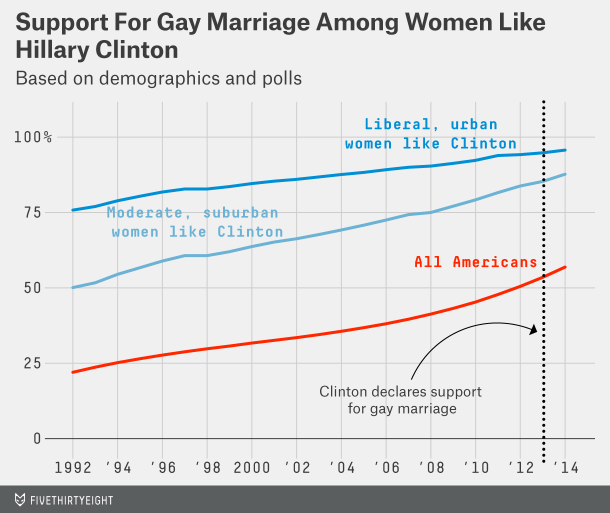
On the latest proof that a Clinton doesn’t really change, Hillary’s inability to own her own anti-gay past, apologize, explain and move forward is still dogging her proto-campaign. As Nate Silver notes, Clinton’s support “on moral and religious grounds” for banning marriage equality for gay couples might have been politically expedient, but it was out of sync with the demographic Clinton is in:

silver-datalab-clintonssm-11

So when women in Clinton’s demographic were roughly between 60 percent and 80 percent likely to back marriage equality (1996), Clinton was backing the Defense of Marriage Act. Or to put it another way, Clinton fits into the ten-to-fifteen percent in her demographic most hostile to marriage equality over time. She can’t really win, of course. But the idea that she has ever risked an iota of her own power to back the equality of gays and lesbians is preposterous. That some gays still regard her as a savior says a lot more about their own delusions and diva-fantasies than anything approaching reality.

Update from a reader:

Not EVERYONE is waiting for you to have an epiphany about Hillary Clinton. As far as I’m concerned, you can wait as long as you like. The really upsetting thing to me is how her presence appears to be depressing any other Democrat from considering a presidential run. Are we not to be presented with any other options? Is it only to be Hillary or nothing? Can it really be that the fractious Democratic Party, which often yields eight or more candidates in a primary, will simple roll over and die for another Clinton? It makes me want to lie down …

A Big Wynne For Equality

A reader relays the great news from up north:

As you may now be aware, Kathleen Wynne was just elected premier of Ontario, Canada’s largest province (representing over 40% of the national population). That makes her the first woman to lead Ontario, and the first openly gay politician to lead a provincial government in Canada.  This is despite winning the leadership of a tired and scandal-ridden Liberal Party only 18 months ago (the Liberals had been in power since 2003), AND where the previous premier, Dalton McGuinty, had resigned in disgrace.

Premier Wynne’s sexual orientation NEVER came up during the campaign, and her wife Jane was with her every step of the campaign trail (including on the victory stage last night).  No one predicted the size of her victory, and the pundits were falling all over themselves last night describing her “authenticity” and “immense charm,” and referring to her as “everyone’s favourite aunt.”  Yesterday I voted for our openly gay transportation minister (Glen Murray, the former Mayor of Winnipeg) who represents the riding of Toronto Centre, and our first directly elected lesbian premier.  I am old enough (47) to remember when marching in the Toronto Pride parade was a little bit dangerous.

I believe Ontario (pop. 14 million) is now the largest jurisdiction in the Western world to have an openly gay leader, after Belgium (pop 11 million) and Iceland (pop 350,000).  Know hope!

Update from a reader:

Regarding this: “I believe Ontario (pop. 14 million) is now the largest jurisdiction in the Western world to have an openly gay leader, after Belgium (pop 11 million) and Iceland (pop 350,000).” Annise Parker, mayor of Houston (pop 2.161 million) is way ahead of the leader of Iceland.

Previous Dish on Parker here.

Fairy Tales Can’t Come True

So Richard Dawkins would rather do without them:

Speaking at the Cheltenham Science Festival, Dawkins, a prominent atheist, said that it was ‘pernicious’ to teach children about facts that were ‘statistically improbable’ such as a frog turning into a prince. … Speaking about his early childhood he said: “Is it a good thing to go along with the fantasies of childhood, magical as they are? Or should we be fostering a spirit of skepticism?” “I think it’s rather pernicious to inculcate into a child a view of the world which includes supernaturalism – we get enough of that anyway,” the 73-year-old said. “Even fairy tales, the ones we all love, with wizards or princesses turning into frogs or whatever it was. There’s a very interesting reason why a prince could not turn into a frog – it’s statistically too improbable.”

Nothing but Zola for the kiddies, then? Gracy Olmstead ripostes:

[T]his is the argument for fairy tales that I don’t think you’ll like – because the more you appreciate the pattern and beauty, the magic and charm of the empirical world, the less likely you are to chalk such things up to statistical probabilities. When you see the wonder of nature and people, the potency of words, the luminosity of our world, it’s very hard to return to a merely statistical, empirical vision. Things do become enchanted and mysterious. We begin to consider visions and miracles. These things are very dangerous, so I can understand why you’re alarmed by them.

Perhaps you’re right – perhaps it’s better for us to just abandon the tales and fantasies. After all, the more we dabble in “creating worlds,” the more likely we are to consider whether our own world had a Creator. The more we construct and tell stories, the more likely we are to ponder the possibility of our own Storyteller.

Update from a reader:

On one hand, I’m amenable to what Dawkins is saying. But the death of the fairy tale is the death of science. The actual practice of being a scientist who advances knowledge demands a kind of imagination, creativity, and questing that can’t be contained in a regression equation. The tools we use to prove hypotheses are profound in their own right, but inculcating a sense of magical possibility and hidden reality in children is the first necessary condition in preparing them to make the next generation of rigorously tested leaps forward.