Robo-Truckers

Computer-assisted trucking is coming soon:

Like Olympic skiers racing in single file to reduce air resistance, two 18-wheeler trucks in Nevada recently proved that uncomfortably close convoys can save drivers fuel and money.

The key, instead of bold Olympic athleticism, is robotic assistance. A computer-assisted truck was able to follow closely behind a human-driven truck perfectly, maintaining exactly 33 feet of distance between the vehicles. The promise is a future of safer, more fuel efficient, and more robotic trucking.

While Nevada is a friendly state for driverless cars, the system tested is only partially automated, with a driver in the computer-assisted truck still responsible for steering. In a way, that makes this a very, very advanced cruise control. The technology, developed by Peloton Tech, uses radar and a wireless link so that the following trucks travel at the same speed, braking simultaneously for safety, and doing so on an automated system that doesn’t have the delays of human reaction time. In addition, the drivers of both vehicles also have a video display, expanding both drivers’ vision and reducing blind spots.

Besides safety, the major selling point of this system is that the reduced drag saves fuel costs. Peloton says the “technology saves more than 7% [of fuel] at 65mph – 10% for the rear truck and 4.5% for the lead truck,” which is tremendous because “Long-haul fleets spend 40% of operating expenses on fuel, accounting collectively for over 10% of U.S. oil use and related carbon emissions.” These savings come primarily from reduced aerodynamic drag.

Joseph Stromberg determines that the “factors that block a broad rollout of self-driving trucks fall mainly into two categories”:

One is safety. People are understandably concerned about the idea of computers driving cars around on the roads, and those worries are amplified for tractor-trailers that can weigh up to 80,000 pounds when fully loaded. But experts actually predict that automated systems will make trucking safer, by eliminating distracted driving and human error. And Google’s driverless cars, at least, have now gone more than 700,000 miles without an accident. …

The other problem is legal. Right now, just a few states (including California, Nevada, and Florida) have laws on the books regarding driverless cars, and their legal status as a whole is murky. For driverless trucking on Interstates to be practical, all states would need to explicitly allow these vehicles on public roads. Advocates are hopeful that national legislation will solve this problem. It’s all very uncertain, but in 2012, Google’s Sergey Brin predicted the Department of Transportation would begin regulating autonomous vehicles nationally as early as 2017.

Update from a reader: “You CANNOT reference computer-assisted trucking and not include this video of Jean Claude Van Damme doing the splits between two Volvos!”:

Bringing Some Diversity To A Galaxy Far, Far Away

Lupita Nyong’o (12 Years a Slave Oscar winner) and Gwendoline Christie (Brienne of Tarth in Game of Thrones) have been cast in the next Star Wars movie:

That’s hardly gender parity — with Carrie Fisher and newcomer Daisy Ridley the only other females currently announced — but it’s certainly a substantial and necessary improvement for a traditionally boys-heavy franchise entering the post Hunger Games universe. Thus far, the only significant female Star Wars characters in six episodes have been a princess and a queen — but Abrams has a solid reputation for strong, well-drawn female characters, from Felicity to Alias to Fringe. 

Alyssa is thrilled:

Beyond the simple joy of getting to see Nyong’o and Christie together on the big screen, there is also something exciting about the fact that these particular actresses are taking their first steps into this particular world.

Because Nyong’o made her international reputation in a socially significant historical drama, she easily could have been stuck there, relegated to playing characters whose experience of abuse is their most salient characteristic. That she is joining “Star Wars” instead, and has optioned Chimamanda Ngozi Adichie’s novel “Americanah,” a contemporary story about Nigerian immigrants who return home, suggests that Nyong’o will not let herself be limited to stories about the American past. Instead, she will stake out territory for herself that stretches from a galaxy far, far away to a part of the present with which many American audiences are unfamiliar.

This makes Nyong’o the first black woman to appear in a Star Wars film, while the entire franchise has only featured two black characters (Lando Calrissian and Mace Windu). Alex Abad-Santos notes why there’s no excuse for this:

There aren’t any rules or constrictions about race or gender in galaxies far, far away. And at the heart of it, Star Wars revolves around an allegory about an outsider.

Other sci-fi/fantasy/superhero franchises have traditionally challenged the way we’ve thought about and perceived race. Perhaps there’s no better example than Star Wars’s rival franchise: Star Trek. Characters like Uhura (Nichelle Nichols) and Sulu (George Takei) contributed to a vision of the future in which positions of power aren’t solely held by whites. Star Wars, on the other hand, has more ewoks with speaking roles in Return of the Jedi than it does black characters with speaking roles in the entire franchise.

Update from a reader:

You’ll probably get a deluge of emails from Star Wars geeks, but I hope I’m not halfway down the pile.  There is at least one other black character in Star Wars: Quarsh Panaka, from Episode 1. He was Padme Amidala’s head of security. He’s a minor, supporting character, but he does have a speaking role.

Another:

Lupita Nyong’o won’t be “the first black woman to appear in a Star Wars film.” That honor goes to Femi Taylor, who portrayed the green-skinned Oola in Return of the Jedi. An understandable mistake!

Who Needs A “Guardian Angel”?

First there was anti-rape underwear. Now this:

One push of a secret button on this necklace gives women an instant escape from awkward situations: The jewelry automatically triggers a call to a woman’s cell phone, so she has a convenient excuse to walk away from unwanted attention at the bar or a bus stop. If things change from annoying to dangerous, holding down the button sends an emergency message to a friend with the victim’s exact GPS coordinates.

The Guardian Angel technology was designed by ad agency JWT Singapore, who were originally asked to create an educational campaign about date rape, but decided to go further than the usual series of ads and try to solve the problem more directly.

Adi Robertson believes the pendant “symbolizes some of our worst ideas about women and sexual assault”:

I understand the reasoning. If you want people to use something, you should make it look like it will seamlessly integrate into, then improve, the rest of their life. I want a smartwatch to feel like a more useful version of what’s on my wrist now. I want checking a fitness tracker to feel like a natural part of my routine. But this reasoning is fundamentally, grossly, offensively unsuited to rape prevention. You are asking civilian women to wear body armor or an emergency alert system in order to go to a bar, restaurant, or party. If this is the place we are at – and we are, it seems, still at that place — then that is not something to be streamlined and minimized. It is something to be deeply concerned about.

And that’s what’s wrong with the Guardian Angel’s gauzy, stereotypical femininity: it ends up normalizing rape as an unremarkable, if unfortunate, part of the female experience. The soothing language – making women “feel less vulnerable” so they can “live their lives to the fullest” – smacks of the vagaries in tampon commercials. It’s something everyone knows about but nobody wants to hear about, and certainly nothing that we want to acknowledge is a shamefully common plague in our schools, our prisons, our armed forces, and almost every other social institution.

Update from a reader:

Guardian Angel seems like a failure on all fronts. It’s not actually pretty or subtle. It’s casually offensive. It doesn’t call 911 or some other protective service. How dense do the creators have to have been to think that rapes are happening because women don’t have a polite excuse to leave? Stranger rapists will likely be undeterred by a phone call. Maybe it’s a closer call with date rape, but it seems unlikely to be useful in a situation where any party is drunk beyond reason or where physical force is being used.

At best, it seems like Guardian Angel usefully transmits your GPS location to use as evidence when your abduction is reported to the police. Which raises the question: Is this something advertisers actually don’t expect women to buy for themselves but want parents to buy for their teenage daughters? Presumably the device can be set up to call any phone and not just your own cell phone. The message is certainly much more consistent with a parent’s fear than women’s empowerment. Because really, what woman is looking is to buy ugly -jewelry-Life Alert but without the emergency services?

Another has a different view:

I think Adi Robertson is a) over reacting and b) not aware of other products on the market that perform a similar function.  This thing is mostly going to be used exactly as it says in the blurb: to ring your phone giving you a convenient way to get out of an uncomfortable situation.  Haven’t most of us pretended to be on a call just to avoid talking to someone we didn’t care for?  Haven’t we even pretended our phones vibrated, signalling an incoming call?

This simply creates an actual ring the other person can hear.  It makes a commonly used (by men and women) dodge a bit more believable.  As to being able to use it to call for help, well, that’s one reason we carry phones in the first place, isn’t it?  To be able to notify someone in case of an emergency.  Why is moving that from your phone to around your neck a huge step in ” normalizing rape”.

Finally, there is at least one product on the market right now, the 5Star Responder, which offers a similar level of protection.  While large numbers of their customers are elderly, they promote their product as “peace of mind” for everyone from children coming home to an empty house to women walking to their cars in an empty parking lot.  I can’t find it now, but in the original marketing material they specifically suggested women call and talk to a representative while walking to their cars after dark.

How women or anyone taking actions to make themselves feel safer can be viewed as a negative is beyond me.

Over The Hill

A reader gives Jonah Hill some credit:

You labeled this as “slur and apology,” but I do not see an apology here. And that’s a good thing, because what I see is something much better. Apologies have become so ubiquitous and meaningless these days, often extorted by interest groups and those seeking to benefit from phony outrage. Exactly to whom should he apologize? To whom does he “owe” an apology? The cameraman seeking the exact reaction he elicited? Others who are not involved but have inserted themselves into the story with self-righteous outrage?

What Hill said was so much better than any empty, extorted apology: it was a genuine recognition of reality and a sincere personal reaction to it. Hill owned his comments and didn’t grovel nor seek forgiveness; rather, he simply expressed that he said something that he felt bad about saying. To me, this was the perfect response. Hill owes nobody anything, and “apologies” forced under the threat of some other consequences are hardly apologies. I would much rather see someone express sincere personal reflection and disappointment.

Contrast that with Alec Baldwin’s lame apology to George Stark. Another reader suggests that the reflexive use of “faggot” or even “gay” as a slur is falling by the wayside with the current generation of kids:

As someone who basically grew up in Jonah Hill’s generation, I regrettably understand where his outburst originates. We all did it constantly in middle school and high school. “Faggot” was just the go-to insult, and “cocksucker” wasn’t far behind. But it was generational, and as offensive as their meanings, I never put connotation on them with being anti-gay.

I’m gay. And I called people this all the time, not because I had any anti-get animosity or self-hate, because I don’t, but because … it just was. I’ve had tons of friends – college and post-college – get into a fight and call someone a faggot and stop to turn to me and apologize to me. It was just a word. I think it speaks more to the percentages of millennials who support gay rights than those who learned an offensive word and fall back on it sometimes.

Update from a reader:

It’s probably worth linking to Hill’s apology on Jimmy Fallon last night. This doesn’t seem to be the scripted “I’m sorry if I offended” schtick his publicist gave him, but I’ll let folks judge for themselves.

The Scourge Of Women Laughing Alone With Salads, Ctd

A reader quotes Clive Thompson:

If everyone reading this article posted their best snapshots online, we could seed hundreds of thousands of free pictures of real things and real people in the real world. The true cure for stock photography is inside your camera phone.

This theory would imply that the reason stock photography is so cliche is because photographers aren’t supplying the right photos. The problem is that advertisers are saladlooking for cliche photos. They are looking for diverse people who look happy, authoritative, or whatever other image the advertiser is trying to convey. Photographers are just supplying what advertisers want.

Even if that weren’t the case, it’s not as simple as posting your photos on Flickr and setting the license. If the photo is for commercial use, as most stock photos are, then you have to have model releases from everybody in the photo. If you don’t, then whoever uses your photos would put themselves at risk for a lawsuit from the people in the photo.

Finally, this whole concept is hugely denigrating to photographers. It takes a tremendous amount of skill to create the kind of photos you see in stock art. A random person with their phone isn’t going to be able to produce similar quality work. It would be like saying that the solution to a broken news media is for everybody to post their independent journalism on Facebook (for free naturally).

Update from another reader:

Did Clive Thompson get paid for his rant about stock photos?

If so, then I have to wonder why he’s so willing to give away photos but not give away words. He completely avoids the ethical issues raised by his suggestion.

The reason stock photos are horrible and also ubiquitous is that people just don’t want to pay photographers, and some photographers have been reduced to playing a numbers game by generating endless generic photos. It reduces photography to a numbers game and is the equivalent of being paid by the click. (I realize some places have to deal with agencies, as the Dish does, but you aren’t posting the genuinely meaningless stock photos that are common elsewhere.) I worked with photographers for years, and I think firing photographers so we can look at stupid stock photos or amateur photos from Flickr was cheap and disrespectful, and suggesting that the unpleasant outcome of devaluing their work is somehow improved by using more free work from amateurs is even more insulting. True, there are many excellent amateur photographers, but there are many excellent amateurs pursuing many artistic hobbies. Thompson says that waiting for new-and-improved-stock photos by the pros will take too long, but that’s only because so many professionals have been dumped. Hire them back.

(Photo: A non-stock image from WLAWS)

Should Washington Rank Colleges? Ctd

Several readers sound off:

From inside higher ed (at the community college level), there are several problems with college rankings. First, everyone already knows which is better than what. Four-year research institutions (Duke, Stanford) are better than four-year liberal arts schools, which are equal to or better than four-year state schools, which are better than two-year schools. Our school charges $100 a credit; Temple University charges roughly $800 a credit. Why? Because they can and we can’t. I highly doubt our school costing one-eighth the per year total will rank in the government rankings as “a better buy” than Temple or Drexel, much less the University of Pennsylvania.

Second, public tax support has collapsed over the last 40 years.

Technically (as in legally and constitutionally from the founding of the college), the state and the county are supposed to provide 66 percent of our operating budget, with the school providing the rest. Currently, public funds provide less than half that. Consequently, salaries and benefits have stagnated, forcing the school to rely more on adjuncts and forcing the young and the talented to look elsewhere. Tuition has gone up, shutting out the poorest students from public education.

If the federal government is going to rate us, what about forcing the states and counties to adhere to their obligations? How well can we do with one-third of the support we’ve been promised?

Also, be aware that 80 percent of our students come out of high school without the ability to read, write, or do math at grade level. Our Reading 1 is a third-grade reading level and has 15 percent of our students. Math 1 is basic fourth grade arithmetic – 20 percent of our students are in that. We have high numbers of poor students, immigrant students, and first-generation students, and increasing numbers of special education students, all of whom are expensive to educate and many of whom would not even have been in college 40 years ago when public funding was comparatively greater. Will all of that figure in?

The third factor is that politics and money go hand in hand. Is anyone seriously thinking Harvard won’t get an A? Princeton won’t be tops in everything? Is anyone really going to say Stanford or Duke should be $10K a year? Is anyone going to force the states to fully finance their obligations? The crisis in public pensions suggests not. And even if the whiff of possibility arose – especially for highly financed politically active “for profit” charters/colleges – we have the Indiana example of changing grades to help donors. So who is it really helping? What’s the play?

Another reader:

I understand that there are predatory administrators, that there are colleges offering terrible returns on investment, and that the whole system suffers from structural inequality. These are real concerns, especially for those in the worst situations. But rarely does the conversation turn to what education is supposed to achieve, or what its goals might actually be. Despite the great hubbub about educational reform, about new techniques of education, about technology in the classroom, the underlying thought remains the same: education is what we do in order to get money.

It beggars the modern imagination to think that someone might offer up some (or even all) of their material well-being in order to get an education which does not immediately result in more material well-being. A person considering getting a liberal education, particularly in a field without firm practical applications, is considered slightly daft – or is granted a pardon on account of already being rich. But this underscores the problem. Liberal education has become a luxury of the rich, rather than a prerequisite for free people living in a free society.

I don’t have a policy recommendation or a favored author (save maybe Plato) to tout. This problem is as large as the world and as complicated as people themselves. But I do think, before we start enumerating the virtues of our colleges and, thereby, driving a stake through the heart of “impractical” liberal education, that we should stop to consider what we hold highest.

Another’s two cents:

I’m an engineering professor. I have indeed seen colleges do unwise things with funds. I am a little bit concerned, though, about university ranking systems because they can drive unintended consequences. The proliferation of fancy sports facilities, for example, was in some measure a response to the US News rankings. Universities compete for students. Those that are highly ranked get more and better students, and they can justify higher tuition. If state support is going to disappear (as it pretty much has already in some states), we have to expect universities to market themselves and rankings to drive the marketing. I cannot predict how exactly, but I know this will not end well.

Update from a reader:

In regards to the person who seemingly works at the Community College of Philadelphia, where he/she commented that they charge $100 a credit whereas Temple University charges $800, simply because Temple can.  C’mon, that’s an apples and oranges comparison. Temple is a university that can bestow graduate and doctoral degrees, is a world-class research center, has or at least had some of the top schools in the country for communications, education, art, has a medical center graduating nurses, NPs, PAs, doctors, and dentist. A law school that is ranked #2 for trial advocacy and #11 for international law. Provides on campus housing for 12,000 students, is the force behind the revitalization of North Philadelphia (it can be debated how much the local community benefits but it is vastly improving). As with other major institutions of learning it also provides for a whole range of extracurricular activities from sports programs to a radio station.

I’m not knocking CCs; a lot of student wisely choose them to knock out their core requirements at a lower cost. I doubt there is any noticeable difference between what you can learn from History 101 at Temple or at CCP. But TU (and other major institutions) charge that rate because they offer more than just History 101, they provide access to many more courses than one could get at a CC, access  to top rate research centers, professors, in the case of TU campuses in Japan and Europe, to some extent connections (TU has over 250,000 alumni), sporting events, concerts, the social life, etc. etc.

Is it overpriced and is that price set simply to cover the cost of education? I don’t know. I do think universities have bloated their administrative staffs to unprecedented levels and that payroll expense is passed on to the student base. Probably more so at the Ivies than anywhere else, you’re paying to have that name and the connections and opportunities it provides on your resume. I think you can make the argument that there’s not much of a difference, scholastically, between a Princeton and TU, but to imply that a CC and a University are on the same level except for the course fees is a bit ridiculous.

(And full disclosure, yes, I am a TU grad, as is my wife and all 3 of her siblings. But I’m not arguing specifically for TU, you could replace the schools with University of RI and RICC and the argument stands.)


Debunking Of The Day

The phrase “rule of thumb” doesn’t have the origins you think it has:

Update from a reader:

As a professional researcher in the legal field, I enjoyed that video greatly. However, I am terrified of sharing it with my friends for fear of being pilloried as a misogynist. When I tried to suggest, while in no way condoning his vicious rants, that Elliot Rodger’s actions were more those of a mentally ill person than a “natural result” of widespread hatred of women, my suggestion was so quickly and roundly dismissed in light of his “obvious” motives that I decided to politely bow out of further discussion. It seems that much of twenty-first century feminism has taken on many elements of religious fundamentalism, in this case using patriarchy and misogyny as its original sin. And like Islamic and Christian fundamentalists, the most faithful interpret the world through their central ideology and will not engage in any discussion that might hold it as less than absolute truth.

The Scourge Of Women Laughing Alone With Salads

170088502

Clive Thompson wants an end to stock photography:

Let me be blunt: Stock photography needs to die. In his 1946 essay “Politics and the English Language,” George Orwell argued that clichéd language produces clichéd thinking. Using a stale image, as he’d put it, “makes it easier for us to have foolish thoughts.” Stock photography imprisons us in the same cognitive jail. Its intentionally bland images are designed to be usable in many vaguely defined situations. This produces wretched photography for the same reason Hallmark cards produce wretched poetry. We live in a visual world, communicating and thinking in pictures. When we use stock photos, we think in clichés.

His solution:

You take pictures every day, many of which I’ll bet are superb. Several photo-sharing sites let you slap on a Creative Commons license, allowing others to use your pics. (A bunch of my own pictures are on Flickr.) If everyone reading this article posted their best snapshots online, we could seed hundreds of thousands of free pictures of real things and real people in the real world. The true cure for stock photography is inside your camera phone.

(Photo: “Smiling young girl eating salad for breakfast.” By Kristian Sekulic/Vetta. More such images can be seen on this classic tumblr. Update from a reader: “How can you mention ‘Women Laughing Alone With Salad’ without also mentioning ‘Women Struggling to Drink Water‘?…”)

Gauguin’s Tahitian Eden

In a review of MoMa’s Gauguin exhibit, Daniel Goodman contemplates the painter’s religious influences:

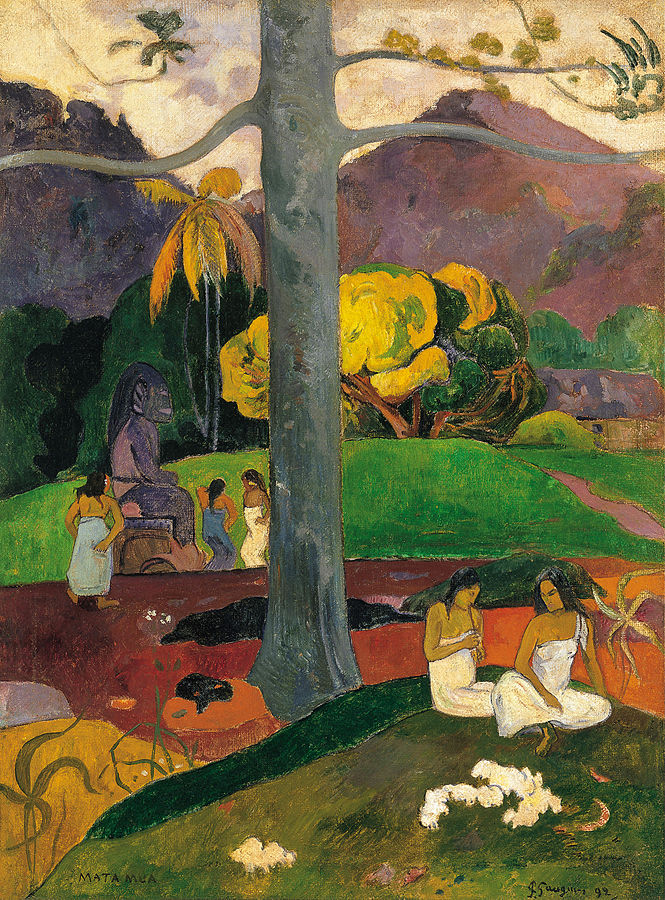
In Mata Mua, Tahitian women dance, play instruments, and worship a statue of Hina, the Tahitian moon goddess. The women frolic in a lush, idyllic landscape dish_matamua in the foreground, while purple mountains protruding out of an off-white sky loom over them in the background, and a large cross-shaped bluish-gray tree (the Tree of Life in this Tahitian Eden?) centers the canvas. What may be most interesting about Mata Mua is that, even though the Polynesian religious ritual is the central subject matter, Gauguin limits the scene to the left corner of the painting and places the cross-shaped tree squarely in the center, subtly reminding us of Gauguin’s abiding interest in Christianity.

In fact, despite his fascination with Polynesian religion, and his dissatisfaction with Roman Catholic doctrine and institutional religion, Gauguin remained interested in Christianity and the Bible. … Of course, Gauguin experienced his own paradise lost when he arrived in Tahiti and discovered that it was not the unspoiled paradise of his imagination. Many of his paintings depict not what he actually saw but what he had wanted to see. Mata Mua is Gauguin’s vision of paradise. He created the pristine world he wanted to experience, rather than the fallen one he had to experience. It’s a “romantic, idealized, but ultimately false” vision of Tahiti, say the MoMA curators; but though Gauguin’s vision of Tahiti was objectively false, it was entirely true in the realm of Gauguin’s imagination. And from the perspective of artistic surrealism, nothing could have been truer than Gauguin’s Tahitian Eden.

Update from a reader:

Left unmentioned in the discussion of Gauguin’s, “Tahitian Eden,” is his well-documented pursuit and abuse of underage Polynesian girls.

During a brief stay on Hiva Oa (I was trapped there for two weeks in 2003 after quite literally jumping ship), it is common knowledge that the nuns in charge of the local girls school were forced to take drastic measures to keep the artist (who is buried on the island) away from the children. Alas, Gauguin eventually ‘married’ three of the local girls, all between the age of 13 and 14.

Gauguin was (and is) widely recognized as a pederast and sexual libertine. Frankly, I find Goodman’s reflection on the, “pristine world he wanted to experience, rather than the fallen one he had to experience,” to be sad and hysterical in its wrongness.

Another also doesn’t see paradise:

I’m neither an art historian nor an art critic, so if an expert says the Gauguin painting is supposed to be idyllic or some kind of Eden, then I’m inclined to try to see what they mean.  But I have to say that I laughed out loud when I looked at the paintings and then read the Gauguin interpretations.  When I see the painting, I definitely do not see a happy place, much less an Eden.  That painting is creepy.  What’s with all the dark and muddy colors? To me, people think it’s a kind of Eden because you look at the women in white right away.  But look around them and at everything else.  What’s with the dude walking toward the two women dancing by the statue?  Does he have his hand behind his back?  Is he carrying a knife?  Maybe that’s why the tree is sorta shaped like a crucifix, the Christian symbol of sacrifice.  The creepy vines curl near the women in white.  What exactly is surrounding them?  The woods in the background are also ominously dark  and the bright yellow tree in the background gets less so one the left side of the tree, almost like it’s curling around the tree to look.  I look at this painting and think, this is a place of terror.

(Image: Mata Mua by Pual Gauguin, 1892, via Wikimedia Commons)

Shinseki’s Other Shoe Drops

The findings of the newly released inspector general’s report are pretty grim:

Some 1,700 veterans waiting for an appointment at Veteran Affairs clinics across Phoenix, Ariz. were nowhere to be found in the system’s official wait list, federal investigators reported on Wednesday. Investigators for the Veteran Affairs Office of Inspector General said they had found initial evidence of “inappropriate scheduling practices” in the Phoenix Health Care System, which had led to “significant delays in access to care.”

Although data reported by Phoenix authorities suggested a statistical sample of 226 veterans waited an average of 24 days for their first primary care appointment, the review found that those 226 veterans actually waited on average 115 days to receive a primary care appointment. Only 16 percent got an appointment in 14 days or less, according to the interim report.

Shinseki’s days appear to be numbered:

Increased calls for political action came swiftly in the report’s wake and focused on VA Secretary Shinseki.

“I haven’t said this before, but I think it’s time for Gen. Shinseki to move on,” Sen. John McCain said in an appearence on CNN Wednesday. Rep. Jeff Miller, chairman of the House Veterans’ Affairs Committee, responded to the report with a statement that said Shinseki should “resign immediately.” … In addition to Miller, four other lawmakers also called on Shinseki to resign after the report was released, adding to the more than 50 members of Congress who have called for him to step down since the scandal broke last month. At least two new Democratic senators joined the chorus Wednesday, suggesting that more members of the president’s party are turning against his appointee in the wake of the OIG’s findings.

But Mataconis points out that removing Shinseki won’t solve the VA’s problems:

In the end, of course, the problems at the Department go far deeper than Eric Shinseki. In many cases, they predate him and to a large degree they involve the actions or failures to act of people under him over which he does not have direct supervisory control. Getting rid of the Secretary of Veterans Affairs isn’t going to solve the problems at the VA unless it is also accompanied by the removal of the people further down the chain responsible for these decisions. There also needs to be examination of the bizarre incentive structure that led to the creation of secret waiting lists that made it appears as though hospitals were doing a better job of addressing veteran’s health needs than they actually were. And, a reassessment of the idea that the VA should be the source of all the health care that veterans receive. … In other words, what’s needed is a transformation of the VA from the bottom up, not just the removal of the guy at the top.

Alesh Houdek argues that the real scandal here is in how long it took for anyone to blow the whistle:

Improvements in oversight and auditing are surely part of the solution here, but there’s a much more fundamental change that needs to happen: Regular line-level employees who see wrongdoing on the part of their coworkers, or are asked to engage in wrongdoing by their supervisors, need to be able to do something about it without threat of retaliation. Any human endeavor examined closely enough is a disgraceful mess, and most of us know this most directly from our jobs. But we also instantly recognize true malfeasance when we directly encounter it. So, of all the people who were involved or knew about these terrible practices who worked at the VA, why did it take so long for the truth to come out? …

Since the Phoenix revelations, employees from VA offices around the country have gone to the press with reports that similar practices exist at their offices. Had there been a robust and reactive system for internal whistleblowing, this would not have happened.

Update from a reader:

I am an ER nurse at a VA hospital (not in Arizona, thankfully). The comments from politicians on this scandal are just asinine.

Why is nobody asking why it takes over 100 days to get a primary care appointment? I hear these same complaints from people in the ER every day, that they come to the ER because it takes months to see their PCP. It takes that long because the VA is not given the budget to hire enough PCP’s. That’s the real fucking scandal. The politicians sent our troops to war and they are not willing to pay for their care when they come back.

Is the claim really that there is some nefarious plot to keep our Veterans from seeing their providers? Who believes that shit? We just don’t have enough primary care doctors and nurse practitioners to see them. Hire some more PCP’s and the wait times will decrease.

As for privatization, that is a fucking joke. Only about half of veterans actually use the VA for their health care now, because those who receive insurance through their employer usually go to private hospitals. The ones we see on a daily basis in the ER are older, poorer, often homeless, with more illness and co-morbidities. They are a distinct population and their level of care will decline if they don’t have a specialized service like the VA serving them.

You may not believe it, but most of us working at the VA actually believe in our mission. We mean it when we thank a veteran for their service. Rather than fixing the problem, and fixing our budget, they are just trying to shuttle more money to private hospitals and continue their anti-government grandstanding. The Republican party and the weak-kneed contingent of the Democratic party make me sick. The only Senator who seems to actually care about the veterans is Bernie Sanders.

Previous Dish on the VA scandal here, here, here, and here.