Getting Away With Murder

There’s a place where it’s possible, apparently:

Let’s imagine Daniel and Henry are vacationing in Yellowstone National Park, and set up camp in the 50 square miles of the park that are in Idaho (unlike most of the park, which is in Wyoming). They get into a fight and Daniel winds up killing Henry.

But rather than bury the body and try to cover up the crime, Daniel freely admits to it and surrenders himself to the authorities.

At his trial, he invokes his right, under the Sixth Amendment, to a jury composed of people from the state where the murder was committed (Idaho) and from the federal district where it was committed. But here’s the thing — the District of Wyoming has purview over all of Yellowstone, even the parts in Montana or Idaho. So Daniel has the right to a jury composed entirely of people living in both Idaho and the District of Wyoming — that is, people living in the Idaho part of Yellowstone. No one lives in the Idaho part of Yellowstone. A jury cannot be formed, and Daniel walks free.

That scenario is fiction, but all the legal maneuvers Daniel employs are completely legitimate, and someone in a similar situation could quite possibly get off scot free. That got a lot of attention when it was first pointed out by Michigan State law professor Brian Kalt in his 2005 Georgetown Law Journal article, “The Perfect Crime.” After all, it implied that there was a 50 square mile “Zone of Death” of the United States where you can commit crimes with impunity, like in The Purge or something. The scenario even got featured in a best-selling mystery novel, Free Fire by CJ Box, who consulted Kalt when writing the book.

Update from a reader:

I served as a chaplain in a trauma hospital in Alabama, and I observed that criminal investigators from rural counties rarely bothered to investigate apparent suicides as possible murders. One case in particular stood out, where a man was brought in who had initially survived a gunshot wound to the head. The story being told by his common-law wife was that the gunshot wound was self-inflicted, but she seemed to be in a big hurry to have his life support removed. Others in the family were concerned that the wife was somehow responsible. When it was all said and done, the county law enforcement spent about 20 minutes investigating the incident and ruled it a suicide. The county didn’t do an autopsy because of funding issues and the man was cremated expeditiously.

I learned at that moment that if you wanted to get away with murder, stage a suicide in a rural county in Alabama.

How Unfair Is It Being The Fat Girl? Ctd

by Chris Bodenner

A few more readers chime in:

I think both dissenting readers are missing the bigger point of that Louie monologue, which is the absolute, irrefutably true statement that in our society, it’s harder for fat women than fat men. I’m writing that sentence as a fat (not BMI of 25 “overweight”) but a full-on fat man. I’m not saying I don’t get judged for my weight or deal with societal repercussions (I do), but there isn’t a doubt in my mind that a women of similar proportions would have it SO much worse. Why?

For starters, our species just loves double standards for women (remember: men who sleep around are studs, but women who sleep around are sluts). But also men are more superficial than women when it comes to dating, and so the pressure to not be fat pushes harder in one direction. Chubby men get a lot of passes (we get to be “husky” or “rugged” and get called affirming things like “big man” or “teddy bear”), that chubby women don’t. They just get told to stop eating and start running.

Another is less sympathetic:

Here’s a radical idea that deserves a place in the debate: The choice of a mate is an individual choice, and it is completely irrational to choose a mate you’re not physically attracted to, unless that’s the only choice you have. Maybe there’s a genetic component for mens’ general attraction to slimmer women, or maybe it’s the cultural forces of mass media. It doesn’t really matter. In either case, the fat girl in Louis CK’ show is essentially asking him – and the rest of the men she likes – to somehow transcend those forces and give her the love she wants.

Um, screw that. Fat or slim, short or tall, clever or dull, wildly successful or hopelessly unemployed, nobody gets to dictate to their crush. Not unless you’re Kim Jong Un, who seems to be doing fine with the ladies.

The scene is self-flagellation, and I understand Louis’ guilt. It’s important for us men to be conscious of the ruthless prejudices that are at the core of our libido, if only because that will help us to cope with the same prejudices that govern women’s attraction. On the other hand, how is Louis doing her a favor by taking her hand? By feeling sorry for her, is he really doing her a favor? What kind of future does a couple like that have?

It’s ridiculous. For some wildly entertaining cognitive dissonance, check out this comment thread on Jezebel. On this feminist blog, women readers routinely rail against the injustice of men who have the audacity to prefer slim women to the heavyset, and yet when those women are challenged to be honest about whether they’re attracted to short men, turns out these ladies have a prejudice of their own. Overweight women at least have the option of exercising and dieting to lose weight, whereas short men can do nothing about their height.

My advice to the fat girl on Louie: Life isn’t fair. Deal with it.

Update from a reader:

By way of introduction, I am a 5’8″ man with a 6’3″ wife. The height difference between us is my most defining physical characteristic as her sheer height is hers. She has dealt her whole life with inane questions about basketball (she hates sports) and lame pickup lines (“Hey, I’d love to climb that mountain”).

She has had female friends tell her that they couldn’t imagine marrying a man shorter than they are. And we aren’t talking about women like my wife who are at the far right end of the height distribution, either. I’ve had men tell me they are envious of my facial position when we dance.

What the actual fuck? Why is this such a thing?

Every now and then, I look across the room and think, “Jesus Christ, she’s tall.” Most days I don’t notice and neither does she. In fact, the nicest thing she’s ever said to me is that she thinks of me being taller than I am. Maybe she’s just compensating, but I love her for it. The only downside is that by the time my kids are thirteen, I’ll be the shortest one in the house and they’ll hide their pot on the top shelf where I can’t see it. Assuming it’s still illegal by then.

The Intercourse Is For Fun, Ctd

by Chris Bodenner

Readers keep the thread going:

The problem I have as a parent of three (two boys, one girl) in telling them the truth – that intercourse is fun – is that I’m not sure how to balance that with the message that they’re better off waiting. “It’s one of the most enjoyable things a person can do! But don’t do it until you’re older!” And we say “because”: because you can get pregnant or get someone pregnant, because it can be emotionally complex, etc. But not getting too deep into this rabbit hole is the same reason I don’t tell my kids that I smoked pot and really enjoyed it – because smoking pot, too, is fun. That’s why people do it in the first place.

I do think you need to tell kids the truth. But, knowing kids, I worry that they’ll blow right past that “because” and focus on the fun. If it’s so fun – why wait?

But another looks to reverse psychology:

I can’t think of a better way to get kids to abstain from sex for longer: Let them know the details, and that mom and dad think it’s fun and cool. Kids never want to like what their parents like.

Another reader:

The latest series on sex being fun and yet inexplicable to children reminded me of when we told our kids “the facts.”

My wife worked from home as a lawyer for families seeking a surrogate.  Sometimes the family needed eggs, sometimes sperm, and often a uterus.  She concluded that she could not keep telling stork stories to the kids while working in the kitchen and talking on the phone with clients about sperm count, viability and the other issues that naturally needed to be addressed.

So when my two girls were 9 and 11 my wife decided it was time to have the talk.  At that time we still had our Sunday dinners as a family, so my wife picked a Sunday and just started talking.  My wife thought it was important that we provide more than the usual detail.  She remembered when her mother, in the early 70s, explained the matter to her and left out the erection bit, and that her reaction had been, “That can’t work.  I’m a babysitter and I’ve seen those floppy things.  That can’t go inside me.”

So the kids got the whole shebang.  Even the warning that “boys like it a lot and will try to talk you into it.” My oldest, always more analytic and scientific, simply nodded and took in the info.  The youngest was horrified.  “Does Joel know about this?” is what she wanted to know, Joel being a close family friend who my daughter obviously respected more than us after telling her the weird things we do.  “Joel has three kids of his own,” was an explanation that did not quite solve the question, but time has passed.

Another story about talking to kids honestly about sex:

When I was in middle school in Marin County in 1977, two of our teachers gathered the sixth-through-eighth graders together for “Sexuality Day.” They told us we were free to write down any questions we might have. “Anonymity promotes honesty,” they said, so innocent to the fact that they were sitting in front of a room of leering preteens. So we wrote down questions and the first one pulled from the hat by a stern Mrs. Meyers was “Can you get pregnant by butt fucking?” Her answer: “I prefer the term anal intercourse. And the answer is no.” The next question was “Do you fuck? Do you like to fuck?” The matronly Mrs. Floyd took this one and answered honestly, bless her heart. “I also prefer the term ‘intercourse.’ And many of you know my daughter Kristen so I guess the answer is obvious. And yes, I’m not ashamed to say I enjoy relations with Mr. Floyd!”

Hats off to these brave teachers of yore. You probably couldn’t get away with that kind of nerdy honesty today.

Update from a reader:

One of your readers mentioned Our Whole Lives (OWL), the progressive sexuality education program created by the Unitarian Universalists and the United Church of Christ. Both our daughters went through the middle school OWL program – and then they volunteered to take the more involved high school OWL program as well.

OWL works by answering every question, and providing more information than you could ever want. As some of your readers suggested, knowing all the facts is generally the opposite of an aphrodisiac. My daughters have been part of informative discussions about pleasure and abortion and LGBTQ issues and masturbation and date rape. They’ve been shown illustrations that include different positions and even disabled people having sex. One of them even won a classroom race to get the condom on the banana first.

The result is that while they have a positive attitude toward sex and toward their bodies, their eyes are open. They’ve made it clear that, at ages 18 and 15, they’re in absolutely no rush to go all the way. Meanwhile, adults in our congregation are wondering when they can sign up to take the OWL classes for people over 35 (there are curricula for six different age levels in all), so that they can explore issues such as, say, how to enjoy sex after a mastectomy.

In fact OWL’s success is so strong that one can’t help but wonder if part of the popularity of abstinence-only programs is an unspoken knowledge that they keep kids ignorant and therefore more sexually malleable – that they keep young women more likely to end up barefoot and pregnant per a certain 1950s ideal.

Wrestling With History

by Tracy R. Walsh

In a review of David Shoemaker’s The Squared Circle: Life, Death, and Professional Wrestling, Miles Wray evaluates the early years of the sport:

Professional wrestling is a beautifully American invention, and a reflection of a beautifully American impulse: wrestling matches at carnivals and fairs of the early 1900s were simply WWE_Legends_of_Wrestling_Andre_Giant_&_Iron_Sheik_DVD_covertoo boring for audiences to watch – they were uninterrupted hours of stalemated, ground-bound grappling. Promoters discovered that a match with a preordained result can provide the sorts of thrills, spills, and mercifully abbreviated running time that an actual competition between two wrestlers simply cannot. Add in a few scheming entrepreneurs over the decades, themselves intoxicated by the possibilities of ever-ubiquitous television, and it’s not too hard to see how wrestling evolved into the colorful, brash, heavy-metal spectacle that it is today.

Reading The Squared Circle, it’s obvious that there is at least one thing definitively superior about the early days of wrestling: the names. Up through the ’80s, wrestling was stuffed with whimsical nom de plumes that make Thomas Pynchon look like an unimaginative namer. A small but thrilling sample of superior wrestling aliases: Toots Mondt, Theobaud “Masked Wrestler” Bauer, The Mongolian Stomper, Stanislaus Zbyszko, Leaping Lanny Poffo, The Halitosis Kid, Big John Studd, Sputnik Monroe, The One Man Gang, Gorilla Monsoon, Burrhead Jones, Soul Train Jones, and Special Delivery Jones.

Update from a reader:

Back in the 1970s, I was walking through Cleveland Hopkins Airport and heard an announcement on the public address system: “Phone call for Mr. Butcher,” the voice said. “Phone call for Mr. Abdullah the Butcher…”

He had a colorful history.

Love At A Distance, Ctd

by Chris Bodenner

The discussion continues:

That reader in a semi-monogomous relationship with his GF who has her own place can live as they please but still have each other … and that’s great – without kids. With kids that’s called an amicable divorce.

Another skeptic:

So this reader is in a non-monogamous relationship with someone they don’t live with. Congratulations, you’ve discovered dating. This is not exactly a breakthrough.

I met the woman who would become my wife when we lived on opposite sides of the country. I moved to be with her and we married a year after I got to town. But even before we got hitched, we lived together. I love her, so I want to be around her. Like everyone, we have times where we recharge individually, but good grief; I couldn’t imagine saying “I love you, I’m so grateful to have you in my life, now go away.”

There’s also the joy of intimacy, and I mean real intimacy – of having someone in your life, of giving yourself to them, of just being around someone. My wife isn’t a roommate with benefits. This is not someone I dig and want to hook up with occasionally. I love her. It would be insane not to want to be around her.

But another reader has had success with living apart together:

Can we talk some more about LAT? It’s something I’ve been thinking about a lot lately. My long-time partner and I maintain separate households in neighborhoods about a half-hour drive away from each other, but we’ve lived together periodically when circumstances dictate (I had to get out of my place for awhile while it was being worked on; he had to sublet his place for a few months while he was unemployed).

Living together just hasn’t worked out so well for us. Both of us live in an expensive city, so our places are small, and we have very different styles when it comes to maintaining our space. I like a clean, peaceful place, and he tends to leave a trail of clothes and crumbs wherever he goes. I sometimes like to binge-watch shows on Netflix, which he hates. Living together, domestic resentments piled up (I don’t like to clean up after another adult, but he’s never going to be as orderly as I am, etc.), and we grew tired of seeing each other morning in and morning out, much as we enjoy sleeping in the same bed, and the focus of many of our conversations were domestic issues. It got boring, even though I find him anything but boring.

We plan to marry, but we will still live apart and date. Visiting each other on weekends and one or two nights during the week  builds in enough space that we have lots of unshared experiences to talk about, and enough space that we’re overjoyed to see each other when it happens. Sex isn’t on the table nightly and therefore easy to avoid; when we see each other, it’s with anticipation. I wouldn’t have it any other way. I want to be with this man for the rest of my life, but sharing a domestic existence would grind that desire right out of me. I’m at an age at which I don’t need a relationship for child-bearing or asset-building; I’m in it for good times, affectionate companionship, and mutual support. It makes sense to keep the good times rolling. Luckily for me, we see absolutely eye-to-eye on this.

Another:

I’ve been so excited to see these posts; they are very comforting to me right now. My husband of seven years recently took a too-good-to-pass-up job offer in San Francisco, moving away from me and our pet rabbit, who live in Boston. It hasn’t been easy, but so far, it’s been working for us. He came home two weekends ago, and we spent the best weekend we’ve had together in years. It’s easier to spend quality time together once a month than every night in front of the TV and laptop screens.

Like the other reader, I see very real advantages to living apart, like moving to the neighborhood he never wanted to live in, and getting the farm share he wouldn’t eat. But as we learn to navigate this new normal in our relationship, it’s tremendously helpful to see that many other people are making it work.

Update from the original reader:

Love the responses, and let me add an addendum: Yes, my GF don’t have (or want) kids (or marriage) which makes it simpler for us. Exactly: for us. We don’t think that our way is for everyone, yet people who criticize the LATs of the world (and they are legion, including many family members, gay and straight, who push us to get married) assume that what works for them (Living together! Daily intimacy! Every damn day forever and a day!) should work for everyone. We all share certain things in common (the desire for love and affection, intimacy and support) but we’re also all different and people ought to do what works for them without scorning or dismissing those who do otherwise.

Waitlisted To Death At The VA, Ctd

by Chris Bodenner

A reader cautions:

Before heating up the tar and getting the feathers that weren’t used during the IRS “scandal”, can we wait and see what the IG report comes back with? Hopefully it will be more professional than the IRS hit job. I rather suspect that many of the problems are due to the soaring number of vets between Iraq/Afghanistan and the aging Vietnam era vets and a Congress that is intent on reducing federal spending. I seem to remember that some of the Bush war critics said that we would be paying trillions in veterans care over the next few decades. I guess the GOP will just put it on the credit card like they did the actual combat.

Another looks to the root of the problem:

Just why are wait times so long at some VA locations? Seems obvious, but I don’t hear any of the outraged people in Congress saying it: the VA is surely under resourced. The lists are almost certainly the result of how things are often done in the government: some high-ranking person removed from day-to-day reality sets an unrealistic performance measure (often based on politics). Underlings are then put in the situation where there is no way to meet the performance measure, so they cheat in order to not be reprimanded, demoted, or fired. As a federal employee myself, I know things sometimes end up working this way. I’m not saying the creation of the secret wait lists was right or justified, but I can certainly see how it happened.

Another goes in depth with his personal experience:

I am a physician who has done disability exams for the VA. I felt compelled to help after I watched Jon Stewart discuss the problem on the Daily Show. He berated the VA for the backlog and for being so out-of-date as to use paper documents.

I have to say it was quite an eye-opener to work on VA disability cases.

There is a very good reason why the charts are paper: they date back to World War II! In recent decades, notes from the VA system are in a good database, where information is categorized and easily accessed by type of visit, radiology report, lab report, consultation, etc. But go back not too many years ago and many if not most of the records are hand-written. It can be like taking a tour through a medical museum. Service records from active duty time-periods are usually quick notes scrawled by sometimes remote military medical personnel. Veterans also add to their files notes from their private physicians and non-military / non-VA hospitals, as well as testimonials from family, employers, and fellow servicemembers, and those notes are all paper-based. One veteran could easily have six bankers boxes full of file folders that I was supposed to quickly sort through to find relevant information. The Veterans Benefits Administration (VBA) tries to flag the important information, but the flags most frequently were not sufficient.

Somewhat of a solution is to scan all of the paper documents and put them in a database. The VBA is in the process of doing that. I have to say, though, that I dreaded getting the scanned records because all you see on the computer is that there are batches and batches of scanned documents that you have to look through. Doctor scrawl from 1963 on a scanned page is not an easy source from which to glean information. The nominal organization of the file folders is lost in the scanning as well. It’s just 80 or 90 pages at a time of unknown documents that you have to scroll through in hopes of finding the information you need. I even had to get a special computer mouse because my hand would ache by the end of the day from scrolling. It was very difficult to feel I was doing justice. I rarely processed the cases as fast as the VA’s goal, and yet I usually wondered if there was something relevant in all those papers that I had not seen.

Most veterans clearly need the disability benefits and I was glad to do my part in helping them, but there are also a not insignificant number who game the system. Some file appeal after appeal after appeal, doing their best to tie any condition they currently have with something that happened while they were in the service, in hopes of getting listed as 100% disabled. Each appeal represents an additional stack of documents that must be reviewed and questions that must be answered. People who misuse the system can make the work discouraging.

It was also quite interesting to me to learn what “service connected” means. Veterans can claim disability benefits for any medical condition that was caused by or incurred during active military service. So if you are on active duty and develop an ovarian cyst or acne or a thyroid problem or high blood pressure, you can claim a service connection for those medical conditions and collect disability benefits for not only for those particular problems, but also for any secondary problems that develop as a result. All requiring more exams, document review, and charting. I would say that far fewer than half of the disability claims I saw were for combat-related injuries. Furthermore, veterans get re-examined with more paperwork when they claim an increase in level of disability, or when the VBA thinks they may have become less disabled.

This is all to say that the problem of processing disability claims is much more complicated than it seems from the outside. It wore me down.

Update from my mother, a retired Army colonel with 26 years of active duty in the Nurse Corps:

After retirement, I was a case manager at a major military medical center in the early 2000s, when our military was fully engaged with Iraq and Afghanistan. My role was to help navigate returning vets through the process of disability evaluation for either a return to active duty or a release back to reserve status (reserve also includes National Guard). I also volunteered at a major VA hospital on the West Coast, working with the social workers who labored every day to help veterans struggling with re-entry into our society.

From my perspective, all of your readers’ comments are spot on. The VA is woefully underfunded for its mission. The documentation requirements and the process of determining disability is extremely difficult to navigate. The pressure against the VA staff to “make the numbers look good” is very strong (though not unique to the VA of course). The volume of needy vets is staggering. On and on.

The whole issue of service connection for disability also needs to be addressed. Combat vets get more money than ever before, and not all of it is justified. For example, we really need to look at why a female soldier who loses her uterus because of fibroids unrelated to active duty needs 20% disability pay – for the rest of her life.

So I agree to wait for the Inspector General Report. The IG is still respected in the military and VA system. But more generally, if the US wants to fight wars, we need to understand the cost after the wars are over. From the beginning of both Iraq and Afghanistan, I was concerned that the public was not realize that the tail of these wars would be very long and extremely costly. We are just now living with that reality.

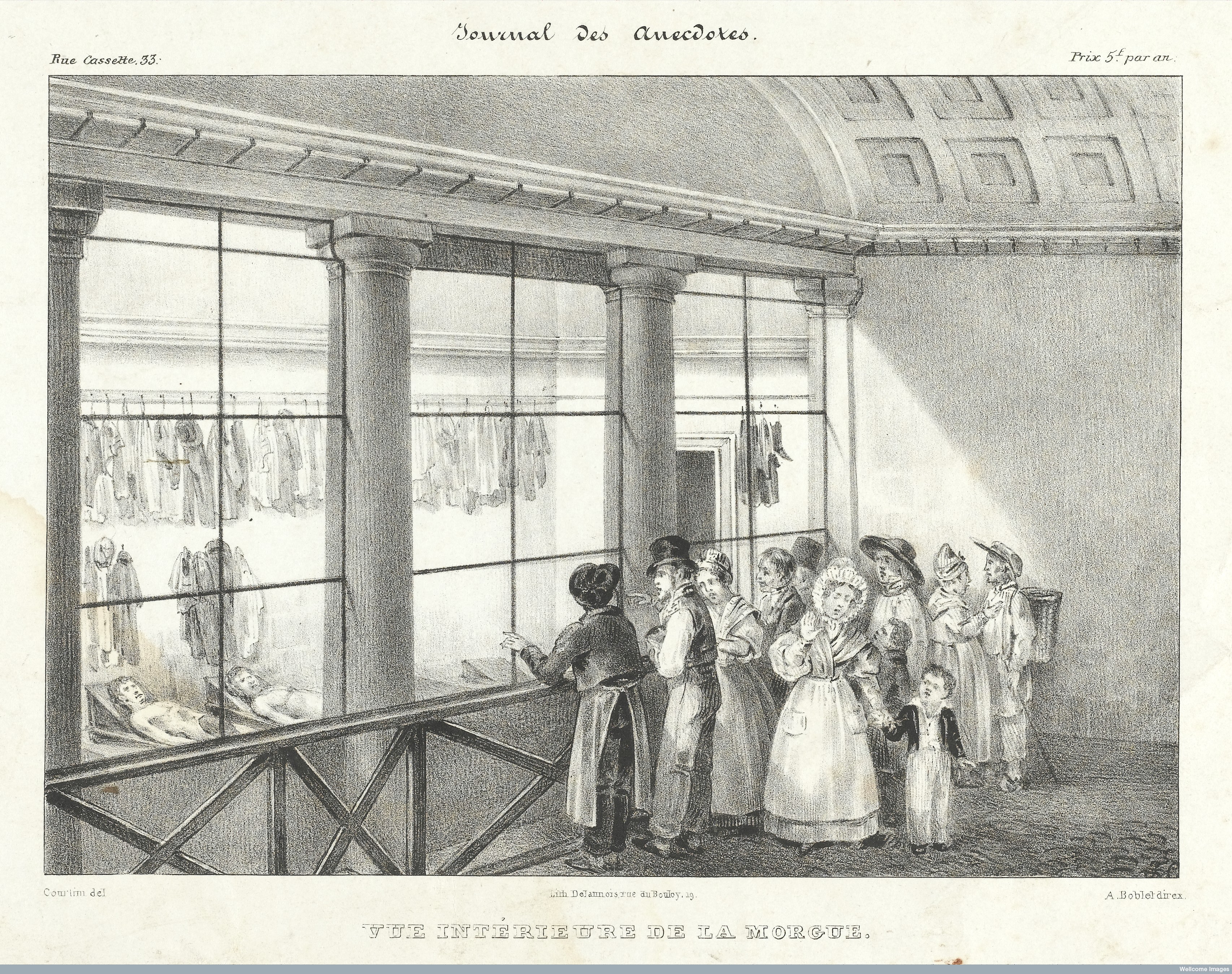
The Biggest Tourist Draw In Paris

by Tracy R. Walsh

L0042495 People visiting the morgue in Paris to view the cadavers.

It used to be the city morgue:

There aren’t many other ways to describe the Paris Morgue during the 19th century other than as a place of entertainment, for Parisians and tourists alike. Conveniently located behind the Notre Dame on the southern tip of the Ile de la Cité, built in 1864, the original purpose of the morgue was of course not to attract tourism but to identify unknown bodies found in the city; many that had been fished out of the Seine or suicides that no one had reported missing. Their unfortunate remains were displayed on slanted marble tables behind glass, inviting friends and families to claim the deceased. Word of the morbid (and free) exhibition of dead bodies quickly spread, and soon the morgue became a fixture on the Parisian social circuit, enticing the curiosity of men, women, even children from all social backgrounds, who would visit regularly, filing past the grisly display, providing themselves with at least a week’s worth of fresh gossip on the possible identities of the corpses and causes of death.

Update from a reader:

I want to point out that MessyNessy’s blog post to which you link today is drawn entirely from the scholarship of the historian Vanessa Schwartz, from her book Spectacular Realities: Early Mass Culture in Fin-de-Siecle Paris. Shouldn’t Dr. Schwartz be mentioned in your post? Historians work hard to dig this stuff up, and they deserve credit.

(Image: A crowd, including a mother and her young son, gathers to view the grisly sight of the bodies at the Paris Morgue circa 1820. Credit: Wellcome Images, Wellcome Library, London.)

A Serious House No Longer, Ctd

Jonathan Eig describes how Andrew Berlin, owner of minor league baseball team the South Bend Silver Hawks, converted a dilapidated synagogue on Coveleski Stadium grounds into a ballpark gift shop:

When Berlin bought the team, he held a meeting with members of the Jewish community and proposed moving the perimeter of the stadium to enclose the synagogue. The team needed a new gift shop, and it seemed a shame to waste such a beautiful old building. He had already pledged to spend $2.5 million of his own money on ballpark improvements. Now, he said, he would spend an additional million dollars on the synagogue’s restoration. The city of South Bend transferred ownership to Berlin.

“It wasn’t exactly what we had hoped for,” said David Piser, president of the Michiana Jewish Historical Society and one of the last Sons of Israel congregants. A Jewish museum would have been preferable, but Piser feared that the building might be knocked down if no use for it was found. Ultimately, everyone agreed that a gift-shop synagogue was better than no synagogue at all.

At one point in the discussions, Berlin proposed painting a target on the synagogue’s roof to encourage Silver Hawks batters to hit home runs. The idea was not received warmly by Piser or by some of the other Jewish community leaders. Today, the roof of the building is covered with an ad for Toyota.

Previous Dish on deconsecrated churches here. Update from a reader, who adds another anecdote to the thread:

There is a church in Grand Rapids, Michigan that became an abortion clinic. After years of protestors, it was bought by a nonprofit currently operating as Pregnancy Resource Center, a pro-life organization started by our church.

Starting With Sex

And other advice from Maïa Mazaurette, a French sex columnist:

[H]ow would you describe the French attitude toward sex?

I can only compare it to the countries I’ve lived in — Germany, and now Denmark, and I’ve made some trips to the U.S. I’d say the main difference is that in France we’re so straightforward. We don’t have these dating rituals; we just start with sex! And then, if the sex was good enough or we feel connected somehow, then we would try to build a relationship.

So you always have sex on the first date, then?

Absolutely! But it’s not even an issue because there is no date. There is just first sex. You think someone is attractive, you give it a try. I think it really makes sense. (Of course I say that, because I’m French, right?) But if you don’t have sex first, you build up too much pressure. You start thinking, I have seen this guy for four or five restaurants, or however you do it in the U.S., and what if it fails? If you get sex out the way first, then you can only have good surprises.

I never dated an American guy, but even with Danish and German guys, there were so many dates and it was taking so much time. At some point I just felt like, Ahhh! Stop it, are you going to kiss me? Are we going to your place? My place? Do something! I felt like I was investing a lot of time in something that might not be worth it anyway.

It’s interesting to me that France is a predominantly Catholic nation, and yet the culture is so sexually free.

Yes, but we don’t connect sex with ethics or morality or values in general, you know? There have been many studies about how French people don’t care about the sex life of our president, or if a person is unfaithful. It’s absolutely not a problem for me. Now, if my boyfriend and I have an agreement, that’s important. But I actually see a lot of my friends who are a bit older than me, maybe 40 or 45, who are always renegotiating the boundaries of their relationship. And a lot of them are okay with being unfaithful, as long as you don’t say it. It’s actually quite old-fashioned, as if we’re in the Victorian era, and your husband or your wife is the person you share children, a house, and money with, but for passion or a bit of adventure, you go elsewhere. The couple is not the place for adventure. It’s the place where you want to feel safe and watch Game of Thrones.

Update from a reader:

Maybe the French “start with sex,” but they are among the least sexually satisfied people on the planet, as regularly found in the annual Durex global sex survey. So maybe French advice on sex isn’t so good.

What’s A Bisexual Anyway? Ctd

A reader resurrects the thread once again:

I’ve been reading your blog for a long time, but never really felt compelled to write. I’m doing so now to thank you for the ongoing series on bisexuality. Recently our teenage son told us he is bisexual. It was a complete surprise to my husband and me. I knew he was interested in girls, so I just put him in the hetero category and never thought twice about it. We have lots of gay friends, several of whom are like extended family. There has never been any question in our house that a person’s sexuality is no big deal. And it’s not.

But even so, this knowledge rocked my world in ways I didn’t expect, including confronting my own ideas about bisexuality. And I gotta tell ya that my close gay friends were NO HELP when I tried to talk to them about it. Every single one of them has responded to some degree with the same comment: Oh, he’s too young to know what he is yet. My reaction: WTF? That does not jive with the “born this way” message I’ve been hearing like a steady drumbeat.

So, that’s where The Dish has helped tremendously. It’s the only place I’ve been able to hear directly from people who identify as bisexual about their journeys, frustrations and needs. I have read every single post in the series, and I hope you keep it going.

Another keeps it going:

I’m one of those bisexuals you have identified as bisexual and heteroamorous. But I’ve come to believe that my truncated sexual attraction to men, i.e., lacking the emotional dimension, is a result of my internalized homophobia.

I was an intellectually and emotionally precocious child, and at the age of 11, had my first huge crush on a girl in my school.  In the next year, I was sent to an all boys’ boarding school, where I promptly developed a huge crush on a boy a couple of years older than me. Sadly, the crush was discovered by a classmate, who suggested that I was a “fairy”.  In terror, I ruthlessly repressed my homosexual desires into adulthood.

Only in my twenties, did I begin to confront my attraction to men, and even that was for years a deeply confused attraction.  As I told a therapist, I’m bi, but I don’t even like the smell of men.  As for my heterosexuality, I allowed myself the full experience of it, and I am unquestionably both heterosexual and heteroamorous – I’m very happily married to a woman.

But over the years, I’ve worked to overcome my homophobic resistance to my attraction to men, and have reasonably succeeded – I even like the smell of men now, and can engage in homosexual sex without the tyrannizing Masters and Johnson-named observer on the shoulder who destroys all passionate sexual activity.  But I strongly suspect that emotional attachment is the remaining prohibition imposed by my internalized homophobia.  I often wondered who I would have grown up to be, had I not learned a terror of my homosexual attractions at an early age – I might even have grown up to be someone deeply attracted, both sexually and emotionally, to both sexes.  I am saddened that the world allows so little room for that.

Update from a reader, who responds to the mother’s email:

If a gay tells her it’s too soon for your son to know his entire sexual mind, it’s not necessarily insensitive or against the “born this way” message. Many of her close friends may have taken years or decades to fully know themselves. I am gay, so I am going by what I’ve read, and bisexuality can be as you have noted – sexual or amorous – but can also be simultaneous or consecutive, meaning the attraction for both sexes is both at the same time or takes turns. I doubt a young man can know so much about what the rest of his life will be, and surely a woman’s more fluid sexuality should inform her that one’s first self-realizations aren’t forever. It also sounds like the mother will only accept from gays what she wants to hear.