Malkin Award Nominee

https://twitter.com/EWErickson/status/553593617856868353

Update from a reader:

Erickson’s recommendation is doubly offensive (and doubly dumb) considering that he’s actually repurposing a trope of old-timey anti-semitism. As Zaid Jilani points out here, using pork products to taunt those who don’t eat them has been a staple of Jew-baiting in Europe for centuries:

In the book Anti-Semitic Stereotypes: A Paradigm of Otherness in English Popular Culture, 1660-1830, the author notes that English schoolboys would taunt Jews with a chant, “Get a bit of pork/Stick it on a fork/And give it to a Jew boy, a Jew.” In German culture, there was a popular concept of the “Judensau,” depicting Jews suckling from a pig; the bigoted imagery was so common it was even placed on churches to keep Jews away. Pope Leo VII called Jews “pigs,” and during the Inquisition, the  Spanish Jews were actually called “marrano” referring to a one-year old pig.

I wonder if Erickson realizes just what tradition he’s drawing on here. I suspect not.

Who Won’t Republish Charlie‘s Cartoons? Ctd

Dan Savage takes aim at another cowardly outlet:

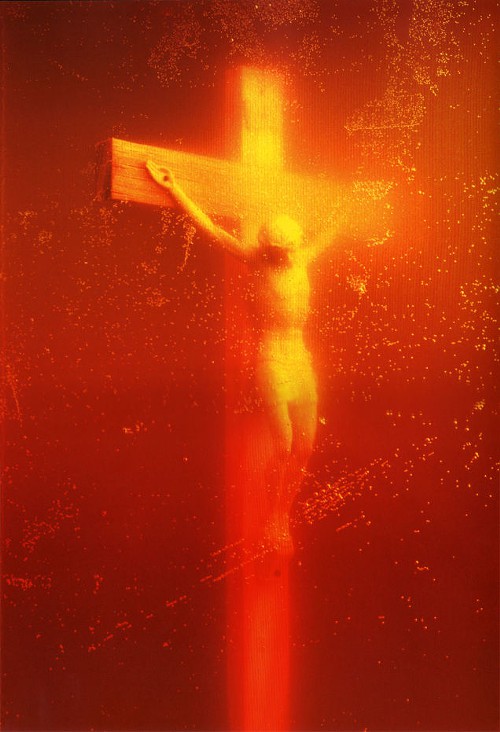
I was thinking about how afraid everyone is when I heard the Associated Press had yanked all images of Andres Serrano’s 1987 work Piss Christ from their website and archives. Before we knew how many people had died in the attack yesterday—before we learned that one of the victims (the one shown on the cover of the New York Times) was a Muslim cop—right-wing news outlets, bloggers, and Twitterers were condemning the AP’s supposed hypocrisy and anti-Christian bigotry. Slate:

The Associated Press is among the numerous news outlets that have been self-censoring images of the Charlie Hebdo cartoons that may have provoked 1420766951-pisschristasWednesday’s deadly Paris attack. In a statement, the news organization said that such censorship is standard policy: “None of the images distributed by AP showed cartoons of the Prophet Muhammad. It’s been our policy for years that we refrain from moving deliberately provocative images.” The conservative Washington Examiner publication then pointed out that the AP nonetheless continued to carry an image of Andres Serrano’s 1987 “Piss Christ” photograph—which is certainly provocative, having been the subject of massive controversy in the United States, and which was actually vandalized by Catholic protesters when it was on display in 2011 in, as it happens, France.

All images of Piss Christ have since been scrubbed from AP’s website—they’re all gone, including legitimately newsworthy photos of a vandalized Piss Christ. In an attempt to explain the memoryholing of Piss Christ, the AP says they’ve “revised and reviewed our policies since 1989.” The implication: Piss Christ should’ve been removed from the AP’s website years ago and its presence until yesterday afternoon was an oversight. (Perhaps the AP will send the Washington Examiner a thank-you note for bringing this matter to their attention.) The AP’s explanation is complete and total bullshit. They didn’t pull down those images of Piss Christ because they were “deliberately provocative.” The AP pulled them down because they’re afraid.

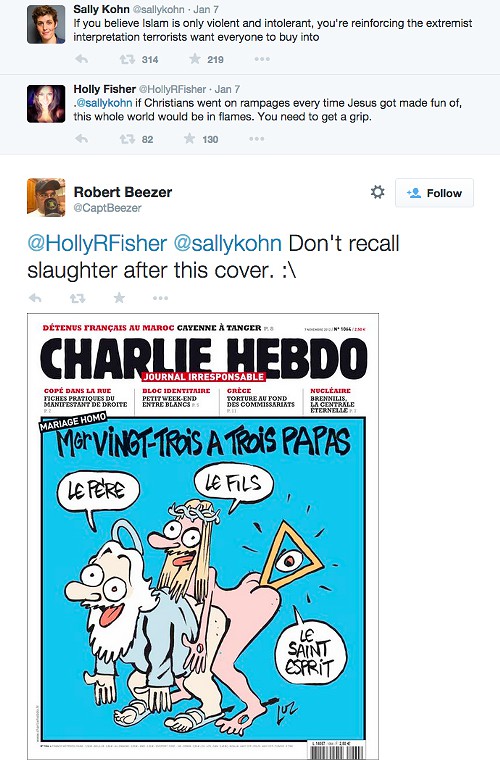
Here’s what the AP should’ve said to Christian conservatives screaming about Piss Christ and double standards: “Yeah, we blurred out those Charlie Hebdo cartoons because we’re afraid of them. We didn’t do the same to Piss Christ because we’re not afraid of you.” [That’s] something that Christians, conservative and otherwise, should be proud of. … Here are two (Holly and Robert) boasting yesterday:

1420763045-dontrecallcharlieimage

Christian conservatives want to have it both ways: They want credit for not reacting violently when their sacred symbols, holy texts, imaginary friends, etc. are mocked while also wanting the same deference—the same kid-glove, blurred-image treatment—that violent Muslim extremists have “won” for their sacred symbols, holy texts, imaginary friends, etc. But you can’t have it both ways. You can’t claim to be better than “they” are because you can take a joke while at the same time demanding that people stop joking about you. You can’t hold up their attempts to eradicate art (and artists) that offend them as proof that they’re hopelessly backwards while at the same time demanding the disappearance of art (and artists) that offend you.

Update from a reader:

I just read your item on the Washington Post censoring the Charlie Hedbo images as offensive. It is odd to me that they would strike them from the web, because they definitely printed the images in the print version of the paper. I wish I could show you an image, but I only know this because my husband noted it as he was throwing the dead tree version of the Post into our fireplace. Because it is cold. But here is an article on it (also still on the Post site): “Washington Post opinions section publishes controversial Charlie Hebdo cartoon“.

Ambinder’s take on the free speech question:

1. The attack ought to be connected to Islam, or religion, but not to Muslims. We cannot be afraid to criticize and even ridicule beliefs we find to be harmful and absurd. But neither is it humane nor in the interest of Europe, to indict the people who at worst have committed a thought crime and who at best can be persuaded to disregard that belief, just like practicing Christians and Jews (and even Bill Donohue, who doesn’t incite violence) have in the U.S.

2. Free speech has consequences. Saying it doesn’t is magical — it presupposes that there is some universal law which holds that good things will always happen when people are given license to speak their minds. Not always. But censoring political, symbolic, and religious speech, or trying not to offend anyone often have worse consequences. Censoring enfeebles our minds. Avoiding controversy removes the edge from humor. Protecting people from cartoons concedes sacred ground to much more harmful beliefs and practices.

Let the ink flow.

Beware Of Nazi Cows

They’re mean bastards:

This particular breed dates back to the 1920s, when German zoologists and brothers Heinz and Lutz Heck, recruited by the Nazis, began a program to resurrect extinct wild species by cross-breeding various domestic descendants — an effort typically referred to as “back breeding.” Among their success stories was the half-ton Heck cattle, a reasonable facsimile of the hearty and Herculean auroch cattle that dated back some 2 million years prior and has roamed en masse all over Germany centuries prior.

The back-breeding program reflected the dual Nazi obsession with eugenics and nostalgia; the wild ancestry of the auroch reflected a time of “biological unity” before civilization softened and “uglified” man and beast alike. And in fact, the program’s research patron, one Hermann Goring, sought to preserve biological unity not only by resurrecting extinct species, but by restoring them to their original habitats; thus his plan was to return the aurochs to the primeval Białowieża forest.

Is anyone really surprised that the cows turned out to be murderously dangerous?

To wit, English farmer Derek Gow, the only owner of Heck cattle in his country, was forced to slaughter half of his herd this week because they were getting far too aggressive:

“I’m not sure how appealing Third Reich sausages would be,” he joked. “But they are very tasty.”

Update from a reader:

Please PLEASE tell me you saw Aasif Mandvi’s bit about “Nazi Cows”. You cannot mention this story without mentioning this bit. It’s classic TDS.

Capitulation Of The Day

[Re-posted and updated from earlier today]

A reader spots an “interesting bit of irony”:

The Washington Post article that criticizes Donohue’s ridiculous comments about Charlie Hebdo and the idea that offensive speech ought to be censored contains this cowardly disclaimer:

Editor’s note: An earlier version of this article included images offensive to various religious groups that did not meet the Post’s standards, and should not have been published. They have been removed.

If any reader knows exactly what images they removed, let us know and we’ll post them here. Update:

I saw the WaPo story before the images were pulled down they were exclusively images aimed at insulting Catholics and Jews. I left a comment asking why they weren’t also running the images aimed at insulting Muslims – i.e., the images that were particularly newsworthy. Awhile later all of the images were taken down. Definitely not my intent in making the comment. I just thought it was hypocritical to run one set of cartoons and not the other.  Here are a couple of the images I remember seeing before they were pulled:

hebdo-covers

Another reader:

The CBC has also refused to air the cartoons. Here’s the internal memorandum courtesy web journalist Jesse Brown:

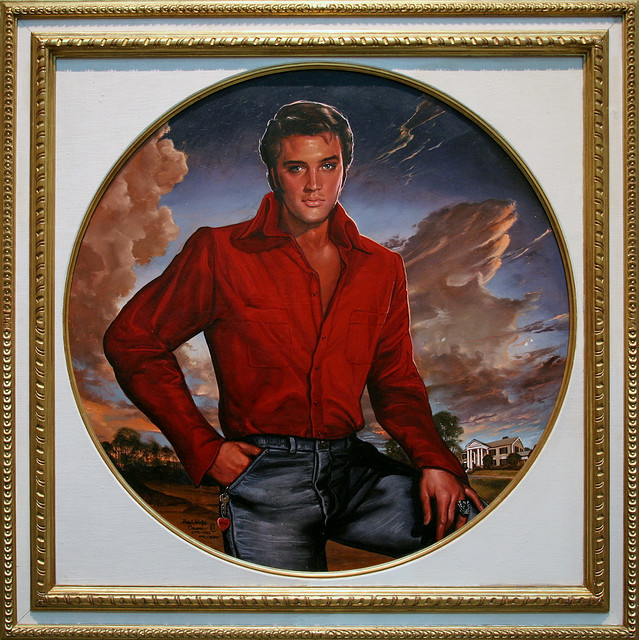
Sighting Elvis

Elvis

Today would have been the music legend’s 80th birthday, assuming you believe he’s dead. Adrienne LaFrance ponders our varied perceptions of the man and his demise:

The tricky thing about Elvis [is] that people can’t agree on the Elvis they think they know. There’s the Elvis who died in 1977, and the Elvis who’s still alive and eating cheeseburgers in western Michigan. There’s Elvis the hip-swiveling hunk who could break your heart, and Elvis the doughy 40-something who couldn’t get through a performance without stumbling over his words. This duality was strong enough that it prompted debate about which Elvis ought to be depicted on a postage stamp. From The New York Times in 1992:

“Postal authorities are not sure which Presley likeness to use: the young, svelte, hip-gyrating Elvis of the rock-and-roll ’50s, or the rotund, road-worn Elvis who died in 1977 near the end of the Age of Aquarius, reportedly after a struggle with drugs.”

If conspiracy theories are a way to impose order on events that can’t be controlled, Elvis sightings are perhaps a way of rejecting mortality, and preserving the American dream he came to represent. After all, it wasn’t just Elvis’ death that challenged his place in American culture, but his actual life. Insisting Elvis never died is also, then, a way of rejecting what he had become.

Update from a reader:

If you’re talking about Elvis, why not include the finest Elvis-related song if all time, Mojo Nixon’s “Elvis is Everywhere”:

On a higher brow note, I recommend the Philip K Dick award-winning novel Elvissey by Jack Womack. This sci-fi novel has corporate commandos sent to an alternate version of Earth to kidnap a young Elvis in order to use him as their nouveau Messiah in a world where Christianity has been discredited.

Another:

Your post made me think about Bubba Ho-Tep, one of the strangest and most delightful films I have ever seen. It centers around an elderly Elvis living in a rundown retirement home in East Texas, having switched places with an Elvis impersonator in the early 1970s in order to get away from all the fame and the pains that came with it. He befriends a man, played brilliantly by Ossie Davis, who believes himself to be JFK (a harebrained and delightful explanation is given) and together they fight a mummy who is sucking the souls of their fellow residents through there assholes.

As I said, it is a very strange story. But it is also a story about death, fame, old age, family, heroism, peace of mind and above all else, Elvis himself. It received a very small theatrical release but after very positive reviews from several top critics (and tremendous praise for the performance of Bruce Campbell who played Elvis) it gained a cult following. As Roger Ebert said:

The King explains all of this in a thoughtful, introspective voice-over narration that also deals with other matters on his mind, such as the alarming pustule on that part of his anatomy where it is least welcome. He talks about Priscilla and Lisa Marie, about his movies (not a single good one), about his decision to disappear, and about how he broke his hip falling off a stage. This narration is not broad comedy, but wicked, observant and truthful. “Bubba Ho-Tep” has a lot of affection for Elvis, takes him seriously, and — this is crucial — isn’t a camp horror movie, but treats this loony situation as if it’s really happening

(Photo by Flickr user Cliff)

Face Of The Day

Temperatures Drop Near Zero Degrees In Chicago

A woman tries to stay warm as she waits on an L platform in Chicago during the early morning rush while temperatures hovered around zero degrees Fahrenheit on January 7, 2015. Most of the city’s schools were cancelled today as wind chill temperatures were expected to exceed -30. By Scott Olson/Getty Images. Update from a proud Chicagoan, who contests Getty’s caption:

It actually gets into some serious linguistic issues. “A woman tries to stay warm as she waits on an L platform in Chicago . . . “ The L – sans punctuation, lone capital letter – is not how Chicagoans refer to their train system.

The Chicago Transportation Authority insists that it’s ‘L’ (single quotations marks, or inverted commas for you Brits).  The scare quotes probably were originally meant to indicate “slang” usage, and probably originated when the vast majority of the system was elevated (now 2/3 of it is at or below grade, including lines down the medians of expressways). But this official usage is contested.  Many great Chicago authors, including Nelson Algren, write El – short, obviously, for Elevated, sans punctuation.  Like the T in Boston. I have worked on a number of books and other publishing projects where this conflicted usage has mattered, so I thought I’d share this Chicago minutia with the Dish’s discerning audience.

So it’s the El I take: to L with all other versions.

The Shrinking Economic Payoff Of Keystone

Michael Levi considers how plummeting oil prices might affect the pipeline:

Lower oil prices reduce both the costs and the benefits of approving the Keystone XL pipeline by reducing the odds that it will ever be fully used. There’s an outside chance that, if prices are sustained at an extremely low level, the Keystone XL pipeline won’t get built. That scenario isn’t likely – among other things, if Canadian production doesn’t grow, the odds of sustained low prices decline substantially – but it’s not zero. Lower prices also raise the odds that the pipeline will be built but not fully utilized. In that case, you still get the up-front construction stimulus, but you get less benefit from greater oil production, and less climate damage from the same. You also have a waste of economic resources.

The more likely scenario, though, is that the Keystone XL pipeline gets built and used. In that case, lower oil prices reduce its economic benefits without any clear impact on its climate costs.

Jordan Weissmann contends that “Keystone is neither irrelevant, nor especially critical to the future of Canadian oil”:

Keystone would probably be a small boon to the American fossil-fuel industry, even at this late date. Remember, the pipeline would send crude to refiners on the Gulf Coast. And what do refiners do? They buy oil, then transform it into gasoline, diesel, and other products to sell. The less expensive the oil, the easier it is for them to turn a profit, and the heavy crude found in the tar sands—which gulf refiners are specially equipped to process—is especially cheap, even compared to similar low grades from Mexico and Venezuela. This week, for instance, Western Canadian Select has traded at around just $33 a barrel. The refinery owners of Houston would surely love to get their hands on more it, but in a world of generally low oil prices, doing so isn’t exactly a matter of life and death for them.

Rebecca Leber wishes the Dems’ amendments to the Keystone bill didn’t focus on jobs:

Keystone emerged as a national issue when it became a symbol of climate change. Democrats ought to be marshalling their resources to remind people that Keystone is more about polution than it is about jobs. The pro-environment amendments have a slim chance at passing anyway. If Democratic amendments are hopeless from the start, they might as well go for bolder proposals, like a carbon tax, that will help at least to remind us of bigger things at stake than a few dozen jobs.

But Morrissey imagines that those amendments might get Obama to sign the bill:

If Democrats offer amendments that Republicans can support, the White House can claim that the bill has changed enough to their satisfaction — in essence, declare victory and depart the field before anyone asks too many questions.

Update from a reader, who corrected the first sentence of this post:

“Michael Levi considers how pummeling oil prices might affect the pipeline:”

“Plummeting”?  The Dish’s own eggcorn?

Busted. But apparently we’re not alone this week, as another reader attests:

It has been fixed now, but when I first read Chait’s column on the conservative glee over Harvard faculty outrage at having to pay copays, I’m sure it read:

As the Times reports, the changes are a response to Harvard’s own health-care experts, many of whom advocated for Obamacare. The story has thus entered the conservative mind as a case of liberal elites suffering under the yolk of a liberal program.

Nous Sommes Charlie, But Do We Really Want To Be?

Yglesias, for one, is dismayed that yesterday’s attack made martyrs of cartoonists whose work he found distasteful in the extreme:

Viewed in a vacuum, the Charlie Hebdo cartoons (or the Danish ones that preceded it) are hardly worthy of a stirring defense. They offer few ideas of value, contribute little to any important debates, and the world would likely have been a better place had everyone just been more polite in the first place.

But in the context of a world where publishers of cartoons mocking Mohammed have been threatened, harassed, and even killed, things look different. Images that were once not much more than shock for its own sake now stand for something — for the legal right to blaspheme and to give offense. Unforgivable acts of slaughter imbue merely rude acts of publication with a glittering nobility.

One of Dreher’s readers makes a similar point:

I am a francophone European, and I sometimes read Charlie Hebdo. I am shocked by these murders and I hope the assassins will be caught and will pay dearly for their crimes. This being said, je ne “suis” pas Charlie et je ne l’ai jamais été: I am not Charlie and I never was.

I’ve always thought that Charlie’s brand of “humour” was despicable and part of the problem, not a solution. I’m not going to change my mind about this because of the murders. The people who died have become martyrs of the freedom of expression, but they were hardly the best defenders of the freedom of expression. First because the freedom to express your opinions does not imply that these opinions are correct – and Charlie was a far left, violently anti-religious rag. It is not because you are free to be vulgar, unfair and insulting that all these things are good. Moreover Charlie was not very good when the freedom of expression of its adversaries was at stake: look at the “Dieudonné” affair for instance.

Dieudonné M’bala M’bala is a controversial French comedian and political activist who’s been convicted many times of antisemitism. Diana Johnstone is on the same page as Dreher’s reader when it comes to Charlie Hebdo‘s spotty record on free speech:

In 2002, Philippe Val, who was editor in chief at the time, denounced Noam Chomsky for anti-Americanism and excessive criticism of Israel and of mainstream media.  In 2008, another of Charlie Hebdo’s famous cartoonists, Siné, wrote a short note citing a news item that President Sarkozy’s son Jean was going to convert to Judaism to marry the heiress of a prosperous appliance chain. Siné added the comment, “He’ll go far, this lad.” For that, Siné was fired by Philippe Val on grounds of “anti-Semitism”.  Siné promptly founded a rival paper which stole a number of Charlie Hebdo readers, revolted by CH’s double standards. In short, Charlie Hebdo was an extreme example of what is wrong with the “politically correct” line of the current French left.

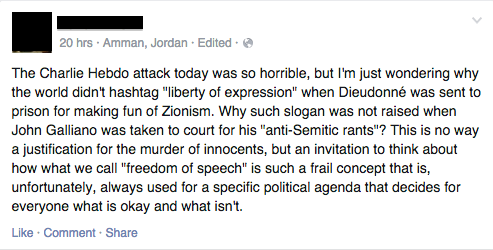
Indeed, many Muslims on social media are wondering why free speech seems a bit freer than usual when Islam is the target. One such Muslim is a Jordanian friend of Dish editor Jonah Shepp, who didn’t want to reveal her name:

Screen Shot 2015-01-08 at 12.19.55 PM

Meanwhile, responding to calls for other publications to reprint Charlie’s most controversial work in solidarity, Arthur Goldhammer cautions against sacralizing artists and journalists who saw profaning the sacred as their life’s work:

Reproducing the imagery created by the murdered artists tends to sacralize them as embodiments of some abstract ideal of free speech. But many of the publications that today honor the dead as martyrs would yesterday have rejected their work as tasteless and obscene, as indeed it often was. The whole point of Charlie’s satire was to be tasteless and obscene, to respect no proprieties, to make its point by being untameable and incorrigible and therefore unpublishable anywhere else. The speech it exemplified was not free to express itself anywhere but in its pages. Its spirit was insurrectionist and anti-idealist, and its creators would be dumbfounded to find themselves memorialized as exemplars of a freedom that they always insisted was perpetually in danger and in need of a defense that only offensiveness could provide.

Update from the in-tray:

Long-time reader (and francophone) here. I just saw you forward a tweet regarding Charlie download (1)Hebdo‘s alleged racism in its cartoon “Rassemblement bleu raciste” [Update: the Twitter user deleted that tweet, but the image in question is embedded to the right]. I am not 100% certain of the background behind that cartoon. Unfortunately, the Charlie Hebdo website isn’t showing much in the way of past content at this time. That said, a quick google search reveals that this caricature – albeit maladroit – might have been put forth as a criticism of the French extreme right’s racist references to Minister Taubira. I invite you to look at the following links – here and here – which give a bit more detail on the text that allegedly accompanied the caricature. I may be wrong here, but I’m pretty sure that caricature was not the whole story and is mischaracterizing Charlie Hebdo’s position.
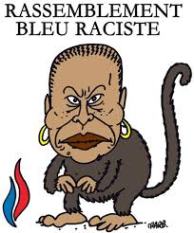
The first link is to a web forum and the second is to an article in French, so if any other readers, especially French-speaking ones, have something more conclusive, please let us know. Update from another:

As a French citizen, I was infuriated by your understanding of this drawing by Charlie Hebdo.  This drawing was made as a response to racism found in the French weekly newspaper Minute, which depicted Taubira as a monkey.  This shocking (and I concede awkward) drawing is meant to denounce the racists from Minute and the Front National, the nationalist extreme right party (their logo at the bottom left of the drawing).  The drawing is meant to exemplify how racist and shocking their words were.  I found that title/question insulting the memory of Charlie Hebdo.

Another adds further context:

Charlie Hebdo’s picture of Minister Taubira was indeed posted in the context when many Front national supporters and representatives made racist comments about Christiane Taubira, who supported legalizing gay marriage. They constantly compared her to a monkey and on some occasions taught their children to throw bananas at her.

The title is in fact a pun on the new name Marine Le Pen wanted to give to the Front national so as to nominally distance her own political agenda from her father’s (who was well known for his antisemitic and racist comments). She called her own movement « Rassemblement Bleu Marine » (this name itself included a pun since it means both a « Blue Navy Rally » and a « blue rally around Marine Le Pen » ). Charlie Hebdo just added a pun on her pun, replacing “Bleu Marine” with “Bleu raciste”. It was meant to show that the new Front national around Marine Le Pen was in fact just as racist as the former one and the caricature of Taubira as a monkey was meant to represent the so-called new Front National’s vision of a black female Minister of Justice.

Regarding “freedom of speech”, Dreher’s reader’s comments about a double standard are quite off the topic. From a legal point of view, in the US sense, freedom of speech is restricted in France. The cases that reader mentions does show an obvious double standard when it comes to antisemitism on the one hand and islamophobia on the other, but rather the fact that there is room for prosecution in France if you make public comments that suggest that you support racial inequality or that you deny the existence of events such as the Holocaust. There is no room for prosecution for any kind of religious blasphemy. Charlie Hebdo fought against the idea that anything was too sacred not to be ridiculed or laughed about. Such was their idea of freedom. They were irreverent by principle, but never racist nor in any way comparable to ideologues such as Dieudonné.

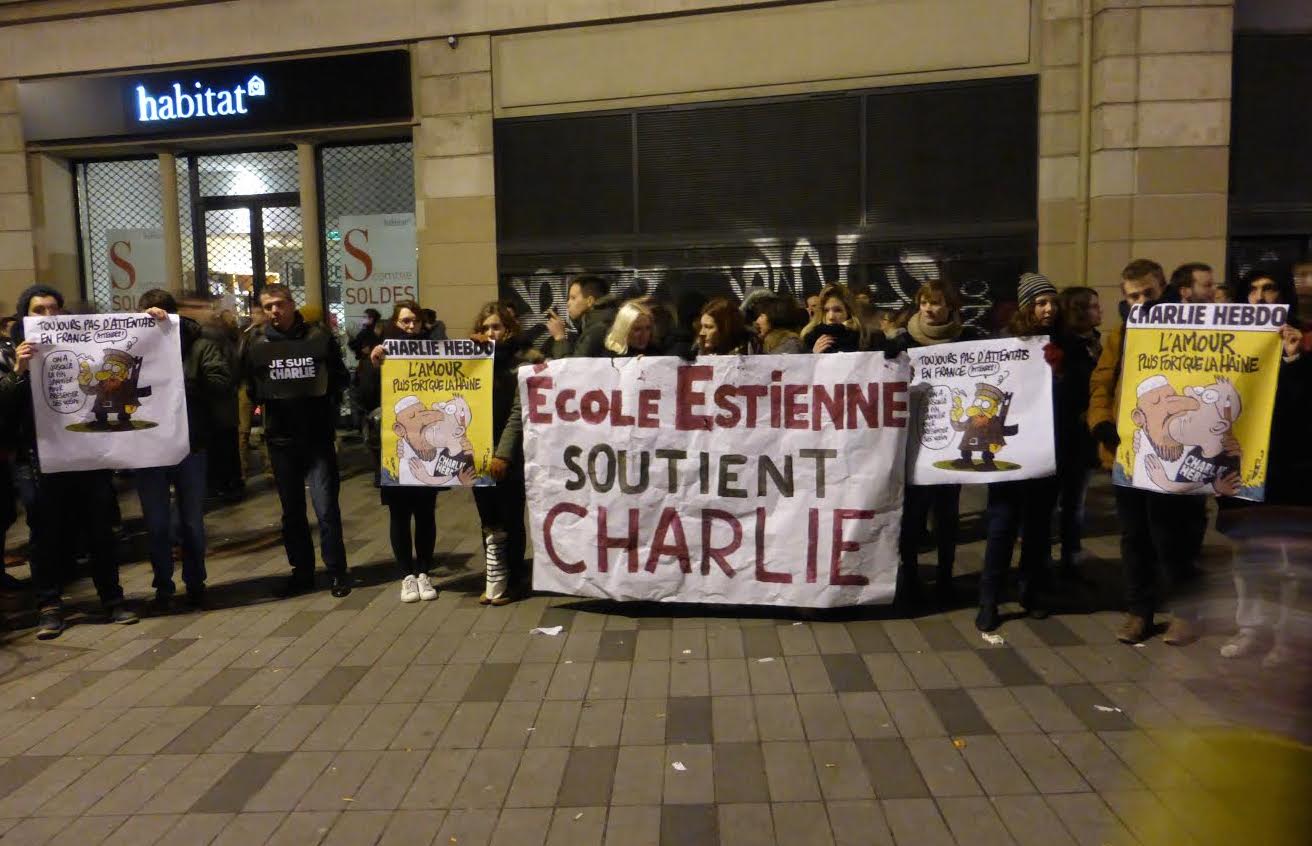
In any case, thank you for your coverage of the Charlie Hebdo attack and for pointing out the MSM’s lack of courage in reproducing the caricatures. Below is a picture I took at yesterday’s march in Place de la République around 8pm:
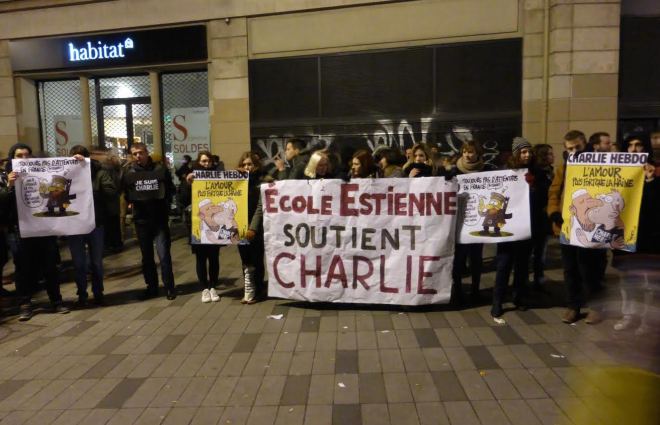
unnamed (28)

Kids, students, anonymous people are absolutely not afraid of showing these caricatures in public in France. It’s important that they are not and to some degree they are less than they ever were.
Slaughtered For Satire, Ctd

A reader writes:

I’m a former Muslim who grew up in Saudi Arabia as the daughter of Pakistani expatriates. I left everything to come to the US and created a wonderful life that has involved practicing as an 10899542_1531240417130999_737500267_nattorney. Several years ago, I worked out my Islamic demons via a blog focusing on my apostasy – still a capital crime in Saudi Arabia – but Islam has become largely irrelevant to my life in recent years. That is, until something like the Charlie Hebdo attack happens.

I found myself thinking that I don’t want them to win, and they win so much, everyday. I grew up in a country that bans philosophy books because they might encourage free thought. When people are killed for speech, speech is silenced. I can‘t stand the thought that fewer people might draw silly cartoons because of Islamism.

So I created drawingislam.com, which will post drawings, cartoons and sketches sent in by anyone who has anything to say about Islam and Muhammad. I’m hoping it will generate enough material that the best of it can be published in a book that Saudi Arabia will have to ban.

I was one of your earliest readers, back in Saudi as a teenager. Thank you for your honesty about Islam. I’m a socialist-level liberal, and I find the liberal cowardice around speaking out about Islamism disgusting. Here’s to speaking the truth, even if it’s in the form of satirical cartoons.

Another counters Chait:

“One cannot defend the right without defending the practice.” I’m sorry – what? As an atheist who personally has no problem with blasphemy, I still don’t think this statement makes any sense.

In a liberal society, we routinely “defend the right” to express all sorts of awful opinions – racist, homophobic, etc. My guess is that Chait would defend the rights of groups like the Westboro Baptist Church or even the Klan to express their vile views. Does that mean that he also defends the practice? That there is no room to say that such views have no place in a civilized society, but that at the same time we will allow people to express them? (And in fact that we must allow them to, or risk repression of vital and valuable discourse as well.)

I am not familiar enough with Charlie Hebdo to know whether their publications warrant the same sort of public contempt as those of hate groups. My guess is that they do not. It could well be that I would defend their practices as well as their rights. But it’s a question of degree, and it does not follow from defending their right to publish that we must also defend their practices.

Another isn’t alone:

I’m missing Hitch. His voice is needed regarding France. His words regarding Denmark will have to make the point:

Hitch’s words – about how religious fundamentalists of all stripes defend each other when it comes to secular free speech – prove prescient:

Bill Donohue, president of the Catholic League, a U.S. organization that “defends the rights of Catholics,” issued a statement [yesterday] titled “Muslims are right to be angry.” In it, Donohue criticized the publication’s history of offending the world’s religiously devout, including non-Muslims. The murdered Charlie Hebdo editor Stephane Charbonnier “didn’t understand the role he played in his [own] tragic death,” the statement reads. “Had [Charbonnier] not been so narcissistic, he may still be alive,” Donohue says, in what must be one of the more offensive and insensitive comments made on this tragic day.

Another reader flags a much longer video from Hitch on free speech. Another shifts gears and wildly speculates about the motives of the massacre:

In thinking about the horrible attack today, the typically dormant conspiracy theorist part of me wondered if this really was an act of Islamic Fundamentalist terror, or if it was only intended to look like one. You posted a snippet of Juan Cole’s message, saying that that this played into the hands of both Al-Qaeda and the “Islamophobic French Right wing.”  Why are we so sure it wasn’t some hardcore nationalists who wanted to create the very kind of backlash the attack is likely to create?

Now, obviously the likeliest scenario is that it was, in fact, perpetrated by three (including the driver) Islamic Fundamentalist terrorists, but two things have made me question it apart from the multiple parties who had motive.

First, the terrorists told the woman opening the door for them that they were Al-Qaeda, in unaccented French, and then they started screaming Allahu Akbar as they perpetrated their assault.  It all seemed too stereotypically like Islamic Fundamentalist terror.  Of course, maybe that’s a stereotype because that’s how it happens, but it made me question things a bit. Second, and this is very tenuous, the skin of the attackers under their masks look very white.  (Yes, there are obviously also light-skinned and/or white Islamic Fundamentalists).

Anyway, that’s my conspiracy theory for the year.  I wish it had to do with something far less sad and horrible.

Follow all Dish coverage of the Charlie Hebdo attack here. Update from a reader:

The discussion around the attack has focused around freedom of speech, and whether or not we should lionize the magazine despite its baiting tactics. Some voices emphasize the need to defend freedom of speech at all costs. The others say that Charlie Hebdo was a little over the top – their cartoons weren’t critiques so much as racist slurs. The problem with both stances is they still limit this attack to an attack on free speech. And while I think that’s a part of this cultural tension, I don’t think it’s the whole story, or even the central one.

Maybe Charlie Hebdo wasn’t attacked because of its cartoons but instead because of larger political forces at work. Maybe people don’t become radicalized because of ideas or teachers, but rather because of living conditions and/or identity politics.  Few commentators have mentioned how European Muslims are statistically poorer and less culturally integrated than Muslim Americans. I haven’t seen any of the write ups discuss the 2010 banning of face coverings, the strict anti-immigration policies that are common throughout Europe, or the lack of Muslim representation in European governments.

Do crazies pick up guns and shoot people sometimes? Of course. But if this is terrorism (and not simply a killing spree), we can not stick our heads in the sand and retreat to cliches like “They hate us for our freedom.” Not only is that an oversimplified approach, it also prevents us from healing the wounds that continue to haunt us. Political violence cannot exist in a vacuum. Talking about this awful crime like it’s simply the product of a few cartoons is unproductive, and leads to deeper lines drawn in the sand.

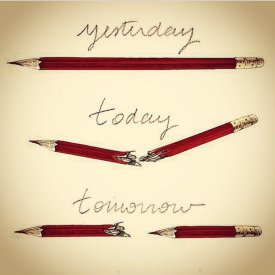
(Illustration details here)

“Take Your Medicine” Taken To An Extreme

A 17-year-old in Connecticut is fighting for the right to refuse cancer treatment:

Known as “Cassandra C.” in court papers, the teenager has Hodgkin lymphoma. Doctors say her survival rate is 80-85 percent with chemotherapy, and she will die without it. Cassandra says she believes chemo is “poison,” and wants to discontinue treatment. Her mother, Jackie Fortin, supports her decision, telling NBC News: “My daughter does not want to poison her body. This is her constitutional right as a human being.” … [C]hild protective services became involved after [Cassandra] missed several doctor’s appointments and stopped going to tests. She was removed from her home, and is now in a monitored room at Connecticut Children’s Medical Center.

In the process, she was forced to undergo two chemo sessions. Nicholas St. Fleur provides context to the “legal battle over whether a 17-year-old can make medical decisions about her own body”:

In the U.S., adults have the right to bodily integrity, meaning they can refuse life-saving medical treatment. … Only a few states allow the “mature minor doctrine” which lets 16 and 17-year-olds argue in court whether they are mature enough to make medical decisions. In 1989, Illinois had a case where a 17-year old Jehovah’s Witness with leukemia who was allowed to refuse life-saving blood transfusions. Normally this doctrine is used when children want to receive treatment that their parents are refusing, but in this case the girl’s parents also agreed in accordance with their religious beliefs. The court decided in favor of her right to refuse treatment under the mature minor doctrine.

Ironically, the girl survived her bout with leukemia because she had already received a transfusion before the court made its decision. It’s unclear if Cassandra’s appeal, which will be Connecticut’s first case calling for the “mature-minor doctrine,” will face similar judicial impediments.

Update from a reader:

This story recalls a somewhat different one in Canada recently, where the aboriginal parents of a young girl (pre-teen, if I remember) refused the chemo that doctors said was necessary and would be successful in favour of traditional aboriginal medicine. The judge in the case sided with the parents on the basis of constitutional aboriginal rights. The parents brought their child to a holistic treatment centre in Florida (one which did not provide particularly aboriginal therapies), but made it clear subsequently that if her condition deteriorated they would agree to a more “Western” medical approach. Needless to say, despite the differences with the case you discuss, it generated considerable debate in the country.