America’s First Bullet Train

California broke ground on it yesterday. Scott Shackford is against the project, which is estimated to cost $68 billion:

The state only has $12 billion on hand for the project and is planning for another $8 billion. The rest is absolutely nowhere to be found. California got $3 billion from the Obama administration as part of the stimulus package, but it’s pretty safe to say they’re not going to see another cent from the federal government for at least the next two years. There is no sign of any private investment coming. The California High Speed Rail Authority is taking the “If you build it, they will come” mantra as a permanent motto. Its chairman, Dan Richard, is hoping they can raise money from selling advertisement and real estate development rights along the route or that the feds will chip in again later.

Katrina Trinko raises other objections:

Backers say the train will be able to make the trip between San Francisco and Los Angeles in under 2 hours, 40 minutes. However, according to a 2013 Reason Foundation study, it’s likely the trip will ultimately take around 4 hours (and sometimes closer to 5 hours) for various reasons (for example, the high-speed train will share tracks with slower trains). To put that into context, consider this:

a flight from San Francisco to Los Angeles is about 1 hour, 15 minutes. Driving, if there isn’t traffic, takes a little under six hours—more time than the train would take, it’s true, but you also have a vehicle at the end of your trip.

Update from a reader:

Sure, a flight between LAX and SFO might take 1 1/4 or 1 1/2 hours, but that does not take into account the hours required for checking in, going thru security, boarding early, and possibly baggage claim at destination, to say nothing of transit from the airport to the city proper.

Eric Holthaus believes that “it’s probably better to just focus on improving the transportation systems we already have, rather than creating a whole new one from scratch”:

Given the incredible pressure that global warming is inflicting, we can’t waste precious resources on high-speed rail. It’s impractical to hope that truly high-speed rail—the kind that will compete with air travel—will arrive in time to do much good.

Instead, limited public transportation funds should be prioritized for climate-friendly projects that will pay off more than high-speed rail in the same time frame. Some options for politicians: 1) Expand the use of upscale electric buses, 2) support self-driving vehicle technology, and 3) regulate airline emissions.

Fallows, on the other hand, supports the project:

1) America is direly short on infrastructure; the financial and political resistance to remedying that is powerful (for reason Mancur Olson once laid out) and usually prevails. China is biased toward wastefully building infrastructure it doesn’t need. The U.S. is biased the opposite way. So when there’s is a real chance to build something valuable in America, I start out in favor of it.

2) The counties of the Central Valley of California, where the first stages of the construction will begin, are not just the poorest part of a rich state but also, taken on their own, would constitute the poorest state in the entire country. Of the five poorest metro areas in the United States, three are there. Most dynamic analyses of the effects of the rail project indicate that it would bring new jobs to a region that most needs them, while chewing up less farmland than normal sprawl and freeway expansion would destroy. Which leads to …

3) The state’s population is growing, and so is the demand for intra-state travel. Any other way of getting California’s 30+ million people from north to south, via cars on new (or more crowded) freeways or planes to new (or more crowded) airports, will be more destructive of the state’s finances, its farmland, and its environment than a rail system.

France’s South Park

A reader writes:

enhanced-27032-1420647847-2Here’s something I’d like to contribute re: the massacre. First, I went to high school with the daughter of one of the victims, a long time ago but still. I met him and knew him – a very nice and funny guy. So it’s shocking on a personal level.

Second, these things do not usually happen in France. Especially the part where a commando uses automatic weapons (AK-47). It’s very hard to procure AK-47s in France. It’s not on sale at Walmart, like here. So this means these are organized criminals (obviously).

Charlie Hebdo is an institution. Its humor was always very corrosive and harsh. The writers and illustrators have been active in one form or another since the late ’60s, making fun of everybody and angering everybody since then.

Its first incarnation, aptly called “Hara-Kiri” was the most scandalous weekly magazine you could find.

The week after the General de Gaulle died, they came out with the title: “Tragic ball at Colombey: one dead.” (Colombey-Les-Deux-Eglises was the village where the General’s private residence was located). After the scandal, they were forbidden to print and had to start another weekly under a new name.

enhanced-22753-1420647659-17Charlie was always committed to intellectual anarchism, virulently anti-clerical and anti-religion and resolutely left wing. But always in a hilarious manner. There is no 40-year-old French person of all political persuasion who has not read and laughed along with Charlie’s weekly delivery of caricatures.

More recently, Charlie been printing lots of cartoons making fun of Islamists and their Prophet. They were already the target of a bombing a couple of years ago. So everybody is thinking what I am thinking. If it turns out to be the doing of an Islamist cell, this is almost like France’s 9/11. On a much smaller scale, but France is a much smaller country. To assassinate the comedians and the satirists is as big, if not bigger thing. It is a direct impact on France’s most cherished cultural trait: the active, public, vocal disrespect and skepticism towards any form of authority, political or religious.

I am crestfallen and scared. This is a very dark moment.

Amy Davidson adds:

Recently, the magazine had mocked the Islamic State in Iraq and al-Sham, or ISIS. Its last tweet before the attack was of a cartoon making fun of the group’s leader, Abu Bakr al-Baghdadi. That is not recklessness; it’s how one knows that ISIS has not won, and never will. There Charlie-Hebdo-Secondary2-320ought to be more such tweets. (Whether ISIS in particular had a role in this attack is a question that can’t be answered at this stage; its members are, sadly, not the only ones in the terrorism business.)

The current issue of Charlie Hebdo, published the day of the shooting, featured a caricature of the novelist Michel Houellebecq on the cover. Houellebecq’s new novel, “Submission,” also out Wednesday, according to the Times, “predicts a future France run by Muslims, in which women forsake Western dress and polygamy is introduced.” The drawing of Houellebecq, accompanied by a joke about Ramadan, is not flattering. The French police have added the protection of Houellebecq to their list of priorities on what is, by all accounts, a traumatic and disorienting day for the entire country.

Update from a reader:

I have to ask, does your reader who states:

Especially the part where a commando uses automatic weapons (AK-47). It’s very hard to procure AK-47s in France. It’s not on sale at Walmart, like here.

… understand that automatic weapons are not on sale at Wal-Mart? Granted, something of the point may stand – it’s not as if illegal firearms play no role in crime in the US – but it makes me question someone’s ability to expound on a topic of they’re willing to throw out factual inaccurate remarks in the process.

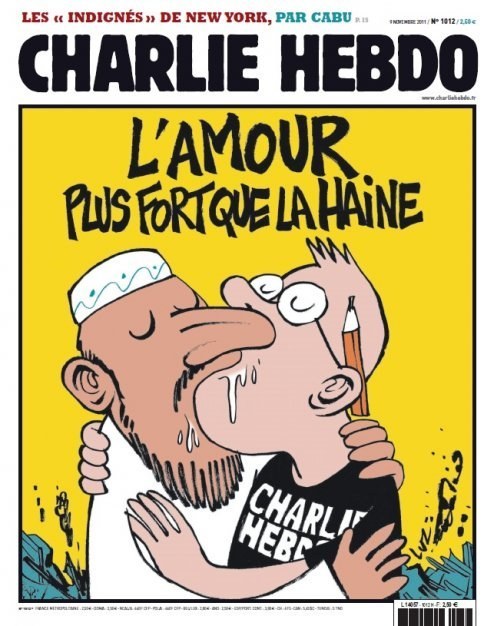
(Top cover translates to “Love: Stronger than hate.” Middle cover depicts Catholic bishops discussing how to get away with pedophilia. Bottom cover is the aforementioned one featuring a caricature of the Houellebecq.)

Faces Of The Day

Lawmakers Convene For Opening Of The 114th Congress

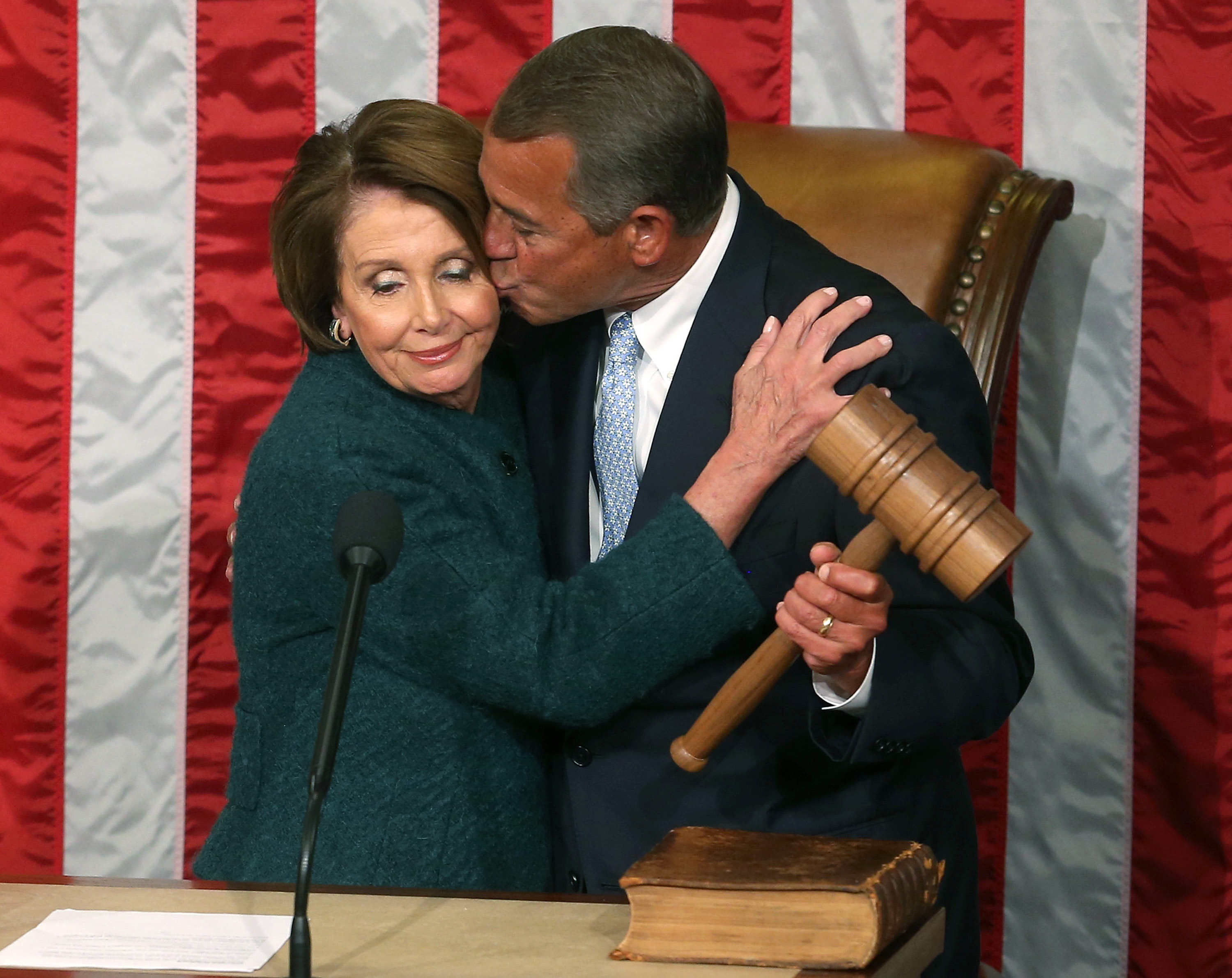
House Minority Leader Nancy Pelosi (D-CA) hands Speaker of the House John Boehner (R-OH) the speaker’s gavel during the first session of the 114th Congress in the House Chambers January 6, 2015. Boehner maintained his speakership but with two dozen House Republicans voting against him. Today Congress convened its first session of the 114th Congress with Republicans controlling both the House and Senate. By Mark Wilson/Getty Images. Update from a reader:

Good Lord, at first glance I thought this was Obama and Pelosi. Why is Boehner so dark in this photo?

Sledding Runs Into Legal Trouble

Dubuque, Iowa is banning sledding in 48 of its 50 parks. And they aren’t the only ones:

Local governments can be held liable for injuries that occur in parks and other public areas—and with at least 20,000 sledding injuries occurring in the US each year, public officials have plenty of potential lawsuits to be wary of. For this reason, as the Associated Press recently reported, a growing number of US cities are banning sledding on public property. Following sledding accidents, one Nebraska family won a $2-million payout from the city of Omaha and another family secured a $2.75-million settlement from Sioux City, Iowa. Both cases involved individuals who survived their accidents but were paralyzed for life.

Wilkinson disapproves of being so cautious:

Americans are not so much unusually litigious as unusually fearful, and this fearfulness extends to the prospect of lawsuits.

The occasional jaw-dropping award in a personal injury or class-action lawsuit creates, like the occasional terrorist attack, a salient sense of pervasive danger. It’s not that Dubuque or Des Moines suddenly faces a new and extraordinary risk of getting sued into oblivion. It’s just that the risk, as small as it is, now looms larger in the imagination, becoming too great for the no-longer-bold American spirit to bear. Shutting down sledding hills is inspired by the same sort of simpering caution that keeps Americans shoeless in airport security lines and, closer to home, keeps parents from letting their kids walk a few blocks to school alone, despite the fact that America today is as safe as the longed-for “Leave It to Beaver” golden age.

As an American (and Iowan!) I find this sort of flinching risk-aversion profoundly embarrassing. We might like to locate the blame for things like sledding bans somewhere out there in the unruly tort system (and indeed Messrs Ramseyer and Rasmusen do), but we must face the possibility that the blame also lies within. Perhaps it’s better to be safe than sorry, but one wonders whether we won’t become sorry to have made such a fetish of staying safe.

Update from a reader:

Dubuque is actually my hometown. Most of the parks aren’t sleddable (is that a word?) anyway. Some are tucked away in residential neighborhoods and fairly flat. Those that aren’t don’t boast hills as much as rolling terrain or they are boxed by homeowner’s landscaping and fences. The only two with decent sledding are the two that the ban doesn’t include – Bunker Hill, which is part of the public golf course and Allison Henderson, where the sledding hills lead to what used to be the outdoor ice rink.

But the heyday of public sledding hills – in Dubuque anyway – ended long ago. I have an old home movie of my parents, uncles and cousins sledding at Bunker Hill one Christmas back in the early 1960s. It includes a shot of my Uncle Jimmy and my mother narrowly avoiding a collision with another sled piloted by a child. The hills resembled a ski resort crowded with adults, teens and kids. Conditions that really haven’t existed for years. Probably not since I was a young adult myself.

I wonder if the “uproar” is really just nostalgia rather than actual despair. Who takes their kids sledding anymore? What kids venture out of their homes to sled on their own?

When I was a kid, we were out on the hills all day and back out in the evening with back porch lights on at nearly every house to light our way. The proliferation of fenced yards in the late ’90s eventually closed down my old winter sledding heaven but there were few sledding in any case. The winter activities that survive are “sports” now like skiing and snowboarding. Activities that require expensive equipment, memberships or day passes.

Sledding was just fun. Maybe that’s why it faded away and became a liability?

Leelah Alcorn’s Last Words, Ctd

A reader focuses the Dish discussion:

There’s a pretty basic point that may deserve explicit mention. A major purpose of puberty-blocking drugs, in particular, is to DELAY the moment of decision until one is prepared to decide. One can discontinue these drugs and undergo puberty later on, with no further intervention. I understand fully why people would be worried about young children making complex irrevocable decisions about their own well-being. What I can’t understand is why those people are against puberty-delaying drugs, rather than being fervent advocates!

Here’s a helpful NPR interview of two doctors who specialize in these issues. Money quote:

How long do you use the hormone blockers to suppress puberty?

Until around 16. Then you use the cross hormones to bring on the characteristics of the opposite sex. And remember, if you just stop the hormone blockers at 16, the person will go right back to genetic puberty within months. So the beauty of the suppressant is not as a treatment but for prolonging the evaluation phase … ’til a young person has greater ability for abstract reasoning. It buys you time without a tremendous fear of their body getting out of control.

That interview was from 2008. From September:

[A] new study finds that the results of such treatments are very positive. … Lead Author Dr. Annelou de Vries explained to CBS News that puberty suppression is a “fully reversible medical intervention” and the extra time allows the young people to work out their struggles related to gender dysphoria before taking permanent steps toward a transition.

Back to the in-tray:

I think many readers are missing Leelah’s point regarding appearance.  The question is not attractive versus unattractive, but rather being “visibly trans” versus “not-visibly trans.”

Transitioning early does not ensure you look like Cindy Crawford, to utilize the example of one reader.  Rather, it helps to ensure that the transgender person is not thrust into a life where merely walking down the street threatens their physical safety.  A trans woman was stabbed on a bus in San Francisco the other day while simply minding her own business – all because the perpetrator (correctly) assumed she was trans from her appearance.  In a perfect world, “looking trans” wouldn’t be a problem, wouldn’t lead to violence or discrimination – but it does. To subject a person to a life with that type of physical and economic hardship because of an abstract point about beauty is cruel.

And again, early transitioners aren’t guaranteed “beauty.”  And it’s not nearly as superficial as some readers suggest – quite the contrary. Additionally, the mere outset of puberty and the ensuing physical reactions (body hair, lowering of voice) induces the medically demonstrable experience of gender dysphoria.  Denial of access to transition related medical care is a leading contributor to suicide, not merely because of the potential long-term consequences outlined above, but because the real-time denial of an identity is emotionally traumatic for transgender people.

Puberty blockers are reversible, but, even still, are only prescribed after a thorough medical process, extended gender identity assertion, and conversations between parents, children, and their doctors.  That’s why this process is quickly becoming the medically and psychologically recommended course.  I understand the initial negative gut reaction to allowing a child to transition genders.  It seems like a big step, and kids are fickle, after all.  Indeed, I’m sure many of the parents who eventually let their kids transition initially feel that way.  People are obviously entitled to their own opinions, but not their own facts.  The facts, and, thus the growing medical consensus, is on the side of allowing children to transition.

Update from a reader:

I have been wanting to share my experience (and my partner’s) on this topic for some time. We are both lesbians. We are both very comfortable with our gender. When we were growing up, however, we both wanted to be boys.  We dressed like boys.  We played mostly with boys. We always chose to play the boy role. It wasn’t until puberty that those feelings changed. I am not sure why that was, but they did. We no longer wanted to be boys. All this is to say that blocking/delaying puberty, which for me, and other lesbians I know, changed the way we felt about ourselves, isn’t risk free.

Another:

Your reader describes how she and her female partner both “wanted to be boys” until puberty, and then got comfortable being females. It may not be possible to know for sure, but this sounds very different from the transgender experience. I do not hear about such people “wanting to be boys” (or girls) as children, but always as insisting that they are boys (or girls). That seems like a fundamental difference.

Another notes:

This entire discussion reminds me again of why I’m so grateful you curate comments for discussion of a topic, rather than have an open comments section. I’ve never seen anything like he cesspool that is the Leelah thread going on at Datalounge. I have no doubt this is what a Dish “comments section” would look like right now if one existed, not because most of your readers share these views (or most Dataloungers share these views), but because this is how it always goes with open comment sections on hot button topics. The rational and reasonable on all sides of a debate flee in droves because of the vitriol, and then the bottom feeders really take over, racing to outdo each other in saying the most repulsive things about each other and people like Leelah.

If The Earth Were To Stop Orbiting …

… we would slowly fall into the sun. Aatish Bhatia provides a timeline. Here’s what Day 35 would look like:

It’s been over a month of Earthfall, and we’re now 20% of the way to the Sun. The Sun in unbearably bright and intense, and noticeably larger in the sky. At 58 C (137 F), the average global temperature now exceeds the historic hottest temperature recorded on Earth, which was 56.7 C (134 F) measured in Death Valley, CA.

For most people on the planet, it’s now impossible to stay alive without air conditioning, and the electricity infrastructure is either tapped out or failing. Forest fires are ravaging through the wilderness. Land animals that can’t burrow in to the soil to get respite from the heat are going extinct. The insects, too, are feeling the heat and dying out. The increasing water temperature will cause fish to start dying out, because warmer water holds less oxygen and more ammonia (which is toxic to fish), and because the entire marine food chain would be disrupted and collapsing.

It’s so hot that even the Saharan silver ant, one of the most heat resistant land animals on Earth, can no longer survive the heat (for it can stay alive up to 53.6 C). However, the Sahara desert ant is thriving – it can survive surface temperatures of up to 70 C. As scavengers, these ants feed on the corpses of other creatures that have died from the heat, and there’s now plenty of food to go around.

Update from a reader:

I’m sure I won’t be the only person to point this out, but I think the title “If The Earth Were To Stop Spinning …” is a bit misleading.  The hypothetical scenario that the post presents is where the speed of the Earth’s orbit around the Sun is reduced to zero, not if the Earth stops spinning around its own axis, which is what the title sounds like. Now, it wouldn’t work out so well for us either if the Earth stopped spinning around its axis, but at least it’s a different sort of problem.

Collectibles Made Of Ones And Zeros, Ctd

A reader sits up:

Woah woah woah! To the reader who wrote “now we can add baseball cards to the list of digital collectibles such as … nothing else, because people don’t collect digital goods,” I would counter with “Magic the Gathering”, a trading card game (famous enough for a recent South Park homage) with an online collecting / playing community that might rival its cardboard sibling.

Remember when the missing Bitcoins at MTGOX made headlines? MTGOX, or “Magic the Gathering Online Exchange” was an online marketplace for exchanging online MtG cards? There is no way to turn physical cards into digital ones, and (for the most part) there is no way to trade digital ones for physical. And yet, as of 2007, MTG Online accounted for upwards of 50% of total MTG revenue. That’s roughly $125 Million a year! In digital-only collectible objects!

At the end of the day, digital collections just make sense for some markets. They don’t lose value due to wear, they are easier to maintain, and trade/sales are much easier to setup. I’m not saying go burn all your hardbacks and buy Kindle copies; just don’t be surprised when the digital collection becomes the norm and not the deviation.

Update from a reader:

You’re reader ignores a few crucial differences between the different “digital objects” he describes.

First, we’ll take Magic cards. Magic: The Gathering is a trading card game with two general ways to play: limited (opening fresh cards to build with) and constructed (using decks built by the player before the tournament). Both of these require particular “packs” or “cards” to build the appropriate deck. Without paying for the digital objects, you literally can’t play the game. Similarly, Kindle books have real utility: you have no other way to read the book short of buying it in some other format.

Baseball cards, however, have no such “use value” outside of looking at pictures and statistics. Unfortunately for Topps, pictures and statistics for major sports figures are easily found via Google, ESPN, or any number of great online resources. While there are also ecosystems of Magic and Book-related content, none of them replaces the actual activity of reading/playing in the way that these sources do for baseball cards.

TL;DR: Digital books and digital magic cards have use value. Digital baseball cards are just digital Beanie Babies.

Another:

Your “update from a reader” gets some major points wrong about digital Magic the Gathering (MtG) cards. Buying online, digital-only cards is not the only way to get that use value out of those cards.  There are any number of web sites where I can play “Constructed” or “Limited” or any of the other variants (there are a lot) without paying a single penny for a card, digital or otherwise.  They implement the entire library of available cards and all of the various rules.  No different than I can look up stats of baseball players on any website.

The only reason to purchase those cards is the same reason a person purchases baseball cards: to get them from the official licensed vendor where scarcity is real (if artificially introduced).  This is the classic definition of a collectible and digital MtG cards are in no different.  I collect digital MtG cards for the same reason someone collects baseball cards, there’s just happens to be a game you can play with your MtG collection if you choose.

Do Cops Treat Blacks And Whites Equally? Ctd

Many readers are pouncing on this email from a white police officer:

While off duty, I’ve been pulled over at gunpoint and have been treated like crap and yelled at for no reason by cops. Every time it was my fault because I had committed a traffic violation.

WHAT?!  Since when is it normal/acceptable for a routine traffic violation to turn into a drawn gun? If a cop thinks that is normal, there may be a bigger issue with policing then profiling.

Another reader on that quote:

Look, I know cops are people too, and can have a bad day like the rest of us. But the entire reason basis for entrusting police officers with the power of the state to threaten and inflict violence, even lethal force, is because we trust and train them to be professionals and act that way. What the reader describes is nothing more than state-sanctioned thuggery.

Several more sound off:

Perhaps those accusing the cop of racism have had the experience of being pulled over, stopped or frisked so many times they start to suspect every time. It’s human nature. The reader’s experience only confirms that these men have been overwhelmed with bad experiences with cops.

I’m a white male. I’ve only been pulled over for no reason once in my 50 years, while I was driving my brother’s red Porsche. I’ve never been followed in a store. But my 13-year-old black adopted daughter, a straight-A student who is honest to a fault, has been followed in stores, stopped by police or questioned by strangers at least a dozen times, almost all of them for no reason whatsoever. One time I watched a store manager follow her around for 15 minutes while all the white kids in the store went unnoticed. These would be all anecdotes except that the data supports the anecdotes, including the one you just posted about off duty black cops.

A lot of white people just need to wake up and develop a bit of empathy.

This reader did:

The latest post from the cop who got accused of being store security reminded me of an incident that happened almost exactly ten years ago. I was waiting for my wife to get off work at the Macy’s at the local mall so we could do some Christmas shopping, so I was wandering the departments. After about half an hour, a black woman confronted me and asked if she could help me. Lost in thought, I mistook her for a sales associate at first and said no. I don’t remember what she said next (okay, I admit, I was a little stoned at the time), but I do remember her gathering up her kids and exiting the store, leaving a basket behind with some items in it.

When I asked my wife later, she figured the lady had mistaken me for security. Apparently that store was locally notorious for their “Loss Prevention” tactics and would follow and sometimes harass people. I’m 6’6″, white, and at the time was recently discharged from the Navy and still sported a relatively fresh military haircut. I was probably wearing my Navy Exchange boots at the time. I probably looked just like a cop trying to blend in.

Anyway, I really felt for that lady. She was having a bad day and I made it worse without even realizing what was going on.

P.S. I guess an alternate explanation is she didn’t want to be in a store with an enormous stoned guy. But I was keeping to myself!

One more reader excerpts another quote from the cop:

Re: “The truth is, people perceive racism when there is none in order to avoid taking responsibility for their actions” … this is part of the poison of racism. It makes it difficult for everyone, of any race, to perceive situations as race-free. If you’re accustomed to you and friends and family members being racially harassed by cops, then you perceive cops as engaging in racial harassment even when they’re not. It may have nothing to do with whether or not you’re willing to take responsibility for your actions.

As Lord Chief Justice Hewart put it, “Not only must Justice be done; it must also be seen to be done.” The purpose of a justice system isn’t merely to settle affairs of private conduct; it’s also to assure the public that the government is fair. Racism corrodes that assurance, even when the government is trying to be fair.

Update from the white cop who wrote in:

To clarify, it’s not normal or acceptable for a routine traffic violation to turn into a drawn gun, but not every traffic stop is routine. Out of the thousands of stops I’ve done, I may have drawn my gun 10 times. The point I was trying to make wasn’t that it’s normal for a stop to go that way; it was that when they do, it’s rarely a result of race. Perhaps I should have went into more detail in my story.

It happened around 2 or 3 am and I was driving home from my parents, half asleep (no I wasn’t drinking). When the cop turned on his lights to pull me over, I looked down and realized I was speeding. At the time I was driving a car that had really dark tint on the rear window. The tint made it extremely difficult to see into my car from behind. I reached down for my wallet and suddenly I hear the cop ordering me out of my car with my hands in the air. I get out and see I have a gun drawn on me. I identify myself and show my badge. The cop then approaches me and explains he couldn’t see through my rear window very well and saw me reaching for something. He was worried I was reaching for a gun and took precautions to protect himself.

At the end of the day it was my actions that led to the encounter. If I had left for my house earlier or slept at my parents, I would have been better rested and perhaps been more cognizant of my speed and not pulled over. Also, if I waited until the officer approached me to retrieve my wallet, I would have never been ordered out of my car.

Personally, I understand why the cop did what he did, but realize some (most?) people are going to read that and think the cop overreacted. In the cop’s defense, yes I was only reaching for a wallet, but what if I had been reaching for a gun? It’s easy to judge a cop’s decision in hindsight, but the question is what would a similar person do in the same situation.

Admittedly, 99% percent of the time a cop draws his weapon, it turns out to be unnecessary. The problem is we have no way of knowing which time will be the 1% when it is necessary. People often say we knew what we were getting into when we took the job. The thing is we agreed to risk our lives, not sacrifice them. As cops we do what we can to minimize the risk to ourselves.

Leelah Alcorn’s Last Words, Ctd

Screen Shot 2015-01-02 at 1.12.10 AM

A reader notes that Leelah was also posting on Reddit – here and here. Another continues to question the conventional narrative:

Yes, it’s a tragedy that she didn’t feel accepted by her parents and had to endure Christianist “therapy.” That said, her decision to step in front of a truck was a terrible and selfish one. I’m sure being transgendered is hard, particularly if you have to deal with bigoted parents. But when I read her postings I hear a typically – I dare say even beyond typically – self-centered 16 year old. No matter how just her grievances, she chose the worst and most selfish way to get satisfaction.

We know that glorifying suicide can bring a rash of copycats. There was no glory in anything she did. Millions of people in this world have suffered worse but didn’t ruin a stranger’s life by forcing him or her to be the instrument of her death. If it were my blog, I’d ignore this particular story and instead focus on a more mature example of responding to transgender intolerance.

The Dish has actually covered the subject of trans children and teens pretty extensively, including posts such as When Is A Kid Truly Transgender?, Transgender Six Year OldsThe Father Of A Transgender 10 Year OldPuberty On HoldIntegrating Trans Kids, The Youtubes Of Trans Teens, and Transgender In A Small Town. And we had a long thread here on “pink boys” who dress and behave like typical girls but who are not transgender or gay. Another reader:

Why are all gender non-conforming kids being actively encouraged to transition or to take puberty-blocking drugs?

Maybe in a subset of the community this is advisable, but check out the trans reddit forum or any online trans forum and you’ll see adult transwomen actively encouraging kids in their early teens to get on hormones (as if they didn’t have enough raging through them) in preparation for transitioning. Sure, there may be some truly gender disphoric kids who need help, but all you have to do is “question” on one of these forums and you’re encouraged to pursue medical intervention.

Sorry, but WTF?  We’re relying on children – and Josh/Leelah was absolutely still a child – to self-assess?  I would have liked to have been a pretty girl when I was 13 or 14, but I ended up a perfectly happy adult gay male.  Yeah, I get that it was harder for me, but I can’t imagine as a confused kid of that age being told I was trans and that “I’d never be a pretty woman” unless I started transitioning before puberty.  Why isn’t anyone calling the trans community out on this gross misogyny?  What’s wrong with fem gay guys and butch dykes?  What’s wrong with ugly women?

Update from a reader:

I am touched by the story of Leelah’s suicide, but more, I am spurred to react to the person who pointed out the selfishness of Leelah’s suicide. Suicide is ALWAYS a “selfish” act in our society. The fact that Leelah added to the selfishness by involving another person is beyond the point. She was desperate, hopeless, driven to the ultimate act of self-destruction by the self-centeredness of everyone around her who scorned/condemned/renounced her. Her parents and the world wanted her to conform to a very narrow parameter of Acceptability, and she couldn’t be what they insisted she be.

How many people, not just transgendered, feel the same despair at being different? How many suicides are caused by society’s lack of compassion, or harsh judgement about the way we think or feel, or who we are or what we need? Look at any media page and the comments to see how readily people flock to the snark, the vilification, towards any who might opine something outside the box people seem to want to put everyone in. It is amazing to me, especially given the “Christian Nation” we’re so often told we are.

I say let’s start pushing to be interested in what makes us different, and how that makes us wonderful. And, like your reader who wants to discuss Race vs. IQ, let’s have conversations that don’t immediately devolve into finger-pointing and rude comments about how “oh, you’re one the Them!”. As to the “selfishness” of Leelah, let us forgive a 16 year old her thoughtlessness and, instead, focus on what drove her to do what she did. Let’s look at our own selfishness, too.

Read the long Dish thread on suicide here.

Collectibles Made Of Ones And Zeros

Baseball cards have gone digital:

David Roth remembers the good old days:

If any or all of this is mind-bending to you, you are probably not Bunt’s target audience. Eighty-one percent of Bunt users are between the ages of 13 and 25, and as such find nothing terribly weird about a baseball card that doesn’t exist in any corporeal sense. But as a comparatively doddering 36-year-old, I felt both old and weirdly, preemptively tired—like, octogenarian-on–Yik Yak tired—in my engagement with Bunt.

[Michael] Bramlage [a VP at trading card company Topps] is right that the younger demographic is “very rational” in its preference for phone-bound virtuality over fragile cardboard—a photo on Instagram is indeed more reliably backed-up and more readily shared than one in a scrapbook—but I’ve never known baseball cards as anything but baseball cards. Having traded them with classmates on a literal gravel-and-hormone schoolyard did little to prepare me for the scaled-up proposition of trading them on a sprawling virtual bazaar.

But he finds some similarities:

[B]aseball cards only exist as an investment because we—kids and adults, all of us held in that tenuous balance between the two that fandom demands—choose to invest these cardboard rectangles with value in the first place. These cards are worth what we decide they’re worth and only that much, and that has always been true. One generation’s cards are neglected in dust-shrouded boxes; another’s move and grow, relentlessly, in the permanent mint condition of the Internet. Which seems more valuable to you?

Update from a reader:

So now we can add baseball cards to the list of digital collectibles such as … nothing else, because people don’t collect digital goods. Home computers have been around for 30 years and I can’t think of a single digital collectible. There’s a small market for replaying old games though those are generally simple games that, aside from the nostalgia value, are legitimately competitive with basic indie games when it comes to gameplay. And either way, I don’t think anybody is making much money off them.

A collectible needs scarcity and age to be valuable. But with digital goods, scarcity means DRM, which means being tied to a specific device or organization. The moment you add DRM you lose the ability to have old files, so you no longer have collectibles.

Take away the collectible aspect – the idea that your card portfolio could exponentially grow in value – then what do you have left? It’s all down to the fun of swapping these digital cards, but without that anchor to the real world (and real value) I’m not sure how they succeed.