Busted With An Eggcorn, Ctd

More tumble in:

An example of an eggcorn has stayed alive in my memory for many years.  A coworker, a smart college student, referred to an injury as having left whelps on his arm.  Unable to resist, I started my version of canine howling.  He quickly realized he was using the wrong term and we would howl together when other poor souls misused the word thereafter.

Another:

I didn’t know this thread was still active, so here’s my eggcorn. 

My wife and I were watching a cooking show and the segment was on beef roasts. The chef said we should cut the FAT CAP off the roast prior to searing it. My wife heard it as FAT CAT. Yes, that layer of fat on a roast can look like a cat, if the cat has white fur. I liked her description better and it conjures up the whole idea of skinning the fat cats with tax increases, which I think is a good idea.

Another:

I know now the Pennsylvania illustrator I interviewed for a class essay said she would give up illustration if it ever lost that “olfactory feel,” but what I heard at the time, and what found its way into my essay, was “that old factory feel.” I thought she meant to rough feel of paints and turpentine, but she meant the aroma of paint and turpentine. I did not catch this until several years later, rereading the essay.

Another:

No funny story, but I have heard this on occasion: Rock-weiler instead of Rottweiler.

Another points to Wikipedia:

Commander Lloyd M. Bucher was psychologically tortured, such as being put through a mock firing squad in an effort to make him confess. Eventually the Koreans threatened to execute his men in front of him, and Bucher relented and agreed to “confess to his and the crew’s transgression.” Bucher wrote the confession since a “confession” by definition needed to be written by the confessor himself. They verified the meaning of what he wrote, but failed to catch the pun when he said “We paean the DPRK [North Korea]. We paean their great leader Kim Il Sung”. (The word “paean” sounds identical to the term “pee on” in American English.)

Update from another:

My boss, complaining about new regulations in the mortgage lending industry in the ’90s: “We’re getting raped over the coals.”

Another:

Many years ago, I listened to the radio while applying makeup before going to work in the morning. I usually heard, with not much interest, the announcers giving baseball scores and accounts of the previous day’s games. Some years later I delighted my husband and his best friend by relating my understanding of the expression, “there’s one up in the win column.” I had heard it as “wind column.” Made perfect sense to me. The ball had been caught by the wind and gone higher than usual, resulting in a score.

One more:

When my wife and I were young and very poor, we went to a free clinic in Ocean City, Maryland to get birth control. In the waiting room we eavesdropped on a couple younger than ourselves, so they must have been teenagers. The girl went in, had her exam, came back to report the results to her boyfriend and announced that she needed a pap smear. To which her boyfriend, mystified, said, “The doctor says you need a Pabst Beer?”

Beard Of The Week

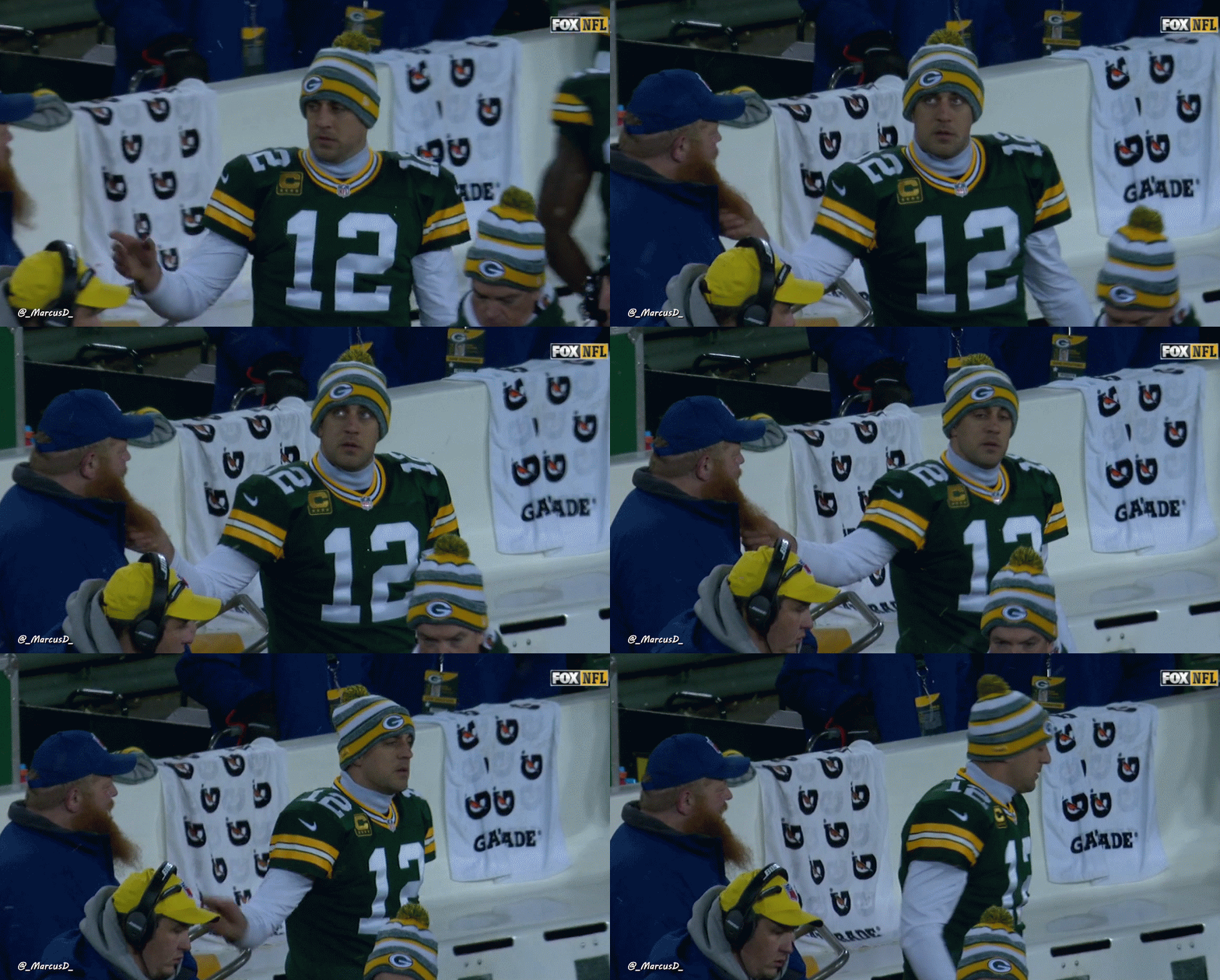
beard-tug

The back-story:

That bearded guy who’s apparently [Green Bay QB] Aaron Rodgers’ good-luck charm? He’s Wausau’s Jeremy Wilcox.

Wilcox, whose company is a Lambeau Field contractor for the Green Bay Packers, caused a social media stir when FOX Sports TV cameras caught Rodgers tugging the man’s beard right before he re-entered Sunday’s game against the Detroit Lions. Rodgers injured his left calf right before the half and sat out two series before returning in the third quarter to lead the Packers to a 30-20 victory that secured a first-round playoff bye and a home game. … [F]ans are joking that Wilcox’s beard was pivotal in the Packers big win.

No joke. James Dator counts the ways:

There are three good reasons pulling this beard is important to Aaron Rodgers.

– It’s a beard that brings him luck.

– He’s wistfully remembering his own beard.

– The beard’s essential oils soften his throwing hand in preparation for the Packers next drive.

Previous BOTWs here. Update from a reader:

You missed the best part of the beard story: “It’s red and 9 inches long, and #Packers quarterback Aaron Rodgers tugs it for good luck”.

Heh.

The Best Threads Of 2014: “The View From Your Obamacare”

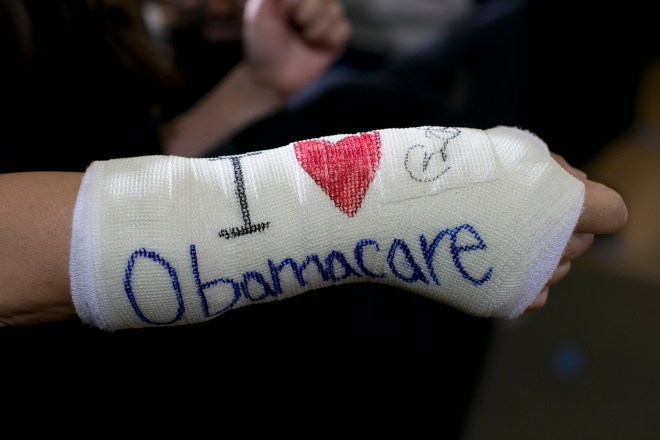
President Obama Visits Boston To Talk About Health Care

The latest reader thread we want to highlight centers on your personal experiences with the ACA – mostly good, some just okay, a few terrible. Read the whole collection here. Several more of your stories are below, aired for the first time:

I’m 43 and was laid off last year from one of the major banks.  I fell off a ladder about five years ago and ended up having four surgeries to get it all straight.  Besides that, I’ve got ADD and generic meds, but no other major health issues.  I was pretty surprised to be denied coverage by a few companies when trying to get it myself last year.  When Obamacare activated, I was surprised that I got subsidies as a member of the upper-middle class and able to get affordable coverage while looking for a job.  When I did get a contract job, I looked into health coverage.  What the contract company was offering was over twice what I was paying on my own!  The benefits weren’t even that different.  I kept my plan through healthcare.gov and am very happy for it.  For an income around $100k, I figured I’d make sacrifices for the greater good, but I’m actually seeing benefits.

Another reader:

My extended family’s Obamacare success stories come with a huge helping of Republican epistemic closure.

First, the successes.  My 52-year-old brother retired early from working in a manufacturing plant for 30 years and started his own small business.  His house is paid for and he is extremely frugal, so his business provides a comfortable yet modest living.  However, he could not afford to purchase insurance just for himself before Obamacare, so he went uninsured.  Now he pays $53 a month for a plan that is very similar to what his girlfriend has through her employer.  Success!

My niece was able to stay on her parents insurance while she went to grad school for nursing.  Success!

My cousin has a 24-year-old son with spina bifida.  With that preexisting condition, it would have been almost impossible (and unaffordable) to find insurance to cover him once he was off his parents’ policy.  Now with the law restricting insurance companies from denying coverage for preexisting conditions, he will be able to enter the workforce with no worries about his coverage.  Success!

Now the epistemic closure part.  Even with all of these personal examples, my extremely Republican parents have been brainwashed by Fox and still think Obamacare is the worst thing ever to happen to this country.  They are convinced that their Medicare will be taken away and they won’t be able to find any doctors.  They are convinced that President Obama just wants to take all of their money and give it to poor people.  I have stopped trying to educate them with facts and real examples because it is no fun beating my head against a brick wall!

Another:

I am a surgical specialist.  My politics would be RINO, but in this day and age, I vote “not Republican”, as I do not believe the party can be trusted with power nor to govern.

ACA is basically a Rorschach test for partisans.  I’m personally for it as a first step towards a better system, so maybe I’m biased.  I see someone every week who now has healthcare who didn’t before.  Unfortunately, these are often neglected issues that would have been better managed in the past, but at least they have a way now to get care.  I also may be unique because I am uninsurable outside of a group plan due to a personal history of blood clots.  I was turned down by every single insurer despite being fit, no other health issues, and a lifetime risk of clotting again of 8% with no medications or 3% with Coumadin, 10.00/3 month supply.

I practice in a blue-collar area with plenty of uninsured and I’ve watched my income plummet with the economic downturn.  I found that about 1/2 of my head-and-neck cancer patients were uninsured and I had to eat the cost of their treatment – no more; this year so far everyone has had insurance.  Medicaid doesn’t pay much, but it is better than nothing.  The homeless guy I operated on last week came in with his tongue cancer small enough that it hasn’t spread to the neck and his surgery should be all he needs.  That saves the cost and morbidity of radiation therapy.  Sure, he is being paid for by the state, but the cost was much less than what it would have been had he hit the ER in a few months with metastatic disease.

I also had a guy follow up today who is no longer insured since losing his job recently. My right-wing office manager of course blames Obamacare.  I had a gentleman last year who was in the union but for some reason hadn’t been working. He had refused working a certain job since it would have been on a concrete floor, which is hard on his back.  I don’t know the other details, but he had opted to not get his Cobra, and being a 62-year-old smoker and drinker, he has some risks.  He tried to buy Cobra, but he was 20 months out – and of course, he blamed Obamacare for his inability to get Cobra. I don’t bring politics into the mix, but the only reasons he’ll ever get insurance again is because of government programs.  Good luck finding a private insurer who would touch him.

Those who love purely private medicine should ask how would a 78-year-old diabetic with heart disease gets insurance, and what would be the cost?  How does someone with MS get health insurance on the private market if they are single and unable to work?   Look at dental care. (This is healthcare, but that’s another argument.)  A sizable percentage of the population has untreated dental disease.   One-half of my on-call weekends are spent dealing with neck abscesses related to dental infections.  Many of these people are uninsured. And the classic story is they had dental work done, had to pay a bunch of money in cash, developed an abscess, were treated with oral penicillin, got worse and were sent to the ER, where the rest of us treat for free.

I see at least one case a week where the ACA has helped someone get insurance and I have yet to see a case where it hurt.  I am sure there are 25-year-olds who didn’t have insurance and who didn’t have a healthcare issue who are financially hurt, but the fact is, statistically, some of them do get sick, injured, etc … and not having coverage is not acceptable to society who has to eat the cost.  Believe me, I’ve fixed dozens of facial fractures on young men with motorcycles, fast cars, or big mouths who didn’t have insurance.

I also do not understand the greed of many.  I have colleagues who makes 3X what I make yet they feel they are being screwed.  I make a very good living and it bothers me that I see people who are poor and have to do without basic care.  I do not think that everyone should make the same amount of money, and I feel my work is worth more than most, but I also grew up lower middle-class and I can’t fathom not caring that hard working people or children unfortunate to be born to bad parents suffer needlessly.

But another dissents from the others, quoting me:

I’m not sure that “Obamacare is as big a liability for Obama this fall as the Iraq War was for Bush in 2006″, but I do think it will potentially be used as a HUGE negative, even for many who voted for him and other Dems in the past few elections. And I believe that if the Democrats do not quickly grab hold of the reins and prepare well and cleverly and early on to counter what will be the number one issue to beat about the head and shoulders of our candidates, we will most definitely lose the Senate and eventually the presidency. Why? Because many of those hardest hit by the worst unintended effects of Obamacare are middle-class independent and Democratic voters.  And they are feeling betrayed and pissed and afraid for their financial safety.

Most of us who supported health care reform did so out of a sense of empathy and fairness; we were tired of seeing so many people going without decent health care, were angry hearing the nightmare insurance stories in which children were denied cancer treatment, in which the mentally disabled and chronically ill and employed but uninsured got all their care through emergency room visits. We wanted our kids covered longer because college is costlier and taking more time to complete, much less find employment after graduation.  We were tired of having our local communities and hospitals and ERs having to foot the bill for the low-income uninsured, for being forced to absorb the costs of long-neglected conditions that ended up being hundreds, thousand and even hundreds of thousands of dollars when decent primary care could have prevented the illness. We thought it was not only stupid financially; it was morally wrong and wanted to find a way to fix it, smartly.

What we all really wanted, whether we knew it or not, was a single-payer/public option that was affordable and spread out the risk nationwide to make all of our out of pocket costs go down. Instead we got the worst possible “free market” solution they could dream up in DC. 

Far too many of us in the middle class – those of us with one or two job incomes and employer provided health insurance – have been financially REAMED by Obamacare – by the tax changes; by the way this law has been manipulated by our employers and insurance companies to pass on their costs to the individual; by the increase in costs and reduction in benefits in an economy that is stagnant and in which most of us haven’t had a raise in years.  Too many people who supported reform, who voted D, who out here are making moderate incomes and dealing with the competing financial demands of raising families, paying for college costs, helping their elderly parents and now desperately trying to save for their retirements (there are no pensions anymore, don’t forget) are being hurt financially by this law, and unfairly so. And – whether I agree with this or not – it’s all being blamed on Obama and the ACA.

Example: I work as an RN at a medium-sized corporate hospital that offers our employees a really shitty BCBS plan. We staff nurses averaging about $50-60K/yr in earnings and many of them are single parents. I am blessed to be able to opt out due to my spouse having coverage (excellent coverage) as a federal employee, but my friends do not.  Over the past two years, they have seen their deductibles jump to $6000K/yr or more, with co-insurance of 20-30% or more pharmaceutical “co-pays” have jumped to ridiculous levels.

This winter several of my co-workers had to pay almost $60 for a generic albuterol inhaler during their recovery from the various flu-bugs we all got. My coworker’s 12 year-old daughter has juvenile diabetes and she pays hundreds out of pocket monthly for her insulin and supplies. Remember that $5000/family tax-free flexible health savings account we all could sign up for in the past? You know, the one where you set an annual amount to divide up like a loan and put into an account that will advance you the money up to your elective limit for health costs?  Well, “Thanks to Obamacare” it’s been cut to $2500, and believe me that goes fast. One of my coworkers had to take both her small children in for abscessed tonsillectomies and it cost her $3500 dollars, out of pocket,  on our hospital’s wonderful BCBS plan. 

I’ve seen more formerly uninsured people get covered, which is fantastic, but now my hardworking peers approaching middle adulthood with diabetes, hypertension, chronic autoimmune disorders like lupus, funny moles on their skin, obstructive sleep apnea, depression and a whole host of health issue are JUST NOT GOING TO THE DOCTOR ANYMORE.  If it’s not free or catastrophic, they’re crossing their fingers and hoping a trip to the health food store or some meditation will fix their problem.

Yes, they get the low-cost, required “essentials and annual freebies”, but in general, too many of us had better out-of-pocket costs before Obamacare (and even then we were sometimes stretched to pay those).  Since we’re insured by our employers, we don’t meet the stringent numbers to qualify for subsidies on the exchanges, so even if we wanted to opt out and buy there, we’d pay even more in premiums than we do now. I am exuberant that my kids can stay on our health insurance until they’re 26, and that my 29-year-old son would have insurance right now after not having any for four years if he had not finally found a job with it as a benefit.

And I won’t even tell you ALL the ways business is blaming Obamacare so that they can ruthlessly make cutes, refuse raises, and generally squeeze out profit and then dump the hurt on their employees.  At our hospital, ACA is blamed SPECIFICALLY for the layoffs and cost cuts that are hurting the quality of care and safety we offer our patients. They have forced on us increased nurse-to-patient ratios and cuts to CNA caregivers, which has resulted in poor outcomes and even a few serious harms to patients.

Physicians at our hospital are miserable, and spend less time on patients and more time trying to learn and use our electronic medical system . It’s clunky, out-of-date and creates serious errors, but because corporate is cashing in on CMS bonuses in reimbursements by implementing electronic medical records now, they are more concerned about their bottom line than doing it well. So they refuse to purchase better software and the doctors yell and insult and dodge putting in orders (which means WE have to step away from the bedside to do it for them.  Worse, they take their business elsewhere down the road, which in turn results in days off for us due to fewer patients in our unit.

Patients are unhappy and give us poor “Patient Satisfaction Scores” because no one answers their call lights fast enough, so they wet their pants, their food sucks and their rooms are dirty longer than they used to be and the equipment looks like something donated to a Third World hospital in Africa, so they don’t trust it.  My CCU is an oasis of relative safety, mostly due to Medicare reimbursement rules about ratio’s and standards of care, but we are struggling every day and stretched way too thin, and we all worry about the looming “sentinel incident” around the corner that hurts or kills a patient and costs us our license.  Would YOU like your nurse to be distracted from your open-heart surgery recovery because she has to leave your bedside to answer the phone, buzz in visitors, deliver food trays, enter medical orders for cranky doctors, answer call lights for water for other patients, and cant get your emergency cardiac iv’s because her computer system has crashed once again? I don’t think so.  

Anyway, this is just a long, frustrated, but hopefully insightful, rant about the day-to-day NEGATIVE impact of ACA has been, and why it will be a big challenge to overcome in the next two election cycles. I really wish we had more focus on THESE kinds of issues and how they will be remedied, and fast because it scares the SHIT out of me that we’ll end up getting an entirely radical Republican national government if we don’t. And there’s no Meep Meep if that happens.

Update from a reader:

Your allegedly sympathetic but frustrated RN asserted that “because of Obamacare,” Health Savings Account minimums have been “cut” to $2,500, and folks can’t sign up for robust HSA accounts anymore. Well, I knew that was bull as soon as I read it because I have an HSA for my kids and me, to which I contribute $4,000 annually. So I Googled the issue. The IRS issues the annual HSA minimums and maximums, which I don’t see has anything to do with “Obamacare” – have a look.

So this RN is using the HSA minimum and representing that as the maximum that “Obamacare” appears to allow. The truth is, anyone with dependents could sign up for as much as $6,550 in HSA contributions in 2014! (That figure is verified here.) And it’s going up another $100 for 2015.

Another:

The respondent discussing HSA limits as quoted by the IRS is discussing a health savings account, which has different limits and is continuable through successive years, as opposed to the Flexible Spending Account as discussed by the RN. The FSA is a tax-differed method to pay for out-of-pocket expenses for health plans without high deductibles. FSAs expire at the end of each year, with any unspent money evaporating. So, in a sense, they are both right, but talking about different beasts.

(Photo by Yoon S. Byun/The Boston Globe via Getty Images)
“A Virtual Work Stoppage”

The New York Post reports that “NYPD traffic tickets and summonses for minor offenses have dropped off by a staggering 94 percent following the execution of two cops — as officers feel betrayed by the mayor and fear for their safety”:

[O]verall arrests [are] down 66 percent for the week starting Dec. 22 compared with the same period in 2013, stats show. Citations for traffic violations fell by 94 percent, from 10,069 to 587, during that time frame. Summonses for low-level offenses like public drinking and urination also plunged 94 percent — from 4,831 to 300. Even parking violations are way down, dropping by 92 percent, from 14,699 to 1,241.

The Post obtained the numbers hours after revealing that cops were turning a blind eye to some minor crimes and making arrests only “when they have to” since the execution-style shootings of Officers Rafael Ramos and Wenjian Liu.

Scott Shackford snarks:

Well, we can only hope the NYPD unions and de Blasio settle their differences soon so that the police can go back to arresting people for reasons other than “when they have to.”

The NYPD’s failure to arrest and cite people will also end up costing the city huge amounts of money that it won’t be able to seize from its citizens, which is likely the real point. That’s the “punishment” for the de Blasio administration for not supporting them. One has to wonder if they even understand, or care, that their “work stoppage” is giving police state critics exactly what they want—less harsh enforcement of the city’s laws.

No doubt police are hoping that citizens will be furious when police don’t do anything about the hobo pissing on the wall in the alley or won’t make the guy in apartment 3b turn down the racket at four in the morning. And they’re probably right to a certain degree. But if they think the city is going to turn into sheer anarchy over the failure to enforce petty regulations, they’re probably going to be disappointed.

Update from a reader:

Nice to see the NYPD are not responding like petty, petulant, spoiled children and have instead taken up a constructive debate over their grievances with the mayor. It would be sad to think that they were so thin skinned as to compromise the integrity of their positions because their soft, touchy-feely side was bruised when the mayor expressed how he cautioned his child in dealing with the police.

Another piles one:

It’s anecdotal, but we went away for Christmas and left the car on the street. At $45, one street-cleaning ticket is cheaper by far than putting it in a garage. Then I changed my return, putting us in line for two tickets. I got back yesterday anticipating a $90 bill—and found nothing on the windshield. Suspecting the wind might have blown the tickets away, I checked online. Zip.

I’m selfishly pleased by that. But if this horseshit “wartime footing” stance by the NYPD union extends even to traffic cops, then the life-and-limb ramifications of minimal law enforcement are appalling. The NYPD is using New York citizens – its bosses, its responsibility, and the folks who pays its salaries – as the ante in its poker match with the mayor. In the past, I’d have expected the citizenry to pretty quickly side with the cops, be it simply out of self-interest. But I think this time the NYPD may have made a bad bet. One of their men killed a man and walked. Then, when even gently criticized, they took the city hostage rather than eat a bite of crow, or even swallow a bite of pride. This time may be different, and I very much hope it will be.

The Foucault You Didn’t Know

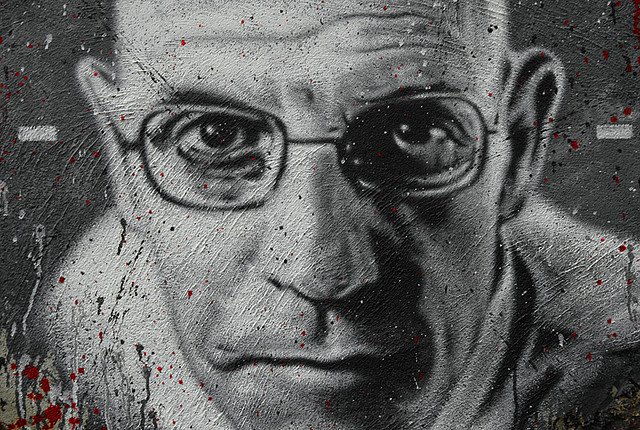
dish_foucault

In an interview discussing a new volume of essays he edited about the French philosopher, Daniel Zamora portrays Foucault, especially in his later years, as more friendly to and fascinated by neoliberals Hayek and Friedman than many of his votaries on the academic left want to believe. Zamora claims to have been “astonished by the indulgence Foucault showed toward neoliberalism”:

[H]e saw in it the possibility of a form of governmentality that was much less normative and authoritarian than the socialist and communist left, which he saw as totally obsolete. He especially saw in neoliberalism a “much less bureaucratic” and “much less disciplinarian” form of politics than that offered by the postwar welfare state. He seemed to imagine a neoliberalism that wouldn’t project its anthropological models on the individual, that would offer individuals greater autonomy vis-à-vis the state.

Foucault seems, then, in the late seventies, to be moving towards the “second left,” that minoritarian but intellectually influential tendency of French socialism, along with figures like Pierre Rosanvallon, whose writings Foucault appreciated. He found seductive this anti-statism and this desire to “de-statify French society.” Even Colin Gordon, one of Foucault’s principal translators and commentators in the Anglo-Saxon world, has no trouble saying that he sees in Foucault a sort of precursor to the Blairite Third Way, incorporating neoliberal strategy within the social-democratic corpus.

Dan Drezner nods, telling conservatives and libertarians to take a second look at their unlikely ally:

One of the virtues of teaching at a policy school is that Foucault is not quite as central to scholarly conversations as in traditional humanities departments. That said, Zamora’s observation rings true — which is why conservatives should embrace him and his work. From a conservative perspective, the great thing about Foucault’s writing is that it is more plastic than Marx, and far less economically subversive. Academics rooted in Foucauldian thought are far more compatible with neoliberalism than the old Marxist academics.

In some ways, Zamora’s book is an effort by some on the left to try to “discipline” Foucault’s flirtation with the right. It will be interesting to see the academic left’s response to the book. But Zamora also reveals why free-marketeers might want to give Foucault another read and not just dismiss him with the “post-modern” epithet.

Update from a reader:

This being an area I am quite familiar with, let me just say that there is very little new in Zamora’s “discovery.” Only the petty bourgeois of identity politics in US academia could ever embrace Foucault as “left-wing.” And they sure did, bereft that they were of any context or any economic culture (let alone knowledge).

It’s not that Foucault is “right-wing” or “left-wing.” I am not even sure that he could be pegged on some sort of “progressive vs conservative” scale.  On the one hand, he once stated that everything that is historically constructed can be politically changed. On the other hand, he blurted out the mother of all elisions in Discipline and Punish (if I remember well): talking of the invention of biopolitics, the thrust by the modern state to catalogue, normalize and regiment living beings (with a particular focus on humans), he wrote “this all took place on the backdrop of the industrial revolution.”

And that was that for economic forces. One sentence! The gall of that man! It’s hilarious. It was a dig at a certain naive and mind-numbing strand of Stalinist historical materialism in vogue in France at the time (the irrelevant and awful Althusser, Sartre, Bourdieu: in the late ’60s-early ’70s Foucault was cleverly waging a positional war against the grand poobahs of France’s intelligentsia).

Of course this played very well in US comp-lit departments, where all things economic or material are sneered at. Now you could be a true armchair radical, no need to worry or study actual economics and the history of capitalism. Boring. Besides, Foucault himself thought it was useless. And that way, as a tenured radical on a US campus, you did not have to question the society, the economic incentives and the motivations that had lead you there in the first place. That is, the booming market for mass education in the late-sixties. Suddenly any small-town middle-class American, low on cultural capital but armed with good grades, could legitimately compete for a tenured job at any University nearby.  Fucking boomers.

Not saying it’s all bad, but hey, you must take the bad with the overall good.  Incredible development in human capital comes with a few philistines. It’s a small price to pay.

(Photo of painted portrait of Foucault by thierry ehrmann)

Why Police Feel They’re Under Siege

Reflecting on the senseless murder of two officers, a reader passes along the disgusting video seen above:

I follow my local precinct on Twitter, to get neighborhood news. And a week or so before the murders, they posted a link to a video with protestors chanting for cops to be killed. I think it was going around in police circles.

I think we have to understand the police response in this context. They felt very much under attack by the mayor, who didn’t have their back against the protestors. And they saw this video, and many of them said someone was going to kill a cop. And then someone killed two cops.

My sympathies are very much with the protestors in general (though not these protestors). When I saw the video, I thought the cops were being hysterical. I thought, of course no one is going to do anything to the cops; no one ever does anything to the cops. And I was totally wrong.

Another reader is disappointed with our coverage of police issues:

I’ve been a cop since 2006 and will be the first to admit that some cops are evil and have no right wearing the badge, but good cops despise those cops. In the aftermath of the Michael Brown and Eric Garner deaths, a narrative was pushed painting all cops as racists bent on murdering black males. While you haven’t been as anti-cop as others, you have contributed to the narrative.

With every other topic you examine, you report or post emails from as many different points of view as possible. Most times you post emails from readers or professionals directly involved in the topic; however, I’ve yet to see a single point of view from a cop.

Additionally, after a grand jury failed to indict Darren Wilson, you published articles stating how rare it is for grand juries to not indict people. It gave the perception that police get away with murder because of their position. You completely ignored the fact that at the very same time in South Carolina, three white cops were indicted for shooting unarmed black men.

I have no issue with questioning police tactics or use of force policies. In fact, I believe it’s an important component of a free society. What I take issue with is not giving an equal voice to the overwhelming majority of cops who are good people. This leads me to my last point.

On Saturday, two NYPD cops were executed simply because of the uniform they wore. They were sitting in their patrol car when they were ambushed. The murderer, whose name doesn’t deserve mentioning, killed those cops to “avenge” Michael Brown and Eric Garner.

It had taken almost two days for you to post about the shooting. I read the post and realized it’s not a condemnation of the shooting; the deaths of two cops is almost secondary to its point. The article is a condemnation of Giuliani and Union President Lynch for suggesting an anti-cop attitude may have contributed to the murders. The rebuttals to Giuliani and Lynch argue that they have no right to feel that way because the protestors are just expressing themselves.

You referred to police turning their backs on de Blasio as “antics.” Lynch has been accused of smearing, ranting, and being divisive to the point of savagery. In one fell swoop, you and your fellow journalists defend de Blasio’s and the protestor’s right to free speech while condemning Giuliani’s and Lynch’s use of it. You haven’t taken a second to allow a cop or their representatives to explain why they feel the way they do. I can tell you for a fact that every cop I know feels there is an anti-cop movement taking place.

Update from a reader, “Are you SURE that video is real?”, pointing to another viral video of protesters allegedly chanting violent anti-cop messages:

A Fox affiliate in Baltimore aired a segment on Sunday showing footage from a “Justice For All” demonstration in Washington, D.C. in which it edited a chant to sound like protestors were shouting “kill a cop.”

“At this rally in Washington, D.C. protestors chanted, ‘we won’t stop, we can’t stop, so kill a cop,'” the WBFF broadcast said.

But the full footage, flagged by Gawker on Monday via C-SPAN, revealed that the chant was “we won’t stop, we can’t stop, ’til killer cops are in cell blocks.”

Would You Report Your Rape? Ctd

by Dish Staff

Several more readers open up:

To echo the sentiments of those before me, thank you so much for continuing this discussion. It has been one year since my rape. I have made a conscious decision not to report the incident and I don’t regret that decision for a minute.

I was 100% sober and many years removed from university.  It was about three weeks into a new romance with someone in the same professional field. Earlier in the evening we had engaged in consensual sex. This time, though, he stood up and said “my turn” before forcing me to perform oral sex. I violently tried to pull back but he yanked my hair so hard that each time I tried to fight him he grabbed even harder to the point where there were clumps on my sheets. Paralyzed with fear, my body went limp as he eventually finished.

I rushed to my bathroom, sat on the floor and choked down sobs in my for what felt like hours.

I got dressed and went to the movies. (A couple of days later he acknowledged and referred to it as “a lesson in understanding each other sexually.”) Despite the sexual assault – and subsequent emotional abuse and manipulation – I dated this individual for another two months while suppressing the night’s events for about six months.

After finally acknowledging the rape and emotional abuse that followed and then slowly telling my parents and my circle of friends, they kept asking the same question: “Why didn’t you press charges?” 

While I know that my ordeal is not uncommon, justice doesn’t reward gray areas. I knew that if I pressed charges, it wouldn’t be my attacker on trial. It would be me: my sexual past, my relationship, my life. There are days where the anger is palpable. There’s anger at him for his attempt to strip me of my self, my strength. There’s anger at myself for feeling responsible for what happened. There’s also anger at the idea that he could do this again … rape again under the guise of a relationship.

I’ve confronted my attacker. And every day I’m regaining more of the my self-worth he stripped from me. The one thing I don’t regret is not reporting it. In not doing so, I’ve spared myself further self-doubt and humiliation that is heaped upon survivors.

Another reader:

I attended a party on my dorm hall and was accosted by the drunken roommate of a friend. I barely knew the guy. He grabbed me and forced his tongue in my mouth while there were a dozen or more people standing around watching. I had only just arrived at the party. I had almost zero interaction with anyone I knew and none with this guy.

I pushed him off. He grabbed me again and tried to kiss me. I pushed him away and he then tried to drag me into a nearby room. All while people – my friends some of them – were watching.

It wasn’t until I was able to push him hard enough that he fell down, and I then went to kick him, that my BFF’s boyfriend and his roommate intervened. They pulled the guy up and away from me. But only, in my opinion, because I was about to hurt the guy, not because they thought he was doing anything wrong.

He was hustled off to his room (to sleep it off as he was quite drunk) and my friends attempted to get me to laugh it off but I simply went back to my own room. Furious.

It took a while mend some of the damage done to my friendships with a few people (who to their credit did apologize later, though the males involved never did understand why I’d been angry). Granted, both incidents were years ago, but the stories that I read that are much more recent lead me to believe that not all that much has changed.

I wanted to report the guy to the Head RA of the dorm in the days that followed, but I was eventually talked out of it. My BFF pointed out – correctly – that I would be the one moved to another dorm not the guy who attacked me and where was the justice in that?

Another:

I have never been raped, but I was once lured by a stranger into a semi-private place where the man then groped me. It was awful and creepy. I blamed myself for being stupid enough to follow him. For a while after it happened, I did not want to be touched by anyone, including my husband. I know it is not as horrible as rape, but just typing about it now gives me anxiety.

One reason I was lured by this man was that I thought I could trust him because he had gotten out of a car with a current-year parking sticker for the law school I was attending. The school was quiet and small, and you could seemingly trust everyone because you seemingly knew everyone. I have to believe a big reason campus rape gets all the headlines is that campuses can seem so safe.

I was able to get away from this man before anything worse happened. Before I left I took note of the make and model of the man’s car and the number on his parking sticker. I went straight to campus police because I figured they would have the parking records to look up the man. I gave them the car description and the parking number. They showed me an array of photos, and I identified the man. They said he did not work or attend the school, but that his wife worked at the school and that other female students had complained about similar incidents from him. They immediately set to work to get a restraining order banning him from university property.

I wanted to write in to share a story of someone whose immediate reaction to an assault was to report the guy. Maybe that was the lawyer part of me at work, knowing that my memory might fade, but I have to say I am happy to have done it. Of course, I didn’t have to go through any high-profile slut-shaming, and I wasn’t raped. I realize it is different. But having the brains to collect enough information on the guy to report him is about the only thing I am proud of from that day.

Update from a reader:

Like the woman who shared her molestation story, I too was once lured to a semiprivate place by a man who groped me. I was 15 at the time, on a cruise with my family, and the man was our room steward. He pressed his tongue into my mouth, something I had never experienced before, which was terrifying and gross. I managed to get away, and told my parents, who reported the incident to the captain. My molester spent the rest of the voyage in the brig.

When we returned home, an attorney for the cruise line called to ask my father if we intended to press charges, and he said that another crew member had come forward as an alibi witness for the steward. My father answered that I had been traumatized enough, and the matter was dropped.

What we didn’t know until years later was that my younger sister – only 10 – was raped on that cruise, perhaps by the same man, perhaps by his friend and alibi witness. She and I shared a stateroom. When I found her bloody underwear, we assumed she had begun her menses and gave her sanitary supplies! (I was 11 when I had my first period, so it didn’t seem unreasonable.) What a horror show.

Happy ending: my sister and I both ended up with loving husbands and channeled our early experience into work with abused women.

“Stephen Colbert” Signs Off

by Dish Staff

A reader writes:

I didn’t know before I saw the episode last night that Andrew was going to be in the star-studded finale of the Colbert Report.  When I saw him there, it felt like a friend had made it into the inner circle.  I was more excited to see him than any of the other guests, like he was “one of us”.  Just sending this because I wonder if other Dishheads felt the same way.

In his review of the series finale, James Poniewozik calls Colbert “America’s greatest, most genuine phony”:

That Colbert was able to be “Stephen Colbert” at such a high level for some nine years was the 56-game-hitting-streak of American comedy, a feat we may not see equalled again. He kept it up in part by taking the show on the road. He brought his act to the White House Correspondents’ Association Dinner, got Doritos to sponsor his favorite-son run in the 2008 South Carolina primary, and — in what was probably his high-water mark — in 2011 went through the process of founding a real SuperPAC. It was simultaneously an epic work of performance-art satire and genuine public-service education.

Before the finale, Colbert was already in the process of letting go of “himself”; on Wednesday’s show, he held a yard sale of Report memorabilia, unloading a copy of his correspondents’ dinner speech to a crying baby, selling a bottle of “Ass Juice” to a lucky bargain hunter. He seemed at peace, and why shouldn’t he be? He’s going on to something new, taking over for David Letterman at CBS. And while that’s generated much interest in what Colbert will do as himself, I’m not too concerned.

Update: A reader flags this post of Andrew’s from October 18, 2005, titled “Pure Genius”:

Last night’s Colbert Report, of course. O’Reilly fileted. My only worry is: how can he keep it up?

Our Two Party Family System

by Dish Staff

Former US President George H.W. Bush(2nd

Karen Tumulty tweeted yesterday that, “with exception of 2012, you’d have to be 38 or older to have lived thru an election with no Bush or Clinton running for prez.” Aaron Blake discovers that it’s even worse than that:

[G]oing back a full half-century – i.e. to 1964 – there have been only three elections (midterm or presidential) in which a Bush or a Clinton hasn’t been on the ballot somewhere for something.

Stretching back to George H.W. Bush’s first bid for U.S. Senate in 1964 (he lost), that’s 23 out of 26 elections. The only exceptions are 1972, 2010 and 2012. That most recent two-election drought was broken when George P. Bush – Jeb Bush’s son – ran for Texas land commissioner this year (he won).

Greenwald believes that a Clinton-Bush match-up would illustrate “the virtually complete merger between political and economic power, of the fundamentally oligarchical framework that drives American political life”:

If this happens, the 2016 election would vividly underscore how the American political class functions: by dynasty, plutocracy, fundamental alignment of interests masquerading as deep ideological divisions, and political power translating into vast private wealth and back again. The educative value would be undeniable: somewhat like how the torture report did, it would rub everyone’s noses in exactly those truths they are most eager to avoid acknowledging.

Even Douthat, who isn’t against political dynasties in principle, has misgivings about a Clinton-Bush race:

[T]here really would be something historically unusual about having the same two families alternate in the American presidency for, potentially, twenty-eight out of thirty-six years. The closest analogue would be the Roosevelts, Teddy and Franklin, who served for about twenty out of the 20th century’s first forty-five years, and they were related in a much looser way, rather than being part of the same marriage or nuclear family. In the main, the American presidency has resisted dynastic control, and the dynasts have tended to be among the less-enduring of chief executives: The Adamses were both one-termers, likewise the Harrisons (a one-monther, in William Henry’s case!), and for all their fame the Kennedys only occupied the Oval Office for the three short years of J.F.K.’s not-entirely-brilliant presidency. And they have also tended to be well-spaced: Twenty-five years from Adams to Adams, more than fifty years between the Harrisons, twenty-four between T.R. and F.D.R.

So it’s hard not to look at Bush-Clinton dominance, however shaped by randomness, as distinctive to our era, and therefore probably somehow connected to stratification and elite consolidation and other non-ideal patterns in American life generally. At the very least, it’s striking how many non-pedigreed men — Truman, Ike, Nixon, Carter, Reagan — won the White House during the golden years of the American middle class, compared to the mix of family ties and Ivy League resumes (dynasty woven into meritocracy, as it inevitably is) that has defined the office’s leading aspirants in recent decades.

Update from a reader:

Oh, please. Conflating the Clintons and the Bushes is ignorant and offensive. The Bushes are on their fourth generation of power and their third presidency. The Clintons are a married couple. Hilary did not inherit anything, nor did Bill. A Washington power couple is not a dynasty. Put these two families in the same sentence when Chelsea’s granddaughter is running.

(Photo: Former US President George H.W. Bush greets his former Vice President Dan Quayle as former First Lady Barbara Bush stands by after inaugural ceremonies at the US Capitol on January 20, 2005. Also pictured are Florida Governor Jeb Bush his wife Columba and former President Bill Clinton and his wife Sen. Hillary Clinton, D-NY. By Don Emmert/AFP/Getty Images)

Why Didn’t Amy Pascal Just Pick Up The Phone? Ctd

by Michelle Dean

A reader compares the Sony hacking to this year’s sexting hacks:

I was a Sony Pictures employee up until two months ago. I worked as a television producer on the Sony lot for the previous two years. On a daily basis, I passed by Amy Pascal and Michael Lynton and the others whose private emails have now been leaked (contrary to Michelle Dean’s disdain that they’re just “big fancy business people,” they’re actually very cool, approachable people), and I have been warned that my private information has very likely been leaked as well – as have any present and former Sony Pictures employees going as far back as 1995. (!)

Let’s first remember what this hack is about: Private documents and emails were illegally stolen and leaked to the public, with more leaks threatened, in order to blackmail Sony out of releasing a film – they have specifically demanded that Sony not release “The Interview.” Put another way, foreign hackers are blackmailing Americans out of exercising their First Amendment rights. And now the media outlets that continue to print the salacious details revealed in these stolen documents are complicit in that blackmail scheme, having given the leaked information the damaging attention that the hackers wanted. The media crossed the line when the reporting shifted from the story of the hack itself and the criminal investigation, to printing every salacious email they could find.

This is not a Snowden leak where it can be argued that this is information about our government that is vital to American citizens. As Sorkin pointed out, these hacks reveal no laws broken by Sony. So this is nothing more than sleazy tabloid journalism using documents stolen by criminals. It is the complete lack of ethics of The Fappening all over again. It doesn’t matter how we got the information, there’s page-views to get! Is this the norm now?

And the worst part is, in the few stories that I’ve read on this, I have seen nothing that would shock anyone in the entertainment industry: Film executives and producers talk bluntly about scripts and actors and personalities because that is the business that they are in. They have to be both passionate and direct, or they aren’t doing their jobs.

Let’s flip the script, so to speak: All of your personal information, emails, your employees’ medical records, payrolls, etc. are leaked by foreign hackers, who threaten to release more if you publish a controversial story. The FBI is investigating. How would you feel about all of your fellow bloggers printing every salacious, taken-out-of-context detail of every email you’ve sent for the past 20 years, making it front page news every day for three straight weeks, and counting? Would you really blame YOURSELF?

To answer the reader’s last question first: I would, at least a tiny bit. But then I’m the self-lacerating sort. And I also tend to see things in questions of degrees.

Of course I would be unhappy to see journalists publish people’s unredacted medical records and social security numbers, which I would agree are analogous to the sext leaks of early September. And I completely sympathize with the panic employees caught up in this mess might feel about that. As far as I know, no one has yet printed things like that but it’s not much comfort.

My point was more limited than this reader imagines. I was simply pointing out that business executives do not have a clear-cut expectation of complete privacy in emails that related to business negotiations and transactions. That goes for the “cool, approachable” executives, too. Business people are regularly called onto the carpet by their lawyers and shareholders to account for their actions in managing the company. It’s just part of the deal along with the rich severance payout.

Is that an abridgement of their First Amendment rights? I’m not so sure. I think it’s just about being a responsible executive.

These emails may not show “illegal” activity per se, in that nothing in them hints at criminality. But they do have the potential to incur big costs for the company in later disputes and litigation. And shareholders do, by the way, have some interest in knowing how the company’s management behaves. The public interest here may not be as clear-cut as in the Snowden matter but these aren’t simply “private” matters. And as an experienced big fancy business person (I think she can survive a tongue-in-cheek remark), I’m sure Pascal knows that intimately.

Update from a reader:

Michelle Dean was right to feel sorry for the in-house counsel at Sony who has tried to prevent everyone there from sending sensitive e-mails – clearly, the message hasn’t gotten through there based on that note from a former Sony employee. News flash to everyone in the US: your company, not you, owns your e-mails! When you hit “delete” on an e-mail, it means “saved forever on a server and/or hard drive somewhere”. Anyone in this day and age who thinks they have any expectation of privacy in any e-mail exchange is sorely mistaken.

When you communicate by e-mail, it feels like a conversation, but it’s like etching something into stone. I tell everyone at my company that for any e-mail you write, imagine seeing it blown up on a giant screen in courtroom somewhere, and you having to explain what you meant by it. I’ve sat through that exact scenario hundreds of times, and have seen offhand e-mails written in the middle of the night create hundreds of millions of dollars in liability for a company, and countless deposition and trial time being spent talking about one or two sentence e-mails. I’ve also seen sexually explicit e-mails (and photos/videos) that would make anyone blush, and these have been viewed and discussed in open court.

I also don’t understand the reference to “First Amendment Rights” by the former Sony employee. Where is the US government involved in stopping anyone at Sony from saying anything? The authorities should go after whoever hacked into the system, and convict them of a crime if they can be caught, but the people who wrote these e-mails assumed the risk when they decided to write an e-mail instead of picking up the phone (or walking down the hall). With everything that’s happened the last few years, including Snapchat hacks etc., it’s amazing to me that people are still surprised when their e-mails get exposed for the world to see.

Forward thinking companies are automatically deleting all e-mails after a short period of time (i.e., 90 days), both to save storage money and to avoid situations like this. Microsoft was at the forefront of this, and has been extremely pleased with the results. Sony (and all of the other studios) may want to consider a similar policy, which would have avoided most of the most embarrassing leaks.