Prohibition News

Here’s classic b.s. from the prohibitionist lobby on pot:

National Institute on Drug Abuse Director Dr. Nora Volkow fears the problem is not being taken seriously because many adults remember the marijuana of their youth as harmless.

"It’s really not the same type of marijuana," Volkow said in a telephone interview. "This could explain why there has been an increase in the number of medical emergencies involving marijuana."

According to the Substance Abuse and Mental Health Adminstration, marijuana was involved in 242,200 visits to hospital emergency rooms in 2005. This means that the patient mentioned using marijuana and does not mean the drug directly caused the accident or condition being treated, SAMHSA says. The number is up from 215,000 visits in 2004.

Notice the carefully parsed statement: "This could explain." And yet, there’s no evidence at all that it does actually explain anything, except perhaps that pot-smoking is enjoying a resurgence. (By the way: I wonder what the annual number of medical emergencies involving alcohol is. Not "could be", but is.) There’s no question that pot is stronger now than in the 1960s; there’s equally no question in my mind that any minor should be prevented from smoking it. But legalization and regulation could help restrict its use among minors, the way we do with nicotine today. And it could also help regulate its potency. But such measures would be a function of a rational drug policy, as opposed to the completely insane one we live under today.

Jonah at Oxford

Oxfordunion20040228copyrightkaihsut

I realize Jonah Goldberg is debating the United States at the Oxford Union tonight. He’ll do fine, I’m sure. In fact, Jonah is a very Oxford Union debater. They love jokes, gags, self-deprecation. They also like conviction spliced in with it. Goldberg – when he’s on form – can pull all this off. And he’s up against some Islamist nutballs on the question of:

"This House Regrets the Founding of the United States of America."

If I were Jonah, I’d kick off with Burke. At some point, ask why they’re not debating in German. Above all, don’t be defensive. A tough Union crowd can sense fear.

It takes me back, of course, to a debate I set up there as president in 1983. The topic was: "There is no moral difference between the foreign policies of the United States and the Soviet Union." As president, I was supposed to chair the debate, but I invited Caspar Weinberger and he accepted, and also invited E.P. Thompson, the leftist historian who was a big macher in the Campaign for Nuclear Disarmament. The Thatcher government was facing an election, had a policy of no-engagement with CND, and talked Weinberger into withdrawing. I was pissed – in the American sense of the word. The debate was rescheduled after the election – so I got to debate in it. I took the losing side, as I always tried to in Oxford debates (far more fun to lose well than to win easily). But looking back, I see some resonances. I was very pro-Thatcher and pro-Reagan. I celebrated the arrival of cruise missiles in Britain with a champagne party at Oxford. About four people showed up. But I still opposed the notion that a democracy can do no evil in foreign policy. I do not believe that any country has a monopoly on moral good, and that the greatest countries are also capable of moral evil. That’s my Catholicism, I guess. But I do remember interrupting Weinberger in the debate with the following question:

"Does an immoral act become less immoral because we have the right to choose to do it or not?"

The answer was no. It still is. End the torture policy.

(Photo: Union bar and library by Kaihsu Tai.)

“Surge The Whole Country”

To his credit, Anderson Cooper has kept his focus on the most important story right now: Iraq. He’s helped by the talent and integrity of Michael Ware. Here’s a conversation they had yesterday that covers in a few sentences all the critical ground:

WARE: To hear American politicians talking about putting pressure on Maliki, a lame-duck prime minister who has no authority with his own people or his government, to force a reconciliation, that reconciliation is in nobody’s interests.

COOPER: Well, if not Maliki, what are the other options? Are there other options?

WARE: A great question, Anderson. The alternatives that are being considered are non-democratic. They point specifically to places like Pakistan and Egypt, where you have military strongmen with a quasi-democracy who first deliver security, and democracy comes after that.

COOPER: Where does the so-called surge – others say just escalation – where does it stand? How is it going? Too soon to tell?

WARE: Oh, way too soon to tell. But what I can tell you right now, that, in terms of Baghdad, if you want to look at it through a microscope, without looking at the rest of the country, the surge will have an impact.

But, at the end of the day, if America wants to win in Iraq, it would need to surge the whole country. But it can’t.

Read those last two sentences again. The truth is in front of our noses. Ware has been there for years. He’s a truth-teller, not a spin-merchant. One obvious sceanrio that hasn’t been fully addressed. If the surge fails to perform a miracle, the Bush administration will be loath to redeploy without some attempt to have a government with actual power. Will there be a coup? Are we going to try and find a Shiite Musharraf?

The Fog Of War

Baghdadjoeraedlegetty

A reader writes:

Keep going on the white lies, Andrew. Here is one that is propagated by the left and the right: It is not an occupation of a sovereign country, dear, it is a front in the war an terrorism.

Here is one way to test if you think the occupation of Iraq is at all part of a war on terrorism: You are the commander in chief. Your general comes to and says "I think the best tactic to employ in the WOT is to occupy a sovereign country and tie up 66 percent of our military for years enforcing that occupation." Would you follow that advice?

My little brother is in Diyala province right now. I had to call my Dad and calm him down after the car bombing the other night. This gives one great clarity. I ask myself if my brother is in Iraq to fight a war or to enforce an occupation?  When he tells me what he does all day and the missions he goes on it is very, very clear what he is doing there. He is there to enforce an occupation. I challenge anyone to show me any evidence that he, or any of our soldiers,  is there to fight a war. Evidence, not rhetoric. And saying we are fighting people who were born in that sovereign country and don’t like it occupied doesn’t count as fighting a war. That is enforcing an occupation.

When do we start to doubt that we are at war with anyone at all?

A friend of mine sat me down last night over a glass of wine and made me watch "The Fog of War", the McNamara documentary that won an Oscar a few years ago. What it brought home was how the war in Vietnam became a moving target: what we had gone there to stop in the first place had become altered by our presence, until the very notion of what victory or defeat meant became harder and harder to define. I scoffed at Vietnam comparisons before. And many are still irrelevant. But this one isn’t: the fog of what we’re doing there and why.

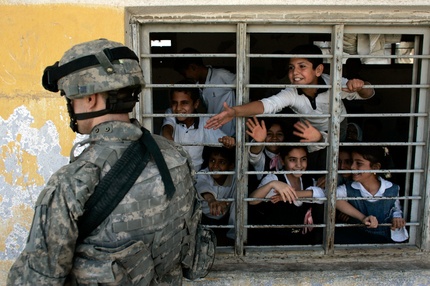
In supporting this war, I did so for a few central reasons: 1) the possibility of Saddam handing over WMDs to Islamist terrorists; 2) the removal of an evil tyrant in violation of umpteen UN resolutions; 3) the establishment of some kind of democratic space within the Middle East to counter the cycle of autocracy and Islamism that was becoming a clear and present danger to the U.S. We have done 1 and 2 – although we discovered that 1 was nowhere near as threatening as we assumed. But in doing 1 and 2 incompetently, we have made 3 more remote and have transformed the war into one in which the U.S. is almost unilaterally and indefinitely occupying a sovereign Muslim country. There may be aspects of this that are good. I have no doubt that Baghdad is more peaceful because of the surge. I’m eager to publish photos like the one above to show that not everyone is hostile to the US there, although many obviously are.

But wars require clarity. We have two clear options: ramp up or ramp down. We’ve picked a middle option: ramp up a bit and hope we will then be able to ramp down a bit. I see no reason to believe that this can achieve anything close to our original objectives within the next six months, and no reason to believe that an indefinite occupation won’t create as many problems as it solves. We are occupying a sovereign Muslim country indefinitely, against the wishes of a clear majority of Iraqis and Americans. That’s the simple fact we have to remember. From everything we have discovered so far, that can’t and won’t work. 

So we should leave. Soon. Let the Shia and tribal leaders and the Kurds confront al Qaeda. It’s about time they did. And they have as good a reason as we do and far better knowledge of the enemy and the terrain. Until they own this war against Islamist terror, it won’t be won. And by continuing to stay, we postpone the day when they have to fight for their own country and their own religion – and win the war we cannot win for them.

(Photo: School children react to U.S. Army Specialist Ron Kreiger from Schuylkill Haven, Pennsylvania of the D-CO 2/325 AIR 82nd Airborne Division visiting their school April 25, 2007 in Baghdad, Iraq. The soldiers, with the help of Iraqi police, delivered school supplies to the local schools. The soldiers are part of the U.S. military surge that is intended to help control the violence in the city. By Joe Raedle/Getty Images)