Bobby and Marilyn

Monroe_2

Did he assist in her suicide? I do not know if the FBI recently disclosed report has any basis in truth – it was compiled by J. Edgar Hoover, after all – but it’s a bombshell if accurate:

On the same day, Kennedy had booked out of the Beverley Hills Hotel and flown to San Francisco where he booked into the St Charles Hotel, owned by a friend. "Robert Kennedy made a telephone call from St Charles Hotel, San Francisco, to Peter Lawford to find out if Marilyn was dead yet."

Lawford called and spoke to Monroe "then checked again later to make sure she did not answer". The document claims the housekeeper, Eunice Murray, who had been hired by the actress on the advice of Dr Greenson, then called the psychiatrist. "Marilyn expected to have her stomach pumped out and get sympathy for her suicide attempt. The psychiatrist left word for Marilyn to take a drive in the fresh air but did not come to see her until after she was known to be dead." …

The FBI report says Kennedy had promised Monroe he would divorce his wife and marry her, but the actress eventually realised he had no intention of doing so. About this time, he had told her not to worry about 20th Century Fox cancelling her contract – "he would take care of everything". When nothing happened, she called him at work and they had "unpleasant words. She was reported to have threatened to make public their affair."

Hence the assisted suicide. Makes Anna Nicole seem banal in comparison, doesn’t it? Of course, it should be treated with extreme skepticism: we are told the report "could not be sourced or authenticated" but nonetheless made its way to the very top of the FBI. The sheer detail of the report, including the threat of Joe DiMaggio Sr to kill Kennedy to seek revenge after Kennedy left office, is striking. A sign of Hoover’s obsessions? Or a sign of the seriousness of the charge? I have no idea. Here’s more context from the writer who discovered the material. Money quote:

One more unclassified piece of this jigsaw puzzle is a 1963 teletype marked "decoded" and "urgent" sent to Hoover soon after the assassination of JFK: "To director: …  [deleted] informed that Attorney-General Robert Kennedy made a very secret trip to Los Angeles for a conference with [Chief William H.] Parker during which conference the Attorney-General allegedly told Parker he would replace Director as head of the FBI." No date for this trip is provided. This is the same Parker the secret memo names as having the Monroe telephone records. Hoover was never removed and Kennedy left the administration of President Lyndon Johnson in 1964.

Over to you, Oliver Stone.

The Core Conservative Question

A reader writes:

In several places in the D’Souza review you ask whether a political system "can" ever be neutral. Well, it can’t. The question is therefore not whether political frameworks can be neutral, but how and against whom they ought to discriminate. At the basis of the democratic truce lies the presumption that a viewpoint-neutral framework – not absolutely neutral, but still as neutral as possible and consistent with its own survival – is the only fair Tcscover and transparent one. But this excludes the true believer, who could never accept a system that proclaims neutrality between truth and error, virtue and vice. It is of course right to put true believers at a strategic disadvantage in this way, but discrimination it undeniably is. Justified it is, neutral it ain’t.

As soon as a democratic system becomes sufficiently diverse, the true believer will begin to be unsatisfied with it. For a while the true believer’s vision can still be enforced through democratic majorities. But then even the majorities begin to dwindle. At that point the true believer has to decide whether to lie down peacefully and see his beliefs swamped, or whether to turn anti-democratic, to reject the most basic clauses of the democratic contract. D’Souza shows the right nearing that point.

Would the religious right accept defeat gracefully? I do not mean one or two elections, I mean total defeat: Drip by drip, state by state, issue by issue, the culture wars are lost, first in the culture at large, then at the ballot box; there is first a mellowing and then a great falling off of Christian belief across the country; after 20 or 30 years, the US is well set on its way to becoming as secular as Canada. This could happen because although democracy and capitalism are not directly hostile or repressive towards faith, they are still great engines of secularisation, by a slow, relentless process of corrosion. 99% of the religious right would surely accept this with good enough grace, but a toxic remnant may just turn against the systemic engines of secularisation. A self-styled "Stonewall Jackson Brigade" of Christofascist terrorists perhaps, secretly liaising with (the successors of) Al-Qaeda.

The religious right is caught in a terrible dilemma, because they venerate both, the Lord and the constitution. But if it turns out that the classically liberal order prescribed by the US constitution is, in the long run, biased against the maintenance of fundamentalist faith, what will they do? Will they be tempted to tear up the constitution in the service of the Lord?

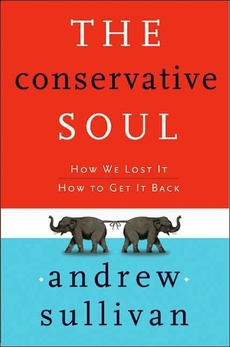
I agree with this reader’s analysis, which is why I felt it necessary to provide an account of a Christianity that can withstand modernity and pluralism in "The Conservative Soul." Such a Christianity isn’t fundamentalist. And the incompatibility with real fundamentalism and the American project is at the core of today’s debate about conservatism. I’m glad to see D’Souza forcing many conservatives to reject his logical extension of recent developments. But they still have not grappled with the deeper question, I fear. My book tries, at least. I think, in some ways, it is an attempt to redefine conservatism as the antithesis to D’Souza’s vision. After reading D’Souza, I understood my own case a little better.