Pundit Wars

A reader adds:

I do think that you get to the point regarding your reader’s comments about playing on a team. Many self-styled conservative pundits are not quite being honest about their membership on the Republican team. They play without their jerseys. The line many of these people take (I am sure that examples abound online) is that ‘we support the Republicans because they are conservative’ when the truth is ‘we support the Republicans because we are Republicans’. In my view this is the core dishonesty embedded in the National Review, Limbaugh, Hewitt, O‚ÄôReilly, Coulter, etc that makes people like you and John Cole and others so very angry. And of course they are all angry at you, because you and others are pointing to the wide play of daylight between principled conservatism and the Republican movement.

That just about sums it up, I think. It certainly helps explain the intensity of the anger on both sides.

The Natural Law of Liberty

Jefferson_4

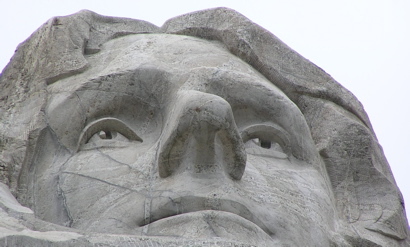
Jason Kuznicki hs a very elegant and persuasive criticism of part of my book on his blog, "Positive Liberty." The conservatism I sketch is very suspicious of what might be called "natural law." My main skepticism is toward the natural law Thomists who want to rest current morality on arguments deduced from medieval and Greek teleology and biology. And Kuznicki doesn’t disagree on this. But he argues that the natural law of Jefferson and Adams survives in much better shape:

[T]he classical liberal idea of natural law was not the product of one man or a small group hoping to reshape all of human society according to some grandiose philosophical vision. Divided government and religious freedom were attempted only out of desperation, when all else had failed, in the exhaustion that came from centuries of religious warfare in Europe. They were putative natural laws, yes — but they were not the kind of greedy, reductionist, dogmatic natural laws that we have seen in the meantime.

Further, wherever these ideas have been given a fair trial, they have brought peace, liberty, and prosperity. The very fact that we are still discussing Jefferson’s formulation today, and that the United States is still formally founded upon it, is ample demonstration of the practical value of natural law in the classical liberal tradition.

In Kuznicki’s first two sentences, you have perhaps a reconciliation between Jefferson’s natural law and Oakeshott’s conservatism. If you think of the natural law as a product of a tradition above all, then you have a conservative grounding of a form of liberalism. But it also has force as an idea in its own right, and is based on a concept of God that is weak enough and broad enough that it might be seen as achievable in a diverse modernity:

To the founders, nature’s God was the deity of every religion — and of none. Nature’s God was present wherever religionists of any faith showed decency and kindness toward their fellow man; nature’s God was absent when the faithful were cruel, intolerant, or uncharitable. Nature’s God demanded that every one of us come to Him on our own terms, not under threat of compulsion. Why not? Because it is impossible to imagine a God who wanted compelled, inauthentic, grudgingly given prayers.

I wonder if that is entirely true, though. Many have imagined many such Gods. The great temptation of all belief is to lean toward indoctrination and even coercion in its implementation. Some Gods do compel submission (this is at the core of the struggle within Islam, is it not?). And Kuznicki’s back-up argument is simply that this idea of natural law has stood up pretty well over the centuries, has made for a happy and productive society. But that too is very close to an Oakeshottian defense of Western liberty as well.

I still believe Oakeshott’s defense is more sustainable. But Kuznicki reveals one of the weaker points in my case. I can see, in other words, where I have given too short shrift in the book to the Jeffersonian idea of a nature’s God as the source of divided government and individual liberty. I’m grateful for the extra perspective.

Am I Unfair To Limbaugh?

A reader protests:

You disavow prescribing a political program in your book. You just elucidate principles and guiding lights for policy makers. However, politics is a contact sport. Limbaugh and his fellow travelers are promoting a political program. They have to be team players. They have to hold their tongue when the coaches (President Bush, Hastert, etc.) call dumb plays. They are cheerleaders who are exhorting their listeners to beat the Democrats and the Left in America. Anyone with experience in teams (corporate, athletic, military) that actually function effectively with coordinated action knows that the individual must subordinate his will to the team’s goals. It’s childish to call a team member a lackey or a hypocrite for sticking with his teammates and refusing to publicly criticize the coaches even if he doesn’t like the plays being called.

So cut them some slack. Of course, they cannot engage you on the same level with the same intellectual openness that you demand. That would compromise their mission and their livelihood. Pick on someone in your own league who doesn’t get dirty in the arena of political combat. Yes, to form a Republican majority means forming coalitions with religious conservatives, spendthrift Northeasterners, and libertarian Westerners. It’s messy. It’s seldom coherent. I’m frustrated, but I understand.

I sense that part of the frustration motivating the intemperate remarks in Jonah’s review of your book springs from your failure to recognize this division of political labor. If you recognized this division of labor, then maybe you could more charitable toward your critics.

The reader has a point. I really have few truly partisan instincts. Maybe that’s because I grew up as a Tory, not a Republican, and so don’t have American partisanship in my blood. Maybe it’s just my generally non-joiner personality. I chose to be a writer rather than a politician for a reason. I can be more honest as a writer. And my people skills are limited. In the book, I do indeed tackle serious arguments by non-partisan thinkers. On my blog, I’m free to tackle anything someone writes.

I’ll concede this, as well. If Goldberg, Hewitt and Limbaugh simply declared that they were Republicans, working within and for a political party, my reader’s point would hold water. But they want both to claim such an allegiance and yet also speak for something called "conservatism." My point is a basic one: in most periods, this finessing between party and principle is a difficult task. But today, when the GOP has abandoned the most basic conservative principles, it’s impossible.

I can understand their frustration. I can understand their anger at someone exposing their cognitive dissonance and spin. But it really is their problem, not mine. The job of a writer is not to express "charity" toward other ideas or players. It is to express one’s own views as honestly as one can. I don’t know what else I am supposed to do. If that upsets some, too bad. I have enough friends already.

Lincoln, Certainty, Doubt

Lincoln_1

A reader sees Lincoln as the model for how the two deep human impulses can properly interact in a statesman:

Lincoln pursued relentlessly a war that left half a million of his countrymen dead and half the country in ruins. He did this first to preserve American democracy and then to abolish slavery. Thus he would seem to fit Jonah Goldberg’s model of a leader who, like FDR and King, realized that "evil is rarely defeated by people who are unsure they are right."

But Lincoln always tempered his personal convictions with Socratic doubt and scientific skepticism. Despite his almost religious attachment to the Union he still wrote of it with scientific detachment, describing it as "dedicated to the proposition that all men are created equal…" and the war an experiment "testing whether that nation, or any nation so conceived and so dedicated, can long endure."

When he wrote "if slavery is not wrong, nothing is wrong," slavery is presented as the worst of wrongs, but only if right and wrong have meaning. He thinks they do, but he must consider the possibility that they do not.

Everything about Lincoln’s words and action speak of a man deeply convinced that slavery is wrong and an affront to God. Yet he also knows, because he is a man who thinks as well as acts, that the conviction that one is right and that one knows God’s will more often has been a curse than a blessing. One must act on one’s convictions, especially if one is the President, but one must also remember how fallible they can be. Hence, when he sums up the great conflict for which he, more than anyone else bore responsibility, it contained not only conviction and justification but also, for himself and his countrymen, reminders of the need for doubt even as one acts:

"Both [sides] read the same Bible and pray to the same God, and each invokes His aid against the other. It may seem strange that any men should dare to ask a just God’s assistance in wringing their bread from the sweat of other men’s faces, but let us judge not, that we be not judged. The prayers of both could not be answered. That of neither has been answered fully. The Almighty has His own purposes.

With malice toward none, with charity for all, with firmness in the right as God gives us to see the right, let us strive on to finish the work we are in …"

Email From Montana

Michaelsavage

A reader writes:

Thanks for your observation regarding Mr. Savage’s comments. They are nearly prescient. Just last night, I was listening to Mr. Savage while I was working in my shop, and I had the same thought: Substitute Jew for homosexual (or liberal) in his diatribe(s) and you have the ravings of Hitler.

I used to think of myself as a conservative. I don’t know where these people came from, but after listening to rabid radio for a while I have become totally turned off on "conservatism’s" message. They are so hateful. I don’t understand their objective, but it certainly turned me away from any support for the Republicans and as such it appears counterproductive. Now, I only listen occasionally in order to know the enemy.

From a supportive, healthy heterosexual in Montana.

There is something deeply Orwellian about the current state of the right. If you ask them what they’re for, you tend to get platitudes. But ask them what they’re against and their eyes and keyboards light up. (This is true on the far left, of course, as well. But the ideological rigor mortis on the right is particularly striking right now). On the Hill, you have the nemeses of Pelosi, Rangel and Frank, the same trio, repeated endlessly. Is it really an accident that they have picked a woman, a black and a gay? Naah. What is Sean Hannity’s mojo? Try this for size:

"To tell deliberate lies while genuinely believing in them, to forget any fact that has become inconvenient, and then when it becomes necessary again, to draw it back from oblivion for just so long as it is needed…"

As for the vitriol thrown in my direction, I may be becoming a useful Emmanuel Goldstein figure for the "movement." Here’s the latest Two Minutes Hate from JPod.