Hugh Hewitt has now retracted his broadcast claim that
"One of the very, very few times that the government needs a compelling reason to treat people differently is when they do so on the basis of race. I mean, that’s what’s so astonishing about this book, is that you purported to write a book about the Constitution, and you don’t know how it works."
After being exposed as plain wrong, he now writes:
That was an error on my part, one of many I have made in 17 years of broadcasting and a decade of teaching, but nevertheless an error. I should have taken the time to more fully school Andrew in the intricacies of Equal Protection analysis. I am glad to correct the error. But I note that the context in which I misspoke was a radio interview when I was pointing out that Sullivan had radically misstated the law completely, not incompletely stated it.
Well let’s go to the passage in the book where Hewitt clams I am misrepresenting American constitutional law. It’s on page 239, and the subject is not about American constitutional law at all. The chapter is about "A Politics of Freedom". It is an essay of political philosophy, about an ideal form of conservatism that I am advancing as my own political philosophy. It refers to no specific constititution. It’s about some basic principles about how a conservatism of doubt should deal with its own citizens, the same politics I advanced in "Virtually Normal":
All that conservatism asserts is something much more modest than a claim that human beings are substantively equal. The conservative merely asserts that while we cannot prove or know the substantive equality of human beings, we do know enough to grant 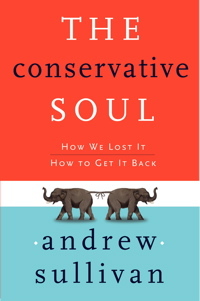 them formal equality. By formal equality, I mean simply the respect due to a fellow citizen, in the limited public world of citizenship. We may think that the woman down the street is a fool or a liar or a saint or a good and old friend. She may be, in our judgment, our inferior or superior on any number of measurements. But none of these qualities or flaws is civilly or politically relevant. None affects her status as an equal citizen in the formal sense. She still has one vote, as do you. She is governed by the same laws as you are. Fools and sages, old and young, male and female, gay and straight, beautiful and ugly, moral and unprincipled, strong and weak: as human beings, we are vastly different. But as citizens, the conservative argues, we are utterly indistinguishable from each other.
All this theory of equality depends on is the fallibility of our own knowledge; and the recognition that, since we cannot fully know another, we owe each other the benefit of the doubt as equal citizens of any political order. From doubt, comes security; and from doubt comes equality.
There may, of course, be occasions when the government must necessarily treat us differently, make distinctions between this group of people or that one. The most obvious distinction is between adults and children. A government is not going to recruit seven-year olds into military service. But even then, in a broader context, the government still acknowledges the citizenship of a child; and the state exists to protect children in some instances, even from their own parents, if their physical security is at stake. There is, in other words, a presumption in the way a government interacts with its own citizens. That presumption is that it will treat each citizen absolutely alike, unless it has a very compelling interest or reason not to. And it is up to the government to prove it has a good reason to discriminate rather than up to a citizen to prove she is equal under the law.
You may notice how modest this political theory is.
[I have added some italics, but some are also in the original.] So it is entirely clear to any honest reader that what I am talking about here is a political theory that may or may not inhere in any specific constitution. It’s as much about the English political tradition as the American one. I am trying to argue that doubt itself is a rampart of equality – a difficult claim I base in Hobbes but that is not particularly widespread. (I’d welcome a good debate about whether this is a sufficient philosophical base for formal equality, but Hewitt isn’t interested in a good debate.)
It is perfectly clear, in other words, that I am not citing the U.S. constitution here – let alone expounding on the intricacies of the equal protection clause or anything else in the constitution for that matter. I am writing about an ideal philosophical version of conservatism that may or may not exist in the ideal world, but which has roots in many of the ideas embedded in the America political philosophy and English political thought, specifically Hobbes and Locke.
So for Hewitt to wrench that sentence out of context on the air and claim that I have "radically mistated the law entirely" when I didn’t even nention the law at all is so dishonest it speaks for itself. To compound this and say that
no one with a legal education in America can agree with Andrew on a major premise of his book
is a batant falsehood which, if he has any intellectual integrity, he will need to retract as well. This isn’t a major premise of the book at all, by the way (another Hewitt hyperbole). It is a part of one chapter, the last one. Since he has read the whole book and is a smart man and knows the context, he knows he’s lying. But this is his modus operandi: lying knowingly in order to smear anyone who dissents from the current party line. To recap: So far, he has been proven empirically wrong on a basic matter of constitutional law (his alleged expertise!) and has had to retract. But his deeper error is to deliberately mislead people who haven’t read the book that the passage he is citing is not about the American constitution at all. It’s about political philosophy – where I have the PhD, and he doesn’t.
Why are so many contemporary "conservatives" lying about the contents of this book? The only reason I can come up with is that they are deadly afraid of its arguments. They know that, unlike many liberals, I know what they believe, because I have been schooled in conservatism and know exactly how deeply they have abused it. I was saturated in Hobbes and Oakeshott and Strauss and Plato and Locke and Burke and conservative political philosophy. Many of them haven’t even heard of these writers. So their only response is a desperate series of smears and lies.
Which is why you should read the book, and make your own mind up.


 The Dish