War and Naivete

Beirutrubbleburakkaragetty

A reader argues:

"Losing Faith" highlighted the type of naivete that your otherwise legitimate criticisms of Bush’s war-management far too often enable. Your correspondent writes:

"After more than 3 years, we’ve completely failed to turn Iraq into anything remotely resembling a stable, prosperous, liberal democracy. I was never expecting Iraq to become New Zealand, but was at least hoping for Morocco … Our presence in Iraq is simply not capable of thoroughly changing the dynamic. We’re now just one actor in a stew of nefarious factions."

The naivete evidenced here is simply astonishing. Your correspondent’s original understanding of the ambitions and abilities of the United States was nothing short of Messianic; he’d have been scrambling for the exits if the casualties and chaos were even half as bad as they are now.

"We’re just one actor in a stew of nefarious factions" – this is said in a tone of hurt surprise. I can’t help myself wondering if the writer belongs to a kind of geopolitical cargo cult, expecting the US to operate as a deus ex machina every time it chooses to involve itself in world conflict. Sure things could have been done differently, and they could have been done better, and maybe the decision to enter Iraq shouldn’t have been made at all. But when you expect to change a brutal dictatorship that depended for its survival on the exploitation of tribal and religious rivalries into a state like Morocco in three years, disappointment is inevitable.

I’m not suggesting you quit publicizing your criticisms of the execution of the war, because they’re an important part of the debate. But I’m afraid far too many of your readers have traded the hubristic illusion that we’d "fix" the Middle East in a few months for the equally dangerous misapprehension that even incremental, blundering progress is impossible.

I haven’t opined on some of the views I’ve been airing these past few days because I think they’re worth airing in their own right. But my own position is more in line with this reader’s than previous emails. I’m angry at the unnecessary bungling of the war in Iraq, but the following caveats must be made:

a) there was no obvious, easy alternative that would have solved all our problems. A rapidly failing state in Iraq, hemmed in by sanctions and inherited by Saddam’s psychopathic sons was not a recipe for success either;

b) no policy there can be judged in three years; and

c) the larger Muslim civil war is greater and more intractable than any single U.S. or Israeli intervention, and will keep us perilously insecure for much of my lifetime. Our task is indeed to find a way for "incremental, blundering progress."

The questions now are, therefore: how do we make the best of the deteriorating situation in Iraq? How do we exploit divisions in the wider Muslim world to empower the moderates and democrats? How at the same time do we protect our own populations from Islamist terror? It may be that these three things cannot be done simultaneouly. But the deeper point is that these questions are not merely matters of sufficient will but of sufficient skill. I wish this point were more thoroughly understood. Questioning tactics is not the same as giving up. Not questioning tactics, when the evidence suggests they are deeply flawed, is the deepest sign of unseriousness.

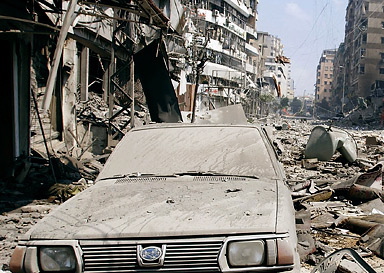
(Photo of Beirut after an Israeli barrage by Barak Kara/Getty.)

Where We Went Wrong

Another reader contributes to the debate over foreign policy in the Middle East:

To some extent I agree with your long-running argument that insufficient troops were on the ground to accomplish our goals in Iraq. But, as Losing Faith now understands, the United States could not by itself provide those troops. In the first place, the American public probably would not support the manpower needs. More importantly, as we have seen, America, acting by itself, is too easily vilified, leading to exactly the opposite result intended. If we’d been able to put together a real coalition of countries, with the overwhelming force Colin Powell wanted, we might then have been able to make a difference.  A real coalition may have had to stay for years, but with the vast majority of the world lined up against a single deviant state, our chances at eventually creating the liberal democratic nation we wanted would have been maximized.

But Bush’s missteps have been a disaster. He could not build a coalition in Iraq because unlike the press and the American public, other countries around the world knew that our stated reasons for intervention were nonsense. They knew Iraq was no threat. Now, where there may well be good reasons to intervene in Iran, which is clearly underwriting Hezbollah and others, we have alienated our historical allies, blown our credibility, squandered our resources and set the precedent that individual nations should have the right to define their interests, even if it means invading another country that is no threat. The probability of building the coalition we need now is made practically impossible, and we cannot go it alone. In one of the tragedies of the last fifty years, Bush wasted our chances at real change by swaggering into Iraq with no sense of history.

The American public has got to grow up.  We cannot export our way of life unless we are willing to use overwhelming force and we have the support of a large percentage of the major powers in the world. War is ugly and it involves subjugation of a culture in order to recreate that culture. Noble war is nonsense. It is always savage, but sometimes necessary. If we are unable to build these coalitions, we must show restraint, engage in diplomacy and work with regimes that are not like us. Democracy by itself is no panacea. We are different because we recognize the individual. Without that characteristic, no country, whether it lies in the Middle East, Asia, Africa or anywhere else, will likely practice democracy as we understand it.

The Gay Far-Left and Iran

This past week has given us a fascinating insight into the worldview of the gay far-left, which sometimes controls gay organizations. Two major human rights groups, Human Rights Watch’s gay wing and the International Gay and Lesbian Human Rights Commission (IGLHRC), refused to endorse or participate in the July 19 vigil for two executed gay teens in Iran. The leaders of this group believe the Tehran regime’s description of the executions as punishment for an alleged rape of a 13 year-old. They don’t believe the extensive reporting of Doug Ireland, and the accounts of gay activists within Iran, which strongly support the evidence that the teens were executed for having gay sex (which remains a capital offense in Iran). They went so far as to organize a competing event during the New York vigil. A decent account of the controversy can be read here. If you know the lineage of these activists, you’d understand them better. Paula Ettelbrick, at IGLHRC, was for many years a ferocious opponent of equal marriage rights for gay men and lesbians – as the gay left once was as a whole. For her and others, it is much more important to distance itself from the anti-Iran stance of the Bush administration than to reach out to persecuted gays in Iran. This despite the fact that the New York vigil was a veritable leftist love-in, including a speaker from "a revolutionary socialist organization of workers and youth." Don’t laugh. They still exist. But even these people are bourgeois counter-revolutionaries to HRW and IGLHRC. Money quote from Ettelbrick:

"In the U.S. we are acculturated to stepping in and taking action. That’s not how other countries do it and it certainly doesn’t work when dealing with Iran. Condoleeza Rice can’t just tell Iran to stop executing gay people. We know now that bringing change in human rights means being globally sensitive … One of the things that came out of the meeting was a question: Is our intent to make ourselves feel good or to affect change? If it is to really affect change, then we need to talk to more people from Iran to understand their environment, we then, as a nation, need to look at our own policies such as the death penalty, and see how they are affecting the situation over there."

So the real problem in Iran is … America’s death penalty. You really cannot make this insanity up.

Losing Faith

A reader writes what others may be thinking:

Over the last few years, I’ve basically shared your view of the Iraq war:  a noble endeavor, woefully implemented by the Bush Administration. I admire your ability to acknowledge bad news without resorting to hysterics and undue pessimism. You are actually one of the least "unhinged" bloggers out there which is why I come to your site daily. 

Personally, though, I’ve lost faith. After more than 3 years, we’ve completely failed to turn Iraq into anything remotely resembling a stable, prosperous, liberal democracy. I was never expecting Iraq to become New Zealand, but was at least hoping for Morocco. 

What’s more, I don’t think we’re ever going to succeed, regardless of how long we stay. And yes, you may be right that things would be much better now if we’d had more troops, planned for the post-war, ginned-up more international help.  That’s the sad feeling I got from reading Cobra II. Still, I’m not completely convinced that even if we’d done everything flawlessly we could have so completely transformed Iraqi society.

It is true that Arabs are not incapable of democracy, and that such claims are border on racist. However, the suspicion that Iraqis were unlikely to establish a reasonably liberal civil society was not so unwarranted. I feel na√Øve for absorbing the idealistic, end-of-history notion that we human are all universally alike, just yearning for some freedom. The people of the middle east are not just a bunch of good folks oppressed by brutal dictators. They are ridden with some very deep pathologies. We kid ourselves by thinking that they’re just like us – only with a Saddam, or an Assad, or an Ahmadinejad

It’s obvious that liberals in the middle east are woefully outnumbered. And, no amount of pushing from the outside – whether new TV channels or regime changes are going to strengthen their numbers. I’m starting to think that those societies deserve the consequences of their ideologies.

Our presence in Iraq is simply not capable of thoroughly changing the dynamic.  We’re now just one actor in a stew of nefarious factions. The best and brightest Iraqis are all leaving, or have already left, while radical jihadists continue to stream in. We keep thinking we’re about to turn a corner; that things will improve once:  Bremer takes over, Saddam is captured, the Governing Council takes over, elections are held, the permanent government is formed – take your pick. All the Iraqi blogs that were so enthusiastic three years ago, have either gone or turned sour. 

If we get out, thing may very well get worse. But would that be so bad? Would it be such a bad thing for the U.S. strategically for a  Baathist/Sunni Jihadist/al-Qaeda side and a Sadrist/Shia fundamentalist/Iranian side to annihilate one another?

Maybe I’m morphing into a Kissingerian gargoyle, but this kind of approach doesn’t sound so bad anymore.