Pre-embryo Experimentation

A reader writes:

You wrote:

"Human life is created and then experimented on to save other human lives."

Your language is deceptive. Sure, that human life was created, and then it was experimented on. But it was not created purely for purposes of experimentation.  This is a very important distinction. The end to which you allude – growing into an adult human – was never achieved. So it seems that it is then valid to seek another end: the alleviation of suffering of millions of future living, feeling, thinking humans who have the misfortune of being struck by disability or disease.  You admit that many of these pre-embryos will be discarded.  I think this is a point that most Americans do not understand; they believe what your above quote, intentionally or not, implies.  If they fully understood the details, I think public opinion would be even more strongly in favor of the use of these pre-embryos for research.

And don’t pretend this research will happen anyway.  The federal goverment is by far the major funder of basic science research. Anyone who knows anything about research knows this. Basic science (lab bench) research is too risky for the private sector.

There are hundreds of thousands of pre-embryos in storage, and many of them are unclaimed. What to do with these? Should we sacrifice benefit to mankind for some abstract, esoteric principle of protecting the rights of a clump of cells that never was and never will be sentient?
Quote for the Day II

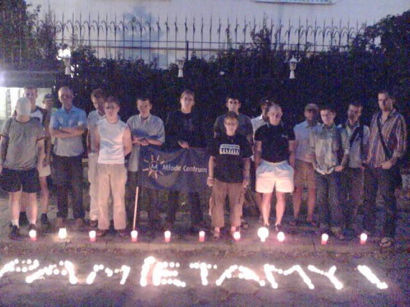
July_19_warsaw

"The founders of this nation designed our Constitution so that we would be guaranteed the rights to life, liberty, and the pursuit of happiness. We are engaged in a bitter battle here at home to defend those rights. And we will win that battle. But we must also recognize our responsibility to extend those rights to others. The right to live an open and honest life should not stop at the borders of the United States.

Many countries around the world need to be told that being gay is not a crime: Iran, yes, but also Poland and Russia, Nigeria, Cameroon, Saudi Arabia, Nepal, Afghanistan, Iraq. We have the right to speak up. We have the ability to organize. The questions are: Do we have the will? And do we care enough about our brothers and sisters abroad? These are questions only you can answer," – my friend, Rob Anderson, who organized the DC rally yesterday.

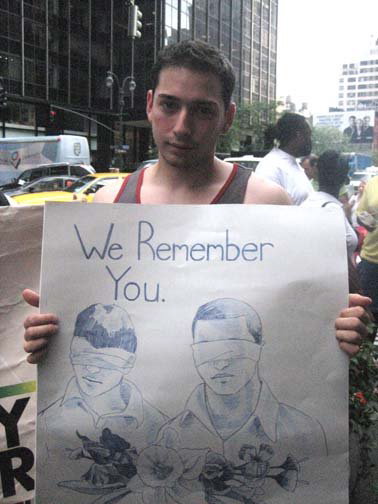
The photo above is from Warsaw, Poland, now run by a pathologically homophobic government. More on the DC vigil here; a round-up of other worldwide vigils here; a Washington Post piece here; and a report from Dublin here. Keep checking Petrelis’ blog for more updates. Notice also that this was done without any serious initiative from the well-financed gay groups. Their irrelevance to this movement is sometimes stunning. Oh, and one more eloquent pic from NYC:

Nyvigiljason

Bush’s Veto

I feel obliged to come to the president’s defense on his embryonic stem cell research veto. I find the absolutism of those who view a blastocyst as a human person to be morally unpersuasive, but I cannot see how it can be seen as anything other than human life. I know also that many of these superfluous blastocysts and embryos will be discarded anyway and so not using them for research does not protect them from extinction. Nevertheless, it is hard not to be troubled by the line this crosses. Human life is created and then experimented on to save other human lives. I think the argument for the benefits of such research is compelling; there’s little doubt that this avenue could be extremely fruitful. I live with one of the diseases, HIV, it might help cure or treat. For those reasons, I don’t believe such research should be banned – or even that individual states shouldn’t, if their citizens support it, directly finance such research from the public purse. I’m a federalist. But when a very significant number of Americans feel deeply that this really is morally unconscionable, and when the research is taking place anyway under other auspices, I see no reason why the feds should actively finance this research as well. I don’t think that Bush’s compromise is so unreasonable, in other words. This isn’t a ban on such research; it’s a decision not to throw the weight of federal financing behind it. I respect the case of those who favor it; but, when push comes to shove, I’m with Bush on this. It took political courage to take this stand. And the morality it reflects – a refusal to treat human life as a means rather than as an end – deserves respect even from its opponents.

Quote for the Day

"The current squawking also strikes me as a useful reminder of how very, very important war is in the neoconservative vision. It is as central to that vision as peace is to the classical liberal vision … Who we’re fighting is secondary. That we’re fighting is the main thing. To be a neoconservative is to thrill to the sound of gunfire," – Gene Healy, on Cato’s blog.

The YouTube War

Ana-Marie Cox analyzes the latest media twist in war-coverage: soldiers’ own YouTube videos. Money quote:

There’s music in a lot of the soldiers’ videos, but precious little uplift. In "The War Tapes," one soldier/auteur complains frequently about the risks he and his comrades take to protect the property of the Halliburton subsidiary subcontracted to feed the troops: "Why the f— am I sitting out here guarding a truck full of cheesecake?" he laments. After another guardsman supplies a Bush Administration-approved justification for their presence (freedom and democracy for the Iraqi people, stability in the Middle East), the cameraman asks, "tell me how you really feel." Deadpan, he continues: "After that happens, maybe we can buy everybody in the world a puppy."

Here’s an actual YouTube video of a real-time destruction of an enemy household in Iraq. If you don’t want to listen to soldiers’ language, then this video might be too racy. But they’re soldiers.

“Spittle Flying”

A reader writes:

Hugh Hewitt reminds me of Lee Cobb’s character in "12 Angry Men." As you may recall, Fonda forces his fellow jurors to deal only with the facts of the case. Through the movie, juror after juror sheds their pre-conceived notions as they eventually come to grips with these facts. Until, in the end, only Cobb is left, raging incoherently, spittle flying from lip, unable to see what is plainly the truth. Hewitt and his kind are no different. Just as Cobb’s juror made the most noise before caving, we can only hope that increasinly incoherently rantings of the Hewitt and Leeden are signaling the beginning of the end of this phase of denial.

Greg Djerejian lobs another one in Hewitt’s direction here.