Maybe the worst music video ever. Richard Simmons appears to have choreographed it.
End of Gay Culture Watch
Or, rather, its continued integration throughout America. Ptown isn’t the only place gays and lesbians can comfortably vacation any more.
The War
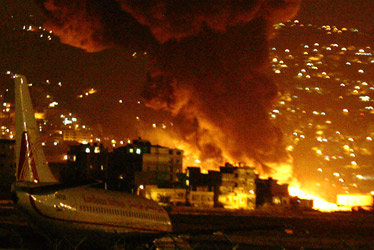
Tom Friedman has the best analysis I’ve yet read of what’s going on in the Middle East. He’s protected from a general readership by his bosses, so I’ll paraphrase his argument. It’s no accident that extreme violence is occurring in Lebanon, the Palestinian territories and Iraq right now. Why? They’re the three Arab countries with democracies, and the Islamist factions in their elected governments, having seized a sliver of power through the ballot-box, are now using it to radicalize the Arab "street", foment sectarian violence (in some cases to create the chaos that helps Islamo-fascists seize dictatorial power), and to polarize the region still further. Other democratic factions have to cope with the terror these various militias and terror groups – the Mahdi army, Hamas, Hezbollah, and others – unleash. It’s tough. And Arab culture is far more accustomed to stand-offs, fatwas and street warfare than compromise, dialogue and parliamentary accountability.
Does this invalidate the attempt to bring democracy there? I’d say not. What’s the alternative? To prop up autocrats that repress those forces and intensify Islamist ressentiment? Or to give it space to breathe and encourage other Arabs to control it by democratic institutions? The problem, of course, is timing. How do you keep the democratic governments on life-support, while they are being murdered and attacked and revealed as unable to maintain order, as in Baghdad? I’d argue that it’s in Israel’s long-term interest to refrain from polarizing the region more than necessary for its self-defense, and in the West’s interest to provide as much guidance, support and help for the fledgling, moderate democratic governments involved (and that, of course, excludes Hamas).
In Iraq, the key, if we are not to despair, is obviously the capacity of the Iraqi national army to fight back against sectarian mayhem and establish the authority that only imposing order can achieve. The U.S. forces can help with this – and we are criminally negligent for allowing the violence to spiral out of control. In a few places, we’re succeeding. But the key is not just more U.S. troops – though we need many more – but the embedding of the best U.S. commanders with Iraqi units in an ambitious and sustained attempt to train the forces of democracy and moderation to fight back. Right now, I’m told that these jobs are not in favor, that they do not bring prestige within military culture, that our best soldiers are not devoted to that critical effort. I cannot vouch for the accuracy of this judgment independently – but I have been told it by multiple credible sources. If we are not to surrender to forces that will not stop at destroying their own region, we have no choice but to engage with greater levels of commitment and guidance.
Democracy is being strangled in its cradle. We are the midwife. It’s time to get serious.
(Photo: Ramzi Haidar/AFP/Getty.)
Email of the Day
A reader writes:
Regarding your comments about Lawrence Kaplan’s comments. With respect, you’re dreaming. A million men wouldn’t have done the trick. You can’t shake and bake democracy and rule of law, and mutual toleration into many places in the world, particularly into Iraq.
Social engineering doesn’t work in Newark, New Jersey. And presumably we have insight into that culture and speak the language.
This effort was doomed from the start, it was a folly from the beginning, Rumsfeld’s so-called incompetence (I call it wishful thinking) notwithstanding. The dilemma of course is we’re stuck. We can’t leave because what would result from our departure would be worse still given the mess we’ve made there.
Joe Biden had it about right in the summer of 2002 when he said it would take 10 years at a minimum to deal with the aftermath of toppling Saddam’s regime. After I heard that I knew it was hopelessly unrealistic to try and re-shape a society about which we only know the broadest outlines. How many Americans and Brits speak Arabic? 200, 500, 1,000 maybe? We’re lost in that place, we have no connections, no way of really knowing what’s going on, and no clue as to how to appeal to the warring factions and how to build a semblance of trust among them.
The original sin remains naively advocating the neo-conservative cause. Real conservatives understand limits and proportion.
I was prepared for a ten year battle for democracy in Iraq. I naively believed that the Bush administration was sincere about long-term nation-building, and deadly serious about a task as immense as the evil that provoked it. I also under-estimated the sheer toll of Saddam’s totalitarian legacy on Iraq’s civil society. Wrong, in retrospect, on both counts. Stupidly, maddeningly wrong. Does that mean we should now abandon the place? I still cannot believe that is the wisest option.
Chav Update
You read about the cultural phenomenon here first. Dan Gross has an update on Brit white trash couture.
Quote for the Day
"[Sayyid Qutb’s] extraordinary project, which is still emerging, was to take apart the entire political and philosophical structure of modernity and return Islam to its unpolluted origins. For him, that was a state of divine oneness, the complete unity of God and humanity. Separation of the sacred and the secular, state and religion, science and theology, mind and spirit – these were the hallmarks of modernity, which had captured the west. But Islam could not abide such divisions. In Islam, he believed, divinity could not be diminished without being destroyed. Islam was total and uncompromising. It was God’s final word. Muslims had forgotten this in their enchantment with the west. Only by restoring Islam to the centre of their lives, their laws, and their government could Muslims hope to recapture their rightful place as the dominant culture in the world. That was their duty, not only to themselves but to God," – Lawrence Wright, on Sayyid Qutb‘s radical theocratic vision, as quoted in an excellent piece by John Lloyd.
The View From My Window

Provincetown harbor, 5 am, yesterday, from my couch.
Summer in Baghdad
Stuff happens. Riverbend blog from the Iraq capital gives a first-hand account of what Rumsfeld’s war "strategy" has led to.
God Loves Baldies
You win some; you lose some. David Plotz blogs Leviticus.
The “Lynching” of Lay
In fact, this white collar thief was actually compared to the black victim of a brutal racial lynching:
[Rev. William Lawson, pastor emeritus of Wheeler Avenue Baptist Church] likened Lay to James Byrd, a black man who was dragged to death in a racially motivated murder near Jasper eight years ago.
"Ken Lay was neither black nor poor, as James Byrd was, but I’m angry because Ken was the victim of a lynching," said Lawson, who predicted that history will vindicate Lay.
Could you make this up?
 The Dish