They may be the future for pop music. As so often, the PSBs lead the way.
Quote for the Day
"Hearing firsthand about Islamic culture increased my understanding, but it also made me nervous about my own society. The very things we resist in Islam, some Christians find tempting. We, too, seek political power and a legal code that reflects revealed morality. We, too, share a concern about raising our children in a climate of moral decadence. We, too, tend to see others (including Muslims) as a stereotyped community, rather than as individuals. Will we turn toward our own version of the harsh fundamentalism sweeping Islam today?" – Phillip Yancey, seeing the Christianist temptation, and resisting it.
I fear that, to some extent, the transition has already occurred in America. The article, however, is in the evangelical magazine, Christianity Today. And, to my mind, it’s a very hopeful indicator of where the debate about faith and power is headed. There are many more evangelical Christians queasy about their leadership’s capitulation to power and control than you’d believe from the press or the GOP leadership. They are beginning to fight back to reclaim their faith from those who want to use it to gain power.
Washington’s Ethics
A reader writes:
There is a third renunciation of power undertaken by Washington which should be mentioned alongside those you mentioned in your posting. Washington, as commander-in-chief of the Continental Army, explicitly renounced acts of military terror against Loyalists and the Undecided, and he forbade any acts of torture or war crimes on the part of American soldiers against British and in particular Hessian forces who were captured in battle. He also required, even during the direst of circumstances when his Army was literally starving for food and clothing in the winters of 1776-77 and 1777-78, that the citizenry be compensated as best as possible for any foodstuffs and clothing requistioned by the Army.
In all, Washington is truly remarkable due to his rectitude and reticence, something that stands in stark contrast with the manner in which the Executive Branch is conducting itself today.
“Letting Go?”
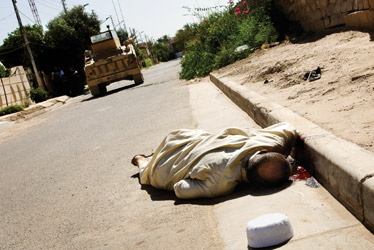
Don’t miss Lawrence Kaplan’s gripping and indelibly depressing first-hand account of the war now with a momentum of its own in Iraq. Money quote:
A conventional wisdom has emerged in Washington, arguing that U.S. forces have been "hunkering down" – the title of a recent article in the Atlantic Monthly – and patrolling less. Indeed, the president himself has pledged "less U.S. patrols, less U.S. presence." But this does not make it true. After the February bombing of the Shia mosque in Samarra, the number of U.S. patrols quadrupled in Baghdad. On a recent week, the Army sent 1,100 of them into the capital. It did so for a simple reason: Letting go has become the whole point of American policy, but officers know that, every time they let go of a sector, it comes apart at the seams.
Lawrence is close to despair at the barbarism that seems to be slowly engulfing the entire country. He alternates between wanting to up the ante, and fearing that the pathologies of Iraqi culture and society are just too powerful at this point to resist. His recent Plank post is harrowing to read:
Would more U.S. troops alter Iraq’s homicidal dynamic? Not really, given that, on the question of sectarian rage, America is now largely beside the point. True, U.S. troops can be–and have been–a vital buffer between Iraq’s warring sects. But they cannot reprogram their coarsened and brittle cultures. Even if America had arrived in Iraq with a detailed post-war plan, twice the number of troops, and all the counterinsurgency expertise in the world, my guess is that we would have found ourselves in exactly the same spot. The Iraqis, after all, still would have had the final say.
I guess he can be criticized for this ambivalence. Josh puts the boot in here. But it is honest – more honest than some other dead-enders on the right. And he has been there. Iraq may be turning several neocons into realists. It has certainly been a chastening experience for me. I don’t believe, with Lawrence, that there is nothing we could have done to prevent the current blood-bath and slide toward civil war. I still think it was doable under the right conditions. I hold Rumsfeld and Cheney and Bush accountable for being unserious about a deadly serious business (and my own gullibility in not seeing their faults soon enough and in not being skeptical enough about cultural difference in the Middle East). We will never know what we might have achieved if we had had a halfway competent president and defense secretary. But we are where we are. And hope is currently a difficult thing to feel.
(Photo: Franco Pagetti for Time.)
Digital Bubble Wrap!
Online bliss.
Mugging Truman
A cranky but often interesting conservative blogger dissents from the Weekly Standard and Jonah Goldberg on the legacy of Harry Truman – and the lessons for our present predicament.
Correction, Please
John Hinderaker at Power Line writes:
"I think the over-the-top coverage of Abu Ghraib, the prison where no one died after it was reclaimed from Saddam Hussein, is the definitive proof of the American media’s bias against its own soldiers."
Does Hinderaker consider this person, murdered by the C.I.A. at Abu Ghraib, dead?

Money quote:
Al-Jamadi died in a prison shower room during about a half-hour of questioning, before interrogators could extract any information, according to the documents, which consist of statements from Army prison guards to investigators with the military and the CIA’s Inspector General’s office.
One Army guard, Sgt. Jeffery Frost, said the prisoner’s arms were stretched behind him in a way he had never before seen. Frost told investigators he was surprised al-Jamadi’s arms ‘didn’t pop out of their sockets,’ according to a summary of his interview.
Frost and other guards had been summoned to reposition al-Jamadi, who an interrogator said was not cooperating. As the guards released the shackles and lowered al-Jamadi, blood gushed from his mouth ‘as if a faucet had been turned on,’ according to the interview summary.
The military pathologist who ruled the case a homicide found several broken ribs and concluded al-Jamadi died from pressure to the chest and difficulty breathing.
The fact that one of the most popular conservative bloggers is still in denial about Abu Ghraib, let alone the dozens of other torture-facilities set up by this administration, speaks volumes.
Not So Fast?
Marty Lederman is skeptical of the Pentagon’s Geneva announcement. As so often with Cheney and Rumsfeld, their mastery of bureaucratic warfare and political dissembling requires maximal skepticism toward anything coming from this administration. Marty thinks they may be pulling a fast one to get the torture-endorser, Haynes, on a federal bench (as elaborated upon below).
The Haynes Context
The decision by the Pentagon to formally abide by the Supreme Court ruling in Hamdan must, however, be seen in context. The critical context is today’s nomination hearings of Jim Haynes for a lifetime appointment to the U.S. Court of Appeals for the Fourth Circuit. Haynes made the Pentagon announcement; and Haynes, when he worked as general counsel for president Bush the Pentagon, was instrumental in the endorsement and enabling of torture. When Haynes was in the White House Pentagon in November 2002, he endorsed the following list of "interrogation techniques" for use by the military and CIA:
"forced nudity; forced grooming; "[u]sing detainees[‘] individual phobias (such as fear of dogs) to induce stress"; 20-hour interrogations; stress positions (i.e. hanging from wrists from the ceiling); waterboarding (the use of a wet towel and dripping water to induce the misperception of suffocation); and "scenarios designed to convince the detainee that death or severely painful consequences are imminent for him and/or his family."
Haynes, by all accounts, is a genial fellow who simply told the president what he wanted to hear. But no man who has endorsed waterboarding as an interrogation technique should be allowed near a federal bench. War criminals cannot be judges. The Senate must deny Haynes a "reward" for following the law. If Hamdan hadn’t forced his hand, torture would still be policy. You don’t reward such criminals; you ostracize them and keep them for ever from public office. One further caveat: we still have no assurance that the CIA won’t still be authorized to torture in secret sites beyond our purview. we know how deeply attached Cheney is to the torture policy. He may still be trying to find a way to get around the law, as he has so doggedly in the past. We have evefry reason to be thrilled this morning, but history cautions skepticism as well.
For more on Haynes’ complicity in torture, see posts by Marty Lederman here and here, and Jane Mayer’s piece here.
The End of Torture?
The United States has now apparently ended the Bush-Cheney-Rumsfeld-Gonzales nightmare of abandoning the base-line demands of the Geneva Conventions. After Hamdan, this is a great moment in a war we can now fight as honorably as the United States has fought every other war since the Geneva protocols were instituted. Much of the military, most of the CIA, almost all the JAGs, the Supreme Court and overwhelming majorities of both Senate and House disagreed with the torture policy. But the White House cabal prevailed. No longer – in the Pentagon, at least. As far as the military is concerned, America is America again. And this president’s brutality has been reined in. Money quote:
"This was the concern all along of the JAG’s," Admiral Guter said. "It’s a matter of defending what we always thought was the rule of law and proper behavior for civilized nations." …
"We should be embracing Common Article 3 and shouting it from the rooftops," Admiral Hutson said. "They can’t try to write us out of this, because that means every two-bit dictator could do the same." He said it was "unbecoming for America to have people say, ‘We’re going to try to work our way around this because we find it to be inconvenient.’"
"If you don‚Äôt apply it when it’s inconvenient," he said, "it’s not a rule of law."
Thanks go to all those, especially in the military, who never gave in to the demands of foolish expediency or the cult of the president-as-monarch. On this day, I’d like to recall the words of Captain Ian Fishback, still fighting for his country in the Special Forces, who saw evil and took a stand while others looked away:
"Some argue that since our actions are not as horrifying as Al Qaeda’s, we should not be concerned. When did Al Qaeda become any type of standard by which we measure the morality of the United States? We are America, and our actions should be held to a higher standard, the ideals expressed in documents such as the Declaration of Independence and the Constitution.
Others argue that clear standards will limit the President’s ability to wage the War on Terror. Since clear standards only limit interrogation techniques, it is reasonable for me to assume that supporters of this argument desire to use coercion to acquire information from detainees. This is morally inconsistent with the Constitution and justice in war. It is unacceptable.
Both of these arguments stem from the larger question, the most important question that this generation will answer. Do we sacrifice our ideals in order to preserve security? Terrorism inspires fear and suppresses ideals like freedom and individual rights. Overcoming the fear posed by terrorist threats is a tremendous test of our courage. Will we confront danger and adversity in order to preserve our ideals, or will our courage and commitment to individual rights wither at the prospect of sacrifice? My response is simple. If we abandon our ideals in the face of adversity and aggression, then those ideals were never really in our possession. I would rather die fighting than give up even the smallest part of the idea that is ‘America.’"
The idea endures.
 The Dish