Dead Duck Bounce

Bush’s ratings remain mired in disappointment. But the Congress should be more worried:

Americans have grown more critical of the job Congress is doing, compared with three months ago. Only 31% approved, down sharply from 39% in March. Asked whether they would be more likely to vote for the Republican or Democratic candidate in the district where they live if the election were held today, 47% said Democrat and 35% said Republican, a two-point improvement for Democrats.

Have they gerrymandered the system so much they can stay in power regardless? That seems to me the real question of this year: whether the corruption has gone too far to be corrected.

The Degeneracy of American Conservatism

This piece of hysterical support for an unlimited executive power in a permanent war, and contempt for the critical role of the judiciary in a constitutional republic reveals the depth of the rot in the American conservative mind and soul. From conservatism being a political tradition rooted in freedom from government control, and in the checks and balances of a constitutional order, conservatism has now morphed in America into a defense of unfettered executive power, in which all judicial checks are regarded as a form of tyranny. Yes: an executive empowered to be judge, jury, torturer and executioner is no problem. A Court attempting to uphold the constitution, in contrast, is a sign of outrageous tyranny. We truly have passed through the Looking Glass.

The De-Throning of King George

My reflections on the Hamdan decision in the Sunday Times of London are here. Money quote:

America is not in essence a geographical entity. When it was founded, it occupied a fraction of the land it now does. Nor is it defined by an ethnic group or a royal line. Its core is essentially a piece of paper, a written constitution, a formal set of procedures designed, before everything else, to protect individual liberty. At the heart of that liberty is the right to a fair trial and the insistence that nobody — especially not the president — can take that away.

Happy Independence Day. It came early this year.

Ever Tried; Ever Failed

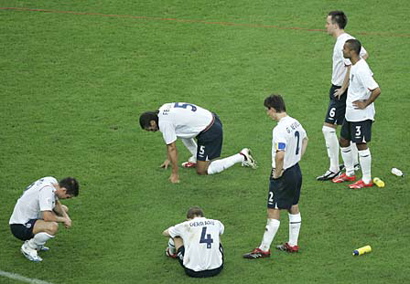
Englandlosemuransezerap_1

I’m no sports fan, but I’m an Englishman by birth and upbringing, and so, when the World Cup comes around, I was brought up and ingrained with a sense of dread. This is England’s game; and England’s domestic league is arguably the best in the world. My family was a rugby household, and my dad never placed soccer on the same moral plane as the bloody butchery of muddy doggedness that is his sporting lodestar. But the World Cup is as much about national identity as it is about sport, and my dad knew whose country he supported. And so, every four years, the English people go through a period – longer or shorter – of emotional trauma and agony. I was two when England last won the World Cup. I remember one day in my youth when, unable to cope with the tension of another grueling match, I went for a walk in my home town. The streets were deserted. No cars; no people. The silence was deathly. And as I turned a corner in the street, I heard from inside all the houses within range, a collective, anguished groan go up simultaneously – as, once again, England choked.

I couldn’t watch yesterday either. At least it was against Portugal, a wonderful little country, with old friendship with England. Losing to France and Germany is existentially far worse. But all the classic elements were there: the endless tension, the injury of the good player, the explosion of the hothead, the injustice of being clearly the better team but without the ability to score, the over-time, the penalty kicks, and then the inevitable emotional collapse; and the consumption of enormous amounts of warm beer to dull the pain. The hangovers in England today are probably epic even by that island’s exacting standards.

The Observer captures a bit of it:

The supporters, so resolute and so fervent, deserved something special from England – and what they got, once Rooney was gone, was the kind of robust, dogged performance in which they take a kind of ironic pride: determination in adversity. It is not for nothing that the fans’ chosen anthem is Elmer Bernstein’s theme tune from the prisoner-of-war movie The Great Escape – a film that celebrates the nobility of courageous, if ultimately futile, resistance.

Played in high humidity beneath the closed roof of the magnificent Stadium AufSchalke, one of the most technologically sophisticated arenas in world sport, the game was, after a slow start, a splendid spectacle, fraught with tension and a slow-burning dread that the game would ultimately be decided on penalties. What else?

What England and their supporters feared most as the drama of the occasion intensified was the horror of repetition: the knowledge that, when it mattered most, England had failed before and perhaps were destined to fail again. ‘Ever tried,’ wrote Samuel Beckett. ‘Ever failed. No matter. Try again. Fail again. Fail better.’

This was the story of Dunkirk: fail better. But one day, one day, England will win. I know they will. Just not this time. Never this time.

(Photo: Muran Sezer/AP).

Charging Bush With War-Crimes?

A reader comments on my post this morning:

The real question, it seems to me, is whether the difficulties and possibilities are legal, political, or some mixture of the two.
My call would be: prosecuting Rumsfeld, Bush, and the others responsible for war crimes is legally possible (i.e. there is enough to make a case), but politically difficult.
There is no legal difficulty about it: the law is quite clear that responsibility flows uphill.  There is already a great deal of evidence available to show the responsibility of those in charge, and only more will come out.  So far as the law goes, it is no more conceptually difficult than the prosecution of Milosevic or Saddam Hussein.
Politically, of course, it could be very painful and divisive – it will depend on the extent to which people of good will can put aside party for the good of the country and its deepest ideals.
So:  is it "difficult to imagine circumstances in which charges might actually be prosecuted"?  Given the degree of partisan entrenchment in the country right now, yes, it is politically difficult.  Is it legally difficult to imagine?  No, no more than for any case in which there is enough prima facie evidence to bring an indictment.

If not the president, then the defense secretary. At some point, someone will have to be held accountable for what they have done. Here’s an op-ed on the same subject which I missed yesterday.

Americans Get It

This is an encouraging nugget from the Washington Post today:

The issue is not without complexity for Republicans. A Washington Post-ABC poll this week suggested that while Americans continue to favor holding suspects at the U.S. military installation at Guantanamo Bay, Cuba, they are leery of an administration policy that has resulted in almost all of the 450 detainees being held without charges. Of those polled, 71 percent said the detainees should be either given POW status or charged with a crime.

That’s always seemed to me to be the right choice. I’d opt for POW status. But I can understand the alternative option. If the opponents of this administration’s bull-headed disdain for Western principles need a slogan, they just got one.

Quote for the Day

"[The prisoner] was informed that dying is not permitted," – from the medical log for one of the younger hunger-strikers at Gitmo.

The methods needed to prevent hunger-strikers from dying at Gitmo have gotten progressively more drastic:

According to al-Shehri’s records and Gitmo doctors, a typical [force]-feeding lasts about two hours, with the inmate left in the restraint chair [or "padded cell on wheels"] for roughly 45 minutes afterward. During the feeding period, the prisoner will receive as much as 1.5 liters of formula, which, in the case of hunger strikers, can be more than their stomachs can comfortably hold. This can produce what is euphemistically called "dumping syndrome," an uncomfortable, even painful bout of nausea, vomiting, bloating, diarrhea, and shortness of breath. And those are precisely the symptoms that al-Shehri and many other force-fed prisoners have reported to their lawyers.

My review of a book analyzing 35,000 pages of FOIAed government documents about medical practices at Gitmo and elsewhere in the war can be read here.

Is Bush A War Criminal?

That question has troubled me for quite a while. The Hamdan decision certainly suggests that, by ignoring the Geneva Conventions even in Guantanamo (let alone in Iraq), a war crime has been committed. And in the military, the command structure insists that superiors are held accountable. I’ve been saying this for a long time now, and have watched aghast as the Bush administration has essentially dumped responsibility for war-crimes on the grunts at Abu Ghraib. The evidence already available proves that the president himself ordered torture and abuse and the violation of the Geneva Conventions. Now he has been shown to be required to act within the law, and according to the Constitution, his liability for war crimes therefore comes into focus. Money quote from a useful Cato Institute Hamdan summary:

Both the majority and concurrence cite 18 U.S.C. ¬ß 2241, which Justice Kennedy stresses makes violation of Common Article 3 of the Geneva Convention a war crime punishable as a federal offense, enforceable in federal civil court. The majority holds, of course, that trying persons under the president’s military commission order violates Common Article 3 of the Geneva Convention, suggesting that trial is a war crime within the meaning of 18 U.S.C. ¬ß 2241.

Furthermore, the majority stresses that the Geneva Conventions ‘do extend liability for substantive war crimes to those who "orde[r]’ their commission" and "this Court has read the Fourth Hague Convention of 1907 to impose ‚Äòcommand responsibility’ on military commanders for acts of their subordinates." The Court‚Äôs emphasis on the liability that attaches to "orders" is significant, because trials in the military commissions are, of course, pursuant to a direct presidential order. Even so, it’s difficult to imagine a circumstances in which charges under Section 2241 might actually be prosecuted.

Difficult but not impossible.