It’s made America more bi-curious. At least online.
The View From Your Window

Wellington, New Zealand, morning.
Strauss and Today’s Academy
A reader writes:
I’ve been following your posts about Strauss with some interest. I spent some time at the University of Chicago and had some interaction with his followers, Joseph Cropsey and Nathan Tarcov. I agree with you that whatever sort of conservatism Strauss espoused, it cannot be equated with contemporary neo-conservatism.
That said, I think you make too big a deal out of the differences between Strauss and ‘the contemporary academy.’ People in general, but especially so-called movement conservatives have failed to notice that academia has largely moved on from the post-modern nonsense that was peddled in many elite departments in the 1980s. To take a few examples: political theory and philosophy is overwhelmingly liberal (with a small L). The dominant figure is John Rawls, who was a defender of classical liberal principles drawn from John Locke. These days, I see multicultural critiques of liberalism in retreat. Empirical political science has its share of po-mos, but they are rarely found in elite departments in the US. These are dominated by rational choice theory and neo-positivist methods, preferably with a statistical component. Economics essentially has no post-moderns, while Marxists are rare.
It is true that Anthropology remains a bastion of multi-culti b.s., but they are essentially alone in the social sciences. I know much less about humanities departments, but friends tell me that the French literary criticism wave passed long ago. English is returning to the close analysis of texts. Academic Philosophy is dominated by the Anglo-American school. Professional academics may be somewhat to the left of average Americans, but they are by no means outside the mainstream of liberal-democratic thought. My point is that Strauss is not such an outlier as you make him out to be, apart from some oddities of methodology (for instance, the search for ‘esoteric’ readings of ancient texts).
The View From Your Window

Detroit, Michigan, 9.48 pm.
Sacredness of Marriage Watch
The Catholic church wants to amend the American constitution to protect the sacredness of marriage, but grants divorces annulments routinely. A reader adds:
I’m surprised and charmed by your unfamiliarity with the Church’s annulment practices. One thing I would emphasize is that even for Catholics married in Catholic ceremonies, annulments seem easy enough. I have a friend, a fund-raiser for the Church, who has had two marriages zapped into oblivion, and may have her third erased as well. Just think, some sunny day gay Catholics will be able to take advantage of this particular brand of Church magic.
A sunny day in the fourth millennium maybe. Another reader comments:
Delighted you have recently discovered the wonderful miasma of RC marriage and annulment rules. As an Episcopal clergman recently observed: "There is nothing that has a greater hold on the minds of people than ignorance fraught with technicalities."
Quote for the Day
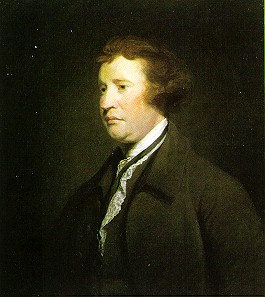 "A person is brought hither in the dungeon of a ship’s hold; thence he is vomited into a dungeon on land, loaded with irons, unfurnished with money, unsupported by friends, three thousand miles from all means of calling upon or confronting evidence, where no one local circumstance that tends to detect perjury can possibly be judged of;‚Äîsuch a person may be executed according to form, but he can never be tried according to justice.
I therefore could never reconcile myself to the bill I send you, which is expressly provided to remove all inconveniences from the establishment of a mode of trial which has ever appeared to me most unjust and most unconstitutional. Far from removing the difficulties which impede the execution of so mischievous a project, I would heap new difficulties upon it, if it were in my power. All the ancient, honest, juridical principles and institutions of England are so many clogs to check and retard the headlong course of violence and oppression. They were invented for this one good purpose, that what was not just should not be convenient. Convinced of this, I would leave things as I found them. The old, cool-headed, general law is as good as any deviation dictated by present heat," – Edmund Burke, leftist abetter of treasonous terrorists, defending the right to due process and fair trial in Gitmo the American colonies.
Can you imagine what writers like Mark Levin or Glenn Reynolds would say to Burke today? Or what Bush and Cheney and Rumsfeld would say to him? They would regard him as a traitor to their conservatism. As indeed he is. To theirs’.
He’s My Man
A dialogue with Leonard Cohen.
Straussians: Gentlemen or Nietzscheans?
A reader writes an eloquent email on the question of Leo Strauss and his impact on today’s Republicans. It’s long but so good I’m running it. Scroll down if it bores you:
Like you, I studied with Straussians, both as an undergraduate and in graduate school (at the University of Chicago, in the Committee on Social Thought, when Allan Bloom was there). Like you, I admired the thinker and at least some of his followers without becoming part of the (very real!) cult following.
I think you are largely right about the disconnect between Strauss’s moderate defense of liberal democracy and contemporary Neocon hubris.
But you are more surprised by this disconnect than you should be.
I observed during my time at Chicago two distinct strands of Straussians. I’ll call one strand "the gentlemen" and the other strand "the Nietzscheans."
Granting your point about Strauss’s skepticism, there are two paths you can go down from there; but first, there is an intermediate step: once you grant that the most appropriate response to the most difficult questions about life is skepticism, what does one do with "the many," as the Straussians call them? Can ALL human beings (ALL prisoners in Plato’s cave) really accept that there are no certain answers to life’s most pressing questions? Can everyone be a philosopher?
Strauss’s answer seems to have been: No, they cannot. Most human beings need answers, and they become very dangerous when denied them. Bear in mind what they did to Socrates, after all. So, the next question is, what answers to give them? To give a definite answer when you don’t really have one (remember: skepticism is a given here) is to lie. To lie in order to prevent harm is to lie nobly. For Strauss, the many need noble lies.
So now the difference between the gentlemen and the Nietzscheans:
The gentlemen (for example, Cropsey), as best I could tell, believe that skeptical moderation is good for its own sake, and that moderate noble lies are also best for a stable polity. That means one’s political myths must encourage the decent virtues as much as possible. It means that the noble lies ("All men are created equal," for example) are not entirely false or implausible. The gentlemen are thus very close to the Strauss described by Smith in his book.
The Nietzscheans (for example, Bloom) take another path from the skeptical starting point. For them, there is one truth that IS certain: the distinction between those human beings who CAN endure the fact that there are no certain answers and those who CANNOT endure it. The Nietzschean Straussians that I knew as graduate students were utterly dismissive of the many ordinary human beings; they believed the scales had fallen from their own eyes and that they had been liberated from ordinary morality. Moderation is good only as a means or a mask, not good in itself. Yet at the same time, they understood Strauss’s cautions about the limits of general Enlightenment and public reason. And so for them, the best regime was the American one, a regime that permits freedom of thought for the philosophers and, for the many, freedom for politics, for hard work, and (alas) for self-indulgence — despite the risk of a plunge into consumerism and philistinism. Hence "The End of History and the Last Man" — by a student of Bloom’s. (Everyone forgets the last man part: it’s not necessarily a happy ending.)
These Nietzscheanized Straussians that I observed truly believed in their superiority and in their right to influence politics and public affairs. Yes, as a student in his 20’s mellows into his 40’s and 50’s, he will lose some of the Nietzschean hubris — but perhaps not the conviction that the many need noble lies that he knows to be false. Not the conviction that he knows best, and can apply this knowledge universally. Hence Wolfowitz, the WMD feint in order to bring on war in Iraq, the plan to seed democracy throughout the Middle East and end all tyranny, the Rumsfeldian arrogance, etc. Disaster.
Gentlemen Straussians, I believe, have been appalled by the hubristic, millenarian idealism of the Neocons and the Iraq adventure. The recognize in it a version of the excessive faith in reason and progress.
But everything depends on how you find your way from the starting point of skepticism. It can lead to moderation, but one needs a very mature body politic for it to do so, since skepticism is usually acid to so-called traditional values, which generally depend on absolutes ("revelation"). There is also always the risk that some skeptics will recognize in their own valiant skepticism a distinction from almost all other mere mortals, a distinction which grants them the right to govern with a contempt for ordinary people and for the truth.
I share your faith in skepticism (quite an oxymoron!), but there is always this caution: How deeply can a body politic truly embrace such skepticism as a founding value? A conservative must always say: it depends. It depends on which body politic you are talking about, and at what time.
Is the American body politic ready for a healthy, not a nihilistic, skepticism? Not if today’s faith-based Republicans have anything to do with it. Apparently, they no longer believe we are strong enough and free enough for it. For them, healthy skepticism is equivalent to relativism or nihilism.
But I still have faith, and I am glad you do, too.
Yes: that great paradox – faith in doubt. My book is really an attempt to accept Strauss’s skepticism, while retaining much more faith in ordinary people’s sense and judgment, and far more faith in the constitutional order set up by the deeply skeptical American founders. And this is the struggle for the soul of conservatism now under way: between cynicism and trust, between lies and moderation, between executive hubris and constitutionalism. Compare some students of Strauss with most students of Oakeshott (I was fortunate enough to be a bit of both). What you see is the temptation of those ultimately drawn to power, and those who are repelled by power and seek merely freedom. Count me among the latter – but we are a dwindling, motley crew on the right.
Which Super-Hero Are You?
Here’s a fun quiz I just came across. I turned out to be Spiderman.
Bush and the NYT
Here’s an interesting theory:
Glad you commented on this NYT story, because it‚Äôs been baffling me as well, but you didn’t mention what I think is the most bizarre aspect of this story, which is that it this story in fact makes the administration look great. It’s a legal and intelligent way to be tracking terrorist activities at home and abroad, and I think Americans would be more shocked to discover that they weren’t doing this.
If this had been reported by Fox News, it would likely have been dismissed by most as simple conservative media cheerleading. So how‚Äôs this for a conspiracy theory? The administration wanted this story to be leaked, and they wanted it to be leaked to the Times. That way they get to a) trumpet what a brilliant job they’re doing fighting the war on terror and b) vilify the Times and the press, which is always good for firing up their conservative base. I think this was Bush and Rove at their finest, and Keller got taken for a ride.
The blogosphere played its part as well, I suppose. And who needs Tony Snow when you’ve got Instapundit?
 The Dish