
Chesapeake Beach, Maryland, 8 am, today.
Chesapeake Beach, Maryland, 8 am, today.
This one’s a beaut:
The BBC’s Jim Muir in Baghdad says there are concerns that Mr Maliki’s plan will not work as it does not seek reconciliation with those at the heart of the insurgency – the radical Islamists, many of them foreigners, who want Iraq to be the centre of a new Islamic empire.
I wondered when the BBC would acknowledge the presence of al Qaeda in the insurgency – and its non-negotiable, maximalist goals. It appears they only do so when it can be used to throw cold water on any progress in the country.
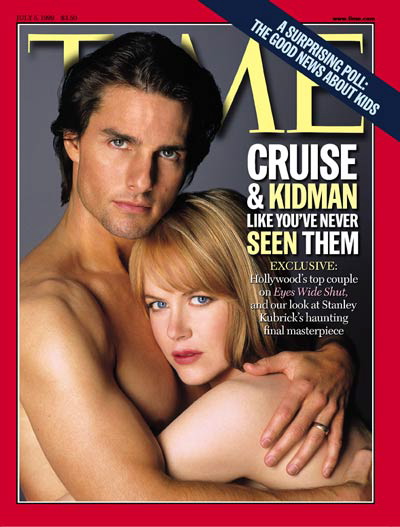
That’s the Catholic Church’s position, and they’re sticking to it. Two kids? Irrelevant. Cover of Time? Never happened. Graphic sex scenes? Hey, we’ve got a Hollywood actress plugging our brand! And she was never married anyway (except legally for a decade). A reader elaborates:
Presuming that Nicole Kidman was Catholic when she married Tom Cruise she was obligated under canon law to be married in the Catholic Church. Since she was not (she was married in a scientology ceremony) the wedding was per se invalid and therefore she had fairly straightforward grounds for an annulment. Basically the form of the wedding was incorrect. Just as a baptism performed in the name of the John, Paul and Ringo would not be valid, a wedding not performed according to the proper form also would not be valid. At least this is how the Pastor at my church described it in a recent church bulletin (suggesting that Catholics who had not been married in the church would need to have their marriage convalidated).
I love my church. Its rules are inviolable and eternal, except when they’re not. Kidman was legally married for ten years, had two kids, but, as far as the Catholic church is concerned, her marriage to Cruise did not exist! She didn’t even have to seek an annulment. But the stricture against a Catholic’s divorce and remarriage is absolute – and a Catholic who obeyed the rules all along, and got married in a Catholic first wedding, would be denied the sacraments and barred from re-marrying in church. I guess because I am deemed objectively disordered by my own church, I haven’t been as aware of this transparent nonsense as I should have been. A reader comments:
This point of canon law is the linchpin of Muriel Spark’s novel, The Mandelbaum Gate. The protagonist, a devout Catholic spinster, has fallen in love with a divorced man. Her only hope of marrying him is if to find evidence that he was baptized Catholic as an infant. If so, even though he had never practiced Catholicism, his Protestant wedding would be invalid. If not, his marriage could not be annulled.
Spoiler alert: The typical Spark twist comes when a rival character, assuming church law works the opposite way, lies about actual evidence he has uncovered and tells them that indeed the man was baptized a Catholic. He’s crushed to realize that he‚Äôs given the happy couple a straight path to the altar. In truth, of course, the first marriage is not invalid, and the annulment will be based on a lie. But by another happy twist of Catholic theology, that doesn‚Äôt matter because it is not the couple‚Äôs lie, and they are acting in complete good faith. You could call it a marriage of invincible ignorance.
How quaint all this preoccupation with the canon law seems today. But think how many lives the Catholic Church has stunted and twisted over the years by forcing people to jump through these hoops.
Yes, but think of the power they have.
Here’s the first in a series of posts on the Bush presidency through the lens of a recovering alcoholic. Money quote:
In 1999, responding to questions about his use of drugs and alcohol, George Bush told the Washington Post, "Well, I don’t think I had an addiction. You know it’s hard for me to say. I’ve had friends who were, you know, very addicted…and they required hitting bottom [to start] going to A.A. I don’t think that was my case."
Having observed the president’s behavior in office, I wonder if he might be wrong. Perhaps not only the president, but also his administration, suffers from alcoholism. After all, arrogance and the inability to take responsibility for one’s actions, classic alcoholic traits, have become trademarks of the Bush presidency.
George Bush’s problems are not only personal. By necessity, they have become the problems of our entire country. And our country is like the family of an alcoholic, devastated by the drinker’s actions but powerless to stop them.
This is too simplistic an analysis, of course. And yet the president’s alcoholism is integral to his personality; and it’s certainly as worth debating as his predecessor’s sexual addiction.
I know we should all be talking about Jerome Armstrong and Bill Keller, but today’s news from Iraq strikes me as a big deal:
One of Iraq’s largest Sunni Arab groups endorsed the prime minister’s national reconciliation plan on Tuesday, and the government announced new benefits to help freed detainees return to normal lives.
The political moves came a day after bombs killed at least 40 people at markets in two Iraqi cities, while key lawmakers said seven Sunni Arab insurgent groups offered the government a conditional truce…
In the first tangible measure after the reconciliation plan was announced on Sunday, the council of ministers said government employees who had been detained and recently released will be reinstated to their jobs and their service should be considered uninterrupted in consideration of bonuses, promotion and retirement privileges.
The ministers said freed students will be allowed to return to school to take their final exams and will not be failed for the 2005-2006 school year despite time missed…
In another boost for the Shiite prime minister’s reconciliation proposal, prominent Sunni cleric Ahmed Abdul Ghafour al-Samaraie offered the support of his Sunni Endowment, the state agency responsible for Sunni mosques and shrines.
But he urged the government to move quickly to fill in the details of the plan and said it should include the disbanding of armed militias, as well as the release of all prisoners who have not been convicted.
"We bless this initiative," he said. "We see a glimpse of hope out of this plan, but at the same time we are noticing that some people are pushing the armed groups to attack some areas in Baghdad, spreading terror and chaos in the city in order to make this plan a failure."
"Thus, the government is required to take decisive actions so that the citizens feel that the state is a real protector," he added.
The only hope for Iraq is that more Sunnis can be drawn into the government and that the government finds the political will to rein in Shiite militias. The news suggests modest progress on both fronts, which would allow for better deployment of American troops. Mohammed comments here.
I confess to being a little bemused by the hysteria in some parts of the blogosphere about the NYT publishing details of the government’s close monitoring of some financial transactions in the war on terror. I should qualify that by saying that the argument against the press is the strongest I’ve yet read in any of these cases. Unlike the NSA wire-tapping program, or the secret torture prisons in Eastern Europe and elsewhere, this program does not seem to be illegal, or only legal under the doctrine that anything the president does in the war is de facto legal. It seems carefully structured to prevent abuse of privacy, it appears to have been effective (although you and I have no way of knowing for sure). If I were Bill Keller (fat chance, I know), I probably wouldn’t publish.
On the other hand, publishing it does not, it seems to me, obviously render the program ineffective. And the Malkinesque charges of treason seem a little, er, excitable. The press publishes stuff that doesn’t always help the government in wartime. Duh. In a democracy, in a war which has sharply divided the country, this is hardly a big surprise. If the NYT didn’t do it, someone in the government would find a way to leak it in another way. One wonders what would happen in Power Line’s perfect world, where the MSM always followed the government’s advice in wartime, suppressed news of defeats and setbacks, and avoided any damaging revelations that might encourage the enemy or inform citizens of government errors or abuses. Let’s say someone within the administration still wanted to leak the program. Wouldn’t they just give the info to an anti-Bush blogger? And would the damage be any less than it is – in today’s media universe? In a paradoxical way, some bloggers both want to dismiss the NYT and then describe it as the essential gateway for all important information. It cannot be both. In today’s transparent, web-based media, wars are just going to be subject to more scrutiny – especially divisive wars, run by controversial presidents, with as many opponents within the government as outside it. Get used to it. And take a Xanax.
I’m not sure I understand. How did the Vatican agree to her second marriage? Do weddings with scientologists not count?

San Francisco, California, 7.30 pm.
The Strauss debate continues:
Since you said: "All refutations of this email gratefully received." There’s one major error in it:
Strauss’ philosophic project is not "essentially apolitical." To the contrary: the mode of philosophy that interested him most of all was classical political philosophy, and Socrates, who "call[ed] philosophy down from heaven, and "compell[ed] it to inquire about men’s life and manners as well as about the good and bad things." ("City and Man") Of that philosophy, he says elsewhere that "It was its direct relation to political life which determined [its] orientation and scope." ("What is Political Philosophy?")
The simplest thing, of course, is that all of Strauss’ work concerns political philosophy. It’s not credible that that’s "apolitical." You might look at the beginnings of the essays "What is Political Philosophy?" and "Three Waves of Modernity."
With a thinker as difficult as Strauss – someone whose thought is on such a high level that I doubt that anyone has yet understood it adequately – the best thing to do is not to try to label him or to put him in the army of one political cause of another, but just to see what he says, and apply his arguments when they’re applicable. And we must always beware of defending him by making him less interesting.
But I think the first emailer’s point was that Strauss’ fundamental interest was philosophy and/or revelation. He grappled with politics because philosophers and saints live among other humans, and the relationship between others and the self, the city and the philosopher, is a critical impediment to the purely philosophical life, or at the very least, a problem to be grappled with before getting to the important things. In that narrow sense, Strauss was apolitical. He certainly didn’t believe that politics accomplished anything of any great importance, except the freedom of a few to think. Meanwhile, another perspective:
There may be another reason for Strauss’s fondness for the D√ºrer watercolor. In a defense of her father published in the New York Times, Jenny Strauss Clay writes, ‘His own earliest passion, he confessed, was to spend his life raising rabbits (Flemish Giants) and reading Plato.’
Sounds pretty great to me.
Guess who’s Coulter’s chaperone these days?
 The Dish