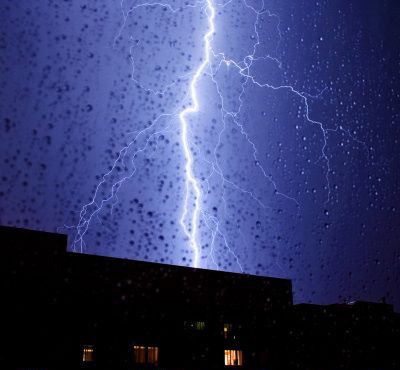
Washington, D.C., 1 am, last night. The storm was amazing.
Washington, D.C., 1 am, last night. The storm was amazing.
I just caught this one from Mickey. It’s a beaut. It recalls so many who claim that president Bush never argued for democratization of Iraq before the war, only afterward, once the WMD debacle has unfolded. They are empirically, and demonstrably incorrect.

Here’s a link to the National Research Council’s new study on temperature change in the last 2,000 years. You can find the NYT’s reconstruction of the data here. Time’s take is here. The study qualifies a little the simple "hockey stick" graph that shows recent times experiencing a suddent, unprecedented rise in temperatures, and shows merely that we are now hotter than for a very long time. Money quote:
The report was requested by Congress after a controversy arose last year over surface temperature reconstructions published by climatologist Michael Mann and his colleagues in the late 1990s. The researchers concluded that the warming of the Northern Hemisphere in the last decades of the 20th century was unprecedented in the past thousand years. In particular, they concluded that the 1990s were the warmest decade, and 1998 the warmest year. Their graph depicting a rise in temperatures at the end of a long era became known as the "hockey stick."
The Research Council committee found the Mann team’s conclusion that warming in the last few decades of the 20th century was unprecedented over the last thousand years to be plausible, but it had less confidence that the warming was unprecedented prior to 1600; fewer proxies – in fewer locations – provide temperatures for periods before then. Because of larger uncertainties in temperature reconstructions for decades and individual years, and because not all proxies record temperatures for such short timescales, even less confidence can be placed in the Mann team’s conclusions about the 1990s, and 1998 in particular.
The committee noted that scientists’ reconstructions of Northern Hemisphere surface temperatures for the past thousand years are generally consistent. The reconstructions show relatively warm conditions centered around the year 1000, and a relatively cold period, or "Little Ice Age," from roughly 1500 to 1850. The exact timing of warm episodes in the medieval period may have varied by region, and the magnitude and geographical extent of the warmth is uncertain, the committee said. None of the reconstructions indicates that temperatures were warmer during medieval times than during the past few decades, the committee added.
The warming is real: that much we now know.
"Consider this post an open letter to Senate Democrats. You’re really doing a poor job in the public debate over Iraq. Luckily, unlike what’s imagined by the imbeciles who write The Note and others in Washington, reality is not simply a DC media and politics confection. The Dems can muff this several times before coming back and getting it right. And they’d still be more or less fine. Because the Iraq War is still really unpopular. And the great majority of the country has lost faith in President Bush’s conduct of the war. But that’s still no excuse for handling this so poorly," – Josh Marshall, lambasting his own side, today.
"I should apologize for that ‘climactic.’ I meant, of course, ‘climatic.’ This was not a world-wide orgasm … though the earth probably did move a little," – the Derb, going all Freudian on us, speaking of the last ice age.
Mark Blumenthal analyzes the Battle of the Bulge, recently referred to by White House spokesman, Tony Snow. Sadly the contrast between a bipartisan war and a partisan one come into sharp focus, comparing polling now and then. There are many people to blame for this, including the hard left, but the buck ultimately rests with the president. He is the commander-in-chief. In retrospect, he should have realized that a war on this scale and duration needed deep, bipartisan support. After 9/11, he probably should have brought in Democrats into his cabinet, named a Democrat defense secretary, and reached out to the majority of the opposition party that was not already beholden to Michael Moore-style idiotarianism. I also think he should have argued that all detainees in the war should be treated as formal POWs, detained until Osama bin Laden, or a successor, issued a statement of surrender, and disarmament. They may not have deserved such an honorific. But it would have said a lot about America that they should be given it. This approach would have conducted the war on a bipartisan highground, helped win over the allies, unite the public and yet still allow us to fight ferociously. Maybe this is a naive scenario – especially after the bitter division of the 2000 election. But, in some ways, that bitterness made such a strategy more important. Especially if you really believe, as I do, that this war is among the gravest the West has ever fought. The idea that it should be waged to help win mid-term Congressional elections for one party is a terribly sad and dangerous one. But I fear it is partly the truth.
The malign vacuousness of Bill O’Reilly needs little further documentation. But when trying to excuse what might have been a war crime in Haditha, and in attempting to ignore or belittle the first American president to order the pre-meditated torture of military detainees, O’Reilly went a little too far. He got his facts wrong, and attributed a World War II Nazi massacre of unarmed American soldiers to the victims, Americans. He did this twice. Faced with this error, he blustered, lied again and then altered the transcript. Keith Olbermann nails him here.
A helpful symposium with some big names.
A reader writes:
There’s something I think you, me, and everyone else who has nominally supported this war has to face: slogans are not going to win the war. At the end of the day, if Rove’s goal is for the president to stick the war out until the end of his term, then shove the issue off on someone else, pulling out and losing is exactly what we’ll be doing. Do you honestly believe that after two-and-a-half more years of carnage the American people would support an upping of troop levels, even if McCain wins? And which troops from where would go? If this war is a drain on resources now, how will our resources look after two-and-a-half more years of sloganeering? Add a slowing economy into the mix and then what?
What I’m getting at is that in a strange irony, by the time someone gets in office who is willing to make the tough decisions about upping the troops, renewing the fight, etc., we may have to face the inevitable anyway but even worse – a pullout leaving us with a severally drained and weakened military. In that case, people like me (ambivalent-to-against the war at first, but supportive once we got there) and you will have ultimately held aloft the GOP’s political hold on this country, while allowing self-interested people to damage our military, our international reputation, and national morale. I know it’s tough to face, but it’s true.
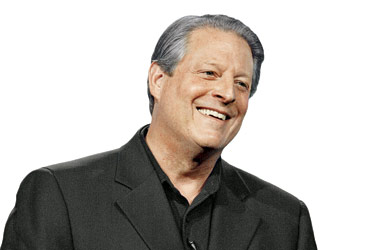
"Let me tell you a few words about the question as to whether Al Gore has changed. Actually, to me he is essentially the same young man I met in a Harvard freshman seminar 41 years ago: inquisitive, respectful of learning and scholarship, emotionally connected, committed to his friends and family, incandescently smart, believing in an order of the universe he still genuinely refers to as God. These are not easily carried into the universe of politics, where cynicism leaves little space for authenticity. But he fought against the demons of triangulation that subvert moral clarity. Al also came out whole, very whole. Yes, he was singed by the president’s troubles that the oh, so facile president made for himself. Gore took the advice of some of the usual Democratic four-flusher professionals in his campaign in the year 2000. Right now, I make this assertion with complete confidence: that Gore would not, will not defer his own instincts or convictions to anyone else. Yes, he can be persuaded. But he cannot be pushed," – Marty Peretz, TNR.
(Photo: Frederick M. Brown/Getty.)
 The Dish