Straws In The Wind

Malikibushbrookskraftfortime

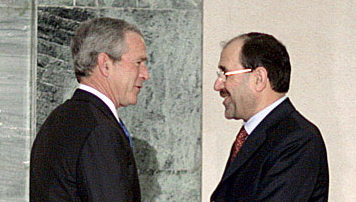
We’ve been subject to grim news lately, so forgive me for connecting some positive developments. They’re unrelated on the surface, but I wonder if they are completely unconnected beneath. The first is the president’s attempt to give the Iraq process one more, giant push. He’s been lucky again. The coincidence (and I presume it is) of Zarqawi’s death, the formation of an Iraqi government, the scheduled review of Iraq policy, and Bush’s visit to Baghdad yesterday has been a real morale boost for the war. And morale matters. Part of what we’re fighting is the sense that this really is hopeless, and there are two publics for which that could be fatal: Americans and Iraqis. I have my doubts about whether the long harder slog is going to become much easier in the future, but the president has rightly thrown his full political weight behind the endeavor. He has little alternative. But his somewhat detached attitude of last year has mercifully disappeared.

Then we have news that the Pentagon may retreat from its intent to wriggle out of the McCain Amendment by including separate interrogation techniques in a classified annex to the Army Field Manual. The three key senators in this entire debate have been McCain, Graham and Warner. All three seem to have been able to win the argument – so far – against Cheney and Rumsfeld. Money quote:

Mr. McCain and Mr. Graham said having two sets of interrogation techniques would violate the legislation that Mr. McCain sponsored and that was enacted last December to bar cruel and inhumane treatment of American detainees. The measure requires that only interrogation techniques authorized by the new Army field manual be used on prisoners.
In addition to the lawmakers’ complaints, some senior generals also objected. At a recent meeting of the nation’s top worldwide commanders, Gen. John P. Abizaid, the head of the Central Command, and Gen. Peter Schoomaker, the Army chief of staff, said the new interrogation techniques had to be clear and unambiguous "so our corporals in the field can understand them," said a military officer briefed on the remarks.

Then we have an interesting election for president of the Southern Baptist Convention. Readers may know more about the back-story (and I’d be eager to find out more), but Frank S. Page strikes me as a bit of a change. There was a real, contested election, and Page cut a slightly different figure than his rivals or predecessor:

Page said although his election did not mean that the church was moderating, it certainly meant that change was in the wind. "I believe in the Word of God," he said. "I am just not mad about it. Too long Baptists have been known for what we are against. Please let us tell you what we are for."

A little less Christianism and a little more Christianity? Here’s hoping.

(Photo: Brooks Kraft for Time.)
Concerned Women for America

Pledgeofallegiance1899

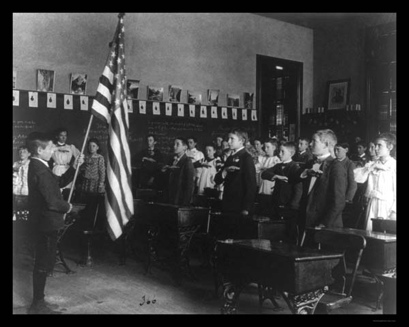
This Christianist organization is now fanning the culture war flames on the pledge of allegiance. The fag-bashing and flag-waving didn’t go over so well. In their latest mass email yesterday afternoon, we learn the following:

Concerned Women for America’s (CWA’s) Director of Government Relations Lanier Swann will join other conservative leaders in speaking at a press conference tomorrow in support of Sen. Jon Kyle’s (R-Arizona) and Rep. Todd Akin’s (R-Missouri) Pledge Protection Act. This legislation would ensure the protection of the phrase "under God" in the U.S. Pledge of Allegiance. The press conference will be held on Flag Day, which marks the day in 1777 when John Adams proposed the stars and stripes as the official United States flag.

Swann said, "As Americans commemorate Flag Day, it is also appropriate to remember the importance of keeping God in our Pledge. CWA strongly supports the mention of God in our nation’s oath in keeping with our constitutional freedoms. We are free from an established religion and free to worship as we choose. Our country’s founding fathers were men of faith who intentionally included the phrase ‘under God’ in an oath that serves as a symbol of loyalty and patriotism to our great country.

The small factual problem is that the pledge was not created or conceived by the founding fathers, whose deist, cafeteria Christianity CWFA would now almost certainly deride as "secular humanism". (Very few of the founders believed Jesus was divine. Can you imagine what CWFA would say about a politician today who shared Jefferson’s worldview?) The pledge was invented by a socialist in 1892; and the phrase "under God" was added as recently as 1954. I have no problem with it, I might add, and find the campaign to banish such harmless invocations of the deity to be petty and counter-productive. But CWA’s hysteria and rewriting of American history need to be exposed. They’re welcome to their version of Christianity. They’re not welcome to their version of reality.

(Photo taken on Flag Day, in 1899.)

Firing a Mormon

"In accordance with the order of the church, we do not consider it our responsibility to correct, contradict or dismiss official pronouncements of the church. Since you have chosen to contradict and oppose the church in an area of great concern to church leaders, and to do so in a public forum, we will not rehire you after the current term is over," – Brigham Young University Department of Philosophy Chairman Daniel Graham, in a letter to an adjunct professor, firing him for speaking out against the Federal Marriage Amendment.

The impermissible op-ed can be read here. Money quote:

A perfect God does not require blind obedience, nor does He need unthinking loyalty. Freedom of conscience is a divine blessing, and our privilege to express it is a moral imperative.

Well said. I am grateful for the man’s sacrifice on behalf of others. History will vindicate his stand. And one day, I believe, churches will be ashamed of what they have said and done.

The Miracle of Dogs

Dustyeddy_2

I’m not surprised that dogs are now being used to search for more and more esoteric substances. Food is always the bait, as any beagle owner will verify:

The training process is similar for almost all odors. For months, the dogs are given multiple items in succession to smell. When they come to the target odor — bedbugs or mold, for example — they get a reward. Eventually they associate the odor with the reward.
"All animals strive for food, sex and praise," Mr. Whitstine said. "We can’t give them the middle one, but we can give them the food and praise." The more odors a dog is being asked to pick out, the longer the training. Mold dogs, for example, are taught to detect about 18 toxic molds, some of which cause allergies.

Food, sex, praise: not a bad combo for managing humans either. There are downsides, of course. I love my beagles but if either one had to pick between me and a potato chip, the potato chip would win every time. And our youngest beagle-mutt, Eddy (behind Dusty in the photo), whom we rescued from the shelter, has been acting up lately. We house-trained her within a couple of weeks of getting her, but two weeks ago, she suddenly decided that she would relieve herself as a matter of course next to my desk. Maybe it was something I wrote. We used something called "Nature’s Miracle" to get rid of the smell but, like other beagles, Eddy was onto something, and we have been forced to crate her again, and to construct a little fence between the main living area and what my other half calls my "blog-cave." The scent draws her back. Or is it just beagleness?

Blog Hubris

Ana Marie finds quite a lot in Las Vegas:

They say, however, there’s a thin line between hating someone and wanting to be someone. Sure enough, the panel on political journalism is an uncomfortable mix of criticism and instruction. On the one hand, political reporters were excoriated for their kowtowing, wishy-washy coverage, and blasted for letting their preconceived notions dictate the "master narrative." On the other hand, the four bloggers on the panel ‚Äî the fifth was Matt Bai, who writes about politics for the New York Times Magazine ‚Äî talk about blogging in a way that implies that they’re re-inventing the journalistic wheel. "To have good sourcing you have to maintain relationships," says one. And as for letting a master narrative guide one’s writing ‚Äî there are few narratives more over-arching than the presumption that most mainstream journalists are corrupt, weak-willed shills who hobnob with sources at cocktail parties and protect the establishment at the cost of our basic rights. Except, that is, for the new master narrative: empowered netizens speaking brave and uncomfortable truths to power.

Torture, Abortion, America

A reader writes:

I almost wish you wouldn’t write about Kafka when you talk about Guantanamo. It’s pretty easy for me to imagine the worst about that place, and it’s usually pretty unpleasant when I do. I don’t need much help on that score.

I support abortion rights early in a pregnancy. But I’ve listened to enough religious talk radio to know where people who disagree are coming from. They see abortion as the murder of a baby – not just as a murder, but as the most heinous murder imaginable. And because that’s the way they see it, they will never be reconciled to abortion.
That’s the way I feel about torture. It is, in its essence, something so vile that I just can’t be reconciled to it. Even if most of the guys at Guantanamo are guilty, and even if they provide useful intelligence under torture.

I read an article somewhere, a while back about torture, and how odd it was that people who are willing to accept collateral civilian deaths in places like iraq, as a normal and inevitable cost of war, can not be reconciled to torture.  If I remember it properly, the idea was that those of us who are so opposed to torture are a little hypocritical for singling it out for special condemnation.

I keep telling people that it’s not about them, that it’s about us. That it doesn’t matter if the guy at Guantanamo is a monster – that if we torture him, we become monsters too.  People who argue for torture always talk as if we aren’t really there – as if the criminal is there, the monster, and torture is there, a fate that isn’t underserved, and which might bring forth some useful information.

The problem, of course, is that we are there, and the practice of torture changes us. Approving of it changes us, carrying it out changes us, to become the sort of people who approve of torture means, in a sense, that the country we love so much has passed from the scene.

My view is the following: I’m not a pacifist, and I understand that in any war, innocents will be killed. But a just war minimizes such a cost as much as is humanly possible, and that cost must be weighed in the decision to go to war. But torture is something different. It occurs not on the field of battle, where fear and chaos and mistakes abound, but outside of combat. It is deliberate and pre-meditated. The victims are already under your control. They have nowhere to go. And yet you still commit violence against them. The use of cruelty against the defenseless – even for good reasons – is categorically evil. I’m not a utilitarian in this sense. Some things are wrong in themselves. A constitutional democracy that practices torture is an oxymoron. The newly formed National Religious Coalition Against Torture has a new ad that can be found here.

Loving Day

What a great idea: a day set aside in D.C. to commemorate the anniversary of the day the case of Loving vs Virginia was decided. The decision ended three hundred years of marriage defined in many parts of America as a racially separatist institution. Inter-racial couples still face lingering social stigma and it’s worth reminding ourselves how vile it is to discriminate against someone because of a couple’s decision to commit to one other exclusively for life. Money quote from Hannah Arendt, writing in Dissent in the winter of 1959, eight years before Loving:

The right to marry whoever one wishes is an elementary human right compared to which "the right to attend an integrated school, the right to sit where one pleases on a bus, the right to go into any hotel or recreation area or place of amusement, regardles of one’s skin or color or race," are minor indeed. Even political rioghts, like the right to vote, and nearly all other rights enumerated in the Constitution, are secondary to the inalienable human rights to "life, liberty and the pursuit of happiness" proclaimed in the Declaration of Independence; and to this category the right to home and marriage unquestionable belongs.

Clear enough. And yet today, it still isn’t to some.