President Bush uttered those words after Abu Graib. My take in today’s Sunday Times of London.
Bush, Military Ethics, Haditha
From the moment George W. Bush exempted U.S. military forces from the Geneva Conventions if "military necessity" demanded it, he sent a message. From the moment George W. Bush refused to accept Donald Rumsfeld’s repeated offers to resign after Abu Ghraib, he sent a message. From the moment, George W. Bush appended a signing statement to the McCain Amendment, arguing that as commander-in-chief, he was not subject to the ban on torture and abuse of military prisoners, the president sent a message.
Those messages – in a tense and dangerous war, where bad things will always happen – made a difficult situation one where abuse and war crimes were almost bound to take place. And command responsibility in the military goes upward. The president cannot fill the role of being commander-in-chief in order to declare "Mission Accomplished" and then choose not to fill the role when his troops commit war-crimes and torture and atrocities. In what George W. Bush himself calls a "responsibility society," he has ultimate responsibility for the forces he commands. And there is a direct and obvious line between his decisions to break decades’ long adherence to the Geneva Conventions and the pandemic of torture, and now incidents of war crimes, that have plagued this war and stained the honor of this country.
To say this is not to be, as Glenn Reynolds argues, "pathetic and poisonous." It is to face the fact that this president has formally lowered the moral standards for American warfare – in writing, and by his actions. He was given a chance to stop this with the McCain Amendment, and he dodged it. He is now reaping the whirlwind. We all are – not the least the vast majority of great and honorable soldiers whose profession has been stained by a derelict defense secretary and a torture-condoning president. The troops deserve so much better. So does America.
The View From Your Window

Lincoln, Nebraska, 8.30 am.
Ishaqi
A reader comments:
As you said, we still need to find out more information about Ishaqi. But an AC-130 gunship obviously would have torn bodies apart, not put neat holes in the middle of foreheads.
I don’t know what to think at this point. Except one thing: Rumsfeld must be fired.
Beinart on Haditha
There’s much in my friend Peter Beinart’s HuffPo posting on Haditha that makes sense to me. My column tomorrow makes very similar points. And then I read the comments. Well … go read them. They are of a piece with the many emails I receive from the anti-war left, who seem motivated entirely by hatred for the United States and pathological hatred of any of us who supported the Iraq war for principled reasons and have subsequently acknowledged our mistakes and errors of judgment. Between the malfeasance of this administration and the unhinged hatred that now roils far right and far left, it becomes ever harder to retain some sense of balance and judgment. I hope Peter is not discouraged. His voice and his book are part of the solution. Many of the commenters at HuffPost are still part of the problem.
Mankiw on Reich
Catnip for Mickey. But did you know former Bush economics official, Greg Mankiw, now has a blog? It’s great. Check it out.
“Surgical Gun-Ships”
A Vietnam vet writes:
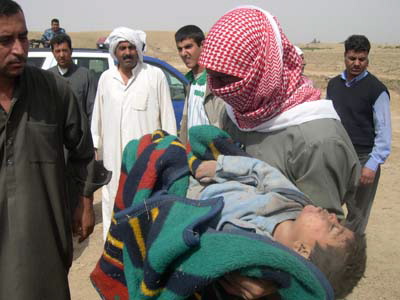
You wrote: "So these civilians may have been shot accidentally by a gun-ship in pursuit of a legitimate target, and not in any pre-meditated or illegal fashion, as is alleged at Haditha." Using a gunship, or artillery, in a crowded urban setting, or a village, guarantees dead bystanders. Since the weapons used are sure to cause widespread, indiscriminate slaughter, claiming the civilian dead are just "collateral" damage is specious word parsing.
The man has a point. Firing random bullets into a civilian home, where women and children could be living and sleeping, seems to me to blur the boundaries of moral warfare. It may be that this is what this kind of urban warfare sometimes requires. I doubt it. But if that is the case, it is surely unsurprising that Iraqi civilians increasingly see the coalition troops as potential enemies, rather than as allies against terror. I also notice that in the latest AP report, the detail about the gunship is missing. I don’t know what to make of that. I should say that my confidence in Pentagon investigations, after the appalling cover-ups and miscarriages of justice in the torture and abuse inquiries, is pretty low.
Let’s also not forget that responsibility in the military is vertical. Commanders are responsible for violations committed by inferiors, regardless of whether they personally knew about them. The commander-in-chief is the president, as he often reminds us. He is the decider. And he is ultimately responsible for any atrocities in the military he commands. In this case, that is particularly true. The standard of military morality and accountability in this war has been set by the defense secretary and president. They have endorsed torture and abuse of detainees – and lied about it. They knew of Abu Ghraib long before we did, and kept it under wraps. It is not a big leap to see why military commmanders, seeing how their commander-in-chief reacts to scandal, would follow his example.
That certainly seems to have been the case at Haditha. I personally see little hope for restoring the military’s credibility until we have a new president. When Bush refused to accept Rumsfeld’s resignation after Abu Ghraib, he sent a clear signal that people in command would not be held responsible for atrocities committed on their watch. We are living with the consequences. And Americans – not just their government – have some responsibility. They re-elected a man who had been shown to have endorsed torture and abuse. When you re-elect such a man, you live with the consequences.
(Photo: courtesy of Raw Story, taken by Agence France Presse. The other photos are far more graphic and disturbing. Do not click on this link if you do not want to see them. My policy is maximum information, within bounds of taste. I published two Danish cartoons; I published Abu Ghraib photos; I linked to the Nick Berg beheading. This photo is reproduced in the same spirit of letting the light in during this war – even into its darkest moments.)
Bob Mould With Hair
This ancient Joan Rivers interview is sent to me by Husker Du fanatic, Mike Crowley, and I link to it purely to embarrass my friend, Bob Mould. May God be praised for YouTube.
Quote for the Day

"Suddenly religion comes along and you suddenly realize, I think we all have to realize, that liberal rights, dear old dreary liberal rights, have got to be continually fought for. It’s like anything else in life, you don’t climb up to a plateau where the sun always shines, you are always marching on relentlessly. Nothing stands still and liberal rights, which are the easiest thing in the world to sneer at, have in fact taken a long time to create, particularly in the United Kingdom. We really have to fight to make sure we keep them," – pop musical genius, Neil Tennant.
The Pet Shop Boys’ new album is dedicated to the teens recently hanged in Iran for being gay. It’s called "Fundamental." I know it’s weird, but for twenty-five years, Tennant and Lowe’s music has been a constant source of comfort and inspiration to me. To discover that their thoughts have been tracking mine doesn’t surprise me, but it does reassure me.
Ishaqi Update
The Pentagon says the dead children were collateral casualties of a legitimate raid on an al Qaeda hide-out:
The footage shows at least one adult male and four of the children with deep wounds to the head that could have been caused by bullets or shrapnel. One child has an obvious entry wound to the side and the inside of the walls left standing were pocked with bullet holes. A voice on the tape said there were clear bullet wounds in two people.
Although it has been known that U.S. air power was involved in the assault on the building in Ishaqi, it was not previously reported that there was an AC-130 gunship, a devastating weapon capable of operating at night and pummeling its target with side-firing guns, including a 105mm cannon. The gunship is flown by Air Force Special Operations crews.
So these civilians may have been shot accidentally by a gun-ship in pursuit of a legitimate target, and not in any pre-meditated or illegal fashion, as is alleged at Haditha. There are some important distinctions here: the collateral civilian casualties that can and do regrettably occur in urban guerrilla warfare; the abuse of detainees under command authority; and battlefield war crimes, in which defenseless civilians are deliberately targeted out of revenge, or in some psychological snap. The first is always terrible – but not out of ethical bounds, as long as force was proportionate. It’s the terrorists who are ultimately responsible if they choose to hide among civilians and prompt a battle. The civilian casualties are always a hideous thing; but so is war. And a just war can be waged minimizing such casualties, but rarely avoiding them altogether.
But the latter two are indeed out of bounds. I feel more strongly about detainee abuse and torture, because it is pre-meditated, committed against targets already under control, and subject to command authority. But that is no excuse for Haditha, if the charges pan out. The conclusions about Ishaqi also seem to me to be provisional. More evidence may yet emerge. We should be cautious about drawing any firm conclusions yet.
 The Dish