In May, this blog got two million page views: a record, I think, outside of election season. Thanks for being such a critical part of the conversation here, for the amazing pictures, smart emails, and brutal criticism. Keep it all coming.
Hillary, Self-Humanized
Well, she’s trying.
A Blogger Best-Seller
Great news for Glenn Greenwald, but even better news for the blogosphere. His book has just made the NYT best-seller list. A writer who has mainly reached a readership through his blog has now managed to translate that into book sales. A tipping point?
The President, The Predicament
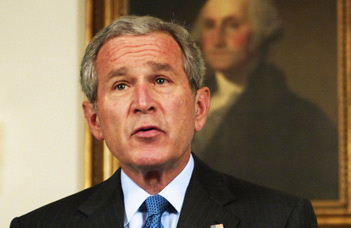
Another reader writes:
Just to join the thousands who have tried to psychoanalyze this president:
I think what you have is a man of fundamentally weak character. I mean, we’re talking about someone who is essentially afraid of the Washington press corps. Ponder that for a moment and imagine how Al Quaeda must make him feel.
He managed, in the wake of 9/11, to muster just enough fortitude to mount some kind of a response, but, in retrospect, there was never any indication even at the very beginning that he had anything like the stomach that would be required to see it through.
That process would have required literally hundreds of gut-wrenching decisions made under the most extreme pressure. And the clear majority of them would have needed to be wise. Although many of us fervently wished otherwise, it is now abundantly clear that this president has never possessed any of the qualities required to beat this enemy–a fact the enemy surely has not missed.
Thus we are caught in the worst of all possible quandaries. We’re governed by a man who had just enough will to start a war but has nothing like the brains or guts required to wage it successfully. And the "opposition"–whether in his own party or the other one–doesn’t want to wage it at all.
I fear he’s right. One thing that has surprised and vexed me a little: that there haven’t been more on the right criticizing Bush for not being serious enough in the terror war. Mark Helprin has occasionally vented. The analyses in the Weekly Standard have sometimes shared this premise, but they have remained civil toward the president, perhaps because the alternative seems even worse. (I endorsed Kerry out of desperation, not enthusiasm.) My own evolving view is that this analysis makes a McCain candidacy much more attractive. He seems to me to be the only figure right now with the determination to fight the enemy, and to do so with sufficient resources, resolve, candor and national unity. As Iran prepares its next gambit, 2008 may, however, be too late.
(Photo: Mandel Ngana/AFP Getty.)
The Last Libertines
One in six Brits is under the influence of alcohol at work, according to a new study. And that’s before the World Cup gets under way. In some strange and nostalgic way, I’m proud of ’em.
Quote for the Day
"The reason that I think this game has a chance is that it’s not particularly preachy. I will say some of the dialogue is pretty lame ‚Äî people saying, ‘Praise the Lord’ after they blow away the bad guys. I think they’re overdoing it a bit. But the message is OK," – Michael Pachter, an analyst at Wedbush Morgan Securities, on the potential sales for the Left Behind video game series, where Christianist teens can fantasize about murdering people for Jesus. More here.
The Bush Conundrum II
A reader offers another, perhaps more persuasive analysis:
If you look at every single aspect of his presidency, Bush has never been serious, never asked for sacrifice (only demanded sacrifice from those unable to say no or even complain – our military). Massive tax cuts with no way whatsoever to pay for them. National security with virtually open borders and minimal port security. Disaster preparation run by a crony whose chief qualification had been managing a horse association.
So you’re surprised that he launches a military campaign that ignores the best advice of his top generals? Why?
Maybe I should drop the attempt to psychoanalyze the guy and accept that he’s simply reckless by nature, and has never had to face the true consequences of his own actions in his entire life. Why would he start now?
The Bush Conundrum
A reader writes:
I think there is no doubt that Bush must know that many of the statements he makes are simply false. There’s too much of a track record of this to doubt it.
On the other hand, it is also quite clear that Bush is in well over his head, and he has turned over the actual thinking about his job to others – Cheney, Rove, Rumsfeld, etc. He pretty much has abandoned leadership on issues except when he gets something fixed in his head, and then he ignores any advice or information to the contrary.
In other words, the answer to your questions: "Is he lying? Or is he just drowning in a job that he is simply unable to do?" is "Both."
There is also the unnerving possibility of psychological denial. I was struck, for example, by the fact that the president recently cited Abu Ghraib as one event that he regrets and that has deeply damaged the war on terror. So I scratch my head and ask myself: has it occurred to him that even the various official reports he commissioned trace that incident to decisions the president himself made to relax detainee standards in the war? Is he even aware that these incidents, again according to his own government’s reports, have been replicated in every theater of combat? And yet, when given the chance to draw a line under all this, and embrace and enforce the McCain Amendment, the president still refused, and issued a signing statement reserving the right to break the law.
My only rational conclusion is that the president cannot face the consequences of his own actions and so simply blocks them out. Confronting Cheney and Rumsfeld on this is beyond his capacity. His psyche, rescued from alcoholism by rigid fundamentalism, has been sealed off from rational assessment of empirical reality, from basic concepts of responsibility and accountability. The people he has surrounded himself with have only one thing in common: the knowledge that the maintenance of his denial keeps them in their jobs. And so we have this bizarre unending war of attrition, where no strategic logic can be discerned, where goals are set with no means to attain them, and where American soldiers and Iraqi civilians are put through a grinder of brutality and terror. I’m saying this as someone who desperately wants us to succeed, but simply cannot understand why the president refuses to commit the necessary resources to do so.
The Case Against the FMA
Dale Carpenter makes it – calmly and brilliantly as ever. Ryan Sager argues for cultural federalism here. You have in this a classic example of the distinction between conservatism and fundamentalism. Conservatism seeks to govern society as it is and as it evolves. It allows for diversity and federalism and local rule. Instead of demonizing minorities, conservatives seek ways to integrate and include them and foster responsibility among them. Fundamentalists, in contrast, begin with an a priori religious deduction – homosexuality is Biblically or "naturally" wrong and homosexuals as such do not exist – and proceed to enforce that view on everyone. If constitutional procedures or principles of federalism get in the way of such doctrinal truth, then those procedures and principles must be abandoned. There is no extreme they will not seek, because God demands it. You saw that in the Terri Schiavo case, where the Christianist right abandoned even a pretense of believing in federalism or the rule of law. And you see it in the case of the FMA. This battle is not just about gays. It’s about the survival of limited government conservatism and inclusion within the Republican party.
The Great Paradox of Iraq
It has been there from the start and it still, frankly, confounds me. We were told by the president that the Iraq war was the critical battle in the war on terror, an effort of enormous stakes that we couldn’t possibly lose. And then he went to war with half the troops necessary to win, with no plan for the aftermath, and refused to budge even when this became obvious to anyone with eyes and a brain. He says there is no greater friend or supporter of the troops, yet he sent them to do an impossible task, with insufficient numbers or support or even armor to accomplish the job. He said we face the equivalent of the Third World War and yet he has done nothing to increase the size of the military to meet the task. He said the invasion was to advance the principles of freedom and democracy, and yet he immediately abandoned those principles in our detention policy and has done more damage to the moral standing of the United States than anyone since the Vietnam war. He says he wants to build democracy, and yet he has gutted reconstruction funds, and withdrawn support for building democratic institutions. He said he will keep troops there until the job is done, and yet sustains a policy to draw down the troops as soon as possible.
There has always been a military solution to Iraq. There still is, as Fred Kagan recently showed in a long article in the Weekly Standard. It just required resources to achieve it, to pacify a post-totalitarian society, provide order and the context in which politics can happen. The American public would have approved the resources necessary, and made sacrifices if asked. And yet Bush has deliberately and by conscious choice allowed anarchy and terror to decimate Iraqi civil society. None of this helps the war; and none of it helps him. There are many times when I am simply baffled by the whole farce. Is he this stupid? Is he this blind? Or was this never a serious venture? Did Cheney and Rumsfeld never want to build a democracy in Iraq, just reduce it to rubble and chaos, while ensuring that Saddam could get no WMDs? Even now, I have no idea. But something here doesn’t add up. Incompetence doesn’t quite capture the enormity of the failure or the incoherence of the project. And so we stagger on, desperate for hope, but forced to confront the worst-managed war since Vietnam. Except the stakes are far, far higher than Vietnam. And the consequences of failure close to existential. I know that in part because Bush keeps telling us. Is he lying? Or is he just drowning in a job that he is simply unable to do?
 The Dish