Red And Blue Health Insurance

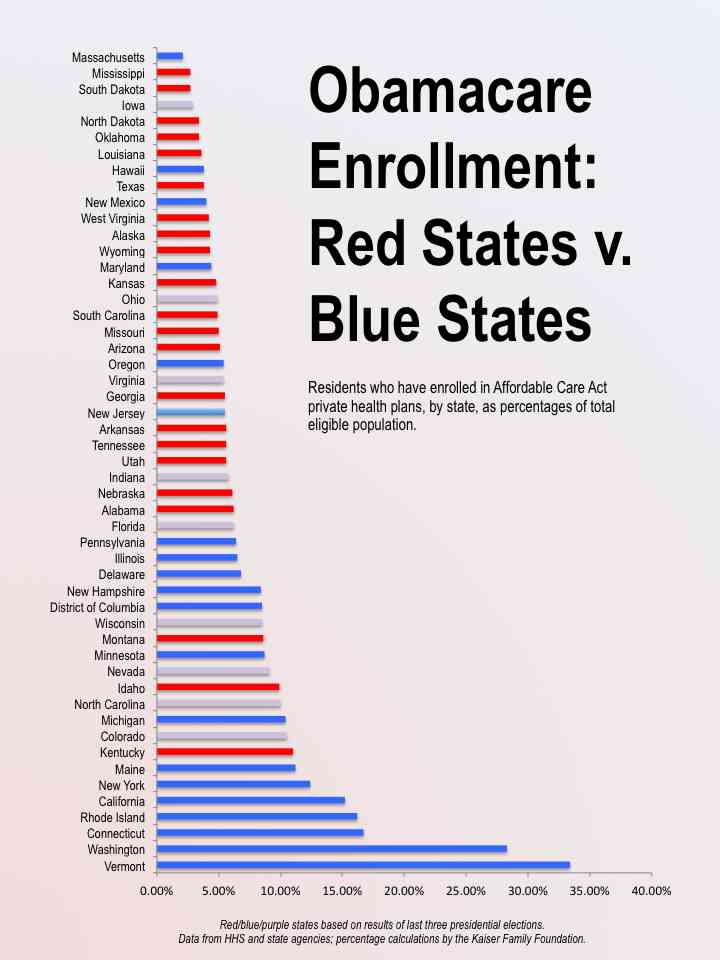
Cohn charts Obamacare enrollment in red and blue states:

enrollment

James Wimberly ponders the causes of this split:

Four out of five – 83% – of all the signups came in December, when healthgov.com was performing about as well as the better state websites. Most customers faced a pretty uniform environment: the same law, an identical or very similar website experience. The variation must be due to local factors. …

The most economical hypothesis is that it’s down to state cultures and above all state policies. The governors of Blue states have been trying to make ACA work, with positive media messages, help to navigators and so on. Setting up their own websites is an effect of this political support rather than an important independent variable. Those of Red states have been trying to make it fail.

Which is why West Virginia is so instructive. These governors are directly preventing their own constituents from getting health insurance at close to no expense for the state. And right now, they’re popular for it. The question in my mind is: at what point will denying people a massive sense of relief and actual access to affordable healthcare remain popular? That will be a vital American test between pragmatism and ideology. Perhaps the best measure of when and if the “fever” on the far right will break is how long they can keep up the pressure and the arguments and the propaganda to have their citizens vote against having reliable and affordable access to a doctor?

Or to put it more bluntly: How many poor red state voters are prepared to die before their time to make an ideological point?

The President’s Position On Pot

In his new profile of Obama, Remnick asked the president about the dangers of marijuana:

“As has been well documented, I smoked pot as a kid, and I view it as a bad habit and a vice, not very different from the cigarettes that I smoked as a young person up through a big chunk of my adult life. I don’t think it is more dangerous than alcohol.”

Kush_closeIs it less dangerous? I asked. …

Less dangerous, he said, “in terms of its impact on the individual consumer. It’s not something I encourage, and I’ve told my daughters I think it’s a bad idea, a waste of time, not very healthy.” What clearly does trouble him is the radically disproportionate arrests and incarcerations for marijuana among minorities. “Middle-class kids don’t get locked up for smoking pot, and poor kids do,” he said. “And African-American kids and Latino kids are more likely to be poor and less likely to have the resources and the support to avoid unduly harsh penalties.” But, he said, “we should not be locking up kids or individual users for long stretches of jail time when some of the folks who are writing those laws have probably done the same thing.”

Accordingly, he said of the legalization of marijuana in Colorado and Washington that “it’s important for it to go forward because it’s important for society not to have a situation in which a large portion of people have at one time or another broken the law and only a select few get punished.”

I want to congratulate Remnick on asking the question which I have inexcusably failed to ask on the few occasions I’ve had the chance to grill the president. One key thing matters about this quote: the president of the US thinks a drug currently viewed by his own administration as the most dangerous kind of drug in existence is less harmful to the individual than alcohol. And that is one thing the federal government really can do: change the DEA’s classification of marijuana so that it complies with basic science and reality. When the government is loudly proclaiming something that a huge majority of reasonable people know is untrue, it is making an ass out of itself. The follow-up question is therefore: why, Mr president, does your own administration hold to a view about pot, with huge legal consequences for millions, that you do not share and for which there is no rational justification whatsoever?

But then, as is his wont, the president wandered around a bit in his own thoughts:

“Having said all that, those who argue that legalizing marijuana is a panacea and it solves all these social problems I think are probably overstating the case. There is a lot of hair on that policy. And the experiment that’s going to be taking place in Colorado and Washington is going to be, I think, a challenge.” He noted the slippery-slope arguments that might arise. “I also think that, when it comes to harder drugs, the harm done to the user is profound and the social costs are profound. And you do start getting into some difficult line-drawing issues. If marijuana is fully legalized and at some point folks say, Well, we can come up with a negotiated dose of cocaine that we can show is not any more harmful than vodka, are we open to that? If somebody says, We’ve got a finely calibrated dose of meth, it isn’t going to kill you or rot your teeth, are we O.K. with that?”

Please name someone who favors legalization who thinks it’s a “panacea” for “all these social problems”. Even I don’t believe that. I think legalizing it would be a net social good, with very few negative consequences, but of course there will be some who suffer from legalization, as well as complexities we don’t yet understand. So while I’m at it, here’s the most honest and persuasive essay on the cost-benefit analysis of legalizing weed I have yet read. It’s by Scott Alexander and its conclusion is that “there is not a sufficiently obvious order-of-magnitude difference between the costs and benefits of marijuana legalization for a evidence-based utilitarian analysis of costs and benefits to inform the debate.” And that’s why, in a nutshell, I’m fine with federalism on this, as I am with marriage equality.

Sullum parses Obama’s comments:

Obama is not really going out on a limb by acknowledging that alcohol, measured by acute toxicity, accident risk, and the long-term effects of heavy consumption, is more hazardous than marijuana. On the face of it, he would be taking a bigger risk by endorsing the theory of evolution. … To say that “it’s important for [legalization] to go forward” is a bigger step than the signals of prosecutorial forbearance the administration has offered so far. Obama seems to be saying he wants these experiments to succeed. In short, Obama is conceding that marijuana prohibition is unscientific and unjust. That is indeed a pretty big deal, assuming he does not find a way to wriggle out of it.

Sargent’s view:

Obama circled back around and noted the new laws in both states could be “a challenge” because of the potential for legalization of other, harder types of drugs. He also noted he has advised his daughters not to smoke marijuana. So it wasn’t an outright endorsement. But the moment was still significant in several ways. In context of the United States’ long-running and highly problematic war on drugs, it is quite notable to have a president come out and say that marijuana isn’t nearly as harmful as it is often made out to be and to back serious changes in the legal regime governing the drug.

Ed Krayewski doubts Obama will act on this:

Given that Obama says he’s quit smoking cigarettes (which are kinda like weed to him) but still drinks socially (which he says could be more dangerous than pot) and has previously laughed off the suggestion that marijuana legalization would be beneficial (and continues to head a federal government waging a war on marijuana), his comments shouldn’t be interpreted as much more than off-the-cuff punditry.

Isaac Chotiner was put off by how Obama answered the question, and others:

It’s not just that the answer is now maddeningly long. Nor is it merely that Obama exhibits his annoying tic of stating his opponent’s case in the most extreme, over-the top way (who exactly thinks marijuana legalization is a “panacea” for solving “all these social problems?”) It’s also, again, the condescension. We know there are other sides to the issue. We know the issue is complex. We know there are slippery slope arguments about drug legalization. But either he doesn’t think that we know these things or, more damningly, he must remind us that he knows them, too.

The reason he does this, I would argue, is that he is more interested in telling us how he thinks than what he thinks.
The War Over Israel-Palestine

It’s not just between peoples or states. It’s not even just a fight among Jews. It’s also a fight between Arab intellectuals who used to be friends. Ben Smith has a great piece on the deepening enmity between Hussain Ibish and Ali Abunimah, amid deepening depression about any two-state solution.

The Cognitive Dissonance In West Virginia

PHi_j0073

The state has been drifting red for a while now, but it is still Democratic enough that the governor agreed to the Medicaid expansion in the ACA so many other GOP-led states have turned down. And that’s why it’s so fascinating as a test-case for the appeal of Obamacare throughout red-state America. So far, the results are quite striking: the number of uninsured West Virginians has dropped by a third since the ACA became operational. A third. And the sole reliable statistic we have as to the impact of that event is, appropriately at this early stage, mental health. To be free of terror that you won’t be able to pay your doctor, that you may be turned down for service when you’re sick, or that you have to alternate months between spending on food and on healthcare: wouldn’t that be an indescribable relief? Yes, of course it is, according to the NYT’s report today:

Waitresses, fast food workers, security guards and cleaners described feeling intense relief that they are now protected from the punishing medical bills that have punched holes in their family budgets. They spoke in interviews of reclaiming the dignity they had lost over years of being turned away from doctors’ offices because they did not have insurance. “You see it in their faces,” said Janie Hovatter, a patient advocate at Cabin Creek Health Systems, a health clinic in southern West Virginia. “They just kind of relax.”

But just as interesting to me is how culture still impacts that kind of psychological and real relief from acute, permanent anxiety and sickness. Obama will get no thanks for tangibly improving the lives of poor West Virginians. They may like the new law in practice, but in theory, many loathe it:

Recruiters trying to persuade people to enroll say they sometimes feel like drug peddlers. The people they approach often talk in hushed tones out of earshot of others. Chad Webb, a shy 30-year-old who is enrolling people in Mingo County, said a woman at a recent event used biblical terms to disparage Mr. Obama as an existential threat to the nation.

Mr. Webb said he thought to himself: “This man is not the Antichrist. He just wants you to have health insurance.”

Eventually, though, people’s desperate need for insurance seems to be overcoming their distaste for the president. Rachelle Williams, 25, an uninsured McDonald’s worker from Mingo County, said she had refused to fill out insurance forms on a recent trip to the emergency room for a painful bout of kidney stones. “I wouldn’t do it,” she said. But when she got a letter in the mail saying she qualified for Medicaid, she signed up immediately.

Isn’t that, in some ways, the entire story of this administration? That what it has actually done – from rescuing the auto-industry to ending wars, from the stimulus to universal access to health insurance – is actually popular on the ground, but still powerfully toxic to a vast swathe of Americans. Maybe history will help us understand that critical cognitive dissonance. Or maybe we’re just fucking complicated human beings, whose emotions – primarily fears – alternate and contradict each other with increasing impunity. Obama’s gift is his liability. He sees through the psyches to the actual pressing needs. He does not feel the way his opponents does. Which has made him far more effective and pragmatic in implementing his vision, while losing political altitude in a very emotional and ideological country precisely because of these successes.

(Photo: Kimberly Christian Hackney of Haysi, Virginia, cries after receiving new dentures at the Remote Area Medical clinic in Wise, Virginia, U.S., on Saturday, July 25, 2009. The clinic provides free medical, dental and optical care to people living in the region of south-west Virginia over a three day period. By Joshua Roberts/Bloomberg via Getty Images.)

When Partisan Politics Began

It looked a lot like today. Reviewing Jeffrey L. Pasley’s The First Presidential Contest, James M. Banner, Jr. takes us back to when John Adams and Thomas Jefferson vied to replace George Washington:

[I]n Pasley’s telling, it was in 1796 that many of the metaphors and symbols we still recognize as integral to our politics first took root. Thomas Jefferson was taken to task for his lack of “manly” virtues—being often thought of as (in Pasley’s words) “an effete dilettante and annoying smarty-pants”—and for his sympathy for revolutionary France. John Adams and even George Washington himself took brickbats for their monarchical bearing and British-like formality. Symbolic language about a “man of the people” and the “father of the state” vied with each other for the first time. And for the first time, too, foreign policy penetrated deeply into the presidential campaign.

While including the requisite caveats, Banner notes that “this first partisan presidential election seems to be the Big Bang from which American national politics has since drawn its energy”:

In 1795 and 1796, people argued about Jefferson’s and Adams’s characters. In bravura displays of negative campaigning, they tore down the candidates’ motivations, dredged up their previous writings, and had at their earlier careers. It was in every way what today we call a cultural war—Pasley calls it precisely that—as they battled over religion and other values and beliefs. In Pennsylvania, the state that even then was a battleground and a sure thing for neither Democrat-Republicans nor Federalists, local politicians engaged in “voter suppression” as partisan and purposeful as any we see today. … For we can now see that the election portended much that was to follow: its boisterousness; the engagement of state legislators, local voters, newspaper editors, and opinion makers; the permeation of questions about the candidates’ characters and their previously written convictions—by such developments the election contributed to what would prove to be the emergence, however slow, of American political democracy.

Exit Ezra, Smiling

The New Yorker's David Remnick Hosts White House Correspondents' Dinner Weekend Pre-Party

The last few years have been fascinating to watch as new media stars have both benefited from and then fallen out with big media companies. Nate Silver is the obvious example. He went from being an independent blogger – heavily linked by the Dish among other new media sites – to becoming the true star of the NYT’s 2012 election coverage. Then he and the NYT could not figure out a mutually beneficial deal, and he quit to run a new 538-style site at ESPN.com. It won’t launch for a bit (maybe March, I hear). But ESPN, as they showed with Bill Simmons’s original blog and now Grantland, is one of the very few big media outlets to find a way to a win-win proposition with Internet stars.

Or think of Glenn Greenwald. First an immediate blogging sensation; then Salon, then the Guardian and now … working on his own news-and-opinion website, with a massive global brand, funded by the founder of eBay. The WSJ’s Kara Swisher and Walt Mossberg are also now exiting the WSJ’s employ to start their own site. The Dish’s story – until last year – was also a story of trying – and failing – to get a win-win arrangement with media companies interested in allying with us.

The truly frustrating thing about all this is that it was surely in everyone’s interests to stick together – legacy media with new media stars is a win-win proposition. And yet almost every time – the one exception I can think of may be Andrew Ross Sorkin’s Dealbook – the deals have unraveled. The egos of legacy media honchos and the energy of new media stars could not quite get along. Mutual resentment, the thorny question of compensation, and the power of personal brands all played a part.

For some, the entire model of individually branded content is a dismaying idea.

Michael Wolff cannot understand it.  His best shot at a description is that we are “less interested in the publishing business per se than in a kind of channel purity and deepness.” But then, Wolff is a big believer in old-school massive media conglomerates, is one of Rupert Murdoch’s primary hagiographers, and with respect to Roger Ailes, makes Mike Allen look like a footnote in the annals of brown-nosing. Today, he’s celebrating the end of net neutrality, so that big media companies – owned by the super-rich – can begin monopolizing again. He finds it mysterious that some writers might actually be in new media not just for the money but also for the freedom to say what they want whenever they want in ways not constrained by highers-up. I’m not so mystified.

Which leads me simply to wish Ezra the best of luck. There are many models going forward, and Ezra may not be content with the Dish’s slow, organic, reader-funded evolution. But we do not exactly have a surplus of trying to find new profitable models for non-listicle, non-sponsored-content journalism. If Ezra can help with that, he can help all of us, but especially readers. Not all of them want to read the stuff that only very, very wealthy corporations think is fit to publish. They might even forgive a few niche interests and quirkiness in the process.

Update from a reader:

You wrote:

The egos of legacy media honchos and the energy of new media stars could not quite get along. Mutual resentment, the thorny question of compensation, and the power of personal brands all played a part.

I think this phenomenon is more general. I have known numerous tech companies that were acquired by behemoths, or spun off as subsidiaries rather than independent companies. I worked for one of them. In every case, the management of the parent swore on a stack of Bibles that they wouldn’t interfere with the entrepreneurial culture of the new venture (as if they knew what the word “entrepreneurial” meant). In each case they couldn’t resist meddling, with serious and sometimes fatal consequences for the spinoff.

There were many reasons, of course: financial straits, changes in corporate strategy, new competitors. But I think the common denominator is the irrevocable human tendency to prefer control over success.

Brilliantly put.

(Photo: Journalist Ezra Klein attends The New Yorker’s David Remnick Hosts White House Correspondents’ Dinner Weekend Pre-Party at W Hotel Rooftop on April 26, 2013 in Washington, DC. By Dimitrios Kambouris/Getty Images for The New Yorker.)

Moore Award Nominee

“[The extreme conservatives’]  problem is not me and democrats, their problem is themselves. Who are they? Are they these extreme conservatives, who are right to life, pro assault weapon, anti-gay, is that who they are? Because if that is who they are, and if they are the extreme conservatives, they have no place in the state of New York. Because that is not who New Yorkers are,” – govern0r Andrew Cuomo, simultaneously illiberal and a gift to the talk radio right.

He has since claimed that his remarks have been “distorted.” But the idea that “pro-life” voters have no place in New York State does not strike me as a distortion, but an insight into the governor’s contempt for those sincerely disagreeing with him over questions to do with abortion.

Update from a reader:

I’ve read the transcript and I don’t think that Cuomo’s comments can reasonably be interpreted to suggest that all conservative Republicans should leave New York. It is quite clear that he was talking about “Republican party candidates,” specifically Republican party candidates that ran against gun-control legislation that was voted for by moderate Republicans in the New York Senate.

Where Are All The Black Atheists? Ctd

A reader writes:

Thanks for having the thread on black atheists. I feel like atheism is the third rail of black identity. I have spent most of my life not fitting in neatly with any particular group while getting along well with almost everyone. I’m a black Jamaican immigrant raised by parents who were intellectual and black power-y enough to give both their children African middle names and eschew organized religion. My parents were both raised in religious households but when it came to raising their own children they said they’d “let us decide for ourselves when we grew up.” Suffice it to say, that meant the default context was atheism and, no offense, but religious origin stories are a tough pill to swallow if they haven’t been ingrained long before one develops the capacity for reason.

I almost feel like being an atheist is something I have to hide so people don’t look at me funny.

Being black and atheist has really resulted in feeling fairly alienated from “mainstream” black American culture. I just flat out don’t get, don’t want to get and can’t relate to the level of Christian religiosity that is part and parcel of African-American culture.

That said, I’m not ignorant. I’ve been to black church services and appreciate the role the black church has played in sustaining African-Americans culturally, spiritually, and political throughout a brutal history steeped in white supremacy and black oppression. Still, I am not about that life.

Pretty much none of my close friends slides much past “spiritual” on the religious scale, and I don’t think it’s an accident that of my very closest friends, not one is African-American. I almost feel like a bad black person typing that, even though I know my expression of blackness is just as valid as the “praise Jesus, God is good” version of it. But there’s just so little room for expressing it, it feels taboo.

Long story long, what I’m trying to say is thank you for providing a venue for me to express myself and for showing me enough other people like me to normalize my experience. Like the attorney in the piece said, we need more images in popular culture – like a black atheist version of Will & Grace – to expand the perception of what blackness includes.

Quote For The Day

“To my infinite regret, we never asked anyone knowledgeable enough about transgender issues to help us either (a) improve the piece, or (b) realize that we shouldn’t run it. That’s our mistake — and really, my mistake, since it’s my site. So I want to apologize. I failed. More importantly, I realized over the weekend that I didn’t know nearly enough about the transgender community – and neither does my staff. I read Caleb’s piece a certain way because of my own experiences in life. That’s not an acceptable excuse; it’s just what happened,” – Bill Simmons, new media pioneer, editor-in-chief of Grantland.

For a more thorough piece on how those mistakes happened, read … Grantland’s Christina Kahrl.

Simmons’ account of how a piece came to be published is fascinating. (I have a question: is there anyone at Grantland who is gay and might have had a role in reviewing this piece? Being gay does not mean understanding the issues facing transgender people, but it helps a little. Diversity does have a point in journalism – and not because of lefty abstractions.) Otherwise, I’m struck by the thoroughness and integrity of the public accounting and the sincerity of the apology. I think it’s way better than would have once happened in legacy media. Because it’s personal and real.

Coding Toys For Girls And Boys

dish_toys

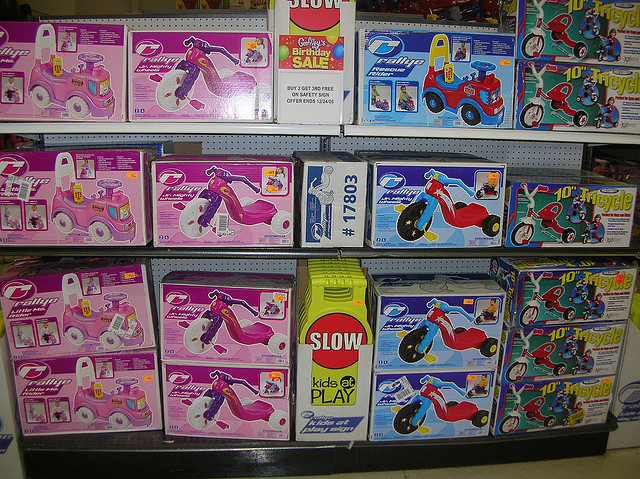
“It seems that the more progress we make toward less rigid gender roles,” observes Susan Bailey after visiting a kids’ toy store, “the more extreme the gender coding of toys becomes”:

The toys were far more color coded than four decades ago. Back then bikes, trucks, airplanes and even dolls sported a wide range of bright colors—red, green, yellow as well as shades of blue and rose.  The pink/lavender vs. black/dark navy dichotomy is a division that, among other things, probably helps sales. Teach children and parents the color-code and you double your market.  What little brother will want to settle for his big sister’s pink tricycle?

Earlier this month, C.J. Pascoe and Tristan Bridges argued that “the denunciation of all things pink should not really be our primary focus if we want to move toward a more gender equal world for girls and boys”:

The focus on the push back against pink and, by extension, princess culture is especially surprising when one looks at what is for sale in the boys’ aisle.

Take the first category of offerings for boys at the Toys R Us website for example – action figures laden with a variety of weapons who are designed to defeat the bad guys.  The closest offering for girls is a dolls category – featuring Barbies, the Little Mermaid, and Strawberry Shortcake. None of them are warriors.  None of them have weapons. We see a similar difference even when looking at the exact same category: Girl’s Building Sets vs. Boy’s Building Sets. Girls apparently build houses, salons… and the occasional bridge. Boys? They build Super Star Destroyers and Monster Fighter Vampyre Castle… and the occasional bridge.  To be clear, the “pink aisle” of toy stores is deeply problematic. It encourages a narrow range of passive, primarily family-oriented and appearance-obsessed femininities.  But, as the toys on the (digital and physical) shelves indicate, we are encouraging equally restrictive and arguably more dangerous masculinities –  warriors, space fighters, and ninjas.

Rebecca Hains joins the discussion, saying she’d “like to see a movement that … challenges marketers to put an end to the incessant pink-washing”:

By “pink-washing,” I’m specifically referring to the instances where marketers or toy makers create a product that is pink for no reason other than to make it as girly as possible. After all, there’s nothing wrong with pink–it’s a perfectly nice color–but there IS something wrong when it’s a) promoting sex role stereotypes and b) basically the only color found in little girls’ worlds. They deserve a full rainbow of colors. …

The Let Toys Be Toys movement is doing terrific work challenging the status quo in the UK. By calling for toys to be desegregated–grouped by theme or interest type, rather than by gender—they’re empowering parents and children to think outside of the pink and blue boxes that marketers have been placing children into. I’d really love to see a comparable movement here in the U.S. and Canada.

(Photo of gender toy divide in Toys “R” Us by Brian Sawyer)