Plugged In To The Real World

Oppenheimer pores over the research of Rutgers professor Keith Hampton:

Hampton found that, rather than isolating people, technology made them more connected. “It turns out the wired folk — they recognized like three times as many of their neighbors when asked,” Hampton said. Not only that, he said, they spoke with neighbors on the phone five times as often and attended more community events. Altogether, they were much more successful at addressing local problems, like speeding cars and a small spate of burglaries. They also used their Listserv to coordinate offline events, even sign-ups for a bowling league.

Hampton was one of the first scholars to marshal evidence that the web might make people less atomized rather than more. Not only were people not opting out of bowling leagues — Robert Putnam’s famous metric for community engagement — for more screen time; they were also using their computers to opt in.

A Glimpse Inside Outsider Art

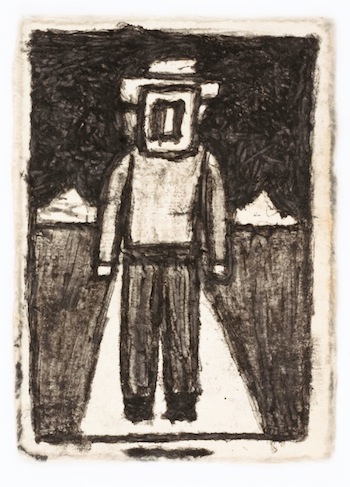
This year, the Smithsonian American Art Museum will host a traveling exhibition of the works of James Castle, who never learned to speak or write but who communicated through art made from spit and soot:

The Smithsonian American Art Museum acquired 54 works by Castle, who lived from 2013.27.34R_1.tif 1899 to 1977, last year. … Castle’s art isn’t exactly obscure — the Philadelphia Museum of Art held a retrospective in 2008 and the Museo Reina Sofia in Madrid staged another in 2011 — but it’s not too well-known outside the art world. And it’s gritty and strange, scrapped together with found ads and packaging, abstract figures from Castle’s life alongside jittery landscapes of rural Idaho shaded with stove-soot; his handmade books are full of arcane symbols and allusive narratives. Maybe bringing this art out to more rural places like those Castle was responding to in Idaho will give it a context that hasn’t always been there. Maybe it will allow Castle’s work to start being discussed as less of a wonder and more of a real reflection of American art. If nothing else, it’s encouraging that the Smithsonian American Art Museum is not just continuing to make these significant acquisitions, but also to put them in the context of the greater art history of the country.

(Image of “Untitled” by James Castle courtesy of the Smithsonian American Art Museum)

Face Of The Day

Screamers

For his series Screamers, Stefano De Luigi captured close-ups of protestors in Italy. Sahara Borja talked to De Luigi about the project:

Give us a bit of context here, which protests did you mostly attend? Can you describe the feeling in the air?

“I worked extensively for about a year on the social protests erupting in the country. Italy has been facing an economic recession for about three years now and the crisis is reaching its peak. What I tried to photograph is the terror felt by the middle class who are losing all the conquered certainties they have acquired over the last 50 years in Europe—this includes widespread wealth, secure jobs, free and high-quality education, and one of the most efficient healthcare systems in the world.”

Regarding the image format, why did you choose to focus on faces only and not the wider scene?

“I deliberately decided to focus on expressions—sometimes very dramatic ones. Images of masses in protest are not able to convey this sense of social discomfort affecting many citizens in Italy, and broader Europe. These frozen faces in a screaming expression of rebellion, terror, and sometimes anger better reveal the drama that many are facing.

(Photo: Milan – 7 October, 2011 – J., 15 years old, by Stefano De Luigi)

Not Jewish Enough For Marriage?

Israelis disagree about what makes a person Jewish, with the state using one identity test and rabbis, who oversee marriage and divorce, using another. The result? Some immigrants are in limbo:

In a concession designed to widen support for the new state, when Israel was founded its secular rulers left matters of marriage, divorce and burial in the rabbinate’s hands. It decides who is eligible for these rites, as well as carrying them out—so would-be brides and grooms must demonstrate their Jewish credentials. Supplying the necessary documents and witnesses can be inconvenient and galling: people resent having to prove what they know to be true. Immigration has made the system seem not just irksome but unsustainable.

For example, the Ethiopian Jews who migrated to Israel in the 1980s-90s, risking their lives and losing relatives along the way, have faced persistent doubts as to whether they are properly Jewish in doctrine and descent.

“I feel that I’m the Jew I want to be,” protests Fentahun Assefa-Dawit of Tebeka, an advocacy group for the 130,000-strong community. “I don’t want anyone to tell me how to be Jewish.” Western migrants, too, are sometimes doubted. The rabbinate considers some American rabbis too lax to vouch for their congregants and rejects their testimonies; it deems many overseas conversions inadequate. Many Israelis worry about the impact of such disdain on the diaspora’s political and financial backing for their state.

The biggest problem comes from the clashing consequences of two great ruptures in 20th-century history: the Holocaust and the collapse of the Soviet Union. Under Israel’s Law of Return, anyone who has, or whose spouse has, at least one Jewish grandparent can claim citizenship—a standard expressly modelled on the criteria for persecution under the Nazis’ Nuremberg laws of 1935. The Law of Return also recognises conversions that the rabbinate rejects. The wave of immigration from Russia in the past two decades means the discrepancy between these two standards has become glaring. There are now several hundred thousand ex-Soviet Israelis who were Jewish enough to get in, but are not Jewish enough for the rabbis

A Poem For Monday

http://www.amiribaraka.com/

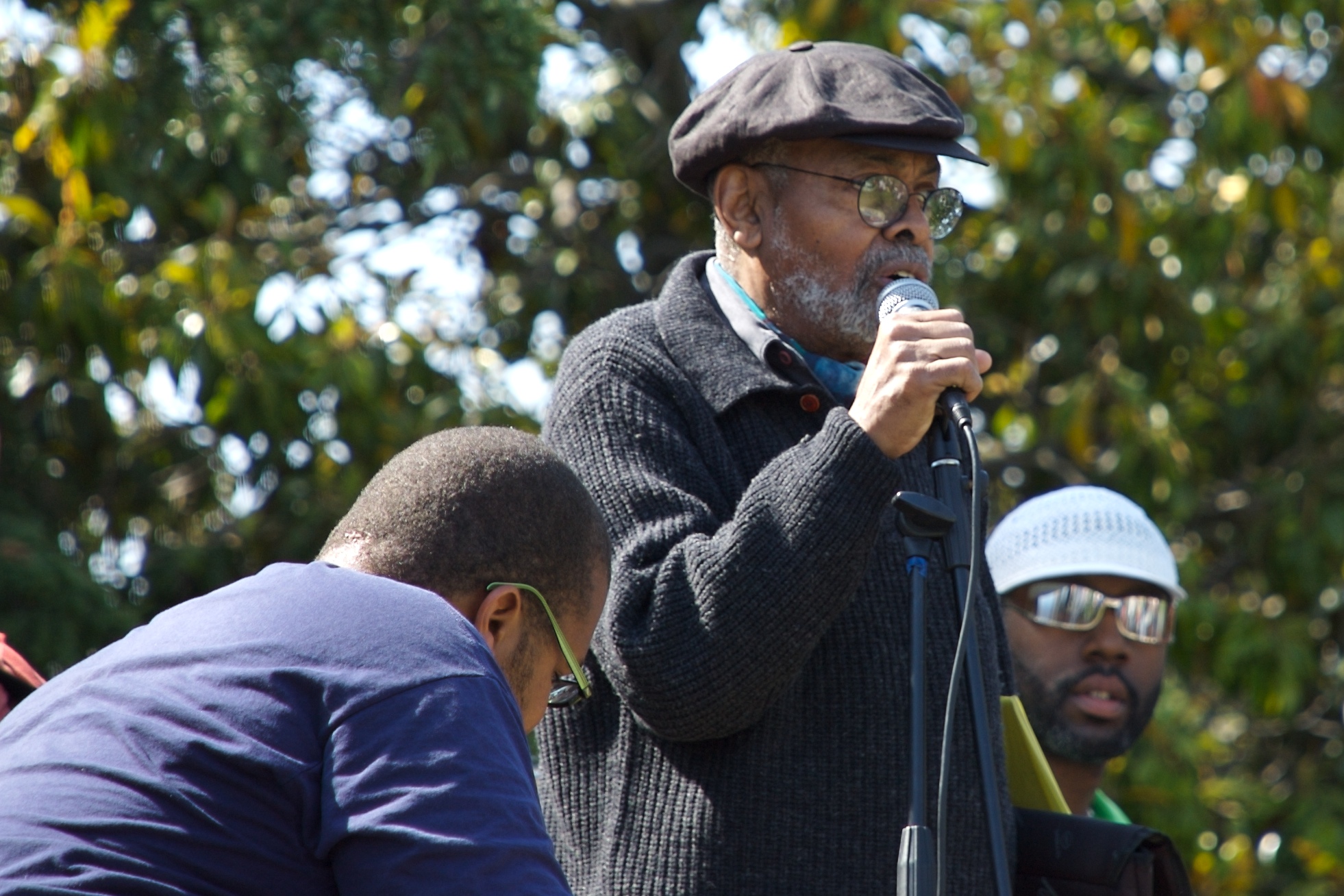
Amiri Baraka – poet, playwright, essayist, music critic, fiction writer, teacher, political activist, and one of the founders of the Black Arts Movement in 1965 – was born Everett LeRoi Jones in 1934 in Newark, New Jersey, where he recently died on January 9. In honor of MLK Day, below is his stirring poem “Young Soul” (which can be found in The Oxford Anthology of African-American Poetry, edited by Arnold Rampersand):

First, feel, then feel, then
read, or read, then feel, then
fall, or stand, where you
already are. Think
of your self, and the other
selves . . . think
of your parents, your mothers
and sisters, your bentslick
father, then feel, or
fall, on your knees
if nothing else will move you,

then read
and look deeply
into all matters
come close to you
city boys—
country men

Make some muscle
in your head, but
use the muscle
In yr heart

(From Selected Poetry of Amiri Baraka/LeRoi Jones © by Amiri Baraka. Reprinted by permission of the Chris Calhoun Literary Agency and Sterling Lord Literistic. Photo of Baraka addressing the Malcolm X Festival in San Antonio Park, Oakland, California, in 2007, by David Sasaki)

Cameras For The Lower Castes

James Scudamore explores how the Flip video camera has empowered citizen journalists in India:

Activism of this kind isn’t new, but affordable cameras have turbocharged its potential. In the past, the best tool an NGO like Video Volunteers had at its disposal was a magazine article or a radio broadcast. Then, in 2006, a small San Francisco-based firm called Pure Digital Technologies launched the low-budget Flip camera. The product was so successful that Pure Digital was bought out in 2009 by the data and networking company Cisco Systems, and its arrival in India changed things completely. Once recruited by Video Volunteers, each correspondent is given in-depth training. They are lent a camera of their own, and receive 1,500 rupees (about £15) per video, with the promise of 5,000 rupees for an impact [follow-up] film. The rise of smartphones and its own move away from consumer products led Cisco to discontinue the Flip in 2011. Video Volunteers petitioned Cisco to donate all its remaining stock and emerged with 583 cameras to keep themselves going until an affordable device with file-sharing capabilities becomes available in India—at which point things will snowball even more. You don’t have to wait for universal web access, it seems, to achieve some of its positive effects: the analogue internet is up and running, and networks are in place for when things go digital.

(Video: short documentary about Video Volunteers)

What Went Wrong With Public Housing?

A recent study examines “the entire public housing experiment by looking at the whole country from 1933 to 1973”:

[Researcher Katharine L. Shester] shows that by 1970, even taking into account local dish_pruittigoe conditions prior to their construction, public housing projects depressed counties’ social and economic levels. Critically, however, that was not true before 1970. Data from 1950 and 1960 suggest that public housing seemed to have positive local effects. Something changed in the 1960s. The source of change was not, in Shester’s analysis, the new projects built in the 1960s, but seems to have been some cumulative aspect of public housing generally.

Decisions and developments from 1950 to 1970, Shester argues, accelerated the physical deterioration of public housing and increased the concentration of troubled families living there. Limits on government maintenance funds, like the limits on the original construction costs, hampered the housing managers. And because of imposed rent ceilings, local housing agencies could not get the funds sufficient to keep up repairs by charging tenants. Physical dilapidation followed.

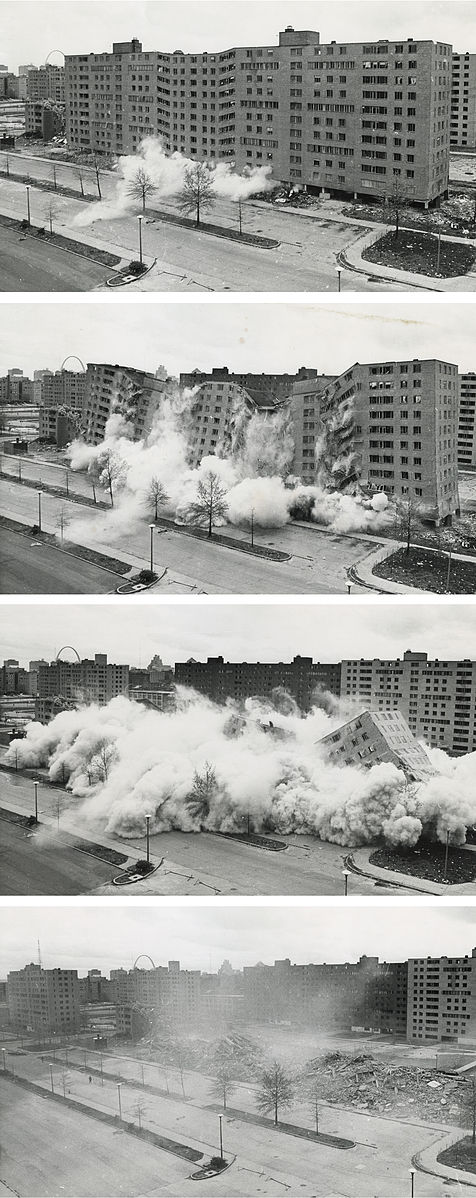
At the same time, tightening the requirements that housing be provided only to the neediest families meant that stable working-class families, once part of the mix, were gone. The renters became increasingly and exclusively the poorest and most troubled families. Their growing concentration in dense (and tense) settings compounded the problems of order. By 1970, public housing projects had gained their nightmarish image. Pruitt–Igoe (and others) came down.

(Image sequence of 1972 demolition of the Pruitt-Igoe project in St. Louis via Wikimedia Commons)

The Football Dad’s Dilemma

Beinart wrestles with the morality of raising his eight-year-old to be an NFL fan:

When my dad made me a football fan, the press wasn’t filled with stories about the way repeated blows to the head erode brain tissue, causing a lifetime of confusion, depression, aggression, dementia, and memory loss. Former players didn’t attach suicide notes like the one found in 2011 in the apartment of former Chicago Bears safety Dave Duerson, which read, “Please, see that my brain is given to the NFL’s brain bank.” So my father can’t be blamed for fostering in me an emotional attachment to football that overrides the moral analysis I’d apply to some other activity that physically and mentally disfigures its participants.

I, on the other hand, have no such excuse.

I could, perhaps, break the chain. Whether he realizes it or not, my son likes watching football for the same reason I did: because it’s intimate time with his dad. If I didn’t let watching football become one of the things we shared, if I told him it’s something I regret, he might take to it anyway. But it would be less likely. And if he made it to adulthood without heartwarming memories of sitting alongside his old man watching other men pulverize their bodies and minds, he’d be more able to rationally decide whether professional football is something a decent society should allow.