The Republican Blog Epiphany

Daily Pundit has a cow over narcing on the Minutemen; Powerline has detected some tiny flaws in the president’s policies. The author of the blog item is John Hinderaker. Yes, the same Hinderaker who wrote only nine months ago of president Bush:

"It must be very strange to be President Bush. A man of extraordinary vision and brilliance approaching to genius, he can’t get anyone to notice. He is like a great painter or musician who is ahead of his time, and who unveils one masterpiece after another to a reception that, when not bored, is hostile."

An epiphany? Just don’t expect Hinderaker to fess up to it.

Quote for the Day

"[T]he Iraq War will stand for a long time as a monument to the potential excesses of evangelical thinking – and when it comes to our foreign policy, I hope the next GOP President partakes of a little less of Bush-style missionary zeal, and a little more of that old-time conservative religion," – Ross Douthat, on how evangelicalism has changed conservatism in the Bush era.

Christianism, Debated

Thanks for your emails. Here’s one I should address:
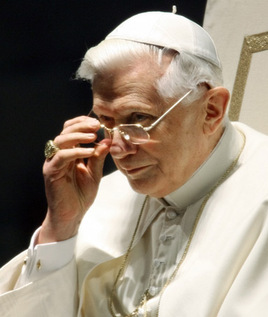
Benedictandrewmediciniap_1 Please keep in mind that it isn’t only right-wing fundamentalists who preach politics from the pulpit. I am a relatively conservative Republican who is active in a liberal Episcopal church. I have a running battle with my priest about his insertion of his own political views (especially on the subject of Iraq) into his sermons, about the church’s one-sided providing of a forum to liberal speakers, etc. For example, the Democratic candidate for a local seat in Congress will be speaking at our adult "forum" next Sunday; I am not holding my breath to see whether her opponent, the incumbent Republican, will be extended a similar invitation.
Obviously one’s religious beliefs should mold his or her views on life in general, including moral and even political issues. And if one’s beliefs lead one to seek a particular political result – whether that result be ending the war in Iraq or opposing abortion or gay marriage – that is his or her right; after all, many of the great moral movements in our history were led in large part by people of faith who were led by their faith. My problem – as I gather it is yours – is when a person tries to bolster his or her political position by proclaiming that it is dictated by God or by suggesting that all good Christians must share that position. This sin isn’t committed solely by religious conservatives.

Absolutely. That’s why I was careful to say in my essay that Christianism can be practised by the left as well. The conflation of the black church with the Democratic party is just as distasteful, if not currently as dangerous, as the fundamentalist right’s take-over of the GOP.

I’m not arguing that faith should have no role in political discourse. Someone’s faith will affect her politics. My faith informs my own positions on torture, the death penalty, gay dignity, the Iraq war, and so on. But in the political sphere, mere recourse to religious authority is insufficient, because, by definition, it cannot persuade those of a different faith or no faith at all. And so religious doctrines need to be translated into moral arguments, applicable to any citizen with good will and an open mind. When Tom DeLay, at a Republican gathering, invokes Christ as his ally; or when the Catholic hierarchy comes close to barring votes for Democrats; or when Jesse Jackson uses the pulpit to garner Democratic votes, they have crossed an important line. It’s important to defend that line – for the sake of politics, and for the sake of faith.

The first rule for a Christian should be, to my mind, humility in the face of God. That does not square with absolute certainty about God’s politics or the willingness to force others to share the same interpretation of Christ’s message as you do. America was founded on this insight, hence the Constitution’s remarkable decision not to endorse any form of religion as American. We face great peril if we forget it.

(Photo of Pope Benedict XVI by Andrew Medicini/AP.)
No Da Vinci Disclaimer

Davincijeanpierremullerafpgetty A pity, I think. It’s hack fiction. People might actually believe it. This isn’t to say there isn’t a fascinating and important discussion to be had about the divisions and debates among the early Christians, and if the "Da Vinci Code" provokes such a discussion, fine. But on its own, it’s fictional dreck and Hollywood hooey.

Can you imagine what Islamists would do if a similar movie were made about the far more dubious origins of the Koran? I guess we should be grateful for our fundamentalists. They may be misguided; they may even be malign; but they are not murderous. For this, muted thanks.

(Photo: Jean-Pierre Muller/AFP/Getty.)

Spencer’d

A reader dissents:

To briefly comment on your characterization of Spencer Ackerman as a ‘pathological pessimist’: may I just remind you that in his blog Iraq’d, and thereafter, Mr. Ackerman demonstrated the kind of intelligent foresight that was all but missing in the governing institutions of the US of that time?
The issues that he worried about were rising instability, the excessive focus on taking out a few individuals (especially Saddam), sectarianism in politics and the constitutional conventions and most particularly the rise of the militias – exactly the things now most endangering the security of Iraq. He has been optimistic about the role of Ayatollah Sistani and the long term (in)effectiveness of Zarqawi, and has been neutral on things like the disastrous rebuilding effort (to the best of my recollection). All this at a time, when many, (including you yourself, as you have admitted) have at times been too quick to reach for rose-tinted glasses.
In short, loth though I am to engage in dispute over meaning of words with a master of prose such as yourself, might I suggest you scratch ‘pathological pessimist’ and replace with ‘balanced realist’?

Not In My Back Bay

As a semi-resident of Cape Cod, I’m all in favor of the project to generate most of the Cape’s power from an off-shore wind-farm. So why is Ted Kennedy planting legislative poison pills to kill it off? I’m with Jeff Jacoby on this one. We have the Kennedy family to thank for preserving much of the Outer Cape as a wildlife and seashore reserve. Why would they not back an anti-pollution measure that also helps the Cape be energy-independent? It can’t be the view from Hyannisport, can it?

Email of the Day

A reader writes:

I am a Christian. I attend a very conservative Bible Church. I am a very liberal Democrat. There are others in my church who are like me, but we are the silent minority. I am politically active. I always vote.
Thank you for exposing the lie that the conservatives promote. My God did not tell me that He is a conservative Republican. Actually, I believe He didn’t tell that to anyone. Thank you, thank you for expressing the position of many of us.

Happy to do so. Now tell your fellow Christians to knock off the politicization and focus on the enormous challenges of actually living a life worthy of Jesus of Nazareth.

Pop Quiz

Who said this:

Liberalism and Western style democracy have not been able to help realize the ideals of humanity. Today these two concepts have failed. Those with insight can already hear the sounds of the shattering and fall of the ideology and thoughts of the liberal democratic systems.
We increasingly see that people around the world are flocking towards a main focal point – that is the Almighty God.

Benedict XVI? Rick Santorum? Pat Robertson? Guess again. (Hat tip: Dan.)

The Spirit of Toleration

A reader comments on my defense of the law’s neutrality on divisive moral questions:

Oliver Wendell Holmes, Jr., probably my favorite Supreme Court personality, had a quote that sums up the role of the courts in adjudicating non-sectarian civil law: "If my fellow citizens want to go to hell I will help them. It’s my job."
The Constitution was not designed to get anyone to Heaven, it was designed to allow each of us to pursue our own route. It seems to me that this is a favorable condition for Christians to practice their faith actively and consciously.  Creating a society whose guiding principle is providing an easy path for people of faith seems to rob credit from the faithful, the object of their faith, and the health of the broader civil society.

I couldn’t agree more. The Christianists are not only undermining democracy; they are condescending to real believers. Real believers, who also know doubt, don’t need the government or any legal education to grapple with the ineffability of the divine.