Is Richard Dawkins Growing Up? Ctd

Some good pushback from readers on this one:

The ideas that Dawkins put forward in the linked article are not new to him; he discussed them as early as 2005, in his book The Ancestor’s Tale (a superb read by the way, with next to no God-bashing). In what way is Dawkins being essentialist? Sure, there is a vast spectrum of religious beliefs and practices out there. What we call “Christianity” or “Islam” varies greatly depending on time, location, and social circumstances. But from this vast range of beliefs, commonalities can be drawn and subjected to criticism. This is not “treating all religions as the same essential thing.” The argument that:

(1) We cannot know whether the universe was created by a god of some sort, and
(2) Even if we did know that, we have no way to determine what this god wants or expects from us (if anything)

… can be used to counter any theist argument from this spectrum of beliefs.

Another reader:

I don’t believe Dawkins has ever applied essentialism to religion. He may not have expressed this clearly in every sound bite (who has?) but it’s completely consistent with his overall philosophy and the philosophy of most atheists I know.

Several years ago there was a bizarre report that Dawkins was converting to Deism.

It turned out to be related to an interview in which he said you could make a reasonable argument for a Deist god. Most atheists likely agreed with his position: you can make a far stronger case for a Deist god than an old-earth Christian god, and a stronger case for an old-earth Christian god than a young-earth creationist one. The odd part was that people apparently thought Dawkins was incapable of making this distinction. So they took his seemingly astounding acknowledgment that a good argument could be made for Deism as evidence he was embracing Deism.

Another:

In Dawkins’ 1996 book Climbing Mount Improbable, he writes:

If a species is intermediate in actual form (as many are) zoologists’ legalistic conventions still force them to lump one way or the other when naming it. Therefore the creationists’ claim that there are no intermediates has to be true by definition at the species level, but it has no implications about the real world – only implications about zoologists’ naming conventions. (page 96, italics his)

Similar quotes can be found in his other books. Of course, the idea of the evolutionary species (which extends the species concept through time) is integral to cladistics, or modern taxonomy. Evolution demands that throughout history, there have been millions of transitions between species and therefore millions of intermediate forms. This is seen today in many species /such as the geographically very widespread so-called “ring” species in which the members living at the extremes may not even be able to mate with each other but ultimately do so through all the intermediates.

So let’s not treat this new Dawkins article as a change of mind on his part; it just isn’t so.
Can Robots Consent?

Mike LaBossiere thinks we may reach a stage where sexbots will have to grant permission:

Since the current sexbots are little more than advanced sex dolls, it seems reasonable to put them in the category of beings that lack this status. As such, a person can own and have sex with this sort of sexbot without it being rape (or slavery). After all, a mere object cannot be raped (or enslaved).

But, let a more advanced sort of sexbot be imagined—one that engages in complex behavior and can pass the Turning Test/Descartes Test. That is, a conversation with it would be indistinguishable from a conversation with a human. It could even be imagined that the sexbot appeared fully human, differing only in terms of its internal makeup (machine rather than organic). That is, unless someone cut the sexbot open, it would be indistinguishable from an organic person.

On the face of it (literally), we would seem to have as much reason to believe that such a sexbot would be a person as we do to believe that humans are people. After all, we judge humans to be people because of their behavior and a machine that behaved the same way would seem to deserve to be regarded as a person. As such, nonconsensual sex with a sexbot would be rape.

(Video: The first webisode of “Jon Davis Gets A Sex Robot.” The other five here.)

A Jolly Joy-Ride

Dan Colman captions:

Season 3 of Comedians in Cars Getting Coffee kicks off with Jerry Seinfeld and his pal Louis CK piling into a very small 1959 Fiat Jolly and taking a leisurely (death) ride through New York City. Eventually, they escape the city and wind up at an unexpected place — aboard CK’s yacht. There, they share a cappuccino, navigate various nautical dangers, crack their signature jokes, and kibitz the day away.

Knocking Back Your Nicotine

Cocktails infused with tobacco are becoming as trendy as they are risky:

South American shamans drank simplistic tobacco teas during rituals and for its supposedly magical qualities, according to Iain Gately’s Tobacco: The Story of How Tobacco Seduced the World. However, the author notes that overindulging in these teas could “induce vomiting, paralysis and, occasionally, death.” That may have been due to the nicotine, which can be lethal in high doses. … The problem with tobacco-infused drinks, according to Stan Glantz, a leading researcher on the health effects of tobacco at the University of California-San Francisco, is that you simply have no way of knowing how much nicotine you’re getting. “It’s impossible to know what the dosage is since these guys are making this stuff themselves,” Glantz tells The Salt. “Don’t forget that nicotine was used as insecticide. So this is like putting pesticides – hazardous substances — into drinks.”

How Coke Gets Cooked

In the above video, Toby Muse reports on how cocaine is made in a small apartment lab in Colombia:

Over the last decade, America has given billions to the Colombian military to fight the narco-traffickers. In some ways it looks like the U.S. is getting bang for its bucks—Colombian authorities destroyed 2,356 labs in 2012, a serious dent in Colombia’s cocaine industry. But producers and traffickers of the drug are finding more creative ways to keep this lucrative business thriving. It’s like a never-ending game of whack-a-mole: Just when authorities think they’ve got the cartels on the run, their methods evolve and adapt. …

It turns out that the latest trend in Colombia’s cocaine trade is moving processing out of the huge plants in the jungle to small, mobile and disposable urban labs. In this new, decentralized world of cocaine production, two men with some buckets, a handful of microwave ovens and only the most basic knowledge of chemistry can take naturally growing coca leaves and turn them into 100 percent pure cocaine powder. And here’s the craziest part…they show us how they do it.

Previous Dish on illegal drug trade in Colombia here, here, and here.

(Hat tip: Kottke)

The Most Literary Liqueur

Absinthe:

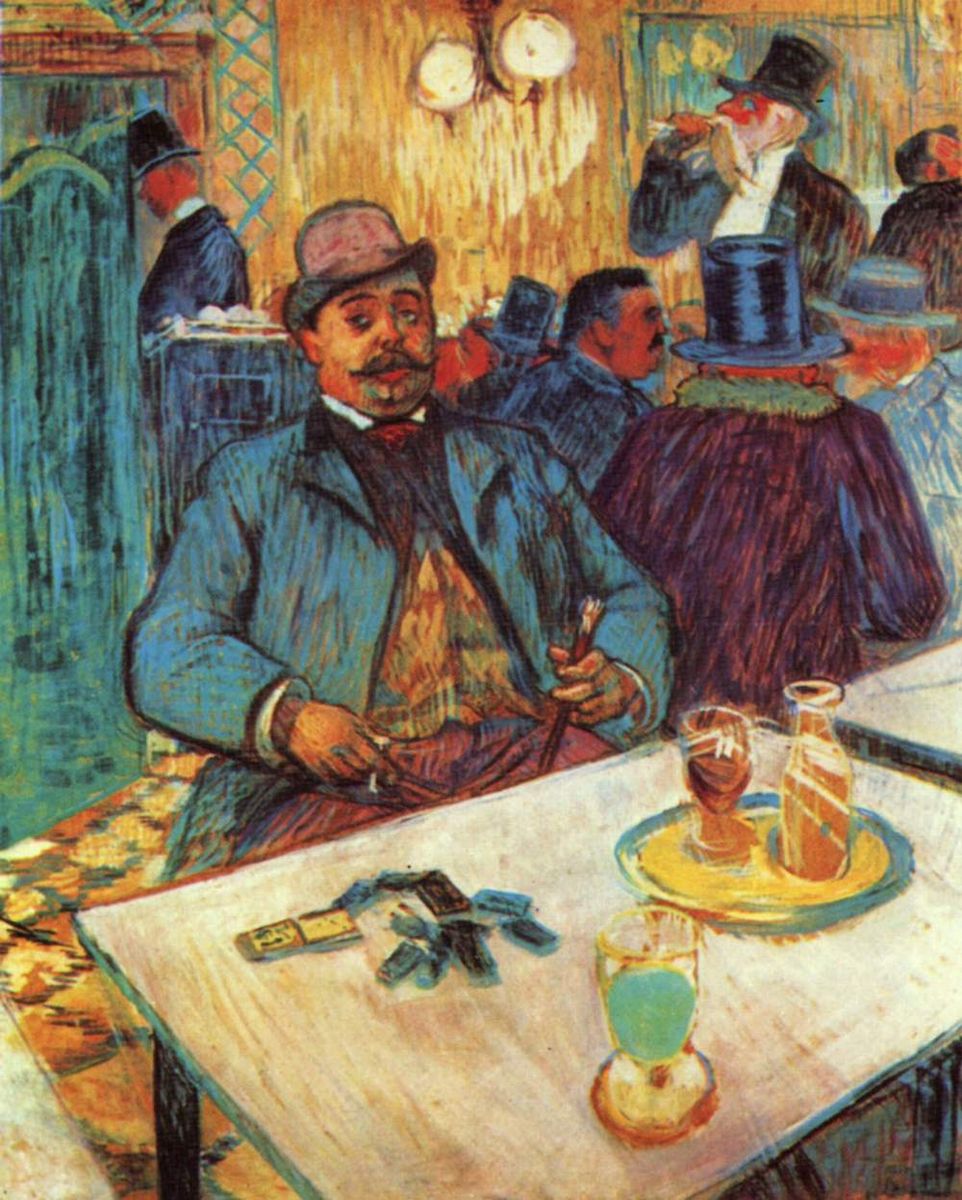
In the poem Poison, from his 1857 volume The Flowers of Evil, Baudelaire ranked dish_toulouselautrec absinthe ahead of wine and opium: “None of which equals the poison welling up in your eyes that show me my poor soul reversed, my dreams throng to drink at those green distorting pools.” Rimbaud, who “saw poetry as alchemical, a way of changing reality,” Edmund White notes in his biography of the poet, saw absinthe as an artistic tool. Rimbaud’s manifesto was unambiguous: he declared that a poet “makes himself a seer through a long, prodigious and rational disordering of all the senses.” Absinthe, with its hallucinogenic effects, could achieve just that.

Guy de Maupassant imbibed, as did characters in many of his short stories. His A Queer Night in Paris features a provincial notary who wangles an invitation to a party in the studio of an acclaimed painter. He drinks so much absinthe he tries to waltz with his chair and then falls to the ground. From that moment he forgets everything, and wakes up naked in a strange bed.

Contemporaries cited absinthe as shortening the lives of Baudelaire, Jarry and poets Verlaine and Alfred de Musset, among others. It may even have precipitated Vincent Van Gogh cutting off his ear. Blamed for causing psychosis, even murder, by 1915 absinthe was banned in France, Switzerland, the US and most of Europe.

(Image of Monsieur Boileau by Henri Toulouse-Lautrec, 1893, via Wikimedia Commons)

A Rebirth Of Storytelling

Hugh Howey forecasts the future of literature:

If these are the end times for literature, then we must be traveling in circles, for the death of storytelling looks an awful lot like its birth. The novel itself isn’t all that old. Sure, we can find a handful of examples going back thousands of years, but you have to stretch your definition of novel the further back you go. Really, the idea of an immutable and unchangeable text dates only to the printing press. Before that, every scribe tasked with producing a tome thought he was an author. Like movie producers dabbling with plot, it was difficult for the hand-copiers of text not to make a tweak here or there. Books were ever-changing. Stories evolved. And that was the way things were until Gutenberg’s time.

Fast forward to 2012, where 1 out of every 5 books sold was part of the 50 Shades of Grey series. Originally a work of Twilight fan fiction, the monumental success of 50 Shades of Grey turned a spotlight on the shadowy world of fan-generated literature. Soon, publishers were seeking out other popular works of fan fiction and signing authors to mega deals. Then Amazon announced its Kindle Worlds program, which commercialized fan fiction and opened up licensed worlds for exploration. To purists—who mix a love of history with a thin understanding of the past—the sanctity of the written word was in jeopardy. It was raining frogs. The volcanoes were angry. These lovers of the very modern novel clamored for a return to our roots. And yet—that is precisely where we are heading.

A Short Story For Saturday

A passage from Edgar Allan Poe’s disturbing 1838 tale, “A Predicament“:

Leaning upon the arm of the gallant Pompey, and attended at a respectable distance by Diana, I proceeded down one of the populous and very pleasant streets of the now deserted Edina. On a sudden, there presented itself to view a church—a Gothic cathedral—vast, venerable, and with a tall steeple, which towered into the sky. What madness now possessed me? Why did I rush upon my fate? I was seized with an uncontrollable desire to ascend the giddy pinnacle, and then survey the immense extent of the city. The door of the cathedral stood invitingly open. My destiny prevailed. I entered the ominous archway. Where then was my guardian angel?—if indeed such angels there be. If! Distressing monosyllable! what world of mystery, and meaning, and doubt, and uncertainty is there involved in thy two letters! I entered the ominous archway! I entered; and, without injury to my orange-colored auriculas, I passed beneath the portal, and emerged within the vestibule. Thus it is said the immense river Alfred passed, unscathed, and unwetted, beneath the sea.

Keep reading here. Peruse Poe’s Complete Tales and Poems here. Previous SSFSs here.