In Defense of Rummy

A reader remonstrates:

You’ve been hammering away at Rumsfeld for quite a while now, and I completely agree with you that he is awful and should have been fired 2 years ago. However, when you write that:

"the evidence is simply overwhelming that this (in my view) noble, important and necessary war was ruined almost single-handedly by one arrogant, overweening de facto saboteur. That man is Donald Rumsfeld. It’s actually hard to fathom how one single man could have done so much irreparable damage to his country’s cause and standing; and how no one was able to stop him."

I think you go too far – the problem isn’t only Rumsfeld, but the war itself.  Pinning all the blame on one person is simply a way for people who supported the invasion from the beginning to get themselves off the hook for not anticipating the wars failures.  I haven’t read "Cobra II," but I have read George Packer’s "The Assassin’s Gate," which clearly describes how incredibly broken Iraqi civil society was at the time of the invasion.

Sure, if someone competent had been running the Pentagon, the Iraqi Army might not have been dissolved, the initial looting might have been prevented, etc..  But this would not have resolved the problematic fact that Iraq was an extremely troubled society–that the psychic wounds of Saddam’s dictatorship had poisoned the populace in untold ways.

We can blame the captain of the Titanic for many things, but we cannot blame him for the iceberg.

Some good points. Iraq was always going to be extremely tough. We under-estimated the appalling damage Saddam had already wrought on Iraqi civil society (which makes removing him even more morally defensible). However brilliantly we conducted the war and occupation, the deep ethnic divisions would have emerged, and the psychic wounds of the past revived. A patient in a fever doesn’t always mean he’s nearing death; it may even be a symptom of recovery. (I might add that Rummy is someone I have known personally for years, and always liked immensely. But such personal attachments have to be set aside in assessing national policy.)

But what I cannot forgive, as Cobra II elaborates, is how many mistakes were predicted by the military, and many alternatives to failure offered, only to be continuously, almost pathologically, rejected out of hand by Rumsfeld. On the question of troop levels, Rumsfeld was criminally reckless, as he was in arrogantly dismissing the rioting and looting and terror such inadequate policing unleashed. He was warned; he had plenty of opportunities to reverse course; but his own fanatical attachment to his own transformational theories overwhelmed all reason, all empirical evidence, all advice from the ground, and so many in the CIA, State Department and military. To persist in deliberate error out of pride and zeal, as he has done, is to prefer dogma to reality. When lives are at stake, and the whole future of democracy in the Middle East, that’s unforgivable. But for me at least, Rumsfeld’s deep involvement in the new military detention policies supercedes everything else. He has not just failed; he has dishonored his country’s reputation. He has offered to resign twice. What more does Bush need?
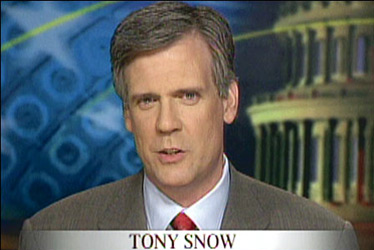

Stephanopoulos on Snow

Snow0425

The apparatchik-turned-pundit hails the pundit-turned-apparatchik:

The fact that Tony has criticized the President in print helps Bush much more than it hurts him. Proves he’s reached beyond the Austin circle for some independent advice. Snow doesn’t just tolerate his former colleagues in the press corps; he likes them. He’s smart but not overbearing and speaks with style and a smile. All that should help Bush in the briefing room. Perhaps even better for Bush, Snow is a movement conservative with a real following in the country. The GOP and the President need to pump up enthusiasm at the grassroots before November. Having Snow at the podium and on the airwaves every day should help at the margins.

It seems to me that this gets things the wrong way round. What Bush needs to do is bring in actual senior staff people who understand and want to reverse his profligate fiscal policy, his incoherent energy policy, and his shambolic war-management. What Bush has – typically – done is get a spokesman, who doesn’t set policy, to appeal to alienated conservatives. It is literal window-dressing. Unless, of course, more is going on than meets the eye. Here’s hoping that’s true.

(Photo: Fox News).

America and the World

I’ve been skimming a new book in the mail, and it looks like it’s worth closer inspection. It’s called "America Against the World," and it’s a mainly empirical, psephological take on how other countries view America and why America is different from so many other places. It’s a complicated piece of work, but it reminds me why, twenty-one years ago, six weeks after arriving here, I wrote to tell my Americaagainsttheworld parents: no offense, but I’ve found a home. Two key characteristics that distinguish Americans are religious belief and the notion that the individual is responsible for his own destiny. Suddenly, after secular, class-based England, I didn’t feel so isolated.

But the data also reveal a stunning unraveling of global good feelings toward the U.S. in the past few years. Anyone who has been abroad lately will testify. My trip in London was mainly filled with social engagements with British Tories: probably the most sympathetic sub-group America has in Europe (with the exception of the Poles). They all seem terribly discouraged by the trends in the U.S. and completely befuddled by the conduct of the war. Many Europeans were never going to give the U.S.the benefit of the doubt. But we seem to have lost the few who would.

In 1999 – 2000, 83 percent of Brits had a favorable opinion of the U.S. That’s now 55 percent. Among the Germans, the percentage has dropped from 78 percent to 41. Among Turks, 52 to 23. But buried in the stats, there are also some glimmers of hope. According to the Pew Global Attitudes Project, there’s been a revival in the last two years in a few places. The biggest surge in pro-U.S. sentiment is in Jordan and Morocco. Moroccans had a 77 percent pro-American rating in 2000. That collapsed to 27 in 2004 but perked up to 49 again in 2005. Jordan, after a similar slump, has just gone from 5 percent pro-American in 2003 to 21 percent last year. Even the French have become more pro-American in the last year. Maybe we are at a turning point. And if we can hang on in Iraq, and show some results, we can begin to achieve what we were hoping for when we began to fight back against Islamism. So much has been lost; but that gives us all the more to win back. Or is my instinctual optimism clouding my judgment?

Bush in a Snow Drift

I’ve always had perfectly pleasant dealings with Tony Snow, and respect his commitment to genuine conservatism and to fighting the war on Islamist terror. I also agree with him that this president has "lost control of the federal budget and cannot resist the temptation to stop raiding the public fisc." I agree that "George W. Bush and his colleagues have become not merely the custodians of the largest government in the history of humankind, but also exponents of its vigorous expansion." I agree with him that "when it comes to federal spending, George W. Bush is the boy who can‚Äôt say no." I agree with Tony that "on the policy side, Bush has become a classical dime-store Democrat." I agree with him that

No president has looked this impotent this long when it comes to defending presidential powers and prerogatives. Nearly 57 months into his administration, President Bush has yet to veto a single bill of any type. The only other presidents never to issue a veto – William Henry Harrison and James Garfield – died within months of taking office. The budget has grown nearly 50 percent on his watch, and he is vying to become the most free-spending president ever. To date, he has not asked Congress to rescind even a penny in profligate spending (even Bill Clinton requested more than $8 billion in rescissions, and Ronald Reagan sought upward of $80 billion).

But I’m not going to stand in front of the press and defend this record now, am I? The first question Snow may get if he takes the job is about his own splendid eviscerations of this president’s rank betrayal of fiscal conservatism and limited government in the past. Good luck, Tony. You’ll need it.

(Hat tip: ThinkProgress.)

Torture and the War on Drugs

This story, reported by Radley Balko, has to be read to be believed. Money quote:

The police are attempting to get the illiterate man to sign an admission of guilt without telling him what it says. They beat him, over and over, hook electrodes up to testicles and shock him, threaten to kill him, and threaten to go after his family. Early news accounts reported that the torture continued well beyond the end of the recording. After the tape ran out, the same deputies apparently repeatedly submerged the guy’s head in a fish tank and a bath tub, threatening to drown him unless he confessed. This guy at worst was a small-time drug dealer. He had no history of violence.

The only reason this has been proved is because the victim’s wife secretly recorded the torture session. Listen if you can bear it. The five cops are now mercifully in jail, but only for, at most, seven years. I guess when the president has endorsed torture by the CIA, it’s hard to put low-level cop-torturers in jail for life. Radley believes this kind of atrocity is more common than we might believe. I have no way to know. What I do know is that when the government launches an ill-defined "war" on a "thing", rather than an explicit foreign enemy, and when you have an administration as profoundly hostile to American liberty as this one is, all sorts of abuses will necessarily follow. And they have.

The Left Awakens

Most people in America are unaware of the Euston Manifesto. It’s an important British-based statement of left and liberal principles in the new era of fundamentalism. Last week, I had dinner in London with Johann Hari and Nick Cohen, two supporters of the project. Norm Geras, an inspiration to many, was a guiding force behind it. In some ways, it’s very compatible with Peter Beinart’s call for the Democrats to revive their anti-fascist roots, and to fight Islamism with the tenacity of Truman and integrity of Orwell. There is much in the manifesto to celebrate. But here’s one passage that struck home to me:

Drawing the lesson of the disastrous history of left apologetics over the crimes of Stalinism and Maoism, as well as more recent exercises in the same vein (some of the reaction to the crimes of 9/11, the excuse-making for suicide-terrorism, the disgraceful alliances lately set up inside the "anti-war" movement with illiberal theocrats), we reject the notion that there are no opponents on the Left. We reject, similarly, the idea that there can be no opening to ideas and individuals to our right. Leftists who make common cause with, or excuses for, anti-democratic forces should be criticized in clear and forthright terms. Conversely, we pay attention to liberal and conservative voices and ideas if they contribute to strengthening democratic norms and practices and to the battle for human progress.

On Iraq, the signers make the critical, inescapable point:

The founding supporters of this statement took different views on the military intervention in Iraq, both for and against. We recognize that it was possible reasonably to disagree about the justification for the intervention, the manner in which it was carried through, the planning (or lack of it) for the aftermath, and the prospects for the successful implementation of democratic change. We are, however, united in our view about the reactionary, semi-fascist and murderous character of the Baathist regime in Iraq, and we recognize its overthrow as a liberation of the Iraqi people. We are also united in the view that, since the day on which this occurred, the proper concern of genuine liberals and members of the Left should have been the battle to put in place in Iraq a democratic political order and to rebuild the country’s infrastructure, to create after decades of the most brutal oppression a life for Iraqis which those living in democratic countries take for granted ‚Äî rather than picking through the rubble of the arguments over intervention.

Those of us who are to the right of these thinkers – on domestic policy, at least – should not corral all of those to our left into the Michael Moore camp. Many liberals are on our side against Islamist threats, and we must support them. Equally, we have to make sure that our criticism of Bush and his dreadful, criminal defense secretary does not mean a capitulation to the anti-Americanism, moral relativism and defeatism of the cut-and-run left. We must fight that tendency as relentlessly as we must fight Christianism and Islamism. But a new coalition is forming – against all these isms. For freedom. For the West.

Quote for the Day

"The true defeatists today are not those who call for recognizing the facts on the ground in Iraq. The true defeatists are those who believe America is so weak that it must sacrifice its principles to the pursuit of illusory power.

The true pessimists today are not those who know that America can handle the truth about the Administration’s boastful claim of ‘Mission Accomplished’ in Iraq. The true pessimists are those who cannot accept that America’s power and prestige depend on our credibility at home and around the world. The true pessimists are those who do not understand that fidelity to our principles is as critical to national security as our military power itself.

And the most dangerous defeatists, the most dispiriting pessimists, are those who invoke September 11th to argue that our traditional values are a luxury we can no longer afford," – John Kerry, last Saturday, uttering the words he never found when it mattered. I guess the 2004 focus-groups told him to stay silent. But better late then never.