After Jafaari

Tout

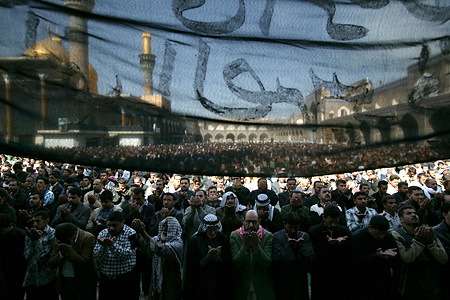
Some quick pundit house-keeping on last week. It strikes me that there was one critical development. That was Jafaari’s withdrawal from the PM slot in Iraq and the selection of Maliki in his stead. One thing we’ve learned from Iraq: it’s obviously unclear at this point what this signifies. It has to be good news that the deadlock is broken; but it’s still sobering that Maliki is expected to take up to another month to staff a government. All the reports – and I got some updates in person in London – are that each day that goes by without a national government, the power of the militias grows – and the influence of Jihadist Shiites in the South waxes. These are very hard and very dangerous trends to reverse, and could prove fatal for the prospects for peaceful self-government in Iraq. Omar is unimpressed:

[W]ill the real problem be solved by this agreement on the top posts?
I guess not because if any of the two new candidates gets to be the new PM, Iraq will – in my opinion – continue to descend for the next four years in the same way it’s been doing since the interim government was installed last year. And after all, the UIA’s decision to replace Jafari with al-Adeeb or al-Maliki is a solution designed for preserving the brittle unity of the UIA and not for the creation of a unity government because they know very well that the rest of the blocs were hoping to see Abdul Mahdi replace Jafaari. Maybe the UIA is twisting arms with this new nomination and betting on splitting the lines of the anti-Jafaari mass, thinking those would not be willing to prolong the deadlock by refusing the new candidates.

The NYT’s analysis is here; Time’s is here. One benefit of taking a breather is that I don’t have to have an opinion on this stuff every day and can get a little more perspective. One thing lingers in my head, when all is said and done: Iraq was always going to be a very tough project, and, despite the criminal negligence – even malevolence – of Rumsfeld (more later), it is far too soon to come to any settled judgment on the outcome. We now look at Kurdistan as a success story. But it was effectively liberated well over a decade ago (by our no-flight zones) and endured a very nasty civil war thereafter. Moreover, in the absence of any really good options against Iran, Iraq is still the best potential lever against Ahmadinejad. If we can achieve a unified, reasonably democratic, and stable Iraq in the next few years, especially among Shiites, we will have shifted the dynamics in the Middle East in our favor – and in favor of freedom – profoundly. We will have achieved something good proportionate to the evil of 9/11. As time passes, our rage at the defense secretary (and the president who retains him) should grow. And our conviction that we must prevail – with or despite them – should deepen.

(Photo: Yuri Kozyrev for Time.)

Thanks, Walter and Michelle

For the last nine days, I was forbidden by my other half, my shrink, my family and my own vestiges of sanity from reading the blog (or much else for that matter). As long-term bloggers know – how many of you out there have been at it for six years straight? (stop bragging, Mickey) – a little detox every now and again is well worth it. So my delight reading the past week’s entry in one go this morning is all the greater. I’d just like to thank Michelle and Walter publicly for filling in, and showing how it’s done. They’re both sharp as nails but also just decent, lovely people. That came through, and then some. As, by now, you know. Thanks.

Something wicked this way comes

Even as I type, a relaxed, rested, and rejuvenated Andrew is jetting his way back across the Atlantic, with a promise to be back in his blogging chair early tomorrow morning. Many thanks for your indulgence these past several days. As Andrew predicted, your emails were terrific. Only a few were vicious and profane enough to merit my contacting Homeland Security–but even those I enjoyed. And please don’t torture Andrew too badly for leaving you alone with me and Walter for so long. Even your Dish-master needs a holiday every now and again.

Michelle

A special issue indeed

I finally picked up a copy of the first ever "Green Issue" of Vanity Fair. What is up with that cover? George Clooney, Al Gore, and Robert F. Kennedy Jr. are all sitting around in varying shades of green, with Julia Roberts looming over them in a poofy, green Bill Blass number and a garland on her head. With the greenish background and the greenish lighting, everyone looks a little ill. Or as a less charitable colleague put it, "They all look like pond scum."

I wouldn’t go that far. But they certainly do look silly, which probably isn’t what they should be going for if they want people to take them and their environmental causes seriously. Maybe Clooney and Roberts don’t care because, hey, they’re actors. (And, let’s face it, Clooney looks ruggedly delicious even as pond scum.) But I suspect Mssrs. Kennedy and Gore aren’t eager to be dismissed as preening loons. Maybe already committed greenies and Vanity Fair’s liberal readers will dig the cover, but my guess is that anyone who just happens to encounter it in the express lane at Safeway will just think the whole group, not to mention Graydon Carter, has gone round the bend.

Then again, five-plus years of Bush have had that effect on a lot of folks.

Michelle

Alone Together

Eating dinner at a bar the other night, I sat next to a sales rep for a company that produces portable home dialysis units. He was drinking pretty hard, celebrating a deal that he’d just closed and telling me how soaring diabetes rates were going to create ever greater demand for his revolutionary product. I thought he was going to propose a toast to kidney failure.

But what bothered me most about our conversation was the streamlined plastic phone device implanted in his right ear and connected via Bluetooth to the Palm Treo lying on the bar in front of him. Every minute or two the earjack would light up, suddenly pulsing white and blue, and I’d forget whatever I was saying to him or whatever he was saying to me. Finally, I asked him what the light was. “That just means the thing’s turned on,” he said. As he said this, he was looking at his Treo screen, which he did about every thirty or forty seconds. His face changed — had some important message arrived? Still speaking to me, but without much focus now, he tapped out a line or two of text with his amazingly prehensile thumbs. He’d left the scene, I sensed; he was somewhere else. At headquarters, perhaps. And I’d been placed on hold.

I didn’t like it. I never like it. And it happens constantly. I’ll be in the middle of what I take to be a sincere human interaction with somebody and they’ll start cutting in and out — checking the Blackberry, texting on the cell phone, stylus-ing the electronic calendar. No apologies, either. No ‘excuse mes.’ As though a mixture of physical proximity and electronic separation is the accepted new mode of social togetherness. I swear I’ve seen couples out on dates who speak to each other only when the menu comes, to negotiate their appetizers, and then drift off into conversations with others until the check arrives.

And yet they call it “communications technology.”

When the dialysis salesman returned to earth, I committed a faux pas by asking him what he’d just been writing about. I thought I was entitled to ask this question because he’d been conducting his business in front of me. I found out otherwise. He glared at me. What kind of spying busybody was I? The warmth between us never returned and we ate our salads in different universes, staring at the TV behind the bar. The light in his earjack pulsed. I paid my tab. When I left, I mumbled a goodbye, but the salesman didn’t acknowledge it. He was tapping on his keys.

–Walter

Score one for Nancy Reagan’s team

I see in today’s New York Times that a state judge ruled yesterday that two lawsuits disputing the constitutionality of California’s fledgling stem cell research agency, the Institute for Regenerative Medicine, have no merit. Brought by attorneys with ties to anti-abortion groups, the suits claimed that because Prop 71, the 2004 ballot initiative funding the agency, authorized money for both stem cell and other types of medical research, it violated a state law prohibiting a ballot measure from proposing more than one issue. Judge Bonnie Lewman Sabraw of the Alameda County Superior Court basically dismissed these claims as the bologna that they reek of.

Good. I’m not denying that there are delicate ethical concerns that need to be addressed in regards to stem cell research. And I keep hoping the federal government will get fully into the game in order to help keep an eye on just such issues. But on the whole, the potential benefits of this field appear to outweigh the costs. And while I understand social conservatives’ moral objections to stem cell research, I’m disinclined to take them seriously until I see pro-life picketers also take on the IVF industry, which is busy creating scads of excess embryos that will never, ever see the inside of a warm womb and will ultimately be tossed out with the trash.

Sadly, the Institute for Regenerative Medicine has to wait until the appeals process has been exhausted until it can start selling securities to raise grant money. (Until then, it’s using loans from philanthropic groups.) Here’s hoping the higher courts’ jurists have noses as well-refined as Judge Sabraw’s.

Michelle

Ick

Page A3 of today’s Washington Post has a large photo of a sobbing woman standing beside another sad-looking younger woman. The headline above: "Family Grieves Over Death of 10-Year-Old." The caption below: "Jennifer Fox, right, mother of Jamie Rose Bolin, stands with her daugher, Lori Dawn Headrick, during a funeral service yesterday for 10-year-old Jamie at Purcell High School in Purcell, Okla. She was found slain last week."

That’s it. No accompanying article. No instructions to turn to another page. No nothing. The extent of this "news" tidbit is a photo of a grieving mom and her surviving child. At first, I could not fathom why the Post would be running such a pic without any related story. An unaccompanied photo of Bush and Hu jogging, or even of Donald Rumsfeld sunbathing, I could understand. But despite the impact of shark-attack-and-child-snatching-obsessed cable news on journalism at large, surely not every youngster’s death calls for having the faces of sobbing family members splashed across the pages of a major daily several hundred miles away. 

A quick nexis search reveals that the details of poor Jamie’s murder were indeed gruesome, involving (as briefly as possible) a mentally unstable neighbor, a cutting board, suffocation, sexual assault, and some disturbing blog entries about cannibalism. But only people already following this case–which has, unsurprisingly, been all the rage on CNN–would understand the point of today’s Post pic. Clearly the paper is trying to have it both ways: It wants to signal to readers that it is still keeping an eye on this sensational story, yet it doesn’t want to stoop to rehashing any of the grisly details and open itself to accusations that it has adopted cable’s tabloid mentality. So it runs an exploitative, seemingly pointless photo without any explanation.

Pompous, tawdry, and confusing. Quite a journalistic achievement. 

Michelle

MyCrime.Com

At least the high-school students in Kansas who decided to shoot up their school but were stopped before they could because they first wrote about their plot on MySpace.Com already have an insanity defense.

Can a craving for attention drive people crazy? It seems to have in this case. The motivation for the crime was also, here, the motivation for discussing the crime online, and that has proved fortunate. But it makes me wonder if these sort of massacres-as-spectacle aren’t the defining offenses of our time. Even politically-motivated terrorism seems to be an effort to garner publicity.

There’s something about the world these days that brings out the worst in the lonely and the obscure and feeds their grudges until they grow enormous. And I don’t think it’s violent video games and movies. I don’t think it’s access to firearms. I think it’s the simple message that you’re not anyone until you’ve done something worthy of media coverage, whatever that thing may be. The star-system has become a kind of moral code with only one commandment: Thou Shalt Not Go Unnoticed. When the concept of fame broke free from its old grounding in the concept of public virtue — when it was supplanted by the lesser idea of Warhol-ish celebrity — the lid was off the jar.

Luckily (I think), the Web has come along, where anyone can make his presence felt — or have the illusion of making his presence felt — without having to perpetrate a sensational crime. The Kansas kids were eager to do both, of course, and they foiled themselves. Perhaps the Web’s promise of liberating people from anonymity will aggravate their mania, but here’s hoping it will bleed it off some.

–Walter

Gasbags

Today’s New York Times has a front-pager that could have been run dozens of times over the past few years: "Democrats Eager to Exploit Anger Over Gas Price." In fact, during the last presidential race, I wrote a column outlining why the Dems’ attempts to use high gas prices as an election year rallying cry were completely understandable–as well as shameless, dishonest, and ultimately doomed to failure.

With the public growing ever more hostile toward the party in power, it’s entirely possible that pump prices will prove a more successful weapon for Dems this time around. But that doesn’t make their exploitation of the issue any more honest or less shameless. I mean, does anyone really believe Dems would have done a better job of tackling our long-term energy crisis–much less short-term gas prices–than the Bushies have? And I say this in the context of the Bushies having tackled bupkiss. I like to kick around the administration as much as anyone, but on the issue of energy, neither party seems able to free itself from some ugly combination of knee-jerk ideology and special-interest money long enough to get serious about hashing out a workable compromise.

Take the excruciatingly annoying issue of ANWR: Some days it seems that any piece of legislation having anything to do with energy or the environment comes to a screeching halt at the feet of almighty ANWR. Enough already. The Dems should stop fetishizing this remote piece of wilderness, and the Republicans should stop pretending that drilling there will make any real dent in our dependence on foreign oil. At this point, Dems should use the oversized ANWR bargaining chip to extract some massive compromise from Republicans on an issue that would have an even bigger environmental impact, such as raising fuel-economy standards or (gasp!) establishing a federal gas tax–an idea that even conservatives like Charles Krauthammer have touted. Alas, since ANWR is what drives environmental activists to distraction, we can expect Dems to keep babbling about the caribou until we all choke to death on a cloud of SUV exhaust.

Admittedly, I’m slow to get worked up about most environmental crusades. It’s not that I’m unsympathetic or consider them unimportant; I just tend to obsess about other issues. But one of those issues is our national security–which is increasingly tied to our energy needs. For a primer on how the parties let the politics of energy trump both environmental and security concerns, check out this 2002 piece by Gregg Easterbrook. What may be most disturbing about the piece is how little has changed in the four years since it ran.   

Michelle