JPod calls Derb insane. The immigration debate continues to tear the right apart. My own neighborhood is an impromptu Latino rally right now. It’s heavily Hispanic anyway, but the one aspect of this crowd, gathering in a neighboring park before a march, that struck me was an obvious one. I’ve never seen so many American flags. I think they realize now the utter stupidity of appealing to Americans with foreign flags. If you want to come to this country, then commit to it. It’s the least this amazingly generous and open-hearted nation deserves.
Love and the Middle East
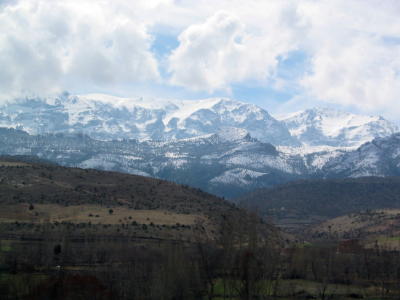
Michael Totten is driving from Turkey back into Iraq. He makes one observation:
"Sometimes it seems like everyone in the Middle East hates everyone else in the Middle East. Arabs hate Kurds and Israelis. Turks hate Arabs and Kurds. Kurds hate Turks and fear Arabs. (Interestingly, Kurds love Israelis.) Everyone, especially Lebanese, hates Palestinians."
The photo is by his friend and fellow-traveler, Sean LaFreniere.
Seniors and Marriage
A reader writes:
"Being a "liberal of doubt," I find I have more in common with "conservatives of doubt" than with either "liberals or conservatives of faith" most of the time. So I check in with you daily. I am also a gay man who didn’t have the nerve to fully come out to myself (let alone anyone else) until three years ago at the age of 52. Of course the biggest fear I have is the sometimes overwhelming loneliness.
That loneliness might be a reason that seniors’ positions have softened. I would not be at all surprised if there is a growing support among the senior population for a variety of domestic partnerships, exactly the arrangements that could sustain some of them through their worst fears. It would be interesting to know if the polls ever looked at attitudes toward other non-traditional partnerships to see if the whole landscape is changing."
Fascinating. Here’s more reporting on the generation of gay seniors now planning for retirement.
The Cancer of Consultants
John Kerry, Christianist
And Islamist. And Buddhistist. And whateverist. Marty has a ball. I’m glad he’s blogging. He’s a natural.
Afghanistan and the Anti-War Movement
The reader who wrote "Revenger’s Tragedy" below backed the war in Afghanistan, which makes his criticism of the Iraq war to my mind more persuasive. But it remains true that some on the hard anti-war left opposed such a war. MoveOn, for example, opposed the war. Michael Moore opposed it. The enclaves of the decadent left opposed it. Criticism of the conduct of the war in Iraq does not vindicate these people. And it’s important to keep score in that respect.
Marriage and the Polls
I don’t think there can be much debate that those of us who favor encouraging gay couples to settle 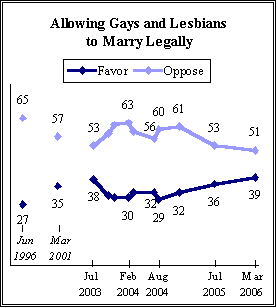 down and get married are winning the argument. Here’s a Pew summary of polling that takes the long view. In 1996, when I wrote "Virtually Normal," the first major book to advance the case for marriage rights for gays, 27 percent of the public agreed. That number is now 39 percent. 65 percent disagreed a decade ago, a number that has now declined to 51 percent. After a spike in opposition to marriage rights in 2004 – the year the Republicans decided to mount a campaign against it – the public has shifted dramatically. I’m most surprised by the demographic where the change has been most pronounced: those over 65. In February 2004, 58 percent of those over 65 said they "strongly opposed" marriage rights for gays. Now, only 33 percent hold that position. Who’d have guessed we’d make the biggest in-roads among seniors? (Of course, it’s partly a function of their being the group most opposed in the first place). This shift seems to me to be salient with respect to the idea of amending the federal constitution to ban any legal protections for gay couples. Whatever your view, passing a constitutional amendment to enshrine for ever a public policy position that is in major flux is extremist and imprudent. But moderation and prudence are not virtues currently valued in the GOP.
Quote for the Day
"’Lawless’ is the best word to describe Baghdad for the meantime. Do whatever you like. No one will ask you what you are doing. You can kill whenever and wherever you want. You can stop your car in the middle of the street, pull your gun and shoot anyone you hate. Do you think police will come for rescue? Huh! Of course not – because they might be the ones who are shooting," Treasure of Baghdad blogger, a week ago. (Hat tip: Greg.)
France. Over.
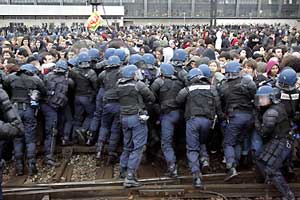
If the French cannot accept even the teensiest attemp to bring market discipline and free labor markets to their over-regulated economy, then they need no longer be considered a nation with a future. They are a nation committing an extremely slow suicide by suffocation. The suffocation is caused by an overdose of insecurity. Its only cure is nerve. But nerve was never a very common French trait, was it?
(Photo: Chistophe Ena/AP)
Revenger’s Tragedy?
A longtime reader sent an email as part of a conversation we’d been having. I reprint it, despite its great length, because it’s powerfully written, and I disagree with much of it. But I disagree with it less than I did a year ago. See what you think:
I supported the action in Afganistan. Everyone – the whole world – realized that that action was necessary. Hell, even Dennis Kucinich supported it. There was no other choice. And had we prosecuted the action in Afganistan competently, and to the end, by securing the peace and rebuilding the country, we might have come out of the war on terror with our heads held high and with the world’s respect and even admiration. Certainly our action there, and the related pressure on Pakistan, resulted in the most important single victory in the war on terror to date: the unmasking of the A. Q. Khan network. But we never finished in Afganistan. We let bin Laden escape. We did not and have not secured the country, or rebuilt it. Why? Well, why have we not secured or rebuilt Iraq? There is a reason. This is not just criminal negligence. This is a pattern.
I opposed the war in Iraq from the beginning. It smelled. It smelled to high heaven. This
was no action in response to 9/11. This was something else. Some grand design for restructuring the Middle East, for "draining the swamp". A war of revenge against the man who ordered the President’s father assassinated. Unfinished business. Oil. Yes, all those and more, as Wolfowitz admitted, but none of them would do as a trigger, so WMD was chosen. WMD was the one excuse that would work, the one threat that, tied to 9/11, would inspire action and overwhelm and silence opposition.
But the real motivation for the war in Iraq, Andrew, was the consolidation of Republican power here at home. Iraq was to be George W. Bush’s great victory, and Karl Rove’s hammer. The victory of the Republican right was to be complete and permanent. Bush and his crew knew the WMD excuse was fraudulent. As Zinni said, he knew, and they had the same information he had. But they did believe the old stockpiles, or some portion of them, were still there, moldering in Saddam’s secret bunkers, and would provide all the evidence needed to justify their war, cover their lies, and secure their
political triumph. The shame of the election of 2000 would be history, Bush would become the image of the man he always wished to be, and Rove would secure the Republican realignment.
But Bush’s great victory has turned to ash, and Rove’s hammer to a dagger he holds by the blade. One could write a book (and no doubt many will) on the Oedipal complex that drove Bush the son to surpass the father, and fail. A Greek tragedy played out in real life, right before our eyes. And could Shakespeare have bettered the cast of characters we have lived with these last six years, or the themes, or the plot? My God, what a play! He would be writing furiously even now. One play? No. Three, perhaps: Bush the Second, Parts I, II and III. We are in the middle of the third play. The end is coming.
I’m not being facetious. The horror and terror of tragedy is its inevitability. The audience sees what the characters cannot. And the audience knows that they too suffer, like the characters they watch. The play is a mirror. The war in Iraq has been our tragedy, our mirror. Perhaps, if we are lucky, our catharsis. But we are not yet to that stage, which comes after. We are still in the midst of the horror, unable to look away from the mirror. You stare into the face of Abu Ghraib. Me? What do I stare at? And all of us. We are living one of the great stories of history, Andrew.
Did I really know all this back then? Yes. Not so clearly, or at least, I would not have been able to express it so simply. Many people saw it, people of good faith, not just mindless Bush-haters or partisans. And every suspicion I had, and shared with those others, about Bush, and Rove and the rest, and about their motivations and methods, has proved out, and then some. And there is, I know, future revelations yet to come. None of it surprises me.
I’m only surprised that you are surprised. I think, Andrew, you were blinded by idealism, the desire to slay the monster Saddam. Have you read the Gilgamesh Epic? Or Castenada? We are betrayed, not by our faults, but by our strengths. Because that’s where we’re truly blind. Thus you. And me. And Bush. The difference is of degree, not kind. But that difference of degree is crucial. Bush doubts nothing. He is trapped in a rigid arrogance, a self-righteousness based ultimately on low self-esteem and fear of failure. Fear is his basic spiritual signature. You refused to doubt, because you love the ideal. We love you for that. But that’s also your blind spot. Yet you have never been trapped like Bush (or Rumsfeld or Gonzalez or Yoo) because, quite simply, you are far more humble, far more secure in your own being and in your trust of the Divine. Your humanity is alive and kicking, while theirs is deeply compromised. And me? Good question. I doubt much, and it has served me well. But I have not trusted enough, and that has not. That is my confession. And so we struggle, Andrew.
But there is one great dividing line here, between you and me on one side, and Bush
and his cohort (and the Christianists and the Islamists and the scientific reductionists, and all the other -ists) on the other: the humility of a faith based on love, with its attendant qualities of acceptance, inclusion and non-violence, and the arrogance of a faith based on fear, with its attendant qualities of judgment, exclusion and, inevitably, violence. You have written of this division in your own way when you wrote of the "conservatism of doubt" vs "conservatism of faith". I truly believe this division marks the great spiritual, social and political challenge before us in the 21st century: the shift from a faith – and a world – based on the fear of God to one based on the love of God. That is an evolutionary challenge. And a global challenge. And I think that some day it will be recognized as the great theme being played out at the center of the Bush Presidency, and the American tragedy in Iraq. Fear and lies, or love and truth. It’s just that simple.
I could have supported intervention in Iraq. Saddam was a monster. But not Bush’s intervention. If his Dad, and Powell, had put together a true global coalition, with a real commitment to pay the high price in money, manpower and years necessary to free Iraq, secure the peace and rebuild the country, yes, I could have supported it. But I knew GWB and his team would never accomplish those ends, because those ends were not his ends. His ends, and his means, speak for themselves. All the rest is lies.
The battle within faith – between a faith of certainty and order and a faith of humility and wonder – is indeed the great battle of our time. I’ve just finished the rewrite of a book on politics. Re-reading it, I realize it’s also a book about religion. The tragedy of our time is that the two subjects are now almost interchangeable.
(Photos: Joe Raedle/Getty; Brooks Kraft/Corbis, Rick Friedman, and Franco Pagetti for Time.)
 The Dish