There’s a definite uptick in reports suggesting that the Bush administration is planning for one.
Yglesias Award Nominee
"I’ve mostly laid off Joseph Wilson, not wanting to let the issue of his (execrable) character interfere with the question of who outed his wife as a covert CIA officer. But this from Daily Kos:
You know when they first started trying to come up with a way to discredit me, which we now know started in March of 2003, they went through the old standbys. "He’s had 3 wives, he’s a womanizer, he’s done drugs." But then they realized they couldn’t use those because I’ve never actually denied them. I mean I’m the first to admit that, unlike Ken Mehlman and David Dreier, I really like women.
is simply intolerable. (I’d hope the report was libelous if it weren’t written by an obviously infatuated Kossack with the handle "tlh lib.") The whole entry makes it sound likely that Wilson is now completely drunk on the sound of his own voice. I was glad to see one commenter call Wilson on his completely gratuitous gay-baiting. No one bothered to complain about Wilson’s expressed desire to punch Zalmay Khalilzad in the face.
Isn’t there some way we can send this jerk back to Team Bush, where he obviously belongs? It’s too bad. Given Wilson’s history, he could have been an effective anti-Bush spokesman, if he weren’t such a toad," – liberal blogger, Mark Kleiman, today.
Patience, Please
I hadn’t read much of blogger/writer/analyst Thomas Barnett before a reader sent me his way. This post strikes me as a remarkably candid and persuasive account of why we should not give up in Iraq. In transforming a post-totalitarian, ethnically divided, economically ruined pseudo-country, we cannot expect instant results. I don’t think anyone now seriously doubts that we made huge errors in the beginning and that the Bush administration was far too cocky and intransigent for at least two years. (One more time: Fire Rumsfeld Now.) But so many of the U.S. military have performed amazing work; so many other good people have contributed to this enormous project; and this endeavor is far too important to get swallowed up by domestic posturing. Let’s just agree that Bush screwed up. But let’s not forget either:
Saying we ‘lost the war’ in Iraq is simply saying ‘I want a return to the old days of the Powell Doctrine,’ which only got us 9/11 and the rising Occidentalism of the Salafis who think American ‘staying power’ is defined by helicopters fleeing over the horizon with their tail rotors between their legs.
The Powell Doctrine was perfect for the old Neocons, because it was a strategy of limited regret, limited impact, limited success and guaranteed long-term reliance on military arms to do nothing more than maintain a declining status quo.
But the Bushies went beyond those limitations on Iraq, which I thought and still think was completely necessary. Yes, it exposed a lot of bad thinking, bad planning, bad force structure, bad doctrine, bad operations, etc. in the U.S. military, but all those exposures have led to necessary change–and change long-delayed at that.
Barnett, however, is open-minded about the possibilities of our current moment, and even thinks John Kerry’s ideas are worth considering. I still think that a Kerry administration would have been able to move this endeavor forward more effectively than the incompetents who helped screw it up. But we are where we are. And I’m not in any mood to throw in the towel or to give up on the only president we have for three years. Barnett helps explain why.
Update: Tom Barnett responds. I had no idea we were together at Harvard.
Jesus and Border Control
His policy was quite clear, it seems:
"We think our national boundaries should be respected. That’s a biblical principle also," said Christian Coalition lobbyist Jim Backlin.
Immigration is turning into a fascinating debate. While you can unite Latino and White and black evangelicals in hostility to gays, you can’t easily unite them in opposition to illegal immigrants. And so one more fissure in the Rove realignment appears. And hope blossoms. They have just one more summer of gay-bashing to reverse the damage.
Bush Nailed
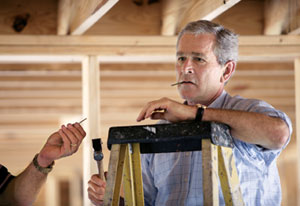
We have a missing link. No, I don’t mean the post-fish. I mean the Bush connection in the Plame leak. It turns out that, according to Libby, it was the president who first sanctioned the leak of the NIE data to discredit Joseph Wilson. Money quote:
"Defendant testified that he was specifically authorized in advance of the meeting to disclose the key judgments of the classified NIE to Miller on that occasion because it was thought that the NIE was ‘pretty definitive’ against what Ambassador Wilson had said and that the vice president thought that it was ‘very important’ for the key judgments of the NIE to come out," Mr. Fitzgerald wrote.
Mr. Libby is said to have testified that "at first" he rebuffed Mr. Cheney’s suggestion to release the information because the estimate was classified. However, according to the vice presidential aide, Mr. Cheney subsequently said he got permission for the release directly from Mr. Bush. "Defendant testified that the vice president later advised him that the president had authorized defendant to disclose the relevant portions of the NIE," the prosecution filing said.
Just a small point. Cheney’s judgment in this matter is extremely odd. Who really cared about Joseph Wilson’s op-ed? Why the extreme defensiveness and then recklessness of the Plame leak? We’re either talking extreme hubris here, or someone who felt he had a lot to hide. Or an admixture of the two.
Life After AIDS

An HIV-positive woman tangles with a life insurance company – because she ended up living too long! She’s not the only one to grapple with such unexpected futures or such posthumous living. And she has the right attitude: "It’s a great thing," she says, "a great thing." Life is. And maybe those people who recover from what were once diagnosed as fatal illnesses appreciate it all the more. Facing death is life’s first and last challenge. Those of us who have looked into the abyss once are in some ways lucky. We see life as it is – perishable, perishing.
“The End of Faith Ctd” Ctd
Another reader joins the conversation about Islam’s potential for moderation and pluralism:
"Your reader is fairly off in his description of of Islamic pluralism.
Turkey was forced single-handedly by Ataturk into a militantly secular society, literally at the barrel of a gun: the military has had a strong role in Turkish government and only in recent years has their iron grip relaxed (and in fact strains are beginning to show).As for India, Aurangzeb was a vicious ruler, and tried to impose a ‘sharia’ tax on the Hindus, thereafter spending most of his time putting down (mostly Hindu) rebellions.
Aurangzeb had a particular hatred for the Sikhs, and in fact brutally murdered some of their ‘gurus’, or great wise men. Other Mughal rulers before him, (Akbar mostly) were more enlightened, although except for Akbar, they made no serious attempt to engage with the Hindu community, spending most of their time fighting battles with other Muslim fiefdoms.
India could never be ruled as an Islamic republic because of the huge majority of Hindus. The wiser Muslim rulers realized this and backed off, but not for want of trying.
What your reader does correctly suggest though is that there was a time when it was possible for Muslim rulers to rule without sharia, and without causing deep internal conflicts: the Middle Ages was after all part of the Islamic golden age. But that time is long gone, and that view of the religion is long gone as well."
No view of religion is ever gone for ever. Islam may not be promising material for modernity; but I’m not prepared to give up on its eventual reconciliation with liberal democracy.
The Religious Left
A primer from Steve Waldman.
The “Perfect Organism”
That’s Mike Crowley’s view of Tom DeLay.
“The End of Faith”, Ctd.
A reader writes:
"I respect Sam Harris, but he is dangerously off base here on Islam. No basis for a pluralistic wordview? Come on. He needs to visit Turkey. He will find at least 50 million people who must have done "some seriously acrobatic theology to get an Islam that is compatible with 21st century civil society." Or go to Indonesia, there’s another 100 million there. Or how about Southern India, where Islam and Hinduism peacefully coexist with Christianity, Buddhism, Sikhism and Zoroasterism? How’s that for plurality? In Hyderabad, I saw many Muslim women in their black chadras casually gossipping and laughing with their Sari-clad Hindu friends. I saw this scene far too many times to believe that Muslims are incapable of religious pluralism. And how does Mr. Harris account for the fact the Mogul emperors ruled India for about 400 years without imposing their Islam on the majority Hindu poplulace? I would say the Moguls were the world’s greatest example of a religiously pluralistic government, not a product of an inherently intolerant religion.
Of course, the Wahabis are dangerous fanatics, and they are widely prevelant in Afghanistan. But we would make a grave miscalculation if we assumed that all Muslims share the intolerance of the Wahhabbi. Sam’s attitude that we must change Islam is wrong. Most Muslims are perfectly harmless and even enjoyable company. We really need to defeat the Wahhabi strain of Islam, which is something most Muslims would be happy to see."
I haven’t read Harris’ book, but I hope to after I’ve finished my own (nearly there). My own view is more in line with the reader’s. What Harris doesn’t grasp sufficiently, perhaps, is the variation within all religion. There is an absolutist, fundamentalist, authoritarian tendency in all monotheisms. Right now, that tendency is ascendant in all the major faiths – but it has become particularly dangerous in Islam. The problem is not religion as such, or faith as such. The problem is fundamentalism, and its certitude. There is another kind of religious faith – more rooted in doubt, more subject to humility in front of the ineffability of an ultimately unknowable God, less abstract, more sacramental. That kind of religion, which sees the different faith of others as an invitation rather than a threat, is compatible with liberal democracy. And it’s that faith we have to recover and reinvigorate if we are to combat the excesses of both Islamic and Christian fundamentalists, and their political ambitions.
 The Dish