A Death Blow To Net Neutrality? Ctd

John Blevins argues that the FCC ruling hasn’t killed the open net:

The FCC’s open Internet rules quite sensibly prevented Internet access providers from engaging in blocking and other unreasonable discrimination. The D.C. Circuit, however, struck down these rules, which has led to criticisms that network neutrality is dead. Fortunately, it’s not.  The court vacated only these particular rules, not the FCC’s ability to act in the future. Specifically, it concluded that the FCC could regulate Internet providers under a statute known as Section 706, which authorizes the FCC to take various steps to promote broadband deployment. The court correctly recognized that prohibiting blocking and discrimination can lead to greater broadband deployment by increasing consumer demand. For instance, the introduction of the World Wide Web (which required no permission or toll payments) fueled the network investments of the 1990s. The growth of online video is driving modern investment today. …

In sum, the FCC still has sufficient authority to protect the open Internet. The million-dollar question is whether it will choose to use it — and whether the public will pressure it to do so. Following the opinion, Chairman Tom Wheeler stated his preference to proceed in a “common law fashion,” which is legalese for individualized decision-making. I am therefore tentatively hopeful that the FCC is heading in this precise direction.

Matthew C. Klein highlights the costs net neutrality impose on ISPs:

The reality is that these companies must spend vast sums on capital expenditures to keep pace with soaring demand for high-speed Internet service. For all the talk about stifling competition and hurting startups, the existing system means that text-based websites end up paying the same rates to Internet access providers as video-streaming services that consume far more bandwidth. Why is one-size pricing — an effective subsidy — fair?

How is that in the interest of consumers? Why shouldn’t companies pay for the data needs they create? If the government can prove that broadband providers should be classified as common carriers in the same manner as telephone companies, then it should regulate these companies as utilities. If not, it should let Verizon Communications Inc., Comcast Corp. and Time Warner Cable Inc. set Web access prices as they see fit. They could use the extra revenue to invest in new capacity and make U.S. consumers better off.

Berin Szoka and Geoffrey Manne assert that the ruling actually gives the FCC “carte blanche to regulate the entire internet”:

[C]ounterintuitively, there’s every reason to think new entrants — the little guys — would benefit most from non-neutrality: Payola (paying radio stations directly for extra airplay), for example, is frequently derided by those who misunderstand it, but it actually helps new artists break through. Sponsored data and other prioritization arrangements on the internet are just a further extension of this. The FCC’s earlier approach would have foreclosed innovative, upstart edge providers from buying the preferential treatment or “premium carriage” they might need to gain recognition and draw users away from well-established incumbents.

Bottom line: The FCC should stop trying to ban prioritization outright and focus only on actual abuses of market power. But instead of adopting antitrust principles, Wheeler’s case-by-case approach will probably be guided by little more than the outer boundary of avoiding common carriage regulation (if even that). And that’s the real issue here. It’s not about what the FCC wins or loses, but that net neutrality “common law” could be haphazard and devoid of economic rigor — and, worse, that the FCC could use the same Section 706 power to regulate internet services beyond broadband. That’s where we should be focusing this discussion: the FCC’s new, sweeping discretion.

Reihan understands net neutrality proponents’ concerns, even if he doesn’t share them:

The broadband market is defined by high barriers to entry, and one suspects that at least some ISPs will be willing to test the bounds of their customers’ patience before competitors spring up to challenge entrenched incumbents. Or perhaps ISPs will find ways to differentiate their offerings in ultimately consumer-friendly ways. I would feel more comfortable if the U.S. were more open to alternative arrangements, like municipal broadband networks, and if more spectrum were available for innovative wireless technologies deployed by new entrants.

Kevin Werbach thinks competition will allow for more innovation than net neutrality has:

It’s important to keep in mind that the point of network neutrality isn’t to ensure that no company ever has a competitive advantage; it’s to allow innovators to thrive and win in the marketplace. And the best way to do that is through a competitive market. Network neutrality was devised in the early 2000s as a “second-best” response after the FCC refused to require physical open access to dominant broadband networks, the approach adopted in most of the world. Even now, the best hope for a dynamic, affordable, and innovative Internet is real broadband competition.

Most of the greatest barriers to broadband competition are at the local level: State prohibitions adopted at the behest of the incumbent carriers, difficulties with zoning and access to rights of way, and limited willingness to invest in the kinds of municipal open access fiber optic utilities that are wildly successful in cities like Stockholm. The FCC has been hesitant to confront these impediments, perhaps because it was so focused on net neutrality. Yet even Judge Silberman, who dissented in part in the Verizon case because he thought it gave the FCC too much authority, expressly stated the Commission could take such actions.

Paul Waldman fleshes out the competition argument:

Is net neutrality the reason that here in America we have some of the most expensive Internet service in the world, at speeds that have consistently lagged other highly developed nations? No. The reason our broadband is so expensive and yet so mediocre is simple: ISPs operate as virtual monopolies, with most Americans having only a couple of choices for broadband service, but we don’t regulate them like monopolies, meaning they can keep raising prices all they want. It’s the deadly combination of low competition and low regulation.

Susan Crawford doubts that competition will keep ISPs in line:

The court’s opinion is about much more than net neutrality. In finding that the FCC must be held to its decision to exempt Comcast Corp. (CMCSA), Time Warner Cable Inc. (TWC), AT&T Inc. and Verizon Communications Inc. from common carriage obligations, the court says the commission can’t require these giants to connect to any other networks, treat new businesses the same as old ones, carry the speech of Americans without altering it, or otherwise refrain from imposing their profit-driven interests. In the Internet access business, competition cannot replace regulation, because real competition doesn’t exist. At the moment the court’s ruling came down, I was in my living room in Cambridge, Massachusetts, talking to my friendly Comcast installer. He told me that our mayor had signed an exclusive agreement with Comcast so that no competitors would be allowed in town. The man may have been a little confused about the legal niceties of what’s happened here, but he was dead on about the reality: My only choice for high-speed Internet access in Cambridge is Comcast. And the same is true for more than 77 percent of Americans: The local cable monopoly is the only seller of wired high-speed, high-capacity Internet access. I asked whether Comcast would soon be installing fiber-optic service — the fastest kind. Nope, he said. Too expensive. Yet in Stockholm, a city I had just visited, 100 percent of the businesses and 90 percent of the homes have fiber optics. In New York, where I also live, I pay four times as much as someone in Stockholm does for service that is an 18th as fast.

Tim Fernholz bets that this ruling blowing up in the winners’ faces:

The basic question—one at the heart of a lot of internet issues—is to what extent the internet’s pipes should be considered public infrastructure, like roads, water lines or telephone lines. Such “common carriers” may not unreasonably discriminate against their customers. The FCC doesn’t consider ISPs common carriers but “information services,” exempt from regulation as new, developing technologies. The federal appeals court said, in essence, that the FCC can only impose net neutrality on the broadband providers if it first declares them common carriers. It could now take that step. The carriers’ allies in Congress have long opposed such a move, but they probably couldn’t force the Obama administration to block it. Congress itself could also put in place—or prohibit—net neutrality rules, although it’s unlikely to do either. Even failing a common-carriers declaration, net neutrality isn’t buried. Both its opponents and proponents believe the court decision has unintended consequences that will empower the FCC to enforce the essentials of net neutrality without re-classifying ISPs. Even if they aren’t considered common carriers, the FCC is empowered to regulate them under a different statute.
The Pro-Pot Party?

Dems Marijuana

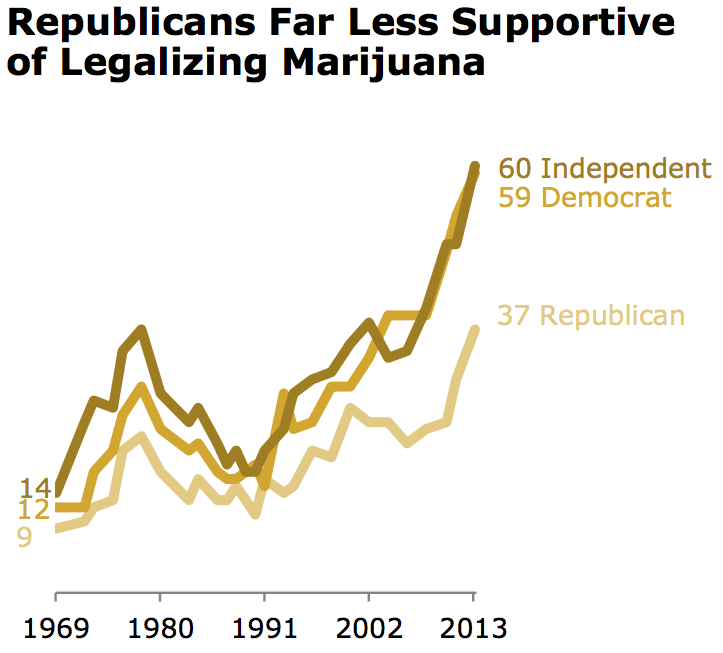
Waldman compares Democrats’ support of marriage equality to their support of marijuana legalization:

I’m not saying that by the end of the 2016 race every Democrat will support legalization of marijuana for recreational purposes. But what the experience of same-sex marriage tells us is that when opinions about an issue are changing, politicians change too. And that means that where a candidate stands right now may or may not tell us where he or she will stand two years from now. So my guess is that all the Democrats will support some kind of legalization. The more tentative ones may support an extremely limited medical legalization of the kind that now exists in the District of Columbia, where there are only a few approved conditions (and a grand total of 120 people have signed up). Others may favor a looser medical legalization that is still limited in some way. But I’ll bet some Democratic candidate, maybe one who’s “serious” but is still an underdog and thus has little to lose, will come out in favor of legalization.

(Chart from (pdf) Pew.)

Where’s The Diplomacy Lobby?

Noah Millman is concerned by the absence of a real pro-diplomacy constituency:

The anti-war left has fundamental doubts about the integrity of American power. But diplomatic engagement requires a comfort with that power, and understanding of its uses and its limits. The anti-war right, meanwhile, has fundamental doubts about the legitimacy of limits on national sovereignty and freedom of action. But diplomatic engagement, again, requires comfort with the architecture of international relations, which is buttressed all over with liberal internationalist structures of one sort or another. As a consequence, it’s very difficult for the anti-war constituencies in the two parties (and outside of either) to work together for a foreign policy that is more restrained in its use of force. Which means that right now, both Democrats and Republicans in the Senate and the House of Representatives are pushing legislation that pretty much everyone involved in the diplomatic process understands is designed to make a diplomatic solution much less likely.

In the absence of a diplomatic solution, the arguments for military action will get louder and stronger. But the substantial majority who oppose war, and the large minority who oppose it fiercely, are basically having almost no effect on the debate over the diplomatic process.

I don’t know what there is to do about that. But it troubles me greatly.

Cannabis In The Nation’s Capital

DC Marijuana

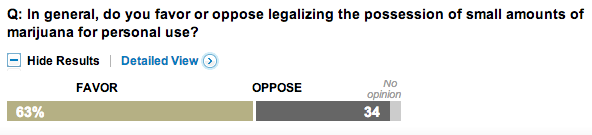
DC residents want to legalize marijuana:

Support for legalizing marijuana has expanded dramatically in the nation’s capital, with residents who were split evenly on the issue four years ago now favoring sales of the drug for personal use by a ratio of almost 2 to 1, according to a new Washington Post poll.

Washingtonians of every age, race and ethnicity — teenagers and seniors, blacks and whites — registered double-digit increases in support of legalization.

Weigel covers DC’s decriminalization push:

In D.C., black people and white people are just as likely to smoke pot. Black people are at least eight times more likely to be arrested for it. That’s untenable, especially in a culturally liberal city that votes roughly 19-1 for Democratic presidential candidates. And that’s why the D.C. council is trying to reduce marijuana to a parking ticket-level offense: $25 if you’re caught with less an than ounce, $100 if you’re smoking outside. Selling and growing would stay illegal, but the smokers wouldn’t be collared anymore.

He thinks that the “decriminalization bill, endorsed by 10 of 13 council members, will probably be law by the spring.”

Treating Criminality

Vince Beiser reports on how Obamacare’s Medicaid expansion and subsidy system could help reduce recidivism rates in our prisons:

An astonishing two-thirds of the 730,000 men and women released from America’s lockups each year have either substance abuse problems, mental health problems, or both. Very often, those problems were largely responsible for getting them locked up in the first place. Most addicted and mentally ill prisoners receive little or no effective treatment while they’re incarcerated or after they’re turned loose, so it’s little surprise that, like Sanders, they soon wind up back in jail. But for some, that revolving door may stop spinning this year, thanks to a little-noticed side-effect of President Obama’s Affordable Care Act. Obamacare, it turns out, might be a crime-fighting tool.

Numerous studies support the common-sense notion that treating offenders’ drug addictions and mental illnesses helps keep at least some of them from going back to jail. Get that junkie off heroin, and maybe he won’t steal your car stereo for fix money; get that mentally ill homeless person on proper medications, and maybe she can find a job instead of turning tricks in alleys. “It’s not the drug itself, it’s the stealing and robbing they do to get the drug,” says Abbie Zimmerman, a therapist at Transitions Clinic, a program based in San Francisco’s hard-bitten Hunter’s Point area that treats former prisoners (including Sanders, who is now an outreach worker there). “If I can keep them sober, I can keep them out of jail.”

But no one has been willing to pay for such treatment for hundreds of thousands of ex-cons. And they certainly can’t afford it themselves: According to a recent report by the Council of State Governments, the vast majority of released prisoners re-enter society with little money and no health insurance. But now many of those former prisoners are eligible for insurance, courtesy of the federal government.

Overweight And Underpaid

Obesity

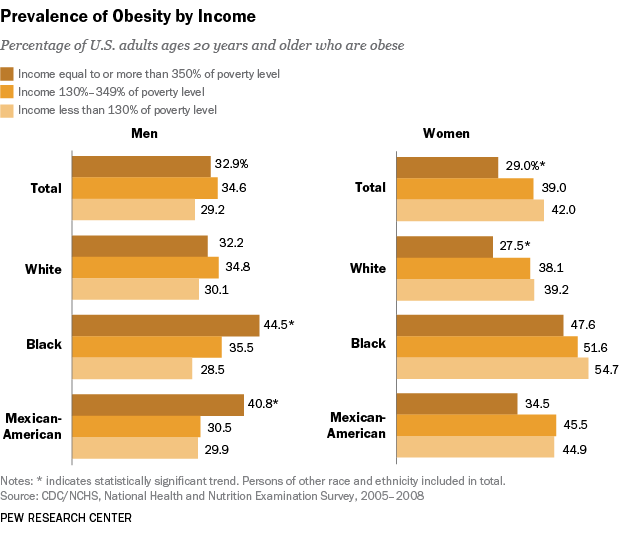
Derek Thompson examines the relationship between obesity and poverty:

[P]overty might make some people obese, but obesity definitely makes many people poorer, through two broad channels: (a) it reduces take-home pay, particularly for women; and (b) it’s related to health conditions that reduce discretionary income, too. If there is there is a close relationship between weight and poverty, it is strongest among women, from the peak of the 1 percent to below the poverty line. At the top, corporate boards appear severely biased against larger women in a way they don’t discriminate against larger men. [John] Cawley’s research found that obesity lowers wages for all workers but particularly for white women. Women who are two standard deviations from normal weight (64 pounds for the typical woman) earn 9 percent less, he writes. Obese women are half as likely to attend college, 20 percent less likely to get married, and seven times more likely to experience illness, depression, or death from being overweight.

(Chart from Pew.)

Publish Or Perish

Alan Jacobs worries that the fast pace of the blogosphere is discouraging writers from doing their homework and really understanding the issues they’re writing about:

[O]ne of the most reliable ways to sharpen your own thinking is to find out what other smart people have thought and said about the things you’re interested in — that is, to take the time to read. But the content-hungry world of online publishing creates strong disincentives for writers to take that time. Almost every entity that has an online presence wants to publish as frequently as possible — as long as the quality of the writing is adequate. And often “adequacy” is determined by purely stylistic criteria: a basic level of clarity and, when possible, some vividness of style. That the writer may be saying something indistinguishable from what a dozen or a hundred writers have said before is rarely a matter of editorial concern. Get the content out there!

Tim Parks observes the same obsession with publishing among fiction writers:

Every year, I teach creative writing to just a couple of students. These are people in their mid-twenties in a British post-graduate course who come to me in Italy as part of an exchange program. The prospect of publication, the urgent need, as they see it, to publish as soon as possible, colors everything they do. Often they will drop an interesting line of exploration, something they have been working on, because they feel compelled to produce something that looks more “publishable,” which is to say, commercial. It will be hard for those who have never suffered this obsession to appreciate how all-conditioning and all-consuming it can be. These ambitious young people set deadlines for themselves. When the deadlines aren’t met their self-esteem plummets; a growing bitterness with the crassness of modern culture and the mercenary nature, as they perceive it, of publishers and editors barely disguises a crushing sense of personal failure.

The Comfort In Killing Cold War Enemies

Gamers are still fighting the Soviets, according to a study on first-person shooters:

North Korea and China, nation-states that might be considered more pressing and relevant rivals to the West, only show up as enemies in games once each. On the other hand, Russia shows up as the enemy 11 times. Either as a future Russian Federation or Ultra Russian nationalists, the most prevalent outcome for an enemy is the Russian context. Terrorists likewise might be considered the most promising enemy in digital games, yet they still are not as prevalent as one might think appearing seven times, mostly in various Tom Clancy series. Tom Clancy series also tend to use Latin American terrorists rather than Middle Eastern. Iraq, Iran, Libya, and Serbia do not appear as enemies at all, but Iraq, Iran, and Pakistan do sometimes appear as locations in campaign modes of some games. …

There are various reasons for these results, but I am interested in hearing what the public might think of these outcomes. The “Russia” result is likely because they are ongoing rivals with the US, it is hard to shake Cold War images, and the fact that China represents a large market for video games and other entertainment forms that is best not annoyed (see my book on Tibet and China for similar themes). The reason we see few games covering terrorism is likely because these fights might hit too close to home and lose the element of fun important in games. Medal of Honor Warfighter was a huge failure for this reason, killing the entire franchise.

Marijuana’s Next Electoral Battles

Adam O’Neal stares at the political horizon:

With even more states considering full legalization, 2014 could end up as a banner year for pot. In Alaska — where possession of less than four ounces and personal cultivation has been already been decriminalized — residents will likely have the chance to vote on an getty-potinitiative that would regulate and tax marijuana and allow for the opening of recreational cannabis shops. A poll from last year showed 60 percent of the state’s residents support full legalization. In Oregon, voters are also expected to consider legalizing the substance, just two years after a similar initiative failed in a statewide vote. As with the 49th state, a poll taken last year in Oregon showed strong support for legalization. Advocates and opponents of legalization both point to Oregon and Alaska as the likely battlegrounds for the issue this year. Though that excites activists, the two states have a combined population of less than 5 million.

To really send a message to federal lawmakers in 2014 — who activists hope will become increasingly deferential to states as more enact legalization — and create momentum going forward, advocates are looking for a major victory. And the already pot-friendly state of California (where medicinal usage has been permitted since Proposition 215 passed in 1996), with its population of nearly 40 million, might provide it. After all, if California legalized marijuana, then roughly one in five Americans would live in a recreational-use state.

He goes on to detail the various legalization ballot initiatives fighting to make it on the California ballot. Meanwhile, Reid Cherlin wonders whether a Republican winning back the White House would reverse the progress being made:

It’s probably safe to assume that if Democrats retain control of the White House, the new president will, at minimum, keep in place the Justice Department’s laissez-faire stance. (There has been little talk of actually amending the Controlled Subtances Act.) Less predictable is what would happen under a Republican—or how the issue might play out in a volatile Republican primary. No one expects marijuana to be the deciding issue, but then again, it might well be a helpful way for the contenders to highlight their differences.

Richard Skinner expects marijuana to be a bigger issue for the Dems:

There’s no organized group backing legalization that has the clout of the gay lobby. (No, NORML doesn’t count). But liberal Democratic voters tend to be more supportive of legalizing pot. With her maternal image, Hillary Rodham Clinton doesn’t seem likely to back legalization. This provides an obvious opportunity for a liberal challenger. But it wouldn’t be hard for her to drift towards a federalist approach. Which is what I suspect she’ll do.

How he suspects it will play out in the general election:

It’s an easy issue to pass off to the states. I suspect both nominees will back a federalist approach, with the Democrat probably expressing more sympathy for those who support legalization. The experiences of Colorado and Washington State will probably have significant impact.

(Photo: Getty Images)

Spraying The Crops

field

Sam Brasch tracks the rise of human pee as fertilizer:

Across the Atlantic, studies have long established urine as a powerful fertilizer. A study conducted by the Stockholm Water Company in the late 1990s diverted urine from four housing projects to a grain farmer outside the city. The scientists concluded not only that urine could replace quick-acting mineral fertilizers, but also calculated that one Northern European adult pees enough plant nutrients to grow 50 to 100 percent of the food requirement for another person. Other successful trials have taken place in China and Mexico, though none as detailed as the Swedish one.

Rich Earth acknowledges that the biggest hurdle to their work is public perception of lingering buckets of pee, or the so-called “ick factor.” Urine is actually sterile when it exits the body, save for rare cases of a bladder infection or salmonella poising. REI has nevertheless developed two strategies for eliminating the risk of pathogens, either by solar pasteurization or long-term storage in a warm greenhouse. Both have proven effective.

A real concern for REI? Left over pharmaceuticals that end up in urine.

(Photo by Michal Fabik)