Poverty Is Bad For Your Health

Hypoglycemia

No shit:

The basic idea is that people struggling to make it paycheck-to-paycheck (or benefits-to-benefits) might run out of money at the end of the month—and have to cut back on food. If they have diabetes, this hunger could turn into an even more severe health problem: low blood sugar. So we should expect a surge of hypoglycemia cases at the end of each month for low-income people, but not for anybody else.

That’s what researchers found when they looked at the numbers for California between 2000 and 2008. As you can see in their chart [seen above], low-income people (red line) were <27 percent more likely to be hospitalized for hypoglycemia in the last week of the month than in the first. There was no week-to-week difference for high-income people (orange line). …

Okay, but isn’t it possible that poorer people just tend to be less healthy in general?

Sure. That’s why the researchers also looked at when people go the hospital for appendicitis, which doesn’t depend on diet. So there shouldn’t be any end-of-the-month increase for low-income people if tight budgets are the problem. There wasn’t. As you can see above, appendicitis cases were flat across the month for both high (blue) and low (purple) income people. In other words, poorer people don’t need more care at the end of the month for every kind of condition. Just the ones that get worse when you don’t have enough to eat.

Adrianna McIntyre sees this study as an example of what gets ignored in our health policy debate:

Policy wonks have a terrible habit of focusing on insurance and health system design (and here I count myself, because health care financing is the research I find most interesting, so it’s what I write about). This gives short shrift to the “social determinants” of health—upstream factors related to lifestyle, environment, and socioeconomic status—that cannot be corrected by medical interventions. We’re fond of highlighting how much more the United States spends on health services, but an idiosyncrasy that receives less attention is how much less we spend on other social services.

Egypt Votes On A New Constitution… Again

EGYPT-POLITICS-UNREST-VOTE

Juan Cole takes a look at the contents of the charter that Egyptians have been voting on yesterday and today:

The constitution itself forbids torture and allows citizens to sue the police. If the provision is actually implementing, it seems to me Egyptians would have more rights in these regards than Americans. It gets rid of the clause that makes the al-Azhar Seminary the arbiter of Islamic law incorporated into state practices, which had been a step toward an Iran-style theocracy. It guarantees freedom of belief (the Coptic church is backing it). It is good on the rights of children. While it gives the army 8 years in which the civilian government can’t interfere much with it, that provision was in the Morsi constitution, too.

But constitutions are only as good as their implementation. Some Egyptians have argued that the interim government has overstepped its authority with its anti-protest law and ban on the Muslim Brotherhood, and that the anti-protest law, at least, is unconstitutional by the text of the new constitution. About that, we’ll see.

Manal Omar gauges the mood of voters in Cairo:

The two-day referendum, which began Tuesday, Jan. 14, is widely seen as an opportunity to end — or at least mitigate — the political debates that have been threatening to rip Egypt apart. The country has been deeply polarized since July 3, 2013, when the military deposed President Mohamed Morsi. The previous constitution was suspended, and a new road map for a political transition, led by a military-appointed government, was established. This government, which has banned the previously ruling Muslim Brotherhood and cracked down on street protesters, wrote the newly proposed constitution. The document incorporates more rights and freedoms than the last constitution, but it also guarantees greater autonomy for the military, still affirms principles of Islamic law as the main sources of legislation, limits the establishment of trade unions to one per profession, and leaves room for civilians to be tried in military courts — all causes of popular discontent.

Yet in voting, many people I spoke to said their primary interest is not in enacting a particular government charter; rather, it is in finding a way to move the country forward and to bring attention back to the much-needed social and economic reforms that inspired the 2011 revolution. Which is to say, they just want to get past it. Everyone also seemed to silently acknowledge the elephant sitting in the polling rooms: A no vote is not even an option.

Maher Hamoud doesn’t see any good coming of the referendum:

That this constitution will pass is a foregone conclusion. It is a fact that will not necessarily bring the much-mentioned stability, but it will provide the military, Mubarak loyalists and the business elite with what they wanted: power, protection and a “democratic” mask to show to international players. We have to remember that no ruler in Egypt since the mid-1970s has been able to afford being an enemy of the US or the west in general (and vice-versa).

But stability? The Muslim Brotherhood is not a small faction, and radical Islamist groups will not let bringing down the only Islamist model, which they did not necessarily like, go unpunished. The political roadmap will continue, the military will retain power (constitutionally this time) either directly or behind a civilian façade. But before we know it stability will be advocated again in another campaign, once people have realised for the third time that the revolution’s goal of freedom and social justice is not yet on anyone’s political agenda.

Steven A. Cook, meanwhile, begs Sisi not to run for president:

[L]arge numbers of Egyptians—with the encouragement of elites associated with the old order and important parts of the media—seem inclined toward an al-Sisi presidency. People are convincing themselves that Egypt needs a strong personality, if only temporarily, to put the country back on track.  They are comforted by the fact that the new constitution, which is up for referendum today and Wednesday, sets term-limits for the president to two, four-year terms.  This is an improvement in a country that has had problems with the overwhelming power of the executive, but observers should know that  1) presidential political systems are prone to the accumulation of power in the office of the presidency, and 2) there are reasons to doubt the durability of the term limits   After all, Anwar Sadat did away with them in 1980 when they became inconvenient.  The July 3 coup set a precedent that the political institutions of the state could be ignored, if powerful people and their allies agree that it is convenient to do so. One can easily imagine a scenario in which authorities override term limits in some way—security conditions, for example—to allow al-Sisi to remain in office. Another president for life is clearly not what Egypt needs.

(Photo: An Egyptian man has on his chest a portrait of Egypt’s Defense Minister General Abdel Fattah al-Sisi with a slogan in Arabic reading ‘I vote for the loin of Egypt for the presidency’ outside a polling station during the vote on a new constitution on January 14, 2014 in Cairo. By Khaled Desouki/AFP/Getty Images)


Is Richard Dawkins Growing Up?

The FSM slayer turns to essentialism:

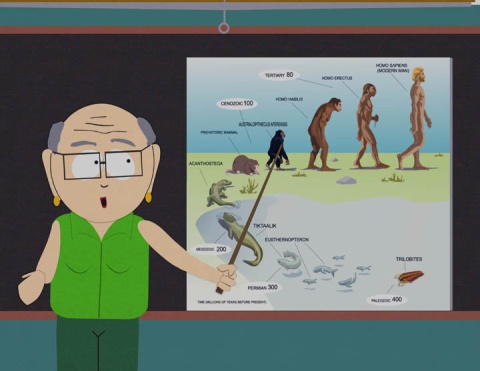
If, like Aristotle, you treat all flesh-and-blood rabbits as imperfect approximations to an ideal Platonic rabbit, it won’t occur to you that rabbits might have evolved from a non-rabbit ancestor, herbert-garrison-20090318040350264-000and might evolve into a non-rabbit descendant. If you think, following the dictionary definition of essentialism, that the essence of rabbitness is “prior to” the existence of rabbits (whatever “prior to” might mean, and that’s a nonsense in itself) evolution is not an idea that will spring readily to your mind, and you may resist when somebody else suggests it.

Paleontologists will argue passionately about whether a particular fossil is, say, Australopithecus or Homo. But any evolutionist knows there must have existed individuals who were exactly intermediate. It’s essentialist folly to insist on the necessity of shoehorning your fossil into one genus or the other. There never was an Australopithecus mother who gave birth to a Homo child, for every child ever born belonged to the same species as its mother. The whole system of labeling species with discontinuous names is geared to a time slice, the present, in which ancestors have been conveniently expunged from our awareness (and “ring species” tactfully ignored).

Phil Burton-Cartledge wonders if this could mark a new direction for the New Atheist:

Dawkins’ contemplative position sets up an opposition, a rigid distinction between believers of whatever creed, and the godless. Being unbelieving is a matter of personal growth, of intellectual and mental maturity, of possessing reasonable and rational-critical faculties. One might observe that this idealist position lapses into essentialist thinking. It’s not that all religious people are unintelligent, but clearly on some level they’re all stupid, or so the assumption goes.

Regardless of what one thinks of Dawkins, whether one hangs on his every dot and comma or takes a more critical stance, his choice to dump essentialism is an interesting one as binning it means breaking with a component of his own philosophical atheism. Hopefully some fresh, more interesting thinking through of religion and atheism is just around the corner.

In thinking about religion in a non-essentialist fashion, I’ve found myself having to be more nuanced than I once was. I now see more clearly that the forms that religion takes can be as important as the doctrinal content, that there are, yes, varieties of religious experience, and that the distinction between faith as a relationship with doubt as opposed to faith as a relationship with total certainty is a real, if still crude one, and that between a lived faith and a neurotic fundamentalism even more critical to understanding our current world.

If Dawkins’ opposition to essentialism is real, he may begin to accept that treating all religion as the same essential thing is far too crude to add much light, rather than heat, to the conversation. For another nuanced take on the varieties of religious experience in modernity, I highly recommend Ross Douthat’s stimulating blog post here.

The Christie Scandal Has Legs

Shafer predicts that it will go on and on and on:

Like so many scandals, this one has been fueled by an official investigation. Lacking subpoena power to gather evidence and compel testimony, journalists depend on those who do have such powers, and in the bridge case it’s the state legislature. Both branches of the New Jersey legislature are controlled by Christie’s political enemies, the Democrats. … [N]o matter what anybody tells you, Chris Christie is the quarry here, not any of his staff or appointees. As mentioned above, testimony, subpoenas, and investigations stoke the news furnace whether they’re productive or not. Add a presidential front-runner such as Christie to the mix and political contention — not just within New Jersey but across the border into New York, where Gov. Cuomo and members of his party are glad to help hurt Christie — and you’ve got the makings of a long-running story.

But Christie’s polling hasn’t taken much of a hit, yet:

[L]ook at the Monmouth poll, the only one taken in New Jersey since the scandal began. … Republicans are sticking by Christie, giving him an 89% approval rating which is in line with the 85% GOP support he received last month. The Republican uptick is a better omen for Christie than anything else in the poll. There are conservatives who, like M. Stanton Evans once said of Nixon and Watergate, like the governor better because of the scandal.

Update: An NBC poll released today also finds that the scandal hasn’t damaged Christie as much as you might expect:

Nearly 70 percent of Americans say the bridge-closure scandal engulfing Chris Christie has not changed their opinion about the New Jersey governor, according to a new NBC News/Marist poll. In addition, 44 percent of respondents believe he’s telling the truth about his knowledge of the events surrounding the controversy.

And far more Americans view him as a strong leader rather than as a bully.

But the survey also shows that the potential 2016 Republican candidate has lost ground to former Secretary of State Hillary Clinton in an early hypothetical presidential match up and now trails her by 13 points.

Ditch The Rock? Ctd

Couple w/ engagement ring

Readers pivot on the thread:

Here’s another aspect of the engagement conundrum: what do we gay folks give as a token of our proposals?  I imagine lesbians (some, at least) will go the traditional diamond route, as our culture clearly accepts a diamond ring on a woman’s hand in a way they don’t on men’s hands.  But guys (most of us, anyway) aren’t interested in a delicate band with a shiny rock perched atop. So what to do?

Here’s what I did when I proposed to my husband six years ago: I bought him a very nice watch (Omega Seamaster, if you must know), and told him (in a romantic setting) that I wanted to spend “every day, every hour and every minute” of the rest of our lives as his husband.  Then I said, “and so you will remember that, I want you to wear this,” and pulled the lovely red box from where I had hidden it.

I think the gift of a watch makes a perfect modern tradition – it has utility, not just attractiveness, plus the added symbolism of marking the time of a relationship intended to last a lifetime.

Another asks:

You’ve probably mentioned this already, but how did you and Aaron signify your engagement?

All I gave Aaron was another round of margaritas.  Another reader on the “perfect male engagement ring”:

Before I proposed to my now-husband, I had seen a handful of friends and acquaintances go through the same process.  There was no consensus on how to propose to another guy, but what I often saw was that one partner would propose to the other with a gold or platinum band, and then either reach into his pocket and pull out another ring for himself to wear, or (in one case) ask the partner to buy him a matching ring.  That all seemed a little odd, and frankly those were wedding rings they were really talking about, not engagement rings.  After all, what were they going to exchange at the ceremony?

I gave it some thought and got my boo the watch he’d always dreamed of, and I had the watch engraved.  It’s the perfect male engagement ring: it’s a piece of jewelry signifying time spent together, it stands on its own (as a diamond ring does) without requiring reciprocation, and, well, it’s a lot more masculine than a diamond.  And we exchanged bands on our wedding day, and it was perfect.

I’m curious as to what other same sex couples have done – and whether the diamond ring tradition sticks with the lesbian community.

Another guy:

My husband and I got engaged a few years back when marriage was made legal in Washington, DC.  When it came to figuring out rings we decided on two inexpensive (“cheap” feels harsh, but they were about $10 apiece) stainless steel rings we bought in a bead shop off Dupont Circle.  We figured they were just engagement rings and we’d get around to buying “real” rings at some point.

Well, life got ahead of us, and after losing our first dog to cancer, the wedding got put on hold for a few years (first grief, and then just the rolling tide of life).  Two years ago we finally got around to getting married. Among all the preparation for the big day, we kept putting off the buying of super expensive rings. Our brother in-law is a master jeweler and had even offered to design special rings for us.  But the funny thing is, we’d gotten very attached to the simple rings on our fingers.  In the end we stuck with those stainless steel rings.

Here’s what made it special for us and more than our engagement rings: our marriage rings – our simple public ritual – included exchanging our rings through all of our assembled friends and family members.  We thought it would be a quick passing of rings through the crowd, but Andrew, the thing that stunned and humbled us was people took their time.  I’m not sure what was going through their minds as we stood there in front of these 120 folks and as music played sensed them blessing these symbols with their thoughts, meditations and prayers.   What was supposed to have taken about 10 minutes took about 20 or so.  Many of our friends have told us it was their most important memory of the day for them, getting a chance to hold our rings for just a few seconds.  Looking at this simple little $10 ring on my hand reminds me that every one of our friends and family, each of them that were there on that truly happy day, held me and my husband’s ring.

I treasure that more than any diamond.

(Photo: Couple with engagement ring, circa 1950s. By George Marks/Retrofile/Getty Images.)

The Cost Of Fish

dish_poorsealion

Richard Harris highlights a report on the hundreds of thousands of sea mammals that die each year because of fishing practices:

[T]he global tally of marine mammal injuries and deaths … is high: Biologists have estimated that 650,000 are killed or injured each year. Of that, 300,000 are dolphins and related cetaceans, and another 350,000 are seals and sea lions. Casualties happen in all sorts of fisheries, ranging from tuna to squid, shrimp, swordfish and bottom-dwelling fish. At the bottom of the ocean, sea mammals can get trapped in trawls. And it’s hard to connect the dots between fish that has been caught using these techniques and those that end up getting imported to the U.S.

Imported seafood is often less ethical:

Most tragic, according to [report author Zak] Smith, is that the U.S. Marine Mammal Protection Act bars the importing of fish caught using methods that don’t include mammal protection measures such as release nets and safer hooks. “But unfortunately this law has never been enforced in its 40 years,” said Smith. …

American shrimp fishers, for example, must use bycatch-excluder devices to help marine mammals escape nets, Cooper said. Those devices cost $400 to $500 each, and a typical shrimp boat has three to four of them. “We also lose some of our catch because of them, so it raises our cost,” said Cooper. “They can catch them for a lot cheaper, put them on our market, and drive our prices down,” he said of foreign shrimp fisheries, which are especially prevalent in Southeast Asia. “We can’t continue on this trend.”

Smith said the U.S. government should require foreign fisheries to prove that they are “moving toward zero bycatch tolerance,” just like domestic fisheries.

Peter Lehner has more on the problem:

North American right whales, which rank among the most endangered whales on the planet, are prone to getting tangled in the long ropes of crab and lobster pots, or stuck in nets meant to trap fish like hake and halibut in the North Atlantic. With an estimated 500 individuals left, the untimely loss of even a single whale threatens the survival of the species. Every year, one or two right whales die from encounters with fishing gear. In Maine, lobstermen use special breakaway ropes that can help an entangled whale free itself. Canadian lobstermen, however, are not required to do so. The same whale that escapes a Maine lobsterpot might perish in a Canadian trap set just a few miles away.

(Photo of an entangled sea lion by Lauren Packard)