The Dish get emails like this one almost every day:
As a native American-English speaker, Dish subscriber and long-time editor at The Washington Post, I beseech you: Stop spelling “advertise” with a Z! Perhaps you are under the mistaken impression that “advertize” is the Americanized version of the word. It’s not. The British and American spellings are the same: ADVERTISE. Ugh.
I can’t really explain it. I’ve tried to stop it, and then it just comes out. An external memo to all my fellow Dishies: stop me before I do it again. Sometimes, I get spelling wrong because of what’s left of my British accent/vocab. Again, I never really decided one day to wake up and start speaking like an American. I just tend to pick up the pronunciations of those around me, largely because I want to be understood. It really shifted when I was hired to teach undergrads at Harvard. After saying the word “ArristOTTle” in almost one guttural English syllable to blank stares one day, I shifted gears. From then on, it was four syllables, took twice as long to say, and went something like this: “Aarristattle.” Suddenly they understood. Not the Nicomachean Ethics, just the name of the author.
But the spelling thing must be some kind of mental glitch I can’t quite shake. I realise that now.
Masha Gessen profiles Nadezhda Tolokonnikova and Maria Alyokhina, of Pussy Riot, in their new role as prisoners’ rights activists:
“I was worried that no one would be interested in prisoners’ rights,” Tolokonnikova says. “I thought this might be just something Masha and I want to work on because we have experienced it.” But prison is an object of almost universal fear and interest in Russia. The country has one of the world’s highest percentages of its population behind bars—not as high as the United States, but a key difference is that in Russia the risk of landing in prison cuts across class lines. No one knows the exact figures, but human rights advocates estimate that more than 15,000 and possibly more than 100,000 of Russia’s roughly 700,000 inmates are entrepreneurs sent to jail by competitors or extortionists. And then there are the political prisoners, a population that is growing despite recent high-profile pardons. Opposition activists are arrested seemingly at random; many of them are not leaders but ordinary grassroots activists or even one-time participants in a demonstration.
The goal of this tried-and-true Soviet tactic is to frighten people away from any and all opposition activity. It’s effective, but its flip side is that when Alyokhina and Tolokonnikova speak about the abuse of prisoners, they grab the attention of millions of Russians who fear winding up behind bars themselves.
While I was writing this part of the book [on prison conditions], I was also watching Orange Is the New Black, which was very helpful for two reasons: it refreshed my vocabulary (I wouldn’t have produced the word “commissary” without it) and it also presented a picture of how most readers would be likely to imagine a women’s prison. So my goal was very clear: I had to show the difference between Orange Is the New Black and hell. The difference is, again, best summed up by the word “torture.” Most, possibly all, Russian correctional institutions for women run sewing factories. Maria sewed bedding, while Nadya, like many Russian inmates, worked on police uniforms. Prison factories get government jobs because they offer low prices—and this they can do because they use slave labor. Inmates do not get paid (though by law they are supposed to); they are forced to work 12-, sometimes 16-hour shifts seven days a week, using outdated equipment. If they object to the work hours or fail to meet their production requirements, they are beaten, deprived of food, locked out of their barracks, and sent to do additional back-breaking labor on facility grounds. When I visited Nadya in prison last June, she told me they had recently been shown an educational American film about the importance of getting enough sleep—and the women watching it, who routinely slept no more than three hours a night, were falling off their chairs from laughter. Or perhaps from exhaustion.
In discussing her experiences with rehab, Anna David contends that committing to getting help is harder for women:
[T]he way women respond to alcohol is fundamentally different than the way men do. “Women metabolize alcohol differently than men,” says Dirk Hanson, who wrote about the need for gender-specific treatment programs for Scientific American. “With less water and more fatty tissue in their bodies, blood alcohol levels are higher for women than for men. Women get drunk faster and have heavier hangovers.”
And yet it’s harder for women to pursue treatment than it is for men. Hanson cites a National Center on Addiction and Substance Abuse (CASA) book which says that for women with small children, “lack of childcare is a serious obstacle to seeking treatment … For some women, fear of losing their children to the child custody system upon admission that they have a problem makes them apprehensive about entering treatment.” And that’s not the only obstacle. “Women are stigmatized,” says Dr. Paul Hokemeyer, a marriage and family therapist in New York. “Because they breathe in the dominant cultural message that tells them they need to be ‘pretty and perfect,’ women often internalize enormous guilt and shame about their condition.”
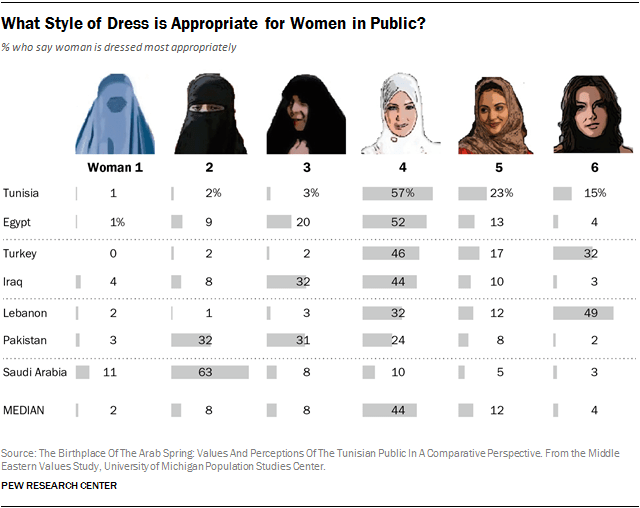
Fisher comments on the above chart showing how people in several Muslim countries think women should dress in public:
The result I found the most interesting is the one not on this chart:
how many people in each country say that women have a right to dress how they want. You might expect that countries where people answer “yes” to this would also be the ones where more people say women should go unveiled. But that’s not quite how it lines up. Saudis are much more supportive of this freedom for women than are Egyptians and Iraqis, for example, even though Saudis tend to approve of much more conservative clothing. Here’s how many poll respondents in each country said women should have a right to dress as they wish:
That last result should be a reminder for us that, even though we often equate the two in the West, a preference for veiling is not always the same thing as a belief that women shouldn’t have the right to choose their own clothing. Piety and feminism are not necessarily mutually exclusive forces. Still, it’s too bad that, even in the countries most supportive of this very basic freedom, only about half support it.
Jon Marcus notices that less than half of federal work-study funds actually go to students in need:
[R]esearchers at the Community College Research Center at Teachers College, Columbia University, have found that only 43 percent of students who receive work study meet the federal definition of financial need as determined by whether they also receive Pell Grants. Work study “disproportionately benefits the students who need it the least,” says Rory O’Sullivan, research and policy director at the youth advocacy organization Young Invincibles. A major source of the problem stems from the fact that the work-study program uses a fifty-year-old formula to determine how federal funds are allocated. Unlike other federal financial aid programs that distribute money according to how many students at a university actually need aid, money for the work-study program is based instead on how much a university received the previous year, and how much it charges for tuition. That perpetuates a system under which the universities that get the lion’s share of federal dollars are not the ones with the most low-income students but, rather, those that have been participating in work study the longest and charge the highest tuition. Consequently, nearly half of work-study recipients attend private, nonprofit universities and colleges.
How to fix the problem:
Reformers say the first step would be changing the formula so that work-study funds flow to schools based on how many low-income students they enroll, not how much money they got last year. The second would be allocating more funds, especially for students nearing graduation, to career-focused paid internships off-campus—positions that frequently lead to offers of full-time employment. The third step would be expanding the size of the overall work-study program, perhaps by asking companies that would benefit from more paid internships to underwrite part of the cost.
Rebecca Rosen highlights a study (pdf) of how one Facebook meme replicated and evolved over the course of two years:
Sometime around early September of 2009, someone decided to show their support for President Obama’s healthcare bill with a Facebook status. It read, roughly:
No one should die because they cannot afford health care and no one should go broke because they get sick. If you agree please post this as your status for the rest of the day.
And more than 470,000 people agreed verbatim. That’s how many people copied and pasted this precise formulation and reshared it. But while copy-and-paste is good enough for some, many people out there changed it. Over the next two years, the “no one should” meme, as Facebook data scientists refer to it in a new paper, would be posted 1.14 million times in more than 120,000 variants. …
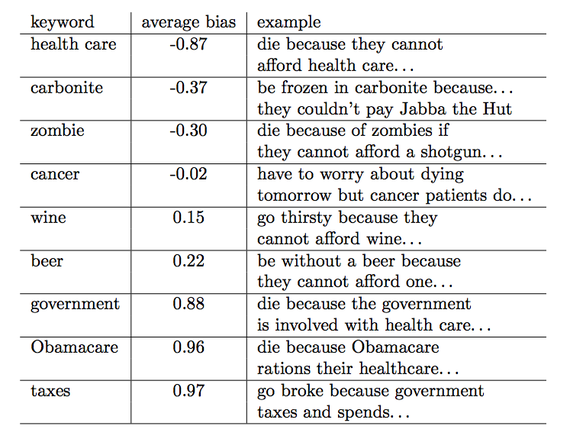
Not surprisingly, the researchers found that the popularity of the assorted “no one should” mutations varied across the political spectrum. Though the meme began as a show of support for President Obama’s health-care plan—a position favored by liberals—conservatives had their fun with it too, sharing status such as “no one should die because Obamacare rations their healthcare” or “no one should go broke because government taxes and spends.” Also popular among conservatives? Alcohol.
(Chart: Average political bias associated with various mutations of the meme. -2 = very liberal; +2 = very conservative; based on user-reported political affiliations in their Facebook profiles.)
Michael J. Totten touts the resignation of Tunisian prime minister Ali Larayedh as further evidence of the country’s progress:
Tunisia’s Islamist prime minister resigned [yesterday] and ceded power to a caretaker government. He was not overthrown by guerrillas or by the army, but by peaceful and legal means familiar to citizens raised in democracies. Tunisia is still the model for post-revolutionary politics in the Arab world. I expected as much at the outset and explained why three years ago. Morocco is the only Arab country in the entire world as politically mature. Egypt is an emergency room case, Libya could turn into a failed state if it’s not careful, and Syria is suffering near-apocalypse. Iraq is…well, it’s Iraq.
Noah Rayman is more cautious, pointing to the challenges ahead:
Under the plan, the Islamist-led government will relinquish power to a cabinet of technocrats ahead of a new round of elections. … But a government of technocrats is no panacea for a country at a crossroads. In one of his last moves before announcing his resignation, Larayedh suspended a new tax hike on vehicles after two days of protests in several cities that stirred clashes with police, the latest in a series of demonstrations fueled by the poor economy. More than 15 percent of Tunisians are unemployed, and that figure is even higher in the country’s interior — including the city of Sidi Bouzi, where a disgruntled street vendor set himself on fire in Dec. 2010 and instigated the initial wave of protests that sparked the Arab Spring. International lenders are all the while demanding more cuts to the government budget, which reached nearly 7 percent of GDP last year, according to Reuters.
Tunisian authorities are also combating extremist Islamists who have gained a foothold in the country since the end of the police state under Ben Ali. The military is battling militants in the remote mountains along the Algeria border, and the government has linked the Islamist group Ansar al-Sharia – which the U.S. designated a terrorist group Friday – to a rare suicide bombing in the resort town of Sousse and to two political assassinations in the past year that shook the nation. To make matters more difficult, the technocratic interim government will not have the electoral mandate to tackle Tunisia’s most pressing issues. That means that while Tunisia’s secular opposition will welcome the demise of Ennahdha rule, the country may have to hold out for new elections, still months down the line, before it sees the reforms it badly needs.
The real money in technology lies in creating entirely new classes of products, forging new markets, and making people realize they have been missing certain things in their lives. But it’s not clear that wearable technology can be that thing. Sure, the young market could blow to become the next smartphone—a mass industry that creates its own economic ecosystem. Or it could be develop into a series of niche products that add up to a bunch of good businesses and a bunch of failed ones. Or it could be a fad that will fade like the Macarena.
My money’s on the second option. Consider the smartphone.
Sure, skeptics abounded that the expensive iPhone and its imitators would become the new standard. But smartphones represented important innovations to a series of mass behaviors. Before the iPhone came along, people were carrying music around, making phone calls and taking photos, sending email, playing games, and accessing information and services on the internet with hand-held devices. Hundreds of millions of people were accustomed to toting these objects around, plugging them in to recharge them, and using them. Smartphones were just a much better, more convenient, all-in-one version of a bunch of popular devices. Switching to smartphones didn’t require a big change in consumer behavior.
But wearable technology promoters are asking much more of their customers. They are asking them to develop new habits very quickly, and to stick with them. The idea behind many wearable tech products is not simply to sell the hardware, but also to sell services like, say, diet and exercise advice to go along with your Up band. But that requires people to incorporate these gadgets into their daily lives in a way that they haven’t before.
Marcus Wohlsen argues that work, not leisure, is where these devices will make a lasting impact:
Take Eyes-On, the smart glasses Epson made with Evena Medical [featured in the above video]. Designed especially for nurses, the Android-based system lets the wearer, in effect, see through the skin of patients to get a precise real-time map of their veins. Health care workers no longer have to guess where to stick the needle when they set an IV or draw blood.
“It comes down to being relevant by vertical, by job function,” [analyst J.P.] Gownder says, noting Eyes-On is “definitely not” a consumer device. As soon as businesses find a specific way wearables can enhance the work they do, he explains, they will rush to adopt such devices.
Those uses aren’t limited to things so serious as medical care. Gownder gives the example of the cable guy who comes to fix a faulty connection. If a technician can’t figure out the problem, he or she typically has to come back for a second visit. With Looxcie’s Vidcie head-mounted camera, the technician can send live streaming video of the problem to other technicians and get real-time advice on how to fix it. Suddenly, two annoying days spent waiting for the cable guy have been cut to one.
The age of the dinosaurs was dramatically warmer than this is right now and it didn’t cook the planet. In fact, life was fine.
Ben Adler gets a response from climate scientist Ralph Keeling:
Climate change is not about survival of life; it’s about survival of civilization. Sure, the planet has been warmer than anything we’re probably going to bring about, but that doesn’t mean it’s good.
It has to do with adaptation to a world that’s extremely different than the world today or anything civilization has experienced. [Gingrich] has misrepresented the threat. It’s not that the Earth is going to go up in smoke, or melt down. Life will survive and humans will probably survive. The question is whether the pillars of our civilization will survive: the ability to grow food, the ability to live in peace with your neighbors. If you neighbors can’t live on their land any more because the climate is intolerable, you have a problem. He’s assuming that the transition to a warmer world is harmless and it’s just like picking a flavor of ice cream in a store. You have to live with the transition.
And to my mind, there’s an obvious difference. Humans created this situation. We are devastating countless other species and precious ecologies. And we have absolutely no right to. Our duty is to pass on the planet to the next generation in as livable and beautiful a state as we inherited. Speaking as Gingrich did is to defend vandalism, not conservatism.
Update from a reader:
To be fair to Gingrich, Van Jones’ “cook the planet” was implying runaway climate change wiping out life, and it is an argument that exists out there. It is kind of important to know that we’re unlikely to hit some sort of geological tipping point that destroys life on earth with global warming; the fact that CO2 levels were much higher in the past is relevant to that; the experiment has actually been performed before. Climate change will still be catastrophic, but it is worth making the point that we aren’t going to become Venus here.