Fox News outdoes itself.
Utah’s Civil Marriages Survive
It’s not yet clear exactly what the legal fate of the more than a thousand civil gay marriages will be in Utah. But the feds are recognizing them. The Obama administration is becoming the most aggressive defender of civil rights in America since LBJ.
Malkin Award Nominee
“You beat Mitch McConnell, you will find many Republican squishes with squishy soiled underwear. Until you beat Mitch McConnell, these guys in Washington will neither respect you nor fear you,” – Erick Erickson.
The New Egyptian Police State
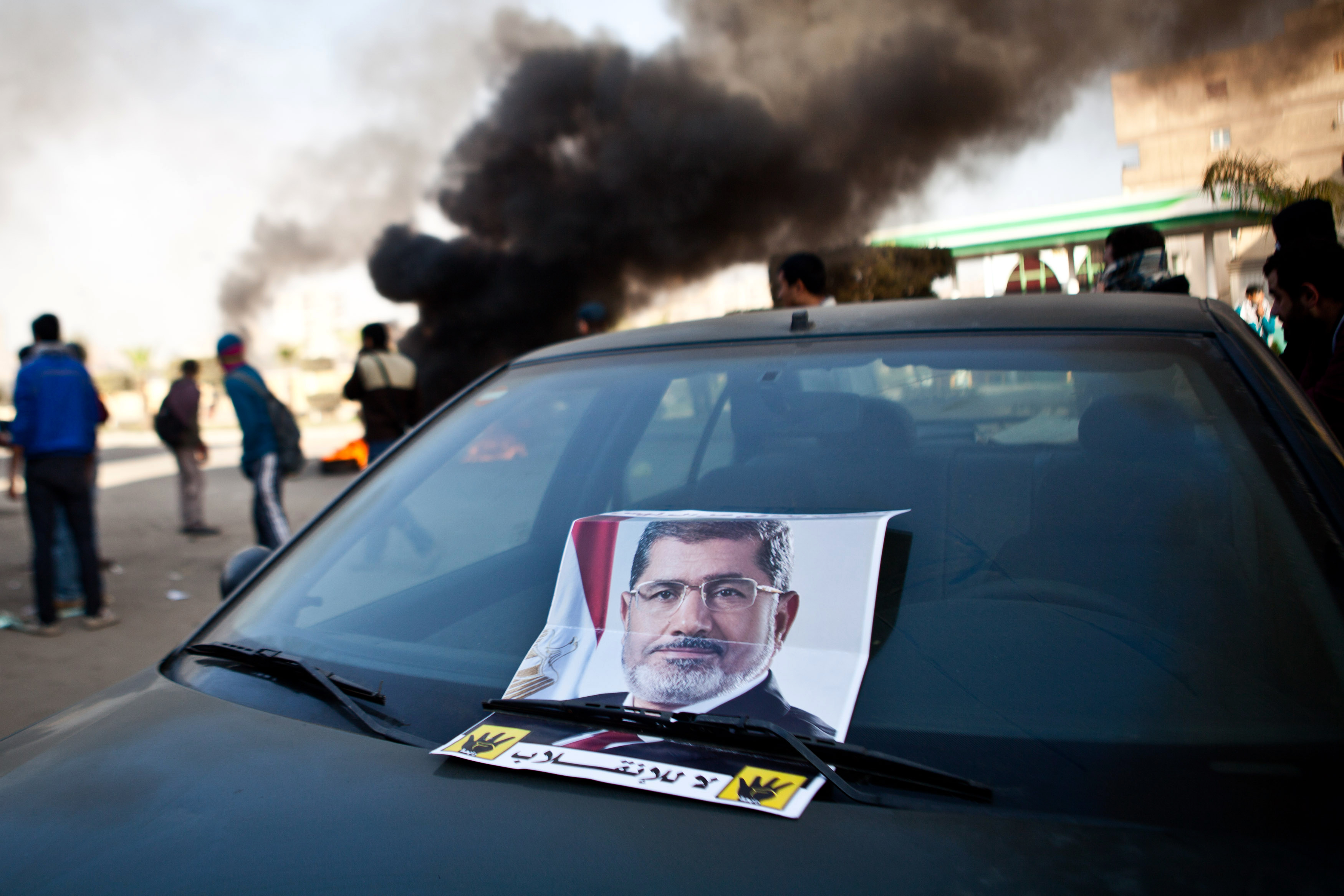
Lynch shakes his head at Egypt’s growing collection of political prisoners:
Egypt’s security services were able to tap into well-cultivated mistrust of the Muslim Brotherhood at home and abroad to justify its initial crackdown. But the intense animosity between the Brotherhood and many activists shouldn’t mask the reality that the campaign against the “terrorist” Muslim Brotherhood and the campaign against other political activists and independent voices are manifestations of the same political project. Both aim at crushing the culture of protest which overthrew former President Hosni Mubarak and restoring the “normality” of a carefully managed authoritarian regime. The arrests and public defamation campaigns aimed at restoring the fear and disengagement which has always been so vital to maintaining authoritarian regimes. The architects of the coup hoped to rebuild that barrier of fear which had been so famously shattered by the January 25 uprising.
He worries about where things are heading:
Right now, Egypt’s roadmap leads not towards anything resembling democracy or even stability but towards greater repression, escalating insurgency, and continuing political failure. Egypt’s current leadership may dream of becoming a something like a big United Arab Emirates, devoid of Muslim Brothers, street protests, or democratic politics. Instead, it is turning Egypt into a new Bahrain: dependent on Saudi Arabia, controlled by unaccountable security services, riven by increasingly irreconcilable polarization, and with political opponents branded as a vast international conspiracy of terrorists. Meanwhile, the military government seems to think that its problems are best met with public relations campaigns rather than genuine political engagement. Can a highly publicized visit by Kim Kardashian ogling the Pyramids be far behind?
Meanwhile, Mohammad Fadel thinks Egyptian liberals will ultimately regret calling in the military to oust the Muslim Brotherhood:
Responsibility for the revolution’s failure lies primarily with Egypt’s non-Islamist opposition. By appealing to the military to remove the country’s first elected parliament and to exclude the Muslim Brotherhood from political life, instead of organizing to defeat it in peaceful elections, they have sent two profoundly anti-democratic messages to the Egyptian people. First, that only the military is capable of solving Egyptians’ political differences. Second, that the Egyptian people cannot be trusted to elect responsible political leadership. Both of these messages, even more than Islamists’ attempts to impose limitations on rights and freedoms in the name of religion, represent a categorical repudiation of democracy’s fundamental premise: that people are capable of governing themselves, not perfectly, but adequately, and that the people, over time, manage their public life better than any authoritarian institution—military, civil, or religious. Rather than a celebration of democracy, the third anniversary of the January 25 Revolution will be a day for somber reflection.
(Photo: A poster of ousted president Mohamed Morsi is seen on the windsheild of a car during clashes between his supporters and security forces in Nasr City, Cairo on January 8, 2014. An Egyptian court adjourned the murder trial of deposed president Morsi to February 1, citing ‘weather conditions’ that prevented his transport to court from prison. By Virginie Nguyen Hoang/AFP/Getty Images)
We Can Afford To Help The Unemployed
The deficit continues to fall:
The Congressional Budget Office this week published its estimates for the finances for the first three months of the fiscal year. Looking at what we know about the first two months, it looks like the government actually ran a $44 billion surplus for December. As a result, according to CBO, the estimated deficit for the first three months of fiscal 2014 was $182 billion—that would represent at 38 percent decline from $292 billion in the first three months of fiscal 2013.
Think about that. Through the first 13 weeks of the current fiscal year, the deficit has declined by $110 billion—or about $8.5 billion per week. The $6.4 billion needed to extend unemployment benefits represents about five days of deficit reduction.
The View From Your Window

Frisco, Colorado, 11.23 am. Update from the reader, who provides a photo of the same scene taken just now:

How Truthful Was Christie?
John Dickerson looks at the pickle the governor has put himself in:
The hope with this kind of press conference is that by showing that you have nothing to hide, you rebuild credibility. But as you let it all hang out, you also build a Jenga tower—an impressive structure that raises the stakes. Christie made a lot of promises Thursday afternoon: He didn’t know about the episode; he had been lied to; the bullying wasn’t indicative of his administration; he was simply a longtime acquaintance of David Wildstein, the Port Authority official who took part in the closure, not a childhood friend; he didn’t condone a culture of retribution; he didn’t know the exact details of the supposed traffic study that was used as cover for the lane closures. If one of those turns out not to be true, then the entire structure comes crashing down.
Cassidy makes a similar argument:
In apologizing and taking responsibility for what emerged from his office, he did what had to be done. But in simultaneously putting the blame on a single staffer and saying he had no involvement whatsoever, he staked his career on the belief, hope, desperate gamble—call it what you want—that no new information will emerge to challenge his version of events. If Kelly, or anybody else, contradicts Christie and provides evidence to back up his or her story, the governor is toast.
Beutler’s take:
My gut tells me it’s unlikely that Christie was genuinely unaware of and uninvolved, either in this specific lane closure or other scandalous acts of political retribution.
Remember, the breezy nature of the comically damning email exchange between his allies — “Time for a traffic problem in Fort Lee,” “Got it” — suggests this wasn’t a one-off kind of tactic. And when you look past Christie’s affect, and at the actual words he said during his press conference, you encounter a bunch of oddities and inconsistencies.
At the same time, Christie’s meta-handling of this whole thing — mocking the reporter who first asked about his involvement, brutally trammeling his advisers who are now free to dish, the abject apology and denial, the willingness to endure a nearly two-hour grilling — bespeaks either a real confidence in his innocence, severe denial or a pathological confidence that he can still get away with it.
David Graham imagines the best-case scenario:
If Christie is telling the truth—it’s hard to imagine he’d lie brazenly and publicly with a U.S. attorney and the state legislature breathing down his neck—he keeps his credibility. But what about his competence? How is it possible that one of his closest aides was running a rogue political vendetta out of his office, without the knowledge of the governor or any of his other top aides? That raises serious questions about Christie’s reputation as an effective, hands-on manager. How would such an executive function atop the federal government if he can’t even handle Trenton?
Tomasky has questions:
What was redacted (or can we just say censored?) from those emails and texts? Was this really “the exception, not the rule” in how the Christie administration tries to enforce political loyalty? We’ll presumably find out answers to these questions.
And if even Christie is telling the truth, that Wednesday was the first time he’d heard that the lane closures were a political act, all that means is that he went out of his way to make sure he didn’t hear it, which in turn means there was a grotesque abuse of political power that happened right under his nose and that he not only didn’t try to get to the bottom of, but tried to sweat it out until January 15. That’s some definition of leadership.
The Worst Jobs Report In Years

It’s ugly:
The new report from Bureau of Labor Statistics shows the U.S. economy added only 74,000 jobs in December, far below economists’ expectations. The unemployment rate dropped to 6.7% – its lowest point since October 2008 – but that appears largely to be the result of people dropping out of the workforce.
Drum created the above chart, which shows net job growth:
The American economy added 74,000 new jobs in December, but about 90,000 of those jobs were needed just to keep up with population growth, so net job growth clocked in at minus 16,000. There’s no way to sugar coat this: it’s pretty dismal news.
Matt Phillips suspects it was a fluke:
[S]omething doesn’t smell right about this report. For one thing, it jibes with hardly any of the other data we’ve been getting about the US labor market lately. … US stock futures are still in positive territory. And while there has been a bit of money flowing into US Treasurys, it’s not as if there’s a huge rush to safety driven by deep concerns about the economy. The market believes that this is a blip that’s better ignored. And for once, we’re going to say the market is right.
Felix Salmon blames the weather:
Once you take into account the weather … the December report wasn’t that bad.
A whopping 273,000 people were counted as “Employed – Nonagriculture industries, Bad weather, With a job not at work”, which is to say that they did not get counted in the payrolls figures even though they’re employed. Most of the time, that number is in the 25,000 to 50,000 range, and although it always spikes in the winter, this was the worst December for weather-related absence from work since 1977.
Greg Ip focuses on the bigger picture:
The more fundamental reason to worry is the ostensibly good news that unemployment had fallen to its lowest since late 2008. This was not principally due to the rise in employment but the fact that the number of people in the labour force (i.e. either working, or looking for work), tumbled 347,000 – even as the population grew 178,000. As a result, the labour force participation rate plunged to 62.8%, tying November’s figure for the lowest since 1978. The number of people who are not in the labour force but want a job – so called discouraged workers – jumped 332,000.
This is not a fluke. The labour force participation rate has been trending lower since before the recession. This remains by far the most vexing puzzle of the labour market.
Neil Irwin weighs in:
[T]he usual caveats around the jobs numbers — it is one month’s number, with a big range of error around it –apply more than usual in this one. Still, one doesn’t envy the policymakers who have to decide what to do based on this shaky data. The Federal Reserve’s policy committee meets at the end of the month and will have to decide whether to continue “tapering” their bond-buying program.
Kevin Roose adds:
The numbers are almost certainly going to be revised next month. But the initial signal is that we’ve been too hasty in calling this a healthy economy. The labor force participation rate fell by .8 percent, meaning that more people stopped looking for work altogether. And several key industries — construction and health care among them — lost jobs for the first time in months…. today’s report is a sign that we’re still dealing with a fragile economy, made more fragile on the policy side by threats of extending sequestration and letting unemployment insurance lapse.
Is The Christie Scandal Criminal?
TPM asks around:
Interfering with peoples’ ability to drive between states by closing lanes on the George Washington Bridge between New York and New Jersey might be a crime on its own. Law professors at two different schools pointed TPM to federal civil right laws, in particular Section 241 of Title 18 of the U.S. Code, which begins:
If two or more persons conspire to injure, oppress, threaten, or intimidate any person in any State, Territory, Commonwealth, Possession, or District in the free exercise or enjoyment of any right or privilege secured to him by the Constitution or laws of the United States, or because of his having so exercised the same …
According to Supreme Court precedent, your right to interstate travel is protected under the above statute, said Frank Askin, a professor at Rutgers University School of Law. Federal civil rights statutes also treat the use of federal interstate highways as a protected activity.
In the bridge scandal, the now-infamous “Time for some traffic problems in Fort Lee” email sent from a Christie aide in the governor’s office to a Christie ally at the Port Authority could arguably establish a conspiracy, said Burt Neuborne, a professor at New York University School of Law. Neuborne portrayed a charge based on these statutes as close to a slam dunk.
“The real question is more a prosecutorial discretion,” he said. “Is this low-level harassing kind of activity such a terrible thing? You have to decide whether you want to unload the heavy artillery.”
Brain-Dead And Pregnant
Texas prohibits removing a pregnant woman from life support regardless of the family’s wishes. This week on AC360 Later, I weighed in on the case of Marlise Munoz, who was 14 weeks pregnant when she became brain-dead:
Amanda Marcotte draws a different conclusion:
Marlise Munoz and her husband are just the latest victims caught in the crossfire of abortion politics. Mandating that pregnant women stay on life support regardless of their wishes is a neat and easy way to establish the claim that the state has an interest in fetal life, even at the earliest stages, that overrides a pregnant woman’s basic human rights. After all, brain death during pregnancy is incredibly rare, making these laws more symbolic in nature than pragmatic. If your goal is to legally enshrine the notion that pregnant women are incubators first and humans second, keeping their bodies alive to grow babies long after their minds are gone is a perfect way to do it.
Of course, rare doesn’t mean impossible, as Marlise Munoz’s family is discovering. “All we want is to let her rest, to let her go to sleep,” Munoz’s father, Ernest Machado, told the Dallas Morning News. “What they’re doing serves no purpose.” The family reasonably fears that the loss of oxygen that was enough to destroy Marlise Munoz’s brain probably did serious damage to her fetus. To make it worse, by going public with their story, Munoz’s family is being treated to a heavy dose of vicious anti-choice rhetoric.
Mary Elizabeth Williams feels that the family is being denied their right to grieve:
Munoz’s husband and parents are trying to come to terms with the fact that she’s gone and she’s not returning. That’s a grief that should be respected. That’s a devastating loss for any family, one that’s being viciously prolonged by a state that’s been petulantly dragging it through weeks of torment. Of course Munoz’s family never wanted to lose her or the child they were hoping to welcome in the spring. But true humanity means accepting loss. It means mourning it, not using a dead woman and her fetus as some insane experiment. “It’s not a matter of pro-choice and pro-life,” Munoz’s mother says. “It’s about a matter of our daughter’s wishes not being honored by the state of Texas.”
Tara Culp-Ressler elaborates on the law:
According to a 2012 report from the Center for Women Policy Studies, Texas is one of 12 states that automatically invalidate women’s end-of-life wishes if she is pregnant. Those state laws ensure that “regardless of the progression of the pregnancy, a woman must remain on life-sustaining treatment until she gives birth.” The hospital that is providing care to Munoz has declined to confirm that she’s been pronounced brain dead, saying only that she’s “pregnant and in serious condition” and their employees are fulfilling their legal obligations. “This is not a difficult decision for us. We are following the law,” a spokesperson told the Associated Press.

