Talking Heads For Prohibition

Scarborough repeats tired, intellectually lazy arguments against the legalization of marijuana:

You’ll notice a few things about this inane discussion. There is close to zero informed understanding of marijuana, its physical and psychological effects. You don’t find discussions about how marijuana hurts the adult mind or how it’s as addictive and socially disruptive as alcohol (because those arguments disintegrate as soon as you try to substantiate them). There is a completely anecdotal premise that a drug used by the last three presidents – and countless truly creative and accomplished people – simply makes everyone “dumb.” You’ll notice above that the entire smug boomer crew on Scarborough’s show has no real response to the point that alcohol can also make you dumb (and violent and out-of-control). They dismiss that scenario if you drink alcohol in moderation. So why not pot in moderation? But my point is this: they haven’t even gotten past that basic stage of the debate because they haven’t spent more than a few seconds mulling it over. To wit:

That should be “our being a fatter, dumber, sleepier …” But I guess a little weed is what’s going to kill off grammar.

Almost all the anecdotes, moreover, are from the distant past and are about white, teenage or college use (something legalizers are keen to discourage). Little data are presented; no specific social harms are identified. In other words: cable news. The other thing I notice is something I saw very early on when a whole bunch of pundits realized they had to say something to oppose gay marriage. These people simply don’t know a lot about the subject, do not regard it as serious enough to be better informed, and offer arguments that are so weak or irrelevant to the central question that they are setting themselves up for total failure in this debate. I give you Ruth Marcus:

Please do not argue that Colorado’s law, like those proposed elsewhere, bans sales to those under 21. Ha! I have teenage children. The laws against underage drinking represent more challenge to overcome than barrier to access. And although alcohol seems to be the teen drug of choice among the adolescents I know, the more widely available marijuana becomes, the more minors will use it. If seniors in fraternities can legally buy pot, more freshmen and sophomores will be smoking more of it.

This would make sense if not for one fact: teens have said for years that marijuana is currently easier to get than alcohol. Prohibition has made it so. All of which is a warm-up for David Brooks’ column today, reminiscing about his former pot-smoking and adding a moral disapproval to pot he would never assign to alcohol:

Laws profoundly mold culture, so what sort of community do we want our laws to nurture? What sort of individuals and behaviors do our governments want to encourage? I’d say that in healthy societies government wants to subtly tip the scale to favor temperate, prudent, self-governing citizenship. In those societies, government subtly encourages the highest pleasures, like enjoying the arts or being in nature, and discourages lesser pleasures, like being stoned.

In legalizing weed, citizens of Colorado are, indeed, enhancing individual freedom. But they are also nurturing a moral ecology in which it is a bit harder to be the sort of person most of us want to be.

But what if pot enhances the higher pleasures – like listening to or making music, or appreciating fine wine or great food? And why doesn’t alcohol fit squarely into the same category? Millions of grown adults (not giggly teens) use the drug the way others use alcohol – with far less socially damaging or physically dangerous effect. What David doesn’t do either is address the real issue at hand: the social costs of prohibition versus the social costs of legalization. On that note, Matt Welch fires back at Brooks:

“Healthy societies” don’t throw millions of people into human meat lockers to satisfy the moral urges of social engineers. It is “a bit harder to be the sort of person most of us want to be” after you go to jail for engaging in the same recreational activity as a teenage David Brooks. The “moral ecology” got a whole better on Jan. 1, and will get better still when people stop using the criminal code as a laboratory experiment on their fellow human beings.

Gary Greenberg, who’s the full-on stoner whose life was apparently ruined in Brooks’ column, joins the conversation [Update: Greenberg clarifies: “What follows here is satire of the Juvenalian variety. I thought I embedded enough tipoffs, but then again I forgot how much stranger than fiction truth can be. So to those who thought it was real and suffered pain as a result, I apologize.] Tom Chivers calls Brooks’ column “startlingly smug, patronising and complacent”:

[W]hat I will say is this: notice that, in David Brooks’s youthful experimentation, his “been there, done that” memoirs, in which no real harm is done to him by this relatively safe drug, there is not a section in which he is arrested, imprisoned for possession, given a criminal record and barred from several professions later in life. And in fact most of these “I took drugs in my youth, but it was a youthful indiscretion, and I regret it, so we shouldn’t legalise them” memoirs are all similar in a noticeable way: they’re written by successful people whose lives weren’t ruined by a criminal prosecution. That’s the “subtle tip of the scale”, that’s the way the government apparently “encourages the highest pleasures”: by locking up people and destroying their future lives.

Matt Lewis adds:

Brooks’ column only serves to prove that many kids will quit on their own, and — in any event — the experience won’t stop them from going on to be highly successful pundits. In fact, the only way his marijuana use might have hurt Brooks (and possibly ruined his life) would have been if he had been arrested. And that danger is now almost completely out the window in Colorado. And so, we are left with a very well-written and thought-provoking column that ultimately fails to make a coherent argument.

Nicole Flatrow also focuses on arrests:

If you’re black in America, you’re four times more likely to be arrested for marijuana, even though all races use marijuana at the same rate. In some states, the disparity is as high as 8 to 1. The overwhelming majority of these arrests are for possession. If you’re poor and black, or if you live in a particular inner city neighborhood, your arrest is a near certainty.

Lastly, a lone Brooks defender: Dreher wishes legalization supporters would treat Brooks, and those like him, more civilly:

I hate the way many liberals and libertarians are so zealous about the issue, in a way that shuts down deliberation. Somebody on my Twitter feed today said that pot legalization is for the left what guns are for the right: the issue on which there can be no legitimate dissenting position.

I sure hope I’ve treated David’s arguments, such as they are, civilly. Ditto my friend David Frum’s. I know they are well-intentioned, and the idea that there can be no cost to ending prohibition is silly. The real argument is that the benefits of legalization far outweigh the costs – an argument David simply doesn’t address. I wish he would. I also wish that every pundit who writes about their youthful folly would do us a favor and research the current state of marijuana use and production, examine the far more sophisticated mixtures of CBD and THC, of sativa and indica, that this amazing plant is now grown to produce, and would acknowledge the medical uses of pot, which research is beginning to show are bewilderingly manifold. I wish they would not insult so many of their fellow adults and fellow citizens by arguing that their pleasure of choice is simply a way to be “dumb.” Calling those who disagree with you dumb is not that civil.
Behind The Curve On Drunk Driving

road_safety_012

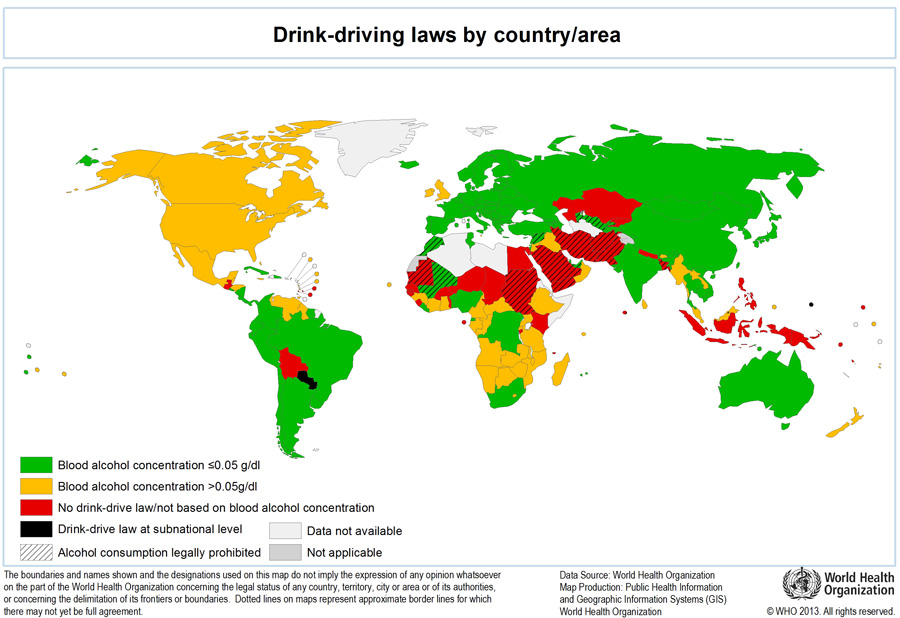
The US has always had a relaxed attitude toward it:

In his 2011 book One For The Road, Barron Lerner explains that Norway’s [blood alcohol content] limit was 0.05 percent by 1936, while Sweden’s was 0.08 percent by 1941. But Americans were much more lenient when it came to drunk driving. Even as late as the 1960s, American courts in many states saw anything less than 0.15 percent as probably not worthy of prosecution, still adhering to guidelines set up in 1939 by the National Safety Council and the American Medical Association. … Fascinatingly, the justice system was especially lenient in part because of the many recent failures of alcohol prohibition in the US during the 1920s. Even organizations like the AMA and the NSC thought it best not to be too harsh on people who drove drunk. Lerner notes in One For The Road:

Well aware of the recently concluded and highly criticized Prohibition experiment, [AMA and NSC] committee members erred far on the side of leniency when it came to the apprehension and prosecution of impaired and drunk drivers. As Stanford University neurologist and alcoholism expert Henry W. Newman later explained, “We would not like to see a parallel to prohibition occur here, with the subsequent revulsion of feeling and the license that followed after prohibition which still prevails to a certain extent at the present time.”

Today, the federal limit in the US is 0.08 percent. That’s much more in line with other countries, but still more liberal than most.

(Map by the World Health Organization)

Obamacare Is A Mixed Bag

Cohn lists five rules for talking about Obamacare. Number four:

The Affordable Care Act’s critics say premiums for people buying coverage on their own will actually increase. That’s true. The law’s defenders say tax credits offset the cost for many and probably most of those people. That’s also true. The law’s critics say some people will lose coverage from employers and won’t be happy about it. That’s true. The law’s defenders say most of those people will be better off, because they’ll be low-wage earners getting subsidies on the exchanges or they’ll be older workers who had stayed working because, previously, it was their only way to get benefits. That’s also true.

You may notice a theme here.

Obamacare sets in motion all kinds of changes. They will typically affect different people in different ways—creating winners, losers, and all sorts of people in between. Are there more winners than losers? How much worse off are the losers? Those are the kinds of questions we need to answer if we want to make a judgment about the law. And the answers are rarely simple.

Jonathan Gruber recommends withholding judgement:

Although many have made bold claims about how this law will impact coverage by private and public insurance, we simply won’t know until we see the data from our major household surveys of insurance coverage, available in the fall of 2014. Ultimately, the projections of the Congressional Budget Office suggest that the ACA will not be fully implemented for three years, the amount of time it took to ramp up to full implementation in Massachusetts. So we won’t be able to draw final and firm conclusions until late in 2016.

Amnesty for Snowden?

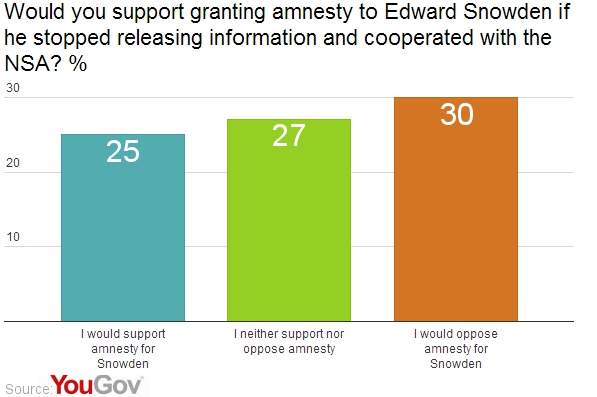
The public is divided on the issue:

snowden3

A NYT editorial proposing leniency, if not clemency, for Edward Snowden has set off a chorus of support and condemnation throughout the blogosphere. Shafer points out that the Grey Lady’s editors are not the first to float this balloon:

You could ridicule the Times editorial for wild, wishful thinking had Rick Ledgett, a top NSA official in charge of the Snowden damage-assessment task force, not also entertained the idea of amnesty on 60 Minutes three weeks ago. “It’s worth having a conversation about,” said Ledgett, who is expected to be the agency’s next No. 2 official. “I would need assurances that the remainder of the data could be secured and my bar for those assurances would be very high.” Ledgett insisted his statement represented a “personal view” — as if top NSA officials expecting promotions are allowed to share their “personal views” about national security on national TV. Was he expressing the agency’s powerlessness to contain future leaks of the 1.7 million documents Snowden’s now believed to have stolen, and trial ballooning the possibility of a deal, or was he gaming Snowden, as I conjectured at the time?

Ed Morrissey argues that the editorial presents “a false binary choice” and that Snowden had other options for exposing the NSA, such as presenting evidence to members of Congress:

Senators Ron Wyden and Rand Paul were well-known opponents of domestic surveillance; why not go to them, or anyone else first before taking the cache elsewhere, especially to China and then Russia? The fact that the Times’ editors never even address that channel shows how weak their argument is — which is why they don’t really try to make the amnesty argument in the end.

There is one argument for offering amnesty, which is to secure what’s left unexposed of the cache.

If it can be established that the cache is secure and no one else has the data, it might be worth a trade in purely practical terms. It’s difficult to see how that could be established, though, especially with Snowden’s travels taking him through two of the less-friendly states to American security concerns. Otherwise, a deal would suggest to people still within secured-data environments that stealing a little data is dangerous, but stealing massive amounts of it might be their ticket to fame and fortune. It’s a bad precedent to set, and we’d be better off spending our time improving our legitimate whistleblowing channels and hardening security.

Max Boot calls Snowden a traitor, not a whistleblower, saying, “the only kind of plea bargain I would like to see offered to Snowden is one that allows him to serve life in a maximum-security prison rather than face the death penalty for his treason”:

Even if you think that the NSA’s collection programs are excessive, it is hard to make the case that sharing the most vital secrets of the U.S. government with the news media–and probably hostile foreign governments in Beijing and Moscow, although the Times doesn’t mention this inconvenient probability–is the way to address the problem. Snowden now claims that he tried to notify a couple of superiors about his concerns; the NSA denies it. Whatever the case, there is no evidence he tried to notify the NSA’s inspector general, the Foreign Intelligence Surveillance Court, or the intelligence committees of Congress. No doubt this is precisely because he knew that all of the activities he disliked were fully authorized by all three branches of government. What we have here is not a case of “whistle-blowing,” as the Times disingenuously claims, but a case of a young, arrogant, headstrong techie with a libertarian bent and a taste for fame who has taken upon himself the responsibility of deciding which intelligence programs the U.S. government may carry out and which it may not. A true whistleblower, like Daniel Ellsberg, stays to face the consequences of his actions–he does not flee to hostile foreign capitals.

Mataconis responds to Boot:

There are at least a few flaws in Boot’s argument. First of all, as the Times notes, there still isn’t any evidence that the surveillance programs that Snowden revealed have een at all helpful in stopping any terrorist cast, or that they could have stopped past terrorism like the 9/11 attacks. Second, while Boot quite apparently does not agree. there are serious questions about whether or not the actions that the N.S.A is engaging in are Constitutional, as Judge Richard Leon has indicated, and without Snowden’s public revelations there would be no Court in nation engaging in a public review of what the agency is doing. Third, as the Times notes, there is at least a plausible argument for why Snowden would not feel safe staying in the United States after the information he had obtained was made public. Finally, while there remain several reasons to distrust Snowden’s judgment, such as his decisions to flea to places like Hong Kong and Russia, there are even more reasons to distrust the government acting in secret in our name and mining vast arrays of data for information whenever they feel justified in doing so. The fact that the American people had no idea that any of this was happening is something that should bother any American, and the response that we can trust the government not to misuse all this data ignores decades of history showing misconduct by the Executive Branch, law enforcement, and Intelligence Agencies.

Conor dismisses the idea that clemency for Snowden would set a precedent for future leakers:

The concepts of pardon and clemency are part our system precisely because there are instances when applying rules we’ve generally decided upon would be unjust and counterproductive. They are meant to be used judiciously, on an ad hoc basis, in what are clearly exceptional circumstances. Snowden’s leak meets those tests. Urging clemency for Snowden is not a radical case against our existing system of rules—it is an acknowledgment that, like all rules, ours are imperfect. One of the finest presidents, George Washington, pardoned farmers who took up arms against the federal government (!) to protest a tax on whiskey. He wouldn’t have granted those pardons had he thought that he was making a radical case against the legitimacy of the U.S. government or setting a precedent for anti-tax insurrections. And it is difficult to argue that any such precedent was set, even at the dawn of the federal republic when norms were still being established. Today, it is even more difficult to imagine that a pardon for Snowden, or one of the lesser forms of forgiveness the Times advocates, would cause other federal employees to imagine that they’d avoid punishment if, say, they made public the identities of American spies abroad or secret codes from the U.S. nuclear program.

An Obamacare Talking Point In Critical Condition

A study released yesterday found that, for those newly insured through Medicaid, access to health insurance doesn’t reduce ER visits:

Advocates for health care expansion reason that the newly insured will seek out health care more often, but will choose a primary-care physician over the ER. One reason the uninsured tend to go to the ER when they do finally seek treatment is that it’s their only option. You need to present an insurance card to get service at most physicians’ offices, whereas the ER is legally bound to attend to any case that comes through the door. Once insured, a patient does have every reason to see a primary-care physician and skip the ER: As every American knows, you don’t go to the ER for a good time. You go there expecting to sit under a glaring fluorescent light on a hard-backed plastic seat for four hours (if you’re lucky), surrounded by a combination of crying babies and hacking coughs. If you’ve got the option of making an appointment at your doctor’s office instead, you take it. But according to the Oregon study, the newly insured still choose the ER over the doctor’s office. What’s more, the increase in ER use documented by the study comes in large part from patients with ailments like cuts and sprains—problems that could have been managed through a primary-care physician or by an urgent care clinic (both of which are covered by Medicaid). Patients aren’t, in fact, substituting primary care for the ER to the extent that many insurance advocates have hoped they would.

Brandy Zadrozny worries that our emergency rooms can’t handle the extra workload:

The Medicaid population is expanding at a time when the general strain on the nation’s emergency care facilities is both growing and used disproportionally by Medicaid patients (They made up a third of emergency room visitors (PDF) in 2010 but make up just 16 percent of the population). And while 38 percent of adult Medicaid patients had at least one emergency department visit in the past year, only 16 percent of the privately insured and 21 percent of the uninsured made similar visits. The visits of Medicaid patients are also more likely to be classified as non-emergencies.

The increase in ER use comes as no surprise to Avik Roy:

[O]ne of the big holes in the myth of uninsured “free riders” is that the uninsured only account for 15 percent of the population, 14 percent of total ER visits, and 12 percent of aggregate ER expenditures, according to a study by the Kaiser Family Foundation. Medicaid beneficiaries, by contrast, accounted for 9 percent of the population, 15 percent of visits, and 9 percent of expenses. Given all of this data and experience, it was obvious that expanding coverage through Obamacare would increase taxpayer costs, not reduce them. But predictably, the pro-Obamacare “fact-checkers,” like those at PolitiFact, have been nowhere to be found.

Suderman thinks this calls into question the efficacy of Medicaid:

These findings ought to spark a rethinking of Medicaid’s value and effectiveness. It’s not enough to provide some positive benefit. It’s also important to ask whether there are other, better, less expensive and resource-intensive ways of achieving the same goal. If Medicaid is to be a financial smoothing program rather than a health-improvement program, then we ought to treat it like one, and make reforms accordingly.

Kliff speaks to a health economist who defends the Medicaid expansion:

[Jonathan] Gruber, the MIT economist, doesn’t see the Harvard study as a compelling case against expanding Medicaid. There are still other benefits to insurance coverage, he says, that aren’t about saving public funding. Separate research on the Oregon expansion, published last spring in the New England Journal of Medicine,  found Medicaid enrollees to have significantly lower rates of depression and were more able to pay their medical bills. “The overall notion is we’re getting people more health care,” Gruber says. “There are huge improvements in mental health. For those who want to argue that expanding Medicaid is a free lunch, this is bad. But that was never the right argument.”

Reihan counters this type of argument:

Imagine if the debate over the Affordable Care Act had unfolded as follows — the president stated that in the interests of improving the mental health of low-income uninsured Americans, but not necessarily improving their health along other dimensions, he hoped to pass a large and expensive Medicaid expansion; to address the needs of the medically uninsurable population, he intended to implement a series of new insurance regulations that would, among other things, prompt the cancelation of large numbers of insurance policies serving the individual and small group insurance markets, with the net result being a reduction in the number of Americans with private insurance coverage, despite new subsidies aimed at low- to moderate-income households; and to finance these new initiatives, he’d restrict the growth of Medicare expenditures and he would raise various new taxes. It’s not obvious to me that this bundle would have struck many voters, including Democratic voters, as attractive.

Harold Pollack weighs in:

The effect size was pretty small—about one extra ED visit per recipient, every 3.5 years or so. In dollar terms, this amounts to an estimated annual expenditure increase of something like $120 per recipient. We can’t say from this paper whether the extra ED visits were valuable or cost-effective. We can say that these results will embarrass some liberal advocates who argued that expanded coverage would reduce overall rates of ED use.

It should. This talking point was never properly evidence-based or even particularly plausible given prior research. It’s not obvious that reducing the rate of ED use is even a sensible policy goal. Advocates across the political spectrum should stop using the ED for cheap talking points about the mythical savings associated with universal coverage or about the misbehavior of Medicaid recipients who supposedly waste huge amounts of money through overuse.

Aaron Carroll argues that more ER visits don’t necessarily constitute a problem:

[U]ntil someone proves to me that the increased ED use was unnecessary, I don’t know why anyone would assume it’s a bad thing. If our goal is to increase people’s access to the health care system, getting more people insurance (like Medicaid) is a good tool for that. If our goal is to help people make more effective use of the healthcare system, increasing coverage isn’t necessarily going to be as good a tool. I’m sure there will be a ton of partisan hay made out of this being another “broken promise”, but I’m not participating in that.

Adrianna McIntyre’s perspective:

Individuals of different socioeconomic statuses have heterogeneous needs, priorities, beliefs, and limitations when it comes to accessing health care—so rational behavior is going to be similarly varied. With expanded coverage, a central challenge on the health policy scene is making the delivery system adapt to meet the needs of a more diverse patient population. That’s something insurance alone can’t do.

Austin Frakt adds:

Ultimately, my view is that “overuse” of the ED reflects the broader problem that the health system is not very responsive to consumer demand or sensitive to all types of consumers. (The disparities literature is relevant here.) In other words, it’s not consumers making “bad” choices, but the system offering poor ones.

Chart Of The Day

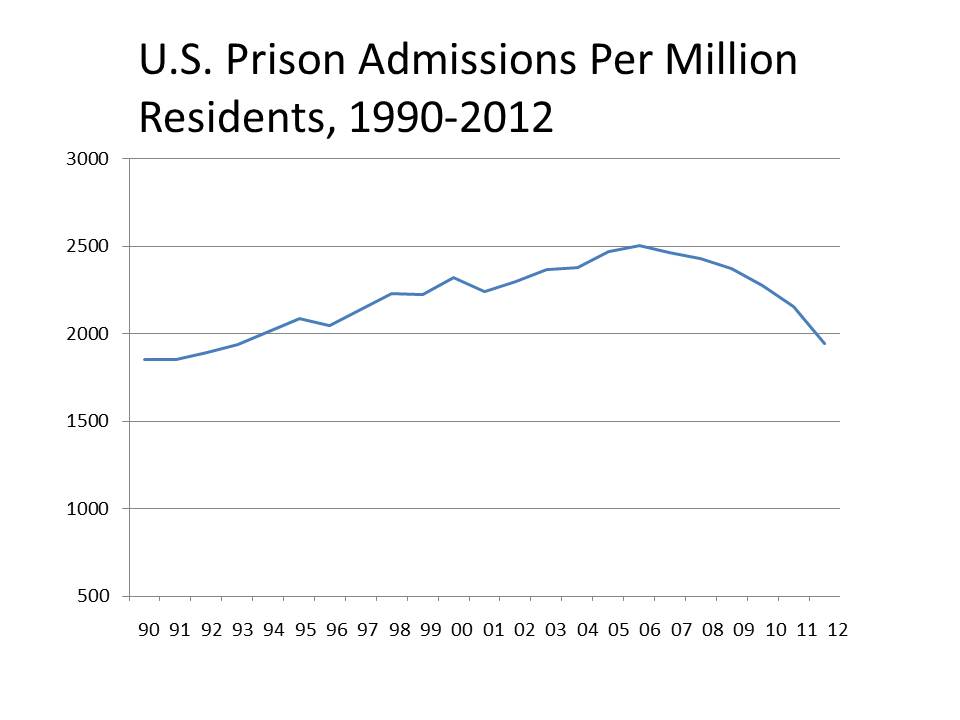
Prison admissions

Prison admissions are down:

When President Obama was elected, the rate of prison admission was just 3% below its 2006 level, which was very probably the highest it has ever been in U.S. history. But by the end of Obama’s first term, it had dropped to a level not seen since President Clinton’s first year in office.

Alex Tabarrok adds:

Drug-related imprisonments are especially down. In 1991, for example, 23% of the prisoner’s sentenced for more than one year were sentenced for drug related reasons (including 8.2% for drug possession). In 2011 only 16.6% of imprisonments for more than one year were for drug-related reasons (including 4.1% for drug possession.) This trend is likely to continue with further drug legalization.

Drum, no surprise, connects the number to lead abatement:

Incarceration rates are way down for men in their teens and 20s, who grew up in the relatively lead-free post-1990 environment. But for older men, who grew up before then, incarceration rates are actually up. Lead did its work on them long ago.


The Digital Doubting Thomas

In a lengthy profile of Evgeny Morozov, Michael Meyer devotes some space to criticism of his contrarian style:

Many of Morozov’s opponents dismiss him as a spoiled child, someone who sits in the corner refusing, as Tim O’Reilly once said, to be “useful,” shouting insults at the adults as they role up their sleeves and solve the world’s problems. Reviewing Morozov’s second book in The Washington Post, Columbia law professor Tim Wu spoke of Morozov’s “promise” as a thinker before lamenting, “One suspects he aspires to be a Bill O’Reilly for intellectuals.” Morozov faces similar criticism even among his supporters. He once defended his style by saying, “We’ve got too many priests and not enough jesters,” an explanation Joshua Cohen, the Stanford professor who brought Morozov to Palo Alto on a fellowship and published some of his earliest long-form work in Boston Review, told me is “bullshit. There’s a vast open field between priests and jesters.”

Morozov insists that his refusal to be useful is its own kind of usefulness—and even, as he recently wrote in one of his essays for German newspapers, an intellectual duty. Traditionally, this is an uncontroversial definition of the role of the critic in intellectual life. But not in the relentlessly sunny realm of the tech gurus, where such obstinance must be baffling, even perverse. The current discourse around digital technology is more nuanced than the caricature Morozov often presents, but its defining idea is that we are living through a benevolent revolution, and that we’re all united by good intentions as we search for new models for our economy and our lives. In this culture of mutual validation, Morozov’s targets are the makers, the innovators, and the disruptors—the people doing, as frequent Morozov punching bag Jeff Jarvis put it, “God’s work.”

Trapped By Trash, Ctd

Did you know the US has a “Space Fence” to keep debris from colliding with spacecraft and satellites? Or at least we had one …

The Space Fence – which, despite its name, consisted of operational facilities on the ground, across the southern United States – [has] been shut down. In more than 50 years of operation, it had played a key role in the Space Surveillance Network, set up by the U.S. military to track man-made debris, and help keep valuable satellites and spaceships from smashing into it.  According to the Air Force Space Command, which ran the network, the shutdown was made necessary by the 2013 budget sequester and will save $14 million per year in operating expenses. But some argue that the shutdown has reduced the capability of an already imperfect surveillance system, potentially increasing the risk of a costly collision. …

To make up for the shutdown, the Air Force Space Command directed two other radars – in North Dakota and Florida – to pick up the slack. However, because these stations are each based in a single location rather than spread out across the country, they cover less of the sky than the Space Fence did. This reduced coverage has led to “a loss when it comes to detecting and characterizing events like breakups,” said [space security expert Brian] Weeden. “You can’t predict when those kind of events are going to happen. It may be that we don’t have any major collisions over the next five years, and therefore it’s not a big deal. It may be that we have a bunch of them, and it’s going to be a really big deal.”

Previous Dish on space junk here and here.

The Guidance Gap

Ann Hulbert questions whether the much-touted flexibility of community college education is doing students a disservice:

If you stop and think about it, the existing postsecondary educational hierarchy could hardly be more perverse. Students at the bottom, whose life histories and social disadvantages make them the most likely to need clear guidance and structure, receive astonishingly little of either. Meanwhile, students at the super-selective top, prodded toward high ambitions and disciplined habits by attentive parents and teachers ever since preschool, encounter solicitous oversight every step of the way.

Take Harvard, where the rising elite chart their paths within well-designed parameters: the college offers a bachelor’s degree in 48 academic fields only to full-time, residential students, who must also fulfill carefully articulated general-education requirements. Their first-year experience unfolds under the supervision of an entire team—a freshman adviser, a resident dean of freshmen, a proctor, and a peer-advising fellow. Residential house tutors and faculty advisers lend support later. Compare that with nearby Bunker Hill Community College, as Judith Scott-Clayton, a professor at Teachers College, Columbia University, has done. Students there choose from upwards of 70 full-time or part-time associate’s-degree or certificate programs, in more than 60 fields, then figure out their ideal course load, and how to best mix online and in-person classes. As to plotting a course of study and then staying on it, community-college students are largely on their own. Student-adviser ratios in the two-year sector are abysmal in many schools: they can run as high as 1,500-to-1. And while spending per student has risen over the past decade at every kind of four-year institution—private, public, research, undergraduate—it has remained all but flat in public community colleges. A surer formula for widening the gap between the haves and the have-nots—at least while still paying lip service to ideals like opportunity and meritocracy—would seem difficult to devise.

Mangling A Myth, Ctd

Readers continue to sound off on Peter Jackson’s The Desolation Of Smaug:

Charm is an essential secret to The Hobbit, and to some extent The Lord of the Rings. Tolkien’s myth depends on the response of ordinary creatures to horrific threats against their comfortable lives. The hobbits prove uncommonly strong and resistant to harm because they carry the warmth of their home inside them, and they repeatedly summon its charms in the darkest times, while facing the most dangerous foes. Surely Tolkien understood deeply the importance of such inner resources from his experiences as a soldier in the trenches of World War I.

Jackson’s Lord of the Rings conveys the very English charm of the Shire and its inhabitants beautifully and consistently. It helps that Jackson’s own love of his New Zealand home continually comes across in those movies. In contrast, the first Hobbit movie unsuccessfully tries to pack most of its charm into the first dorky meal with the dwarves, and the second film is practically bereft of charm. I could forgive all of Peter Jackson’s additions and vanity if it weren’t for this. In trying to fashion a more epic Hobbit, he lost the basic warmth at the heart of Tolkien’s work.

More readers get deep into the nerdom:

All these people talking about how The Hobbit movies are horrible but the LOTR movies were great are complete loons. The LOTR movies were terrible. Yes, they were lovely to look at, and the visuals were nicely done and accurate, and film isn’t print, accommodations for the different medium, blah, blah, blah. Fine. But Jackson was so obviously tone-deaf about what Tolkien was trying to do in his creation of a faerie land that he misses the really important things for the sake of his own grandiose vision of mayhem in Middle New Zealand. Three simple for-instances:

1) Faramir. For Tolkien, Faramir is the explicit anti-Boromir. Two brothers. One wants to wield the ring for himself; one refuses to touch the ring. Two brothers with different approaches, different relationships with their father, and different ends. It’s an important contrast in the novel that Jackson doesn’t merely elide, he actively destroys by making Faramir the same kind of ring-stealing power-monger as Boromir. Egregious assassination of an important moral compass point so that he can slip in footage of Osgiliath.

2) Aragorn. For Tolkien, Aragorn is a pure hero cut from the Anglo-Saxon cloth of Beowulf (of whom Tolkien was an eminent scholar). Remember Beowulf? “Hey, I hear you have a monster problem. I have the strength of 30 men. I’ll fix it for you.” So Tolkien’s Aragorn–a hero who never doubts his heritage or his calling, who takes the palantir to issue a direct challenge to Sauron, who wins and is crowned king. “I am Aragorn, son of Arathorn, heir of Isildur. I will claim what is mine by right.” Contrast Jackson’s maudlin, conflicted, postmodern, wimpy man. Every orc in the trilogy has more balls. Heck, his girlfriend has more balls.

3) Elrond. Ugh. By the blazing flames of Sammath Naur, how do you cast Agent Smith as Elrond?!  If you want a scary psychopath, why not cast Jack Nicholson? I mean, what the hell? Do you have any idea who this character is? He’s not a bitter, racist, computer virus, that’s for damn sure. “He was as noble and as fair in face as an elf-lord, as strong as a warrior, as wise as a wizard, as venerable as a king of dwarves, and as kind as summer” (Tolkien, The Hobbit). GAH!

The LOTR movies were absolutely awful adaptations of Tolkien. The Hobbit movies, by contrast (well, I’m seeing the second tonight), at least have the characterization mostly right. I can live with interpolated ass-whuppins and all the Hollywood if you respect the characters. The Hobbit is a simpler story with simpler, less noble characters and so suffers less from Jackson’s ignoble depredations.

Another reader:

Count me enraged that Jackson didn’t stick to the text and show the barrels bobbing quietly down the river for a few minutes or even an hour. Who needs action in a film when there’s confined space and waterlogged dwarves to depict? And I’ll take my Tolkien films without any female roles, thank you very much – who needs romance or intrigue when you can wonder how all those sweaty beardos relieved their sexual energies? AND WHERE’S THE CRAM?! We got all kinds of lembas in LOTR, but Jackson chooses to discriminate against dwarven baking traditions and thereby defaces the Hobbit, which, by the way, corresponds exactly to a 52-minute film and not a moment longer. Boycott New Zealand!

One more:

First, I understand that people think this is a bad adaptation of The Hobbit. But Tolkien himself recognized that The Hobbit was inconsistent with his later works and tried to rewrite it. He made changes to “Riddles in the Dark,” turning Gollum from a fair-minded game-player to a cheating, evil sneak to reflect the corruption of the Ring. Things like Bilbo revealing the existence of the Ring, Smaug’s apparent ignorance of its presence (when even petty Orcs could detect its power in the Pass of Cirith Ungol), casual mentions of stone-giants, Beorn as a whole, the silliness of Dwarves in the early chapters … so much is dissonant with The Lord of the Rings and the legendarium in general.

What Jackson’s attempting to do is make a film that’s consistent with the Lord of the Rings films. That added bit where Bilbo goes berserk over the Ring, then claims it (“Mine”), and then nearly vomits? That is consistent with the Ring and its power. A plan for which a burglar makes sense (as Bilbo’s original role was going to be to steal all of Smaug’s horde, apparently one bag at a time over dozens of years)? Far more consistent with the Dwarves as we are shown them in LOTR and especially in the appendices to Return of the King.

Cory Olsen, a.k.a. the Tolkien Professor, has an excellent two-part podcast reacting to this. I think his first half, where he addresses many of the common criticisms (“X change was made to make money,” “They changed it and it sucks solely because it’s different,” etc.) is very valuable. I think his second half has a great perspective, even if I don’t agree with much of what he says, especially with regard to Tauriel. But his larger point that Jackson may have created a more thematically consistent work than Tolkien did is an interesting one. You can find the podcast on iTunes. I particularly recommend the Silmarillion seminar, as it brought me to a whole new appreciation of the work.