Howling About Wall Street, Ctd

A reader rolls his eyes at the film’s critics:

The Wolf of Wall Street mocks its Masters of the Universe mercilessly. They’re dumb, they’re vulgar; even Jonah Hill’s teeth are tacky as hell. The film is a comedy and its characters are the butt of the joke. If someone looks at this film and thinks those guys with their vintage Quaaludes are cool, that’s on the viewer, not Scorcese. In the end, when the FBI agent is riding on the train, Scorcese isn’t mocking him; the director is telling us, the rest of society, that we’ve got it wrong.

That’s the biggest joke of all, really. People are so wired to respond to money and luxury that they can’t comprehend a picture of wealth and success might not be flattering. We’re in it so deep the humor is lost on us.

Another singles out Yglesias:

I’m not sure where he got the idea that it’s a Hollywood director’s job to make movies that educate the public about Wall Street dealings, but I thought it was pretty obvious that Scorsese’s film makes little or no distinction between legal and illegal thievery. The early scenes with Matthew McConaughey establish that everything his firm was doing was legal, but it was the same practice DiCaprio uses later: same mentality, same coke-fueling, same tricking of clients. It’s all thievery!

Another compares The Wolf of Wall Street to other Scorsese films:

The movie is vastly entertaining, a tremendous comedy. But I can’t imagine anyone leaving it and not saying “These are some fucking horrible people.”

On some levels they’re worse than the gangsters in Goodfellas, even though there are no bullets in the head in this one. But like Goodfellas, Wolf glamorizes a certain lifestyle not because it is a preferable way of life, but because it is a tempting one. Scorsese – ever a Catholic filmmaker – has made a career exploring the various forms of temptation. That could be flouting the law in Wolf or Goodfellas, turning to vigilante justice in Taxi Driver, or – like Jesus faced in Last Temptation of Christ – simply being a normal person.

Another is close to the subject:

First of all, let me admit to being a (completely drug-free, commuter-train riding) Wall Street employee. I must say that I’m incredibly annoyed by this whole debate about the movie and the question of what’s wrong on Wall Street. The fact that this “wolf” sold penny stocks is really not relevant to the story. He could have been selling oil royalties or timeshares or Nigerian lottery winnings. He’s a talented salesperson without any morals preying on people’s desire to get rich quickly. And it takes three loooong hours to depict this.

The real Wall Street debate is a very complex one: if our financial system takes no risk, there will be no growth capital for the economy, and if there’s too much risk, there is systemic risk to the taxpayer. How do we find the balance? How do we foster “normal risk” while containing “catastrophic risk”? Those are difficult questions. Given that the “Wolf” stopped himself when explaining what an IPO is, we can’t expect a lot of help from Mr. Scorsese, I’m afraid.

Another reader:

Jordan Belfort of the film is a masterful salesman; I imagine the real Jordan Belfort is no different. His book, and subsequently the film, are simply the next steps in doing what he does best. He pulled the wool over the eyes of investors, his employees, and the attentive audiences at the seminars he held. I cannot help but think that the film audience is simply the next in line.

And then what? A reality show? Another reader suggests he’s getting some help from a familiar face:

Take a look at the appalling YouTube video of DiCaprio [seen above] in which he personally endorses Belfort. Was this the price paid for access to the guy? The words spoken by DiCaprio sound like copy for an informercial. Very creepy.

A Poem For New Year’s Day

NYDpoem

“Prayer” by George Herbert (1593-1633):

Prayer the Churches banquet, Angels’ age,
God’s breath in man returning to his birth,
The soul in paraphrase, heart in pilgrimage,
The Christian plummet sounding heav’n and earth;
Engine against th’ Almighty, sinners’ tower,
Reversed thunder, Christ-side-piercing spear,
The six-days’ world transposing in an hour,
A kind of tune, which all things hear and fear;

Softness, and peace, and joy, and love, and bliss,
Exalted Manna, gladness of the best,
Heaven in ordinary, man well drest,
The milky way, the bird of Paradise,
Church-bells beyond the stars heard, the soul’s blood,
The land of spices; something understood.

Please consider supporting the work of the Poetry Society of America here.

(Photo by Isaac Bowen)

When Do The Obamacare Delays Stop?

Yuval Levin believes that “the individual mandate is probably done for”:

I would now assume that no one will pay the individual mandate fine for 2014. The administration may give up on the mandate in the course of the ongoing enrollment period if the political pressure is great enough, or they may keep up the pretense of it through the end of the enrollment period in March (when it will have finished its work, so to speak, since its purpose is to influence choices made during that period) but then exempt everyone from it as they did with the employer mandate for this year. Having now exempted from the fine people whose policies were canceled and who haven’t spent the money to get more expensive and less appealing new coverage, the politics of still applying the fine to everyone else who is uninsured this year will probably just not be sustainable, and the politics of exempting people from it (especially if they can hold out on doing so until after March 31) will be far too appealing for this White House to resist. They may claim the mandate will be back in 2015, but if they do exempt everyone from it in 2014 it will be hard to bring it back.

McArdle agrees:

If the administration had been resolute in the face of early complaints, and had stuck to the rules it wrote before October, then it would be in a stronger position to deny the next round of complainers. But it hasn’t.

And each round of special exceptions makes denying the next one harder: “The president was willing to help them, but not us! What’s wrong with us? Doesn’t the president care about people like me?” When you stick to the rules for everyone, you are not making any particular statement when you enforce them in an individual case. But when you start carving out exemptions on the fly, each individual case becomes a referendum on how much the Barack Obama administration cares about [the middle class/small-business owners/writers/early retirees/insert your group here]. And the president cannot afford to tell anyone that he doesn’t care about their problems. So I find it hard to believe that the mandate, or the clawback of overpayments, or any other rule that might upset people, will be enforced for 2014. And of course, that makes it more likely that none of them will be enforced, ever.

 Adrianna McIntyre weighs in:

The one thing that could still be a huge blow to the law is a full delay of the individual mandate, which HHS could maneuver by expanding the recent “hardship exemption” to include those who were uninsured. I’m not confident that’s off the table yet—especially considering that some state exchanges are still struggling—but if the administration does offer a blanket delay, I don’t think we’ll see it until the end of open enrollment. The reasons are both pragmatic and strategic: we can’t know the extent of “hardship” until enrollment wraps, but we also know that people tend to sign up just under the wire. Massachusetts illustrated this, and so did enrollments before the “soft deadline” this week, if the limited data we have so far is any indication.

A one-year mandate delay is also something the exchanges could probably recover from. I’m more bullish on this than others, but that possibility was the original context of my “risk corridors” post; the risk adjustment mechanisms are in place for three years. Moreover, the penalty is weak enough in the first year ($95 or 1% taxable income, whichever’s higher) that I’m not sure that enrollment will be meaningfully different with or without a mandate in the first year. This is doubly true if a mandate delay were to be announced late in the game, when most of the people who would have signed up will have signed up.

Sit, Stay, Helix

The DNA of a dog is 99.9 percent the same as a gray wolf’s, but “half of that minuscule genetic difference is a sophisticated interface for interacting with humans”:

Notably, dogs become attached to people. Wolves – even when raised as cubs in a home – do not. This is true to an extraordinary extent. A dog put in a stressful situation will relax if a familiar human is there, but a familiar dog, even his mother, will make no difference. … Dogs have an ability to read and interpret human faces that is unique among all animals. Their first instinct when faced with a problem is to look to a human for guidance, something wolves do not do. Dogs will also communicate by looking at a human, then at a target object, then back again.

Wolves are not very vocal: they generally reserve howling and barking for long-distance communication with out-of-sight animals. Dogs bark far more frequently than wolves. They do it to communicate aggressiveness, fear, despair, playfulness, and happiness. But, in most cases, dogs do not bark to communicate with each other; they bark to communicate with us.

Previous Dish on dogs and wolves here and here.

Brittle China, Ctd

As the Chinese government threatens to expel foreign journalists and warns domestic reporters not to air “wrong points of view,” it turns to the country’s universities:

Chinese academia has increasingly had to bend to the will of the party, which on Dec. 23 publicly announced a new wave of Marxist campaigns in schools and colleges which will incorporate “socialist core values” in the curriculum. In 2013 alone, several prominent Chinese professors have resigned or been fired for bucking the party line. In October, the prestigious Peking University in Beijing dismissed economics  professor Xia Yeliang, a noted advocate for multiparty elections, because of what it insisted was poor performance, leading Chinese netizens to question whether Peking University’s motto – “Follow the principle of freedom of thought with an all-embracing attitude” – still held true. Zhang Xuezhong, an outspoken legal scholar who championed free speech and constitutionalism, was fired in early December by East China University of Political Science and Law in Shanghai, one of China’s leading law schools. That ouster led netizens to ask how many more scholars the Chinese academy would lose if universities continued to cave to political pressure.

The View From Your Window

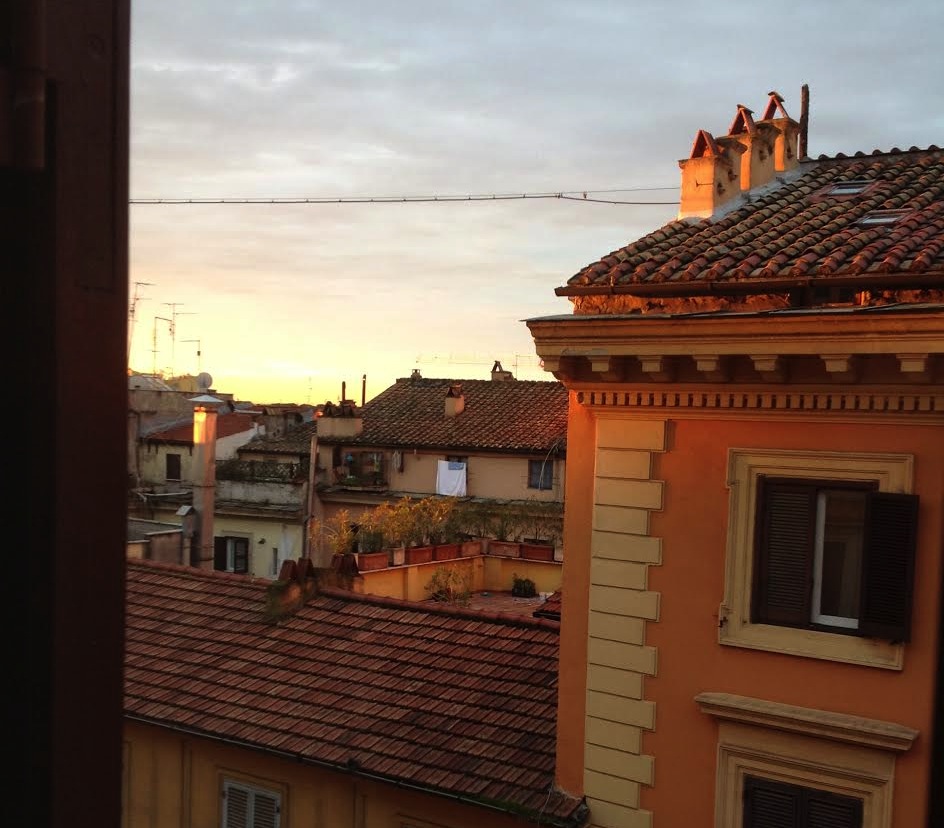
Rome-730 am

Rome, Italy, 7.30 am.

Update from our reader:

I saw that you posted my picture. I’m really quite floored – thank you! Today at Vatican City was amazing. A little background: I’m not Catholic, and were it not for Pope Francis, not only would I have not been interested in seeing the Pope, I would have made a point of avoiding any celebration of him. My opinion of the Catholic Church was, given its history of sexual and financial abuse, pretty much rock bottom, but Pope Francis has changed that. (BTW, I made a point of reading your Deep Dish on Francis before we left on this trip.)

Our accidental encounter today with the Pope:

We thought we had tickets for the Vatican Museum, but my husband had the day wrong. So we got into line for what we thought was a tour for St. Peter’s Basilica … turns out we were in line for the Papal Mass in the outside seating area, so we stayed and watched the mass from nearly front row seats on a big screen just outside the Basilica (my first Mass). Afterwards, we were in a great location to see Pope Francis give his New Year’s address live on his balcony (our binoculars helped). Needless to say, the crowd was huge and amazing. Wonderful experience, especially since none of it was planned.

My family is a funny group religion-wise: my husband is agnostic, my daughter evangelical, my son an atheist, and me … I come under that fuzzy heading of “spiritual and seeking” but turned-off by organized religion (actually, turned off by Christianism, to use your term). I had a lot of thoughts today about religion and its purpose in people’s lives which I hope to jot down when I return from vacation. Not sure it would be anything significantly new, but I may send it your way. Why? It was your Time article “When Not Seeing is Believing” that brought you into my life almost 8 years ago, and you have been an almost daily presence since.

Lighting Up In Latin America

As Roberto Ferdman informs us, “It’s barely been a month since Uruguay moved to legalize marijuana, and yet the effects of the decision are already being felt well outside of its borders”:

Neighboring Argentina, a long-time proponent of keeping marijuana illegal, gave its first indication that Uruguay’s pivot has tempted it to at least consider legalizing the drug. The recently appointed head of Argentina’s counter-narcotics agency, Juan Carlos Molina, admitted as much in a recent radio interview (link in Spanish). “Argentina deserves a good debate about this. We have the capacity to do it. We shouldn’t underestimate ourselves,” he said.

There are signs that Mexico is pondering legalization too. Earlier this fall, shortly after Uruguay’s lower house approved a bill to legalize marijuana, Mexico City’s council proposed legislation that would create a system of marijuana growing co-operatives, which would let people grow pot, but also allow the government to oversee its production and consumption.

Pot-friendly legislation still faces obstacles. Support for marijuana legislation across the region is still well below 40 percent, and a number of governments, including Peru’s, Mexico’s, Brazil’s and Colombia’s have been reasonably steady in their support for US-style wars on drugs. However, a growing proportion of young people in some of the region’s largest cities seem to be slowly changing their views. An overwhelming majority of Argentine, Chilean, and Mexican youth are in favor of legalization – 81 percent, 79 percent, and 73 percent, respectively (link in Spanish).

Previous Dish on the Uruguay experiment here and here.

The Dish Subscription Surge

One last note before the New Year begins. When I was asked a little less than a year ago what our ambition was for revenue in 2013, I grabbed a number out of the air. It was our combined editorial budget at the Beast in 2012, which was $900K. Maybe it was unreasonable to think we could make the same salaries independent as we did under a corporate umbrella; maybe I should have made the goal higher – because we also had to find staff and time and resources in 2013 to do all the administrative, business and technical work that the Beast had done for us; maybe I should have set the goal considerably higher if we were able to corrall enough resources to start commissioning and publishing more long-form pieces. But, hey, I didn’t know what to expect, and $900K seemed fair enough if I had to pick.

Well, we kinda did it. As the hours tick down on 2013, here’s a graph of our new subscriber revenue month by month, after the initial massive wave:

Screen Shot 2013-12-31 at 2.02.39 PM

That’s what you call a strong finish. We end the calendar year with gross subscription revenue of $851K. We have no debt. We have almost 34,000 subscribers. Almost 9,000 of them are now on auto-renew, and if our 25,000 original supporters renew next year in numbers comparable with the very beginning, then we’ll finally have a solid basis for a ongoing, entirely-online blogazine with no sponsored content and (so far) no advertizing.

To coin a very 2012 phrase: you built that. And we’re incredibly grateful to live in it.

Thank you. And a very Happy New Year from all of us – me, Patrick, Chris, Jessie, Matt, Alice, Chas, Brian, Brendan, Jonah and Tracy – to every single one of you.

To Resolve Or Not To Resolve

Jessica Lamb-Shapiro points out that it may be wise to skip New Year’s resolutions this year:

The statistics are bleak: only 8% of people who make New Year’s resolutions stick to them, and those who don’t usually abandon them after just one week. Unrealistic resolutions are fated to fail. And it is unrealistic to think that you can immediately overcome a habit you have spent years establishing. But is this necessarily harmful? There’s a good chance that it is. If your New Year’s resolution is to eat less, but you have no plan in place — or even if you do have a plan and you fail — you will do damage to your sense of self-worth. If you already have a complicated relationship with food, your likely coping mechanism for failure is eating more food. Thus the New Year’s resolution to eat less can actually result in your eating more. Ditto drinking, drug use, smoking, finding a mate, exercising, etc.

But all hope is not lost:

Naturally, if you set more realistic goals, you are more likely to succeed.

In a study that looked at the role of expectations in exercise, the psychologist Fiona Jones and her colleagues found that people with more modest expectations were far likelier to complete a twelve-week-long exercise course. And once we’ve set goals, we’re most likely to reach them by creating a firm plan. The theory of implementation intentions, a term coined by the psychologist Peter Gollwitzer, maintains that we have a better chance of sticking to a goal if we think about contingencies in advance and devise a direct, automatic response to each of them. (If feel too tired to go to the gym, I’ll have some coffee or eat an apple before heading out.) “It’s harder to break a specific commitment then a nonspecific one,” [psychologist Katherine] Milkman said.

Sunstein gives more advice:

It’s easy to resolve to be more altruistic, to exercise greater self-control, to be more patient, or to enhance one’s life, but it’s costly to do these things. Suppose that you aren’t always as generous and kind as you would like to be, or that you have trouble resisting temptation, or that you don’t give yourself enough time off. If so, it’s probably because it’s costly to do those things, and it’s hard to anticipate those costs and burdens in advance.

The best remedy is to find ways to reduce such costs and burdens. If you want to be more altruistic, you might set up automatic monthly gifts to your favorite charity. If you want to increase your self-control, you might alter your environment so that you run into temptations less often — for example, by keeping less food in your refrigerator. If you want to have an adventure or two, you might accompany your New Year’s resolution with a purchase, today or tomorrow, of a plane ticket.