When are we happiest? he asked her.
Not one of them could get the seats
to go back, not one of them really knew
what was in the glove box, though
everything there was theirs.
When they got to where they were going,
a park, a gray squirrel came jumping along.
Childhood! It was in one of the houses nearby.
Money! Every day it seemed to loose itself
from its lurking-place and drift away.
So he smelled the underside
of his own arm. And the squirrel
paused, one of those little eternities
never mentioned again.
Please consider supporting the work of the Poetry Society of America here.
Cayte Bosler unpacks a study that “shows there are residual health benefits to having your mind blown”:
“People increasingly report feeling time-starved, which exacts a toll on health and well-being,” states the study. Using three experiments, researchers Melanie Rudd and Jennifer Aaker of the Stanford University, and Kathleen Vohs of the University of Minnesota, examined whether awe can expand perceptions of time availability. They found that participants “who felt awe, relative to other emotions, felt they had more time available, were less impatient, were more willing to volunteer their time to help others, and more strongly preferred experiences over material goods.”
It can be hard to generalize what people consider jaw-dropping, but Vohs says research demonstrates what consistently creates an awesome experience. Travel ranks high. So does gazing at the cosmos on a clear night or watching a sensational film, as well as anytime we encounter massive quantities: colorful tulips in bloom, a bustling market in India, or a stunning school of fish. Novelty and perceptual vastness forces us into the present moment. The study underscores the importance of cultivating small doses of awe in the everyday to boost life satisfaction.
More on how “awe” works:
“The experience of awe is one where you are temporarily off-kilter in terms of your understanding of the world,” explains Vohs. “People mostly walk around with a sense of knowing what is going on in the world. They have hypotheses about the way people behave and what might happen; those are pretty air-tight. It is hard to get people to shake from those because that’s just how the brain works. We are always walking around trying to confirm the things we already think. When you are in a state of awe, it puts you off balance and as a consequence, we think people might be ready to learn new things and have some of their assumptions questioned.”
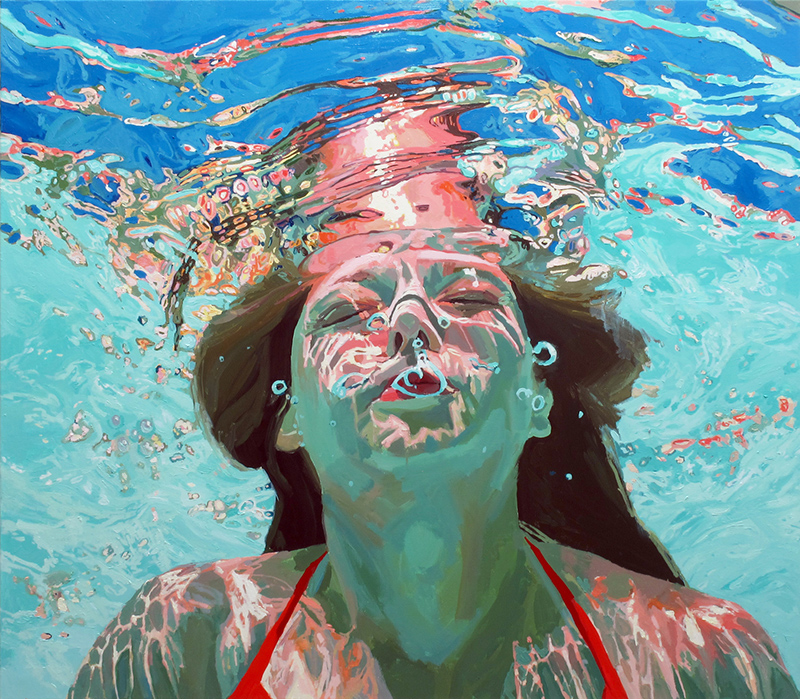
My current body of work is focused on swimmers underwater and above. Using vague yet consuming memories from my childhood summers spent immersed in the tepid lakes of northern Minnesota, I attempt to recreate the quiet tranquility of water and nature; of days spent sinking and floating, still and peaceful.
Recently the Dish featuredthepoetry of Mary Szybist, whose collection, Incarnadine, won the National Book Award in November. In an interview, she discusses the connection between her religious life and writing:
When I was young, spiritual faith had an enormous presence in my life. When I was a young adult, its absence, at times, felt enormous. Now my relationship to it is more complicated, and I try to let those complications into my poems. W. H. Auden once said that “poetry might be described as the clear expression of mixed feelings,” and my mixed feelings about faith and spirituality often drive my work…. I don’t think I was ever after spiritual clarity, at least not the kind that might be held as an enduring truth. An insight that helps me through the struggles of one day will not necessarily answer to the spiritual unrest of another. That is, I think, why artists keep creating and writers keep writing. We change; our world changes; what suffices one day will not necessarily suffice the next day. We need new visions. I like Robert Frost’s idea that a poem is a “momentary stay against confusion.” Clarity may be “momentary”—but that does not make it less valuable or needed.
She goes on to argue that the poems in Incarnadine could be seen as a feminist response to the Biblical tale of the Annunciation, when Christians believe an angel told Mary about her miraculous pregnancy:
Feminism means, in its most basic sense, a belief that men and women should have equal rights and opportunities. I do, of course, believe that. Feminism might also be described as activity in support of women’s interests, and I think Incarnadine does answer to that description. I grew up identifying with the icon of Mary, mother of God, since I was named after her. I also felt myself to be in her shadow. I think Mary is a problematic ideal to hold up to women for many reasons; she is celebrated for being both mother and virgin—an impossible ideal. It is particularly the virginity ideal that is held up to women (and not men) that I find problematic, and virginity is a concept and expectation that still has real and often dire consequences for women throughout the world. I wanted to complicate the figure of Mary and the way she relates to this “ideal.” So … I would say this is a feminist response.
Stuck in an airport for hours with nothing to do? Erika Kuever recommends seeking solace in the worship room:
Every airport has a non-denominational worship room, and many are worth a visit, if for no other reason than to get some quiet time. It’s rare to run into anyone else in these rooms, but when you do people tend to smile at you with kind eyes, recognizing another wayfarer considering their mortality in an enormous, climate-controlled, heavily secured, globally elite space.
Due to their essential in-between-ness, airports are fine places for reflection, for thinking broadly and deeply about the world and your place in it. Without consciously intending to I sometimes find myself in a terminal taking stock, thinking about my changing life goals, my strengths and weaknesses, and my hopes and fears, or just deciding this will finally be the year I read Infinite Jest. It’s an even better place to look outwards, to consider human hubris and the march of history.
The “modern oblivion” of Steinberg’s subtitle was just that: centuries during which the central fact of Christ’s phallus in hundreds of Renaissance paintings was overlooked, denied, and, sometimes, bowdlerized. Steinberg adduces several examples of Christ’s genitalia being painted over or touched up to make them look like a mere blur. In one case, probably in the mid- to late nineteenth century, the Alinari brothers, famous for their photographic reproductions of paintings, blackened out the Christ child’s penis in their photograph of a fifteenth-century “Madonna and Child” by Giovanni Bellini. Such censorship, Steinberg believes, was meant as distraction from an uncomfortable theological premise: “A disturbing connection of godhead with sexuality.”
Steinberg’s point was more than prurient – it connects to theological debates about the meaning of the Incarnation, or God becoming man:
He held that artists used the evidence of Christ’s genitals to prove that Christ submitted to becoming human before returning to the godhead. The revelation of his penis demonstrates, as Steinberg puts it, Christ’s “humanation,” that moment of incarnation which proved Christ’s love for humankind. And the many representations of the Christ child’s circumcision are important as foretellings of his crucifixion—the blood of Christ’s penis is fulfilled in the blood from Christ’s wounds.
Entering with obvious relish the realm of Christian sexual hermeneutics, Steinberg relies on St. Augustine, who emphasized his surrender to and then escape from the “fleshpots of Carthage,” to argue that Christ’s erection was a singular way to demonstrate Christ’s chastity. Without the capacity to yield to lust, Christ’s triumph over carnal desire would have no human meaning. Unlike men after the fall of Adam, who fell victim to lust, Christ willed his erection; it was not an involuntary physiological event. By both willing and resisting it, he declared his victory over the stain of sin bequeathed to humanity by Adam and Eve, and over the death that their carnal weakness brought into the world. That, after all, is the significance of the resurrection.
(Image of Madonna and Child Blessing by Giovannia Bellini, 1510, via Wikimedia Commons)
Peg Nelson is a nurse practitioner experienced in palliative care, helping patients and their families deal with dying. In an interview, she describes what her role can teach us about our lack of control:
Once you admit to yourself that dying, like birth, is not something you can control, it frees you up to use your compassion to help people. For example, we can usually make dying patients comfortable and help them find ways to make the most of their remaining days. We are less like surgeons performing an operation ourselves than coaches helping someone else. And there is a lot we can control. We can always listen—really listen—to patients and families. We can always be with them—really with them—in the moment. And we can always care—really care for them—throughout the experience.
What she says to those just beginning to grapple with their impending deaths:
There are some phrases that we tend to use a lot. I can’t tell you how many times I have said, “I wish things were different,” or “I’m so sorry.” Of course, you must not only say it but mean it. And even in the midst of shock and anger and despair, there are always healing things you can say. For example, I often hear myself saying, “You have such a beautiful family,” or “I am feeling a lot of love in this room.” It is not only pointless but harmful to pretend that dying is not happening.
On the other hand, if you do it right you can help people find lasting meaning—even something beautiful in it. More important than anything we say is to listen—asking questions, being quiet and present.
Love Actually is interesting because it is a story about the different aspects of love, not just romance. New love (Jack and Just Judy). Old love in a rut (Emma Thompson and Alan Rickman). Unadulterated lust (Collin). A parent’s love, as well as love for and duty to a deceased partner (Liam Neeson). Siblings (Laura Linney). Unrequited love (Mark and Juliet). Love between friends (Billy Mack). Love with obstacles (Jamie and Aurela). Love you try to deny but can’t (HG and Natalie). I really like the fact that it isn’t a traditional love story.
Relating to the point of work required for a relationship, while Liam Neeson’s character displays this in the care and devotion he shows the son of his departed wife, it was best illustrated by a storyline left on the cutting room floor. In the deleted scenes, there is a story about the principal of the posh elementary school where Emma Thompson’s children are enrolled. The principal has her own love story, providing hospice care to her beloved longtime partner, and dealing with the grief over her loss.
Another reader:
The rabid fans of Love Actually I know are all chronically, unhappily single. I know some coupled folks and happy singles who like the movie well enough. But it is the unhappy singles who spontaneously post their adoration of the movie on Facebook or will at the slightest provocation tell you their favorite scenes in great detail. Far be it from me to suggest that the inability of these people to form the sort of meaningful relationship they so desire and the movie’s unrealistic portrayal of how love is found, won, built and sustained is anything more than sheer coincidence.
Another:
It certainly isn’t a how-to for romance. Some of the relationships are entirely inappropriate. No one recommends buying an expensive piece of jewelry for a flirtatious coworker instead of your wife or declaring your love to your best friend’s new wife.
But I think the central running theme here is about allowing your heart to run and giving up self-censorship.
That’s the fundamental romanticism of the film. And like all romanticism it’s not realistic; it’s emotional. The one character who doesn’t release her self-censorship (Laura Linney) misses her chance. The others get the chance to at least express their emotions, which is refreshing in an emotionally stilted culture. I like the movie and I will probably watch it again in the next week, not because I need pointers on how to cheat on my wife, but because I want to enter into the emotion that causes these people to do profoundly stupid things.
Another:
I just love the movie and find it to be an uplifting paean to love and the yearning for connection. It seems to me that this movie displays how the world does look to someone who is actually in love, particularly in the first flush of romance. When in love, we see mostly good and as love matures, we are given the opportunity to work with the difficult as well as the easy. This film does display some of the challenges that may occur in relationships, as reflected in the characters played by Emma Thompson and Alan Rickman, and what happens after the death of a loved one for Liam Neeson’s character. Also we have Laura Linney’s character, her mentally ill brother, and her delicious co-worker, as another representation of love and yearning for connection but involving difficult choices.
One more point. I find this movie especially interesting because it displays the pursuit of love mostly from a male point of view, one not often portrayed in films. I do think that this film can be unsettling to some men since it does reveal that most men do have a deep sensitivity to love and a desire for real connection with someone, whether the preference be female or male. This deep sensitivity carries with it an anxiety about potential rejection from the desired individual and, as revealed in this film, guys are as vulnerable to this as women are. But most films do not display that aspect in men’s lives. And most men have been culturally trained to not let this vulnerability show. It is not macho.
So I would recommend that people just “lighten up” and try to balance joy with all of the intellectual analyses of this film. This film presents us with a beautiful invitation to get out of our head and into our heart.
Another points to the above scene:
The best part of Love Actually is the last minute or so, where the filmmakers simply show real people meeting loved ones at the airport (to a soundtrack of the Beach Boys’ “God Only Knows”). I defy anyone not to be moved!
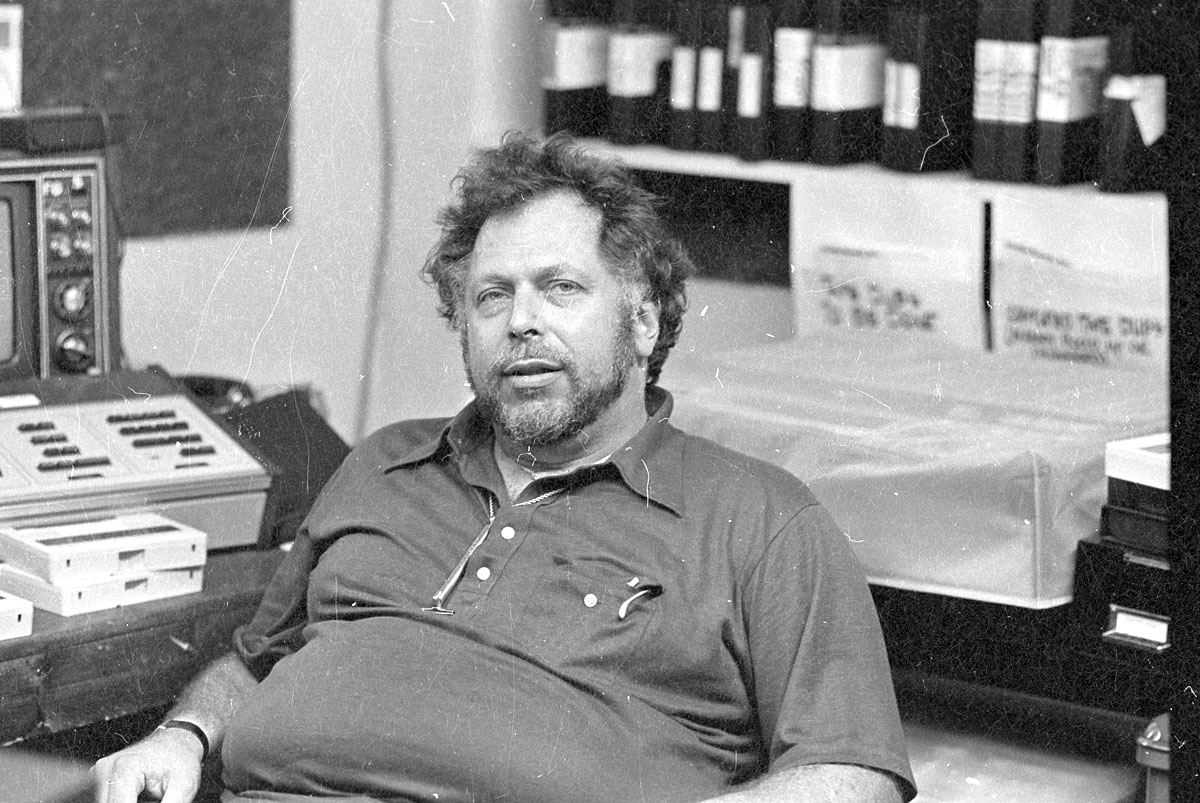
That’s what Will Sloan calls the creator of Screw magazine, Al Goldstein, who died earlier this month:
Goldstein launched Screw, his “weekly sex review” of New York, in 1968. United States courts were regularly redefining what constituted obscenity and what passed for “redeeming social value,” but from the beginning, Goldstein said, “a hard-on is its own redeeming social value.” Unlike Playboy, the publication to which Screw stood in contrast, there was no attempt to flatter the reader’s sense of sophistication, or to depict sex as anything but a physical act. “The word love is alien to us,” said Goldstein in his 1974 Playboy interview. “Who needs love? Yuck! We deal with masturbation, the most common sex activity for most people, in graphic words and pictures.” …
Playboy had the debonair, sophisticated WASP Hefner; Screw had the obese, crass, and very ethnic Goldstein. Hefner often shot the early Playboy pictorials himself, leaving articles of his clothing in the background to hint that he’d seduced the women; Goldstein admitted (or perhaps bragged) that he could rarely get laid unless he paid for it. Hefner lived a lifestyle that his magazine urged readers to strive for; Goldstein was proudly in the muck with the rest of us. Screw gained enough counterculture credibility in the late ’60s and early ’70s to score interviews with Henry Miller, Salvador Dali, and John and Yoko (during their Montreal bed-in), but Goldstein was the kind of interviewer who could bring anyone down to his level. He got Jack Nicholson to admit he used the magazine to masturbate.