Freeze Frame

dish_kelly

Photographer Angela Kelly enlisted her son to help her snap shots of bubbles as they formed in below-freezing temperatures:

Kelly said she used a homemade bubble solution with water, Karo syrup and dish soap that she found on the Internet. “We quickly realized that using a mostly shady area was necessary in order to get the bubbles to freeze in their entirety and conversely using a partly sunny area allowed the bubbles to only partially freeze along the bottoms up to about the mid-point of the bubble,” she said.

Using that information, Kelly and her youngest son set about with the idea that they wanted to see them in all different stages: frozen completely, half-frozen and only partially frozen.

“We were both awestruck as we watched how each bubble formed its own unique ice pattern as they froze,” she said. “My son was amazed as I blew a gentle puff of air across the top of one bubble that had completely frozen and watched intently as it broke away from the surface it was on, rolled over and showed its shattered shell.”

(Photo by Angela Kelly, Kelly Images and Photography)

“Nights Dark Beyond Darkness”

In another round of The Guardian‘s “Great American Novelist tournament,” Cormac McCarthy’s The Road trumped John Fante’s Wait Until Spring, Bandini. Matthew Spencer pays homage to McCarthy:

[T]here will never be relief in McCarthy’s post-apocalyptic world: ‘Nights dark beyond darkness and the days more gray each one than what had gone before. Like the onset of some cold glaucoma dimming away the world.’ The unnamed man and his son, ‘like pilgrims in a fable’, must travel south in the hope that the winters will be warmer and therefore more survivable. He scavenges for food in abandoned buildings and dwellings ever watchful for traps and bands of marauding cannibals. This novel is a grey suppurating wound. It is frightening and a warning to us all that unsettles and shatters and amazes in equal measure. McCarthy insists that it is a paean to the father and son relationship.

The boy is cast as a redemptive figure, he carries the figurative light of the world. He is forgiving and hopeful and the father is beautifully indulgent of him because he knows that their lives are extremely temporary. These touching moments are interspersed with fraught episodes of jeopardy and shocking violence. There are many references to religion in this hellish world, and to a God that has surely forsaken them, perhaps typical of this southern writer whose style is second to none: part Gothic, part future modern, part Shakespeare (although he does have the punctuation skills of my 5 year-old). Every set piece is brilliant and can be read in isolation like a piece of brutal poetry. ‘He knew only that the child was his warrant. He said: If he is not the word of God God never spoke.’ Mccarthy tells us, we must carry on along the road and protect the feeble spark of life that has roiled and rolled through the millennia. … The Road is a masterpiece, the black yardstick by which every experience, let alone novel, needs to be measured.

The Floating Economy

Rose George fears that we suffer from “sea blindness.” She wants us to recognize the importance of and problems with the shipping industry, which brings us almost everything we buy:

Recently, Craig Martin looked into the history of the shipping container and how it revolutionized the industry:

From the nascent designs of the 1950s, through the roll-out phase of the 1960s, to the standardization of the 1970s, the container became central to the burgeoning growth of consumer capitalism, particularly the move of manufacturing to traditionally peripheral economies. The shipping container models the fundamentals of late capitalism even as it facilitates it: a standardized, reproducible structure that looks and functions the same everywhere. But just as much as it has amplified the practice of consumer capitalism, the shipping container also underwrote an aesthetics of capitalism as well. The geometric simplicity of the container’s design echoed the uniformity of high modernist architecture of the ‘50s and ‘60s, including the serial arrangement of tract housing, or in the standardized, modular architectural designs of Buckminster Fuller and Le Corbusier. What better way to fill the rows and rows of housing blocks in a booming suburbia than with baubles and gizmos delivered by rows and rows of shipping containers on a nearby dockyard?

The Identity Crimewave

Mike Riggs wonders why most people don’t report identity theft to the police:

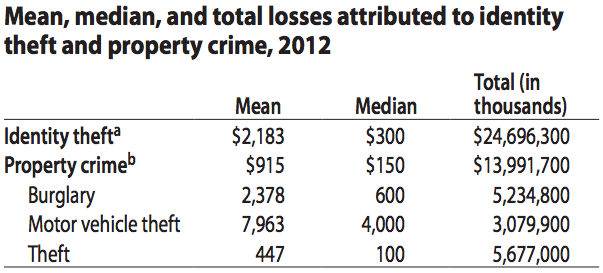
Property and violent crime affect us where we live and work, and we expect local government to do something about them. But even though these categories seem comprehensive, neither one includes identity theft. Considering identity theft now costs Americans nearly twice as Identity Theftmuch as property crime, that’s an odd omission. In a recent report, the U.S. Bureau of Justice Statistics found that total losses attributed to identity theft in 2012 were $24.6 billion, compared to $13.9 billion for property crimes. Not only is the total loss amount higher for identity theft, the mean and median loss per incident is roughly double (see the chart at right).

This isn’t to say we don’t talk enough about identity crime, because we actually talk about it a lot (mostly as it relates to personal finance and online security). But the BJS report suggests even identity theft victims don’t actually think about identity theft when they think about crime where they live. The biggest indicator? Only 9 percent of identity theft victims even contact the police.

A commenter provides a sensible explanation:

Reasons people report property crime include insurance and an overall perception that the police might catch the burglar/thieve who was physically present on the property.

Identity theft is often committed by people operating from overseas or using elaborate IT resources to conceal their own identity and location, making it very difficult to trace, let alone apprehend, especially if no major money trail was left. Even a dedicated local police office, well staffed and set on the right priorities, couldn’t do much to go after, say, a Russia-based online gang group that used the credit car info to attempt a purchase on a website from Singapore…

Sick Too Young

Three years ago, Leah Sottile’s husband was diagnosed Ankylosing Spondylitis, an autoimmune disease. She reflects on how this changed their lives:

I thought this would be the time when we’d be preparing for the rest of our lives: earning money, going on fun vacations, having families, building our careers. And we are, but at the same time, we’re doing it while we’re trying to manage pain symptoms, chase down prescriptions, and secure stable health insurance. When I was in college, I remember being prepared to survive in the workforce, but I don’t remember a class that told me how to do that if half of your household is in so much pain on some days that they can’t get to work. I’m barely over 30. I thought I had so much more time before I had to think about this stuff.

She also discovered that her husband isn’t alone:

It might be that our lifestyle is why Americans are so sick. Another theory, according to Dr. Frederick Miller of the National Institute of Environmental Health Sciences, might be that humans are being weeded out in different ways than in the past, as more communicable diseases have been eliminated.

“If you do away with the infectious disease risks that perhaps killed off a number of individuals early in life [in the past], people who may have altered immune systems, who perhaps couldn’t have handled [those infections, then] go on in adulthood to develop these diseases,” he says.

He points to the “hygiene hypothesis”: As humans have eliminated infections and led cleaner early lives, allergies and autoimmune disease incidences have increased because of our underdeveloped immune systems. “It’s not completely proven, it’s a hypothesis,” Miller says, “But it is consistent with some of the data out there.”

“There may not be too many free rides in this world,” he says. “As we move away from one disease, we may be moving toward other diseases.”

Face Of The Day

The Ice Bear - 2013-11-26_234548_nature.jpg

Alice at My Modern Met has details:

The winners of the National Geographic Photo Contest 2013 have just been announced! Taking home the grand prize is an image you probably remember spotting on a blog post right here on My Modern Met just over a week ago. Seattle-based photographer Paul Souders took the beautifully eerie photo of a polar bear positioned right beneath the surface of Hudson Bay’s freezing waters.

More of Souders’ work here.

Fans Of The Flat-Rate

Catherine Tucker reviews research on the “flat-rate bias,” which describes the behavior of “consumers [who] will often choose a flat rate over a metered one, even when it’s not in their best interest”:

[In 2006, then-doctoral student Anja] Lambrecht found that the flat-rate bias could not be explained only by the fact that customers prefer the certainty or convenience of flat-rate pricing, or that they are overestimating their usage. Instead, it seemed that consumers actively avoid schemes where there is the possibility of feeling discomfort by mentally linking every extra unit of consumption to an increase in price. In other words, it’s not just a fear that you might underestimate your phone use or the congestion on your morning commute— it’s that consumers hate knowing that each extra minute or mile is costing them money. Lambrecht christened the discomfort that customers feel when the meter is running the “taxi-meter effect.” It appears that in general consumers want to enjoy a journey—or a phone call with a friend—without worrying about their wallets.

Surprisingly, however, the “taxi-meter effect” also seems to apply to experiences we don’t enjoy.

In a study of retail banking that came out earlier this year, Itai Ater and Vardit Landsman of Tel-Aviv University found that when an Israeli bank stopped charging per transaction and changed to a flat rate, their revenues went up by 15 percent. The previous pricing scheme had charged customers for most interactions with the bank, including check fees and fees per phone-banking transaction. Customers were happy to pay more per month to avoid having to pay per transaction. This work showed that the taxi-meter effect is not limited to a particular industry (previous experiments had focused on telecom), but is more deeply rooted in consumer psychology.

Has Photography Lost Its Power To Shock?

1200px-Child_laborer

Taking in an exhibit of early photojournalism, Joseph Neighbor wonders if any photographer today could move viewers the way Lewis Wickes Hine did:

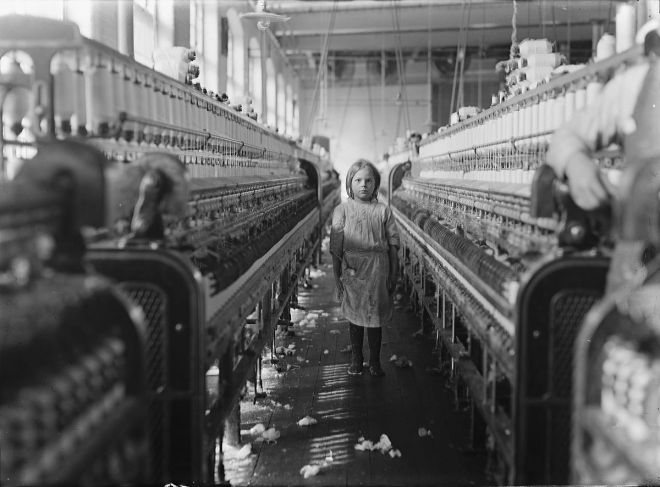
The naked optimism of Hine’s photographs is moving. The subtext of a picture of a child missing an arm is that it was worth taking, and that somebody would see it and be incited to action. Hine’s photographs contain a tacit faith that reform is possible, that good can come of bad. At this moment there are more pictures being taken, more videos being filmed, more words being written than at any point in history. Many of them document the suffering endured by child laborers across the world, children who make our sneakers and gadgets. But this quantity of evidence has not generated a significant public outcry, as in Hine’s day, perhaps because modern viewers are inundated with images of suffering and injustice from all over, from all throughout time. Endless exposure to barbarity and agony inures us to a photograph’s emotional impact. It is difficult, and perhaps becoming more difficult every day, to find a place in the heart for genuine surprise, horror, or indignation.

(Lewis Hine’s A Little Spinner in the Mollahan Mills, Newberry, S.C., 1908)