The Power Of Great Leaders

This file photo taken 15 October 1990 sh

Joshua Tucker uses political science to downplay it. Stephen Dyson counters:

Why do political scientists place less emphasis on the importance of individual leaders? One reason is that science means moving from studying specific phenomena to developing general explanations. Why South Africa democratized leads to the question of why countries democratize. The more instances of democratization that there are to explain, the less the vivid details of each case – such as a monumental leader – seem to matter. Explanations of many events cannot logically rest on the idiosyncrasies of one event.

The distinctive features of a leader – Evan Lieberman identified Mandela’s remarkable self-restraint – are also harder to measure than factors like the economy.

Why it’s worth focusing on individuals:

Tucker draws our attention to the dangers of the “great leader” view of politics: it promotes apathy and resignation as we wait for superheroes to appear and fix all of our problems. Yet there are also dangers in minimizing the role of leaders, and they go beyond missing important causes of major events, although this is a clear risk. In the explanations of historians, the reporting of journalists, and the political decisions of citizens, leaders often play the role of personifying abstract trends, ideas, and forces, and offering a human connection between politics and life. People learn, understand, and are motivated to take action by compelling narratives, and compelling narratives involve individual human beings. A worthy goal of science is to provide systematic, rigorous knowledge about issues of social importance. But science should also engage with the moral and empathetic possibilities that come from taking leaders seriously.

Alas, political science – a misnomer from the get-go (and I say that with a PhD in it) – is terrified of human nature, individual character, the unknowable biographical and psychological factors that bear down on any leader’s decisions, and anything that, effectively, cannot be quantified. But a huge amount of human behavior cannot be quantified. Which is why I often thought, as I sat through another stats class, that we’d do better to study Shakespeare than mere regressions to the mean.

(Photo: This file photo taken 15 October 1990 shows African National Congress leader Nelson Mandela sitting beneath Mahatma Gandhi portrait in New-Delhi.  By P Mustafa/Getty. I don’t think Mandela is asleep.)

What’s A Bisexual Anyway? Ctd

Ann Friedman is distressed by some of the reactions to Tom Daley’s coming out:

“Of course I still fancy girls,” said British diver Tom Daley last week. “But, I mean, right now I’m dating a guy and I couldn’t be happier.” There were some standard-issue homophobic reactions (which Buzzfeed and HuffPost obligingly collected), but Daley also elicited a more specific sort of disapproval from certain fans – biphobia, the Advocate called it. These were the people who assumed Daley was gay but unable to fully admit it, or unwilling to relinquish the privileges of being straight. He was called greedy and accused of trying to have it all. (Which is baffling. It’s not as if he’s dating six people at once.)

By contrast, a few days before Daley’s announcement, actress Maria Bello published an op-ed revealing she was in love with a woman after years of dating (and marrying) men. While the headlines were conflicted – some said she’d come out as gay, other said she was bi – her son summed it up best: “Mom, love is love, whatever you are.” The idea of a woman being legitimately attracted to both men and other women was heartwarming rather than confusing.

Let me place a bet with Friedman: Daley will never have a sexual relationship with a woman again, because his assertion that he still fancies girls is a classic bridging mechanism to ease the transition to his real sexual identity. I know this because I did it too.

Maybe we’ll check back in in a few years’ time, and see which one of us has turned out to be right.

Her broader point is the rather tired and utterly uncontroversial notion that “a tiny multiple-choice list of sexual identities doesn’t capture the breadth and depth of the human sexual experience”:

I know women who married men, then divorced them and are now partnered with women. I know women who were in serious relationships with women throughout high school, college, and their twenties, only to meet and marry men in their mid-thirties. I know women who get off on lesbian porn but only sleep with men. I know women who are happily married to men but have an open relationship that allows them to sleep with women occasionally. Some of these women call themselves bisexual, but many don’t.

I know far fewer men who transcend traditional sexual categories this way, but I don’t think this will be the case forever. Traditional definitions of masculinity – which tend to go hand in hand with homophobia – are going through a real shake-up. More hetero men are tentatively admitting that they’re turned on by certain sex acts associated with gay men. And Daley’s ambiguous coming-out had some mainstream sports sites sounding like a Gender Studies 101 classroom. “In truth, there should be no need for him to declare his sexuality,” wrote a blogger at BleacherReport. This is progress.

Not much evidence of fluid sexuality among men there, is there? And a reality check: just because straight guys would totally be into rimming their girlfriends (I can write that on the Dish) doesn’t mean they are somehow in any way gay. They’re just using gay men’s sexuality to get their hetero on. And there’s nothing wrong that that either.

I suspect, pace Friedman’s dreams, that there will always be far fewer men who transcend traditional sexual categories – because male sexuality is much cruder, simpler and more binary than female. It’s much more nature than nurture, even though the precise balance has always been close to unanswerable. So, as the cultural constraints recede, we may soon find out a lot more. Or not very much at all, as I confidently predict.

Read the rest of our popular thread on bisexuality here.

Quote For The Day II

b00j6xxv_640_360

“I have for a long time looked upon the Conservative party as a body who have betrayed their trust; more from ignorance, I admit, than from design; yet clearly a body of individuals totally unequal to the exigencies of the epoch, and indeed unconscious of its real character,” – Benjamin Disraeli, in his novel, Coningsby, appalled by the Conservative Party’s indifference to soaring social inequality in the mid-nineteenth century in Britain.

In his subsequent novel, Sybil, where he railed against the emerging “two nations” – “between whom there is no intercourse and no sympathy; who are as ignorant of each other’s habits, thoughts, and feelings, as if they were dwellers in different zones, or inhabitants of different planets; who are formed by a different breeding, are fed by a different food, are ordered by different manners, and are not governed by the same laws,” – he articulated a future conservatism that could manage to address not the etiolated dogmas of its past, but the urgent practical demands of the present:

In a parliamentary sense, that great party has ceased to exist; but I will believe that it still lives in the thought and sentiment and consecrated memory of the English nation. ( . . . ) Even now it is not dead, but sleepeth; and, in an age of political materialism, of confused purposes and perplexed intelligence, that aspires only to wealth because it has faith in no other accomplishment, as men rifle cargoes on the verge of shipwreck, toryism will yet rise from the tomb over which Bolingbroke shed his last tear, to bring back strength to the Crown, liberty to the Subject, and to announce that power has only one duty: to secure the social welfare of the PEOPLE.

No, Disraeli was not a Communist; he was a Conservative who saw the rapaciousness of unfettered, ascendant capitalism as a direct threat to constitutional and social order. I find myself returning more and more to Disraeli these days, for reasons David Simon would understand.

The Longterm Politics Of Obamacare

Avik Roy susses them out:

Now, thanks to the colossal foul-up of the Obamacare exchange software, we might not get to 24 million exchange enrollees by 2017. But let’s say it’s half that. That’s still 12 exchange plus 12 Medicaid equals 24 million Obamacare enrollees by 2017. Is the Republican nominee for President in 2016 really going to run on a platform of taking health coverage away from 24 million Americans? Especially after the Republicans ran in 2014 on ensuring that Americans can keep their health plans? …

It’s hard to imagine a Republican winning the 2016 GOP primary by stepping back from the party’s insistence on repealing Obamacare. But it’s also doubtful that a Republican can win the 2016 general election by throwing 24 million Americans off of their health plans. And therein lies the rub.

Indeed it does. But the GOP hardly has a reputation for thinking ahead, does it? The party that gave us Gitmo and no post-invasion plan for Iraq and no adjustment on taxes, even as the debt ballooned, tends to wing it, then hunker down in compounded error. It’s a way of life for them. Greg Sargent flags the above ad, from the GOP primary for a Georgia Senate seat. The ad attacks Rep. Jack Kingston for suggesting that Republicans fix Obamacare. The whole concept of responsibility, dealing with reality, or coming up with constructive solutions to emergent problems … well, that’s not the Republican way. The Republican way is to keep mouthing the same slogans of late-Reaganism until their jaw muscles seize up.

And, of course, as Greg notes, “Kingston is now furiously walking back his apostasy, pointing to his dozens of votes to repeal the law as proof that his zeal to get rid of it knows no bounds”:

Democratic lawmakers and candidates at least have some flexibility to deal with problems as they arise — they can call for fixes while defending the law’s broader goal of expanding affordable health coverage. Republicans don’t have any flexibility. Remember, a recent CNN poll showed that only Republican voters believe the law should already be pronounced a failure, while moderates and independents still think its problems can be solved. Republican lawmakers and candidates must continue to insist on full repeal and nothing else, even as the number of people gaining coverage continues to mount.

Dems will seize on this to argue that Republicans are only interested in sabotaging Dem solutions and are unwilling to engage in constructive governing. They will contrast this with their own “keep and fix” stance, noting that one side wants to fix the health system, and the other wants to go back to the way things used to be.

Charlie Cook wonders whether Obamacare will doom Democrats during the midterms. Bernstein pushes back:

The opening of the exchanges was a natural media event, and when Healthcare.gov opened with catastrophic problems, it’s not surprising that the result was a press frenzy. But the exchanges are no longer in total disrepair; whether the experience is now pretty good, or sort of okay, is not the kind of story that drives a lot of press coverage. Nor are there all that many news hooks remaining. …

The fundamentals of the 2014 cycle suggest small Republican gains. Gains, because the president’s party usually loses seats in second-term midterms; and small, because in the House, Republicans already hold most of the seats they normally can compete for. It’s still too early to know if those expectations will be met, but there’s nothing in the numbers so far that would indicate anything unexpected. Either way, it’s unlikely that health care reform will move a lot of votes this time around.

I just don’t know.

Quote For The Day I

“I’m utterly committed to the idea that capitalism has to be the way we generate mass wealth in the coming century. That argument’s over. But the idea that it’s not going to be married to a social compact, that how you distribute the benefits of capitalism isn’t going to include everyone in the society to a reasonable extent, that’s astonishing to me. And so capitalism is about to seize defeat from the jaws of victory all by its own hand,” – David Simon.

In Mandela’s Shadow

South Africa Holds A National Day Of Prayer For Nelson Mandela

Eve Fairbanks sizes up Mandela’s successors:

People are deeply, deeply disillusioned with the leaders who’ve followed Mandela, both official African National Congress politicians and emotional leaders like Mandela’s offspring. Mandela’s relatives seem to have bucked his example entirely; some have banked millions in mining, an industry against which the apartheid-era ANC railed against as the heart of South Africa’s satanic injustice, while others have cashed in with a reality TV show.

The allegations against the politicians in actual office are more troubling. The country’s second democratically-elected president, Thabo Mbeki, was bitterly criticized for denying South Africa’s AIDS epidemic. Mbeki’s successor, President Jacob Zuma, was prosecuted for both rape and racketeering; he was acquitted of the former, and the latter charges were dropped on technicalities, but recently a huge scandal around taxpayer-funded upgrades to his massive home dominated the papers until Mandela’s—for Zuma, very propitiously timed—death. Daily, the whole black political class is accused in the media of corruption in the awarding of government contracts and greed in treating itself to swanky vacations and flashy vehicles.

“They were heroes,” one of the students standing beside me on the police line mused grimly, “but then they started buying cars.” As they buy cars, economic growth has slowed, basic education has fallen into disrepair, and inequality has deepened. This fall, The Economist concluded in a cover package pessimistically titled “Cry, the Beloved Country” that South Africa “is on the slide both economically and politically” and that the ANC’s “incompetence and outright corruption are the main causes.”

Applebaum argues that Mandela’s death should “should cause South Africans to look critically at the state he helped create and, above all, at the ANC, the party he led”:

There are reasons why the ANC continues to win elections, legitimately, even while failing to deliver much in the way of economic growth to its supporters. So far, rival parties have failed to capture the national imagination, even if some have done well in some regions. So far, the ANC has persuaded black voters that they would be “outsiders,” even traitors, if they voted for others. But Mandela’s aura—the patina of history and glamour he lent to the party—were also part of the explanation. During its last elections, in 2009, one South African journalist wrote that it felt as though the ANC were still “overseen by a pantheon of deities, including Mandela.” …

If South Africans really want to honor Mandela’s memory, they should deepen South Africa’s democracy, and vote for somebody else.

Reihan examines South Africa’s economy:

One of the key reasons for South Africa’s weak performance is that while high-growth countries saw large numbers of workers shift from low-productivity sectors, like subsistence farming, into high-productivity sectors like export-oriented manufacturing, South Africa’s high-productivity sectors have seen little growth. There are many theories as to why this has been the case. Some will attribute this to the rigidity of South Africa’s formal labor market while others will attribute it to a failure on the part of South Africa’s government to pursue a more ambitious industrial policy. Regardless of the answer, what is striking is that despite South Africa’s economic woes, the same political party keeps winning election after election.

He follows up in a later post:

[T]he ANC has made expansive commitments to its poorest citizens, which have often been cast in terms of racial justice. South Africa’s weak economic performance has thus engendered a great deal of bitterness, and a political and social climate that has led large numbers of educated young South Africans of all ethnicities to emigrate. The tragedy is that the South African economy had many advantages relative to other countries in its economic weight class, including a relative large English-speaking minority well-suited to thriving in a knowledge-intensive economy and relatively good infrastructure. Despite the ANC’s economic policy failures, it has not faced a serious political challenge, at least not yet.

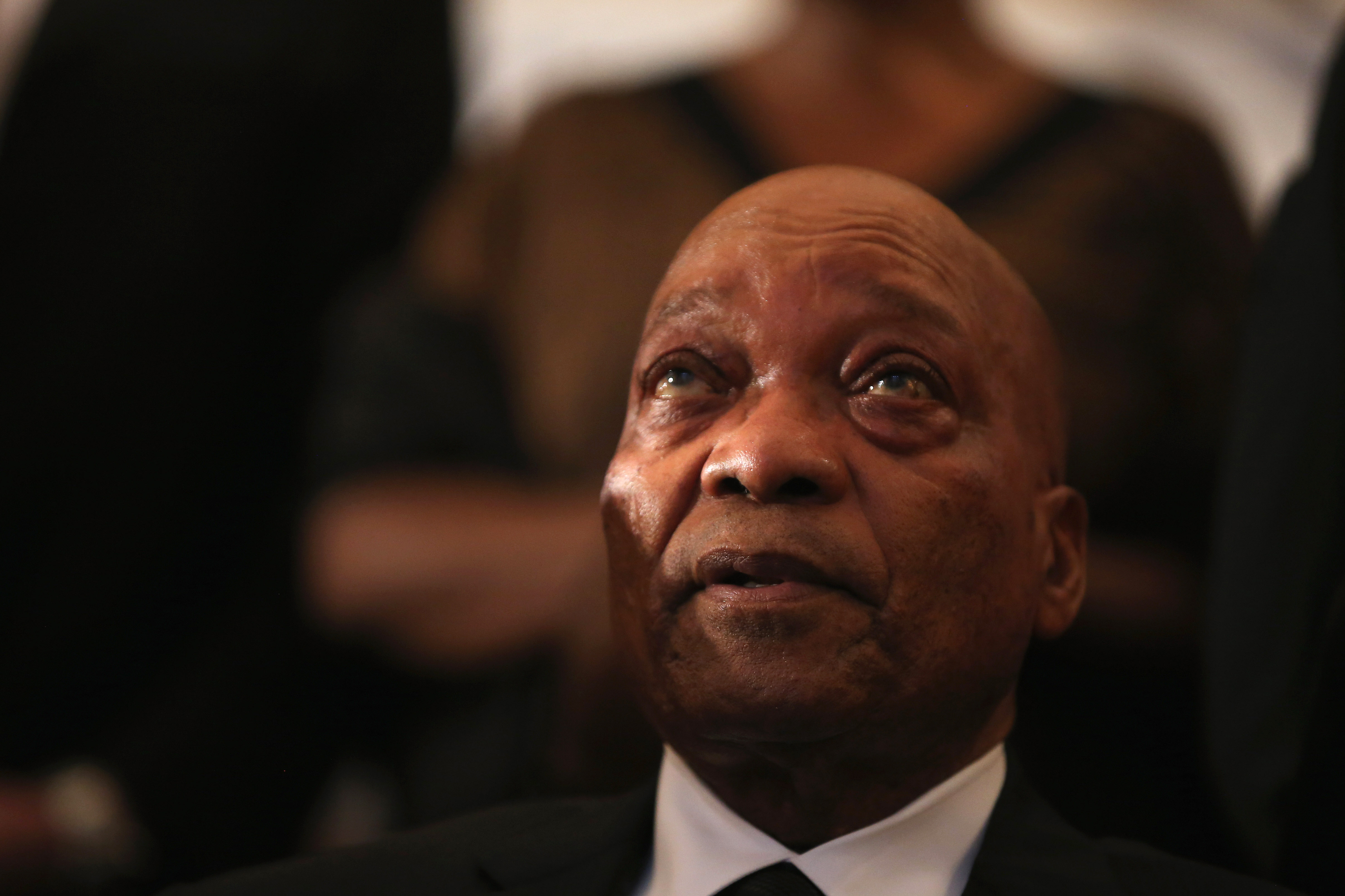
(Photo: South African President Jacob Zuma attends a service at Bryanston Methodist Church during a national day of prayer, on December 8, 2013 in Johannesburg, South Africa. Mandela passed away on the evening of December 5th, 2013 at his home in Houghton at the age of 95. By Christopher Furlong/Getty)

Coming Out Of The Year

Andy Towle has a dizzyingly long list of what are mercifully becoming less news-worthy events. My vote goes to Ted Chalfen, a senior at Fairview High School in Boulder, Colorado, for this integrating, positive commencement speech, which managed to avoid all sense of victimology:

How can anyone not describe this as a moral advance for America?