Major Lazer’s latest:
Major Lazer – Sweat from Pomp&Clout on Vimeo.
Major Lazer’s latest:
Major Lazer – Sweat from Pomp&Clout on Vimeo.
Ken Budd describes the challenges of writing and researching in the wake of his father’s death:
Writing a memoir is a selfish act. For the memoir to work, to truly be alive, the honesty of the writing must outweigh the feelings of your subjects. As the central figure, you have to write what scares you: the drama resides in the dark places where you’re least comfortable. And that means exposing yourself. It’s like ripping off the front of your house and saying, “O.K., here we are, take a look — I’ll be in the shower if you want a closer view.” If you can’t do that — if you’re unwilling to bleed, naked, on the page — why write memoir?
This honesty isn’t easy for friends and family, who probably weren’t eager to be “characters.” But the living can at least retaliate. A fellow writer once told me about a friend who released a memoir. “It’s really good,” she said. “He shares all these wonderful stories about his family. None of them will speak to him anymore, but it’s a really good book.”
The dead can’t retaliate. And I didn’t just write about my father’s life — I probed that life. Our relationship was strong, but parts of him were unattainable to me. He was a workaholic. He spent long hours at the office. Like me, he internalized his thoughts. So I compensated by interviewing his friends and co-workers, who told me stories I’d never heard. A former boss revealed how he and my father laid off 30 workers, agonizing over the horrible task. … Once that narrative goes from the mind to the page, the dead can’t correct you; they can’t say, “Wait — that’s not how I remember it…”
Recent Dish on memoirs here.
Laura Parker picks up on a new trend:
Though disabled gamers may still be cut off from traditional gaming systems to some degree, a growing number of developers are using the built-in accessibility features of mobile devices like the iPhone and iPad—voiceover, assistive touch, and guided access—to create games for physically disabled and visually impaired players that don’t require the specialized hardware that living-room gaming consoles often do.
BlindSide is one of those games. It’s a survival horror setup, about an assistant professor named Case who wakes up next to his girlfriend, Dawn, in their apartment, after what initially appears to be a power outage. But Case, Dawn, and everyone else have actually inexplicably become blind. At the same time, scary-sounding monsters roam the city. Because Case is new to the feeling of being blind, one of the objectives of the game is to teach players to navigate the environment using audio cues, both from Case, who yells when he bumps into things—“The door is to my left, the kitchen is to my right”—and subtler hints, like the way sound travels in a particular environment. For example, if you’re facing an open window, you hear traffic noise in both speakers, but if you turn to the right, you only hear the noises in the left speaker. Other sounds—a dripping faucet or a noisy TV—also help you get around. …
[A] large part of BlindSide’s success seems tied to the fact that it doesn’t feel like a game that’s been designed for disabled players. A game with no visual stimulus can be just as engrossing for players who can see as for those who cannot, it seems.
Daniel Mendelsohn, the classicist and essayist, reflects on the rudiments of good criticism:
One of the courses I like to teach is a Great Books course that’s mandatory for first year students, and after I read their first papers it’s always very clear to me that they have no model, no template for what a critical essay is supposed to do—what (or how) you’re supposed to be arguing when you’re writing about a text or a movie or anything. They don’t understand there is a rhetoric of criticism—that there’s a stance you have to have, that you have to position yourself, that you don’t just blather about your impressions or your “opinions” or, worse, your “feelings” about a work. They literally have no idea, at first, what the point of being critical is—no doubt because, in part, they are being raised in a culture where a bland, everything-goes, multi-culti niceness is the paramount virtue. You have to know who you are—as a person, but also as a member of a given civilization—in order to speak about a work.
I always tease them at the beginning of the semester about their writing—I say, “Whenever you write me at 11 o’clock on a Thursday night begging me for an extension on the paper, the prose is always so beautiful and the email is so wonderfully structured.”
It’s a joke, but it’s also not a joke—in that situation they understand the rhetoric of the form to which they’re committing themselves: They understand who they are as a writer and a beseecher, they understand who I am as the person in charge, they understand what evidence to adduce in their favour—their dog died, their computer broke or whatever. Which is why the email begging for the paper extension is always a well-written piece. But whenever they have to write three paragraphs about women in Genesis or whatever—when they have to make an argument—it’s basically “word salad,” because they’ve never read anything that presents a text, wrestles with it and comes up with some conclusions. For that reason, I think it’s better that they should be reading Pauline Kael reviews in the New Yorker than Derrida.
Mairead Case contemplates Beckett’s 1958 work Krapp’s Last Tape, a one-act play “about power, ritual, sound, and men, set on a ‘late evening in the future'”:
It is small, a punch: Krapp, a desk, a banana, a closet with a light, a tape recorder, some reels, and some fart jokes. Every year on his birthday, Krapp records a tape about his thoughts and whatever’s happening in his life. Then he listens to it and the ones he made earlier. The play is very funny and very sad and still beautiful. It is barely half an hour — all power, no clutter. There is no one else, not even a dog or a landlady, and since Krapp doesn’t seem cold or hungry or locked in we think yes, okay this is how he wants it. …
The first five minutes — or ten or fifteen — of the play are silent. Krapp shuffles around the stage; he eats a banana, pours himself booze. When he finally speaks — “spool” — it’s funny, like blowing a raspberry at a funeral to make a baby laugh. First Krapp listens to older reels — here he is, throwing a ball for a little white dog; and there in a boat, with a lady who has gooseberry scratches on her thigh — and next he records a tape for this year, his sixty-ninth. He has to restart it a couple times. He is freaking out about his dogs loose in the desert. “Everything there, everything on this old muckball, all the light and dark and famine and feasting of… the ages!” Krapp says. “Yes! Let that go! Jesus!” He is passionate and so crabby.
Case imagines a conversation between Krapp and Gertrude Stein:
In all ten years I’ve been reading it though, Krapp never once gets up from that table for real. I want to put Gertrude Stein next to him. Maybe her head is in her hands, or maybe her chin is out, defiant. “If everybody did not die the earth would be all covered over,” Stein tells Krapp, like she says in Wars I Have Seen (quoted also in Claudia Rankine’s Don’t Let Me Be Lonely). “And I, I as I” — I as I! I can be someone else a while — “could not have come to be and try as much as I can try not to be I, nevertheless, I would not mind that so much, as much as anything, so then why not die, and yet and again not a thing, not a thing to be liking, not a thing.” I don’t think Krapp would get up, even then.
Recent Dish on Beckett here.
(Video: Part 1 of Krapp’s Last Tape, from a 2006 performance featuring Harold Pinter as Krapp)
A long excerpt from David Foster Wallace’s “The Depressed Person” (pdf), which first appeared in the January 1998 issue of Harper‘s:
The feelings of shame and inadequacy the depressed person experienced about calling members of her Support System long-distance late at night and burdening them with her clumsy attempts to describe at least the contextual texture of her emotional agony were an issue on which she and her therapist were currently doing a great deal of work in their time together.
The depressed person confessed that when whatever supportive friend she was sharing with finally confessed that she (i.e., the friend) was dreadfully sorry but there was no helping it she absolutely had to get off the telephone, and had verbally detached the depressed person’s needy fingers from her pantcuff and returned to the demands of her full, vibrant long-distance life, the depressed person always sat there listening to the empty apian drone of the dial tone feeling even more isolated and inadequate and unempathized–with than she had before she’d called. The depressed person confessed to her therapist that when she reached out long-distance to a member of her Support System she almost always imagined that she could detect, in the friend’s increasingly long silences and/or repetitions of encouraging cliches, the boredom and abstract guilt people always feel when someone is clinging to them and being a joyless burden. The depressed person confessed that she could well imagine each “friend” wincing now when the telephone rang late at night, or during the conversation looking impatiently at the clock or directing silent gestures and facial expressions communicating her boredom and frustration and helpless entrapment to all the other people in the room with her, the expressive gestures becoming more desperate and extreme as the depressed person went on and on and on.
The depressed person’s therapist’s most noticeable unconscious personal habit or tic consisted of placing the tips of all her fingers together in her lap and manipulating them idly as she listened supportively, so that her mated hands formed various enclosing shapes – e.g., cube, sphere, cone, right cylinder – and then seeming to study or contemplate them. The depressed person disliked the habit, though she was quick to admit that this was chiefly because it drew her attention to the therapist’s fingers and fingernails and caused her to compare them with her own.
The story also can be found in DFW’s collection, Brief Interviews with Hideous Men. The Dish recently featured other short stories here, here, here, and here.

You have until noon on Tuesday to guess it. City and/or state first, then country. Please put the location in the subject heading, along with any description within the email. If no one guesses the exact location, proximity counts. Be sure to email entries to contest@andrewsullivan.com. Winner gets a free The View From Your Window book or two free gift subscriptions to the Dish. Have at it.
Dish poetry editor Alice Quinn writes:
This week we’re featuring fragments or drafts of poems by Emily Dickinson, composed on envelopes or postal wrappers from the years 1864-1886. According to Jen Bervin and Marta Werner, the editors of the astonishingly
beautiful book which gathers them together, The Gorgeous Nothings, they are culled “from 1,414 contemporaneous drafts and 887 letter drafts.” Bervin writes, “Sometimes Dickinson’s writing fills the space of the envelope like water in a vessel or funnels into the triangular shape of the flap,” as is the case with the example we’re featuring today.
For those who live in or near New York City, there is a riveting exhibit at The Drawing Center of similar material, “sometimes referred to as ‘scraps’ within Dickinson scholarship,” as Bervin notes. Gazing at Dickinson’s handwriting on the back of a Western Union telegram or a household memo or recipe is an experience not to be missed – truly breathtaking. The exhibit is up until January 10 at 35 Wooster Street.
The first selection:
In this short life
that only lasts an hour
merely
How much- how
little—is
within our
power
(From The Gorgeous Nothings by Emily Dickinson © 2013 by Christine Burgin and New Directions. Transcription images copyright © 2013 by Jen Bervin and Marta Werner. Reprinted by permission of New Directions Publishing Corp.)
Eva Holland recounts her journey to the site where Christopher Johnson McCandless, the idealistic hiker depicted in Into The Wild, died in the Alaskan wilderness in 1992. Admirers of the young adventurer – some of whom Holland met in the above video – still retrace McCandless’s steps to see the abandoned bus where he spent his last days:
Fairbanks City Transit System Bus #142 has become a shrine, its rusting shell etched with motivational phrases left by visitors. But the pilgrimage is risky. One hiker died while crossing the Teklanika [River] in 2010, and dozens more – 12 in the summer of 2013 alone – have become lost, hurt or stranded by the rising river and have needed to be rescued by local authorities. …
The trail is nobody’s idea of a lovely hike – one of many things that mystify the Alaskans who watch the McCandless pilgrims set off each year. (“Of all the places you could hike in Alaska …” one local had said to me two nights earlier, shaking her head in disbelief.) The Stampede Trail is a boggy thoroughfare for motorized off-roaders. During the day that I spent on it, I counted seven bus-bound hikers, 22 four-wheeling moose hunters, two guided Jeep tours and one guided ATV [all-terrain vehicle] tour. Hiking there today is no way to capture the solitude and engagement with nature that McCandless was seeking. As I slogged back to my waiting car, I could not see the point of the pilgrimages. Nor could I fathom how the loss of more young lives honored his memory.
The pilgrims, of course, see the journey differently.
A spiral notebook left in the bus by the McCandless family when they visited by helicopter in 1993 has since been filled with handwritten entries, each praising McCandless and the impact his story has had on the writer’s life. One 2002 visitor left a poem: “I came up here to get away / It’s the last frontier they say / I came across this bus today / It’s gorgeous here I think I’ll stay.” Another entry, left by a man in 1999, reads: “I started my journey here hoping for two things, one that somewhere out here I would find myself, and two that I would find some hope for the future. Now I am here at the bus, and I am happy because the future looks up and I know who I am.”
One undated entry, written in pencil, is addressed directly to McCandless: “Christopher J McCandless, AKA Supertramp, I envy the ability you had to put this world aside and live out your dream, something so many of us lack. If your spirit still looms here, if this is your eternal paradise and you watch us come and go year by year season by season, I hope you help instill some of your awesome qualities in each of us that make the grueling trip to your resting place.”
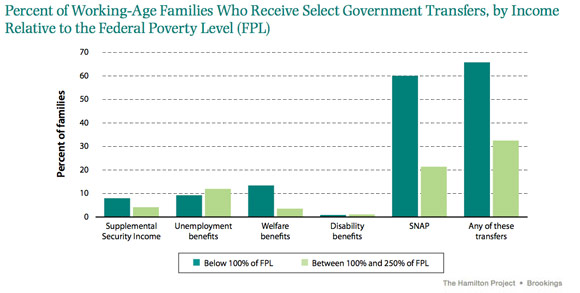
Vauhini Vara draws attention to the plight of the lower-middle class – families who make between $15,000 and $60,000 a year:
Compared with the poorest families, lower-middle-class families are more likely to be headed by married couples and to benefit from two incomes. They are also more likely to include a family head who has attended college. So far, so good: studies have shown that children who live with two parents are more likely to be more economically secure and to be healthy, as well as to graduate from high school; other studies show similarly positive effects for children of college-educated parents. And parents benefit, too.
And yet, many of these lower-middle-class families are still struggling to get by. About 60 percent of families below the poverty line receive food stamps (shown in the chart [above] as SNAP, for Supplemental Nutrition Assistance Program); so do more than 20 percent of lower-middle-class people. All told, more than 30 percent of lower-middle-class people receive food stamps, unemployment benefits, welfare, or other benefits.
This matters for a couple of reasons.
It reframes how we think about the people who access government benefits. Many of them, it turns out, are married, college-educated, and working – that is, people whose choices reflect traditional values and whose plight should inspire sympathy from both the political left and right. And it highlights the structural problems that make it difficult for lower-middle-class families to make ends meet and to rise into a higher income bracket. If you’re a married, stay-at-home mom who wants to work, for instance, you face a dilemma: if your husband’s salary is low enough to qualify your family for government benefits, getting a job could actually cost your family more in taxes and lost benefits than staying out of the workforce.
Hamilton Nolan comments:
The lower class is the most important class. But the lower class has the advantage of at least being obvious in its wretchedness. The lower middle class, by contrast, is easy to forget. On the one hand, it’s easy to assume that they are doing okay, because they’re working; on the other hand, they don’t make enough money to assert any real political influence. And all the time, they teeter on the edge of economic oblivion.


