In Bangkok, protests that began over a week ago demanding the resignation of Prime Minister Yingluck Shinawatra turned violent over the weekend. Joshua Keating explains the origins of the protests and points out a curious anomaly:
Thailand’s political predicament appears to contradict the longstanding idea in political science that as populations become wealthier and more educated, they will become more democratic. In Thailand, the wealthy, urban middle class are perhaps the least supportive of democracy. It’s not the only place where this seems to be the case.
Steve Herman notes that Thai democracy “has long been fragile here with the military conducting 18 coups since the end of absolute monarchy rule in 1932.” Jay Ulfelder considers why certain countries are prone to coups:
The most informative factors in thinking about coup risk are a country’s wealth, its form of government, and the recent occurrence of coup activity.
Coup attempts very rarely happen in countries that are rich, either fully dictatorial or fully democratic, and have no coup activity in the recent past. Almost all coup attempts, successful or failed, occur in countries that are relatively poor and have political regimes that mix features of autocracy and democracy. These mixed regimes are especially susceptible to coups when politics within them is sharply polarized, as it has been in Thailand for nearly a decade now.
Bruce Einhorn adds that, with the anti-government forces pressing for the military to step in, the current standoff could end the same way:
Pimpaka Nichgaroon, head of research for Thanachart Securities in Bangkok, warns that the current unrest could end as it often does in Thailand, with the generals intervening. Chances of a military coup are now 50-50, according to Pimpaka. The anti-Yingluck forces “want some kind of national unity government to help reform the political system before the country has a new election,” she wrote in a report published yesterday. However, that kind of regime change is unlikely “without some kind of military intervention or a coup, a risk we see rising from only 5% a month ago to a 50% probability now.”
I have had four miscarriages and, at the age of 40, have finally accepted that I will never have my own biological children. Your reader with the PhD in genetics wrote, “When something is very wrong with the genetic makeup of the embryo, it doesn’t develop properly and the body rejects it, as it should. … I wish there was more education about this; I think people would have an easier time accepting this outcome if they understood.”
This reader has obviously never experienced a miscarriage. I guarantee you that when a woman has a miscarriage, the first question she asks is, “What went wrong?” And unless a specific medical cause can be identified, she hears the above explanation. For most people, this in no way will lessen the grief. The loss of the pregnancy means the loss of not just a future baby, but all your hopes and dreams for that baby and your family. It sounds corny, but unless you have experienced the loss of a very wanted pregnancy, it is difficult to express the depth of grief and loss.
And yes, an early miscarriage is very different than a late term miscarriage, a stillbirth, or the death of child. But, to basically tell parents who miscarried early that they should get over it more easily because the baby was just not “meant to be,” biologically speaking, is highly insensitive at best.
By the way, I had an abortion in my early 20s. I have never regretted it, even now. Having a child at that age would have destroyed my sanity and life. My parents are very strict Catholics and I would probably have dropped out of college due to the shame it would have brought on my family. Why should I have destroyed my life just because our contraception of choice failed? Despite my four miscarriages later in life, I have always been, and remain, pro-choice. It’s so very personal.
Several other readers sound off:
I am a childless older gay male, and I have been really interested in reading your posts on the impact of miscarriages on couples. Thank you for bringing this to public conversation. The most important factor to me is how society treats this particular loss – by ignoring it, essentially. I have been guilty of the same ignorance – with my sister and niece, who both miscarried but subsequently had great kids. I was also struck by juxtaposing these comments to an earlier post on your site, “When Children Weren’t Cherished,” which tells the story of how losing young children before the 19th century, not to mention early miscarriages, was treated with as little emotion as the loss of a pet. Of course, many children died early then, so maybe it was so common that it wasn’t as sad as it might be today. However, there’s also the possibility that those older mothers grieved much as we do today, but it wasn’t noted because they were women and women had considerably fewer modes of communication then.
Another male reader:
Thank you for the thread on miscarriages. Because my wife was high risk, we knew we would have difficulty with her getting pregnant. We tried for years and then decided to try IVF. IVF was successful in getting her pregnant, but she suffered five miscarriages (all early on in the pregnancy). They were extremely emotionally painful. She viewed the miscarriages as her weakness (or maybe her fault). That, of course, is understandable, but, as a result, she didn’t want me to talk to anyone about them. She could talk to her trusted friends to help her process the pain, but I was kind of left to suffer in silence. I could, of course, talk to my wife about it, but I didn’t want to burden her with my pain. She was dealing with hers. It sucked.
Well, after the five miscarriages, she got pregnant again (via IVF). All was going well and about four weeks in she went for a routine sonogram. I usually went to all the appoinments, but couldn’t make this one. Our regular doctor was not there and one of the other doctors did the sonogram. He told my wife that the fetus was not viable and that a DNC will be scheduled. Of course, she was devastated and called me very upset. She then said that something did not feel right about the whole thing and she called our regular doctor. He said come in again the next day and he will re-do the sonogram. Of course, I went.
Well, he found the pulsating of a viable fetus. It was a miracle. Well, that little bundle of pulsating cells is now a beautiful six-year-old girl who is the light of our life. To this day, I can’t tell this story (or type it) without tearing up. To know we came so close to ending her life based on a faulty sonogram. Thank God my wife felt something was not right. Thank God!
Another happy ending from a reader:
I am sure that you’ve been inundated with stories in response to this thread. I was a bit reluctant to share, but others’ tales have deeply touched me … as so many of your threads have over the years. My husband and I had been happily married for over 13 years when we mutually decided that we would like to share our lives with a child. At 37, I was older to be trying for the first time. But for some reason, it never really crossed my mind that we might have a tough time getting (and staying) pregnant … even when the doctors warned that it might be.
After trying for several months, we were ecstatic when an early test came back positive. My husband was away on a business trip and I snapped a selfie (before everyone was calling them that) and texted him the great news with a subject line of “congratulations, Papa!” We told everyone, blithely. I went to the first OB visit on my own, figuring there would be many more visits when my husband could join me. The OB performed what we both expected to be a routine scan, but they couldn’t find a heartbeat. He told me not to be overly worried, as it was early on. I cried all throughout a blood draw, as a nurse told me to stop because my tears were “bad for the baby.” The tests indicated that I was still pregnant, but the scare left me shaken and I cried all the way home. I continued to feel pregnant and looked forward to the next visit, but they were never able to locate a heartbeat and eventually I stopped feeling pregnant and began to bleed.
Flash forward a few months and we were again elated when an at-home test came back affirmative. We were far more circumspect this time around and waited to tell even our families until I had a positive test at the OB and we saw a heartbeat on the monitor. We allowed ourselves to get excited and shared our good news. I was told that the signs looked good for us and started working out again. At just over 12 weeks, I was resting at home on a beautiful winter’s day after a workout when I felt a strange pull. I went to the bathroom and to my horror, was bleeding profusely. I called the doctor, asking if I could go to the emergency room. He said there was nothing they could do. He said he was very sorry that I’d miscarried again and that he would see me on Monday and we could talk about next steps. Distraught, my husband asked me what I felt like doing. I replied honestly, “I feel like getting drunk.” We cried over beers at the now-closed Brickskellar and decided that we still wanted to try again. That we truly wanted to be parents. I bled all weekend.
My husband took me to the hospital on Monday, but didn’t come in as we had our beloved dog with us. I cried as I recounted what had happened with the doctor. He sympathized and said that he would still need to do an ultrasound to let him know what we should do next and whether I would need a D&C. He began and then pulled back in surprise. I’ll never forget what he said next, “I don’t know what to tell you, but you have a completely healthy baby here.” He showed me my lovely and lively girl on the screen, with the strongest heart beat clearly visible. Through laughter and tears, I told him I’d gone drinking the night that I thought I had miscarried. He laughed and said not to do that again … but also not to worry. Everything was fine. I ran to the car to share the unbelievable good news with my husband. I burst out laughing again as I said that I had a feeling this was going to be one tough girl.
And she has been. She’s the strongest, funniest, most quixotic child and we know that we are unaccountably lucky and blessed to have her in our lives. Since all of this, I’ve comforted a number of my friends as they’ve dealt with their own miscarriages or pregnancy scares. It amazes me how no one talks of this … until we do. I now know that my own mother miscarried shortly after I was born. Thank you for making the space for this important conversation. It’s been cathartic to write out my own story.
While I truly despise the parents who followed Kimmel’s Halloween candy prank, I have to disagree with Sam Harris, who only lied to his kid once. I’m sorry, but I really did enjoy maintaining the fantasy of Santa Claus for my child. It was not only a lot of fun, but it provided great motivation when her behavior threatened to go to the dark side. Heck, I expanded the concept to include “Kenny the Birthday Kangaroo” who shared files with Santa. My best friend claimed to have Santa’s cell phone number on speed dial to report any last minute misbehavior. The Tooth Fairy paid ransom for teeth in both of our homes.
Those are all lies, and our children trust us. But it’s not the act of lying; it’s the intent behind the lie that determines if our children trust us. Our children know we would not harm them or cause them unnecessary pain (unlike the children who were tortured about candy so their parents could get a few minutes of fame). That’s what trust is about.
Another:
My wife once told our oldest son a good one.
When he was around 3, we went to Kauai for vacation and he discovered Fruit Loops at the hotel’s breakfast buffet. He fell in love and would make a beeline for them every morning. His mom and I weren’t happy about all of that sugar, but let it go as we were only there a week & hoped he would forget about it as soon as he stopped getting his breakfast at a buffet. Wrong. The first morning back home in Seattle, he started getting a little belligerent about wanting Fruit Loops. After a few minutes of firm no’s and trying to reason with him, he was still insisting. So she told him that unfortunately they were a regional food available only in Hawaii. He thought about it for a few seconds and that was it. He calmed down and ate his normal breakfast without further complaint. I thought it was genius.
Another differs:
I hated being patronized as a kid and always try to “keep it real” with kids. Judaism is my favorite Abrahamic religion because, in addition to revering scholarship and devoting a holiday to all-night Talmudic study, they avoid the Christian tendency to turn religious holidays into occasions for inventing impossible narratives (a flying fat man and a giant bunny delivering toys and candy respectively) and misleading children into believing them.
David Auerbach assesses the current state of Healthcare.gov:
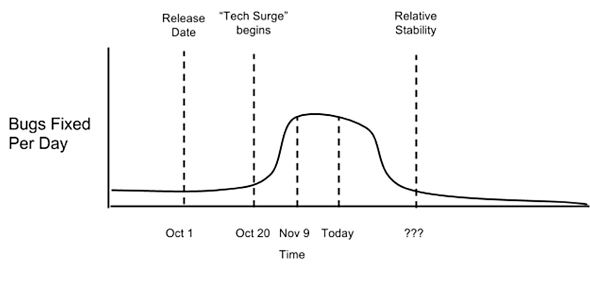
The report says little about what work is ahead of the engineering team, but at least one graph suggests there’s some ways to go:
Aside from confirming that it took the administration until early November just to start making significant progress on functionality fixes, the graph also indicates that engineers are still frantically fixing the site. If the site were anywhere near stability, you would expect the number of fixes to start to level off close to the administration’s self-imposed Nov. 30, signaling that they were ramping down crisis mode and making fewer fixes per day. But it doesn’t, indicating that they are still in the hump of this bug-fixing graph:
Suderman worries that fixing these bugs will prevent the rest of Healthcare.gov from being built properly:
With 30 to 40 percent of the site, including critical insurer payment systems, yet to be completed and tested, you can bet these problems will continue. Not only because it clearly takes longer than expected to excise flaws from the system, but because lingering problems with the portion that’s already been built will take time and energy away from constructing and testing the portions of the system that have yet to be put in place. The administration delayed the Spanish language version of site from its initial planned opening, and just last week announced that the federally run small business exchange that was supposed to open last month would be postponed by a year. The team working on Obamacare is already reported to be working around the clock on repairs; even if they don’t burn out from the weeks of long hours, it’s inevitable that building additional functionality and putting it through the paces will fall by the wayside if the existing troubles aren’t fixed.
Update from a reader:
In this post, the data regards bug fixes per day. To understand the stability of the site, however, you need to know how many new bugs are found per day (by end-users and QA staff). If their bug backlog was at 600 on November 1, and no other bugs have been filed, then the fix rate will drop off drastically in a week or two. If their bug backlog is still at 600, however, then the bug-fix trend line could continue to rise for months to come. To get a true understanding of the stability of the web site, we need to see open bugs over time and/or bugs filed over time.
Ramesh contends that the ACA violates “our statutory right to act on our religious beliefs”:
Up until 2012, no federal law or regulation required employers to cover contraception (or drugs that may cause abortion, which one of the cases involves). If 2011 was marked by a widespread crisis of employers’ imposing their views on contraception on employees, nobody talked about it.
What’s actually new here is the Obama administration’s 2012 regulation requiring almost all employers to cover contraception, sterilization and drugs that may cause abortion. It issued that regulation under authority given in the Obamacare legislation. The regulation runs afoul of the Religious Freedom Restoration Act, a Clinton-era law. That act says that the government may impose a substantial burden on the exercise of religious belief only if it’s the least restrictive way to advance a compelling governmental interest. The act further says that no later law should be read to trump this protection unless it explicitly says it’s doing that. The Affordable Care Act has no such language.
Amy Davidson has argued against that line of thought:
Hobby Lobby is arguing that it counts as a person whose religious expression, according to the Religious Freedom Restoration Act of 1993, shouldn’t be “substantially burdened” by a law unless there is a “compelling government interest.” (Adam Liptak has written about how this draws on the dubious logic of Citizens United.) But the burden of complying is missing and the compelling interest is clear. The owners of Hobby Lobby aren’t the ones taking Plan B.
The government, in a reply to the company’s SCOTUS filing, quoted the opinion of a judge who, writing about a related case, said that the mandate would not “encourage (the corporations’) employees to use contraceptives any more directly than they do by authorizing (the corporations) to pay wages.” The government, meanwhile, heavily underwrites the entire employer-insurance system through its tax treatment of the money that companies spend on health care. (As my colleague John Cassidy argues, a lot of this would be simpler if Obamacare had been more radical, introducing a single-payer system.) The government also has an interest in women being healthy and having fair access to the care they need.
One argument that has been made again and again by supporters of the legal challenges is that the religious consciences of employers are being burdened so that employees can get “free” contraception. But this is an erroneous argument that misapprehends the basic concept of employer-provided health insurance. Contraception provided by health insurance isn’t “free,” it’s earned. Companies get substantial taxpayer subsidies for partly paying employees in health insurance instead of cash. In exchange, this insurance has to be comprehensive enough to provide value to the employee. Women getting basic health-care needs covered by insurance they’re receiving as compensation are not receiving any kind of free ride.
This point underscores just how weak the legal challenge to the mandate is. The employers in question are claiming that there’s a major religious freedom issue at stake depending on whether employees obtain contraception through direct wages or through the insurance employers get tax benefits for paying employees with instead. But there isn’t. The “burden” imposed by the mandate is utterly trivial, and the argument that it violates RFRA should be rejected by the Supreme Court.
Meanwhile, Edward Zelinsky believes “this entire controversy is unnecessary”:
The tax law contains devices for reconciling the religious concerns of employers like Hobby Lobby with the policy of expanding medical coverage: health savings accounts (HSAs) and health reimbursement arrangements (HRAs). The current regulatory exemption from the contraception mandate should be amended to include for-profit employers and to exempt from the federal contraception mandate employers (both non-profit and profit-making) who maintain HSAs or HRAs for their respective employees. Compromise along these lines would respect the genuinely held views of religious minorities while implementing the federal policy of broadening access to health care.
Gabriel Arana has a long, pull-no-punches profile of the DADT activist and Iraq veteran. One of Choi’s darkest moments was at his trial earlier this year for chaining himself to a White House fence in 2010:
Dan called four witnesses to testify, then showed a video of his Rachel Maddow interview. While it played, he wept. “The defense rests!” he announced, putting his head down on the table and throwing up his arm. The judge called for a recess; Dan lay on the floor and shouted obscenities. In the afternoon, the prosecution delivered a brief closing argument. Dan gave a 40-minute speech. Raving and disjointed, it was a broken mirror of the life story he had told six months earlier. When the judge found him guilty and fined him $100, Dan cried out, “I refuse to pay it. Send me to jail!” Instead, friends took him to the emergency room of Washington, D.C.’s VA Medical Center, where he was admitted to the psychiatric ward.
The trial laid Dan bare. His passion. His penchant for inflamed rhetoric. His ability to attract followers. His solipsism. His vulnerability. On a few occasions, Dan has told me the trial was a plea for help. “I didn’t know what to do with myself after ‘don’t ask, don’t tell’ was repealed,” he says. Other times, he finds his nerve. “I just want them to apologize to me in open court—that’s all.”
I knew Dan, if not as well as many others. Every time I saw him, I told him to find some solace outside of the struggle, to get some peace of mind, to take care of himself. I feel terrible I didn’t do more. I know how one’s personal life can become besieged by a cause. For more than a decade, marriage and military activism consumed me, even as I was psychologically traumatized by the hatred other gay activists directed toward me and consumed by the stories of pain and self-destruction so many gay men confided in me. If you believe, as I did, that this was a transcendent moral calling, it became harder and harder to put limits on how it took over your life. I talked with Dan about this – especially about absorbing the suffering and pain of so many who looked to you for some kind of help. How do you say no? How do you say: this is where the struggle ends and my life begins?
This is the challenge for anyone trying to create change. I am luckier than Dan in some respects. I have a therapist of great skill and compassion; I have a faith that always imposed a spiritual check on my own narcissism; I have and had friends of surpassing loyalty and love and honesty; I found a husband who anchored me, and empowered me and kept me from self-harm. I see in Dan a human being whose passion for others in the end occluded his own sense of self. He forgot that happiness is an option – indeed that our struggle is about extending the full pursuit of happiness embedded in the Declaration of Independence. Alas, as time went by, I found myself consumed with work and too easily forgot my comrade on the battlefield. And when we did meet – sometimes randomly on the street – he seemed too far gone to reach any more.
Arana’s conclusion:
A few things I am certain of. Washington can make people, even those who fight for human rights, lose their humanity. It gets covered up with talking points, strategy, branding. At the height of Dan’s celebrity, few in the repeal movement pulled him aside and said, “All this doesn’t matter more than you do. Let’s go home.” Maybe that’s because he’d cut himself loose from the people who cared enough to tell him he was losing himself—people like Grace, Isaac, Sandra, William Cannon, Sarah Haag-Fisk, and Laura Cannon.
None of this is to say Dan would have listened. He had fallen in love with his own martyrdom. He had conflated activism with celebrity.
Dan’s story runs in my head like an episode of E! True Hollywood Story. He starts out naïve and precocious. He rises. He succumbs to the pressure—all those interviews, rallies, fan letters, expectations. But instead of playing out on Bravo or in the pages of Us Weekly, it played out on MSNBC and in The Advocate. What I have to keep reminding myself is that by speaking when no one else would, Dan Choi did a good and courageous thing, and in part because of it, gays and lesbians can now serve openly in the military.
(Photo: Former US Army Lt. Dan Choi, a gay rights activist and opponent of ‘Don’t ask Don’t Tell’, arrives at the E. Barrett Prettyman Federal Courthouse on March 28, 2013 in Washington, DC. The former Iraq War vet and graduate of West Point was going to trial to face charges that stem from a November 2010 arrest for chaining himself to the White House fence to protest “Don’t Ask, Don’t Tell.” By Brendan Smialowski/AFP/Getty Images)
The administration has given up on success, as it might once have defined it. The object is no longer 7 million people signed up through the exchanges, with 2.7 million of them young and healthy, and the health-care cost curve bending back toward the earth. It is to keep the program alive until 2015. The administration’s priorities are, first, to keep Democrats from undoing the individual mandate or otherwise crippling the law; second, to keep insurers from raising premiums or exiting the marketplace; third, to tamp down loose talk about the failures on the exchanges; and, only fourth, to get to the place where it used to think it would be this year, with lots of people signed up for affordable insurance. It is now measuring the program’s success not by whether it meets its goals, but by whether it survives at all. And all of its choices are oriented toward this new priority.
But, as Beutler points out, repeal gets harder every passing day:
In the months ahead Republicans will squeeze every drop of political juice they can out of every Obamacare failure and hardship they can unearth or spin into existence. But the goal won’t be repeal. It will be to channel the right’s Obamacare obsession into voter turnout in 2014 — at which point millions of people will be insured and the law will be unrepealable.
Chait declares that there “is no existential threat to Obamacare”:
So what are we fighting about? How smoothly the law operates, and how many customers it manages to enroll by the end of Obama’s term, are open questions. Likewise up for debate is whether Obama’s approval ratings will recover. But these are not fundamentally questions about the life or death of Obamacare. They’re about how much political pain Democrats in Congress must endure. We’re not fighting over health-care policy. We’re fighting about the midterm elections.
[W]hat you’re likely to see over the next several days are mostly anecdotes and spin. Democrats will point to examples of Americans having success with the website (and there are more and more of those). And Republicans will point to examples of continued problems (and those still exist). But to gauge if the website is truly better, there are two things to watch for in the next two weeks. One, are the insurance companies and government beginning to air their multi-million TV ad campaigns? “The big tell of if/when people finally believe it’s working is when you see the states, insurance companies, etc., restart their ad buys and outreach programs that they put on hold to drive people to the site,” a Democrat paying close attention to health care’s implementation told First Read. Two, are skittish Democratic politicians — especially those from red states — a little less skittish than they were last month? Or more skittish? That will be another tell.
Maybe, however haltingly, we are finally getting to the main event. The day when people can get a good idea for themselves just what value Obamacare presents for them. The premiums, the deductibles and co-pays, as well as the provider networks. Not just the people who are now uninsured or have had their policy canceled, but also those who don’t need Obamacare today but think they might someday. All of them voters focused on finding out for themselves what this Obamacare thing really is.
That clearly looks like Glasgow. After last week’s contest highlighted the tiebreaker rules, I’m going to accrue an unbeatable number of previous guesses in the event I do actually try and wind up tied!
Another is super confident:
Any graduate of the University of Wisconsin in Madison will recognize this view of the campus, with the yellow Stock Pavilion on the right, Liz Waters Hall in the upper distance and Lake Mendota on the left. The iconic peninsular Picnic Point juts out into the lake from the left. Harder to pinpoint the window from which the shot was taken, but probably somewhere in Van Hise Hall, the tallest building on campus.
Another:
I like to guess at images that look like somewhere I’ve been, rather than using all the technology other readers do. So, it looks like Tarrytown to me, with the Hudson River in the background.
A few others also guessed upstate New York. Or further north:
My wild guess is Quebec City, somewhere north of downtown and close to the river. That could be the Manoir Ste-Genevieve in the far distance, just to the left of the yellow house, and the peninsula could be Sinte-Petronille.
One reader had a lot of ideas:
The architecture reminds me of Germany, but the buildings are too new and the density is too low for Germany. The landscape seems Laurentian Forest, with a glacial lake or inlet, so maybe upstate New York, Quebec, New England, or upper US Midwest? Alaska or British Columbia? The buildings in the background could be timeshares – a resort town?
Another settles on the correct side of the Atlantic:
I have no wherewithal to defend this, but Amiens, France is my hunch. Spent a few similarly grey days there almost eight years ago while “studying” abroad.
Another:
This one seems pretty likely to be in northern Europe somewhere, but it seems a little too plain for Germany, so I thought it might be in the eastern side. Started looking at Prague, another place I’ve always wanted to visit, and it is so charming I never got around to looking at anywhere else. You can even street view in the zoo there! And the public art is amazing.
Another heads in the right direction:
The architecture screams Germany – particularly the yellow building with the gabled roof. Looks like northern Germany, Schleswig-Holstein, which isn’t particularly hilly except around the Holsteinische Schweiz, which also has lakes. Without knowing the exact location, it could easily be Kiel. Butcould also be Ratzeburg, Flensburg, any number of places. I’ll go for Plön.
Another gets much closer:
This has to be Oslo. It’s an image full of Nordic gloom, but also prosperous bourgeois architecture and a dramatic fjord. Not sure of the neighborhood, but my guess would be Nordstram, just to the east of the center of the city.
Another gets a similar hunch:
Just feels like southern Norway on a fjord. Colors of buildings and roofs are similar to those seen in the area. No pictures pop up in a quick search – so I’ll just lay my marker on Oslofjord, and let the pros dig deeper.
This week’s view comes from Lidingo Island on the outskirts of Stockholm, Sweden. The picture was taken from the fifth floor of the Scandic Foresta Hotel, possibly room 507, and looks north by northwest along a heading of 342.68 degrees:
It was room 509, not 507 – you’re really slipping, Doug. Meanwhile, only one other reader guessed even the correct country. The entirety of her entry:
Stockholm – Sweden – Europe
Close enough for a win this week. From the submitter:
Great to see my window photo used in the contest for the second time – the first was Contest #5, of the midnight sun over Tromso, Norway. Also exciting to see two of my windows from one trip; later in the day I took the photo, I flew to Beijing, where I took the photo you used from the Summer Palace.
As I wrote when I sent this week’s photo, it’s from room 509 at the Scandic Hotel Foresta, on the island of Lidingö in the Stockholm suburbs. From the Street View that contestants surely will find, the building appears to have only four stories. This is because the hotel is a sprawl up the hill from the historic castle-like Villa Foresta. The modern wings have made this a conference hotel. I was there to speak at a transgender health conference. So, if instead of a room number you get a circled window, I believe it is the top floor window visible in the Street View. The Foresta sign is quite visible as one crosses the bridge to Lidingö, and the hotel borders the well-known sculpture garden and museum of Carl Milles – the Millesgården, so this should be a more recognizable view than last week.
By the way, the Foresta had perhaps its most famous guests when the Beatles stayed there at the height of Beatlemania in 1964: