Jill Harness praises Sarah Ernhart’s pictures of dog-owners with their terminally ill or elderly pals:
Photographer Sarah Ernhart has captured a variety of images of dogs spending their final days with their loving humans and while heart-breaking, the series is simply beautiful. It really captures the friendship and love between people and their pets.
“Christ’s resurrection is not an event of the past; it contains a vital power which has permeated this world. Where all seems to be dead, signs of the resurrection suddenly spring up. It is an irresistible force. Often it seems that God does not exist: all around us we see persistent injustice, evil, indifference and cruelty. But it is also true that in the midst of darkness something new always springs to life and sooner or later produces fruit. On razed land life breaks through, stubbornly yet invincibly. However dark things are, goodness always re-emerges and spreads. Each day in our world beauty is born anew, it rises transformed through the storms of history. Values always tend to reappear under new guises, and human beings have arisen time after time from situations that seemed doomed. Such is the power of the resurrection, and all who evangelize are instruments of that power,” – Pope Francis, The Joy of the Gospel.
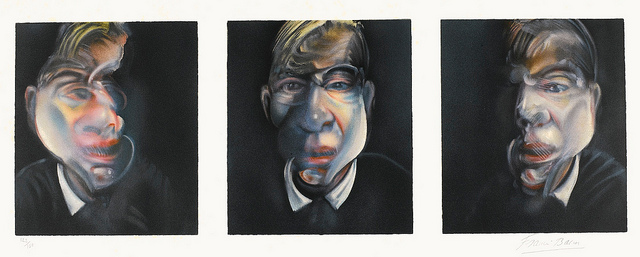
David Griffiths, a Catholic writing professor, broke down in tears when he heard the announcement that the new pope would be named Francis. Looking back, he realized how the experience helped him make the connection between two of his heroes – St. Francis and the artist Francis Bacon, both of whom were “bursting with a desire to embrace the ugliness and spiritual poverty of this world in a way that called attention to it, named it, so that others might see”:
In retrospect, my reaction to Pope Francis’s election makes so much more sense when I consider that during my tenure at the college my artistic guiding lights were St. Francis and the painter Francis Bacon. About as far from a saint as one can imagine, Bacon is infamous for showing us things that perhaps we would rather not see: nightmarish self-portraits, unnerving studies of screaming popes, and writhing and wrestling biomorphic forms.
But Bacon was not interested in merely horrifying us. He was painting, as he said in an interview, to “excite himself”; spreading paint in a way that was expressive of his anger, his lust, and his love of painting. In a rare explanatory moment, he revealed to an interviewer that his numerous paintings that reference crucifixion were not religious but “an act of man’s behavior to another.” Some moralists have said that his paintings are corrupting and harmful, but I’ve always felt that they do no more harm than if one took to hanging around a butcher shop or meat packing plant. To me, his paintings, like all great art, make us confront essential questions about the human condition.
(Image of Francis Bacon’s Three Studies for Self-Portait (1981) from Flickr user Cea.)
he’s two nights gone for the second
time. two weeks before that he left
the rehab house and they wouldn’t take
him back. that was two years after he
left the penitentiary and broke two
hearts when he was paroled to my custody
on the condition of marriage. but it
would only take a couple of months before
he started backsliding, picking up the
old habits, old homies, old tracks.
it got to be too much for me and i was
two jumps from killing him when
he split. last time we made love was to
that Doors song of like refrain. now
that he’s gone all I seem to do is
remember how good the two of us got
when we put one-and-one together
David E. Campbell, the co-author, with Robert Putnam, of the in-depth study of religion’s place in America’s social fabric, American Grace, reveals a twist to the trope that believers are more charitable than the non-religious:
Having found that religion and charity go hand-in-hand, Robert Putnam and I sought to understand why. The answer might surprise you. We initially thought that religious beliefs must foster a sense of charity—whether inspiration from biblical stories like the Good Samaritan or, perhaps, a fear of God’s judgment for not acting charitably. However, we could find no evidence linking people’s theological beliefs and their rate of giving—which also helps to explain why the “religion effect” varies little across different religions. The rates for charitable giving according to the Jumpstart survey are: 61 percent of Black Protestants; 64 % of Evangelical Protestants; 67 % of Mainline Protestants, 68 % of Roman Catholics, and 76 % of Jews. By contrast, only 46 % of the not religiously affiliated made any charitable giving.
Rather than religious beliefs, we found that the “secret ingredient” for charitable giving among religious Americans is the social networks formed within religious congregations. The more friends someone has within a religious congregation, the more likely that person is to give time, money, or both, to charitable causes. In fact, even non-religious people who have friends within a religious congregation (typically, because their spouse is a believer) are highly charitable—more so than strong believers who have few social ties within a congregation. Our findings thus suggest that if secular organizations could replicate the sort of tight, interlocking friendship networks found within religious organizations, they too would spur a comparable level of charitable giving.
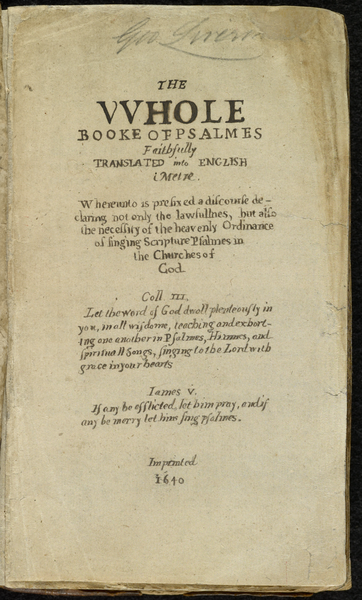
Translated directly from Hebrew into English, the Bay Psalm Book was printed in Cambridge, Massachusetts, in 1640, less than twenty years after the Mayflower left Plymouth, England. It was the first book printed on the Puritan minister Joseph Glover’s press, the first such device to make the journey across the Atlantic. Although Glover died during the 1638 crossing, his widow, Elizabeth, inherited the press and saw to its installation. She established America’s first print shop in a little house on what is now Holyoke Street in Cambridge. …
One can scrutinize every verse of the Bay Psalm Book online. The text rewards such study, but it does not explain why the first book printed in America was a Psalter. Psalters are an unfamiliar genre for many, even those who worship regularly. Psalm-singing had for centuries been the demesne of a hand-picked choir, but the English Reformation invited the voices of the entire congregation. This printing of the Psalms in verse, set to meter, allowed them to be sung by all. Thus the Bay Psalm Book is a kind of hymnal. … America’s history spans just a few centuries, but hundreds of hymnals. Colonists came seeking religious freedom, so the first book they printed was not a political tract or even a Bible, but a hymnal: a book to be used regularly in communal and even private worship.
Thinking through the function of religious rituals, Dreher grapples with what he’s learned from repeating the sacrament of confession again and again:
I’ve found over the years that eventually I get tired of bringing the same damn thing to my confessor, and that sense of accountability provides a nudge to try harder not to do the damn thing. Most of us have a tendency to hide from ourselves — to rationalize and to avoid. Once you get into the habit of confession, and the habit of mind that confession creates in you, it becomes a lot harder to hide from yourself. Some of us struggle with scrupulosity — that is, an unbalanced preoccupation with our sins. I can’t say I was ever scrupulous, strictly speaking — I’m far too lazy for that — but when I was a pious young teenager, I would pray often for specific sins to be forgiven, but never really could be sure that I was forgiven. The rite of confession, I learned later in life, gave me a sense of security in knowing that my sins had been forgiven. Somehow, I needed to hear it from a priest: “Go, your sins are forgiven.” There’s life-giving power in that.
I can’t imagine an atheist version of confession. What would it look like? How would it work, if you don’t think there’s any such thing as sin? What standards would you use to measure whether or not one had missed the mark? If you see no man (or woman) with actual spiritual authority over you, or at least as the channel of real supernatural grace, how would the ritual work to relieve the psychological burden? Of course there is a secular version of examination of conscience in the presence of a trained professional; it’s called therapy. But it’s not really the same thing as confession, as Rabbi Rieff explained to us all. Confession is about helping you achieve sanctity; therapy is about easing anxiety about your condition, which might entail changing your behavior, or might not.
The Catholic Church makes its definition of sacred music pretty clear, stating in Musicam Sacram that music for the mass must “be holy, and therefore avoid everything that is secular.” It goes on to say that sacred music must also be “universal in this sense.” … I think it’s fair to say that the music has to be about God. The word sacred by definition must have to do with God or the gods, and most of the music of the contemporary worship movement fits this criterion. Perhaps then we should consider the purpose of sacred music: to function as part of the mass or service, most often as a part of worship. Worship derives from Old English weorthscipe ‘worthiness, acknowledgement of worth’. So if sacred music is intended to worship God, then such music must be of worth.
Kenan Malik suggests an alternative definition, one that operates “[n]ot so much as an expression of the divine, or as a set of rules and taboos, but, paradoxically perhaps, more [as] an exploration of what it means to be human”:
From the late medieval period on, ‘sacred’ art became increasingly humanized. The German critic Eric Auerbach called Dante, in the title of a famous study, a ‘poet of the secular world’. Dante’s Divine Comedy, despite its focus on the eternal and immutable features of heaven and hell, is at heart, Auerbach insisted, a very human exploration of this world. The human takes centre stage in The Divine Comedy, in way that had not happened previously in Christian thought. In this, Dante looks forward to the poets and artists of the Renaissance and beyond. Eventually the sense of transcendence in art came to be detached from religion entirely as in twentieth-century works such as Stravinky’s Rite of Spring or in Rothko’s paintings, in many of Barbara Hepworth’s figures or in Pablo Neruda’s love poems. It makes little sense to call such works of art ‘sacred’. There is, yet, a transcendent sensibility that links these to, say, works such as Bach’s Cantatas or Giotto’s frescoes or Dante’s Divine Comedy. To lose sense of that is to diminish both what is ‘sacred’ about sacred art and what is transcendent about much non-religious art.
(Video: performance of Bach’s cantata 184 “Erwünschtes Freudenlicht” (O welcome light of joy))
A woman, single or married, can never become ordained. Many lapsed women have told me the Church’s treatment of women is the reason they have drifted from Mass and never returned. The anger the women in this anthology feel ranges from those who have sprinted from the Church and never looked back to those who long for a return home, even if that house feels broken. My gender precludes a complete understanding of this anger, this distance.
In that vein, when I posit that the best pieces in Unruly Catholic Women do not consider the Catholic hierarchy as a formless omnibus, I do not mean those words as an apologetic retort. One can hold such an opinion, of course, but it makes for thin creative work. Sustained critique is not possible with straw men.
Consider Kaya Oakes’s excellent recent memoir, Radical Reinvention. Oakes finds spiritual direction from both women and men in the Church; she notes its imperfections while finding its ultimate perfection in Christ. There are pieces in this anthology that perfectly capture the paradox of distaste and desire. Place a complaint of the Church delivered through caricature next to the earned wit of “Exile” by Colleen Shaddox: “To be raised Catholic and switch denominations is a lot like giving up Haagen-Dazs for broccoli. You miss the richness, even if you know it’s bad for you.”
Oakes reflects on her decision to remain a practicing Catholic:
[A] female Episcopal priest [told] me that the great feminist theologians are all Catholic for a reason, “because they’re still fighting. Because they’ll be fighting for some time to come.” We can’t bless the bread, or tear it with our hands. But look closely—in the pews, in the back, some of us are lifting our hands. We can’t read the Gospel. But we read everything else. We can’t baptize the children we might bear, lay our dead to rest with those words of grief and consolation; we can’t preach, we can only offer a “reflection” once in a great while. We can’t. We cannot. …
But in that “cannot” I have heard in my church, in the church I freely choose when it tells me all of the things I can’t do, I’ve never felt denied to the point of resentment. Because, vocation? My vocation isn’t behind an altar. My vocation is putting my ass in a pew, week after week. My vocation is the vocation of billions of people, in nearly every religion. It is the vocation of showing up.