How To Write Tall Tales

Nick Ripatrazone riffs on Andre Dubus’ essay on the craft of short story writing, “The Habit of Writing,” in which he reveals how and why he “changed his method while writing a story, ‘Anna,'” which is told from the perspective of its eponymous female character:

“At my desk next morning I held my pen and hunched my shoulders and leaned my head down, physically trying to look more deeply into the page of the notebook. I did this for only a moment before writing, as a batter takes practice swings while he waits in the on-deck circle. In that moment I began what I call vertical writing, rather than horizontal. I had never before thought in these terms. But for years I had been writing horizontally, trying to move forward (those five pages); now I would try to move down, as deeply as I could.”

Horizontal writing is focused on amassing pages and words.

When Dubus wrote horizontally, he wrote convinced that fiction was created through aggregation. Vertical writing, in contrast, values depth over breadth. Stories are written when they are ready to be written; they are not forced into existence by planning or excessive drafting. Horizontal writing seeks to move across the page; vertical writing seeks to dig into the page, to value the building of character and authenticity over the telegraphing of plot. The folly of horizontal writing is that it convinces writers that fiction writing operates on a production model. If they simply sit at the desk and pound out page after page, the story will come. That might be true, but Dubus argues that such forced work creates a lot of “false” fiction. Curiously enough, by seeking to undermine the stereotype that writing is the result of inspiration, writers have fallen for the other, no less romantic opposite: that writing is factory work, and daily devotion is rewarded with final drafts. Both approaches are magical thinking. Vertical writing is no less work, but it is better work, work at the right time. It requires patience in the willingness to wait for a story to feel ready to be written, as well as the attention and focus necessary to inhabit the story once gestated.

Read last weekend’s Quote For The Day from Dubus here. Check out all the Dish-love for Dubus here.

A Smaller Screen For Sex

NSFW, but safe for NSFW Saturday:

Adam Sternbergh asks why there’s a “tendency in modern mainstream movies to treat sex as something that happens elsewhere, offscreen and unspoken of”:

Part of the reason is because of the internet, that perpetual digital orgy, which has busted the movies’ monopoly as the place where we go to glimpse naughty things. (That sexy scene in Moscow on the Hudson? The whole movie’s currently streaming on Hulu.) And part of the reason is because Hollywood, in the blockbuster age, has succumbed to the self-neutering gospel of the four quadrants — by which the world is split up into increasingly gory R-rated action and horror films; fun-for-the-whole-family superhero epics (superheroes, it’s well known, have no genitalia); animated films for the kid in all of us; and movies by Nicholas Sparks.

In the era of Top Gun, The Big EasyBody Heat, or other steamy Hollywood thrillers, the goal was to appeal to both men and women with the promise of (among other things) onscreen sex.

(Ergo the fabled “date night” movie.) Now the goal is to appeal to adults and their 12-year-old kids with the promise of the absence of sex. As for more serious films, flipping back through the Best Picture nominees from the last few years — films like Argo and The King’s Speech and Inception — the only ones with truly memorable sex scenes are Black Swan and The Wolf of Wall Street. Yet in the former, the sex (between Natalie Portman and Mila Kunis) plays out like a nightmare; and in the latter, the sex feels like a porno directed by Hieronymous Bosch.

But the real cultural shift — as any with a pay-cable subscription will tell you — is that the small screen has finally steamed over. After decades spent as Hollywood’s prudish country cousin, TV now brings televised sex of near-Caligulian variety and inventiveness into our homes. There’s even a term, sexposition, created specifically for moments when characters are communicating information while also having, or watching, sex. TV, in particular pay cable, has claimed this ground in part because it can — there’s no MPAA threatening to slap censorious NC-17s on True Blood every week.

Of course, Dan Savage has been trying to reverse this trend for years with his amateur porn festival:

Worst Sex Of The Year

In fiction, anyway. This year, Ben Okri has been awarded the Literary Review Bad Sex in Fiction award for a passage in his tenth novel, The Age of Magic:

“When his hand brushed her nipple it tripped a switch and she came alight. He touched her belly and his hand seemed to burn through her. He lavished on her body indirect touches and bitter-sweet sensations flooded her brain. She became aware of places in her that could only have been concealed there by a god with a sense of humour.

Adrift on warm currents, no longer of this world, she became aware of him gliding into her. He loved her with gentleness and strength, stroking her neck, praising her face with his hands, till she was broken up and began a low rhythmic wail … The universe was in her and with each movement it unfolded to her. Somewhere in the night a stray rocket went off.”

Okri faced some, er, stiff competition for this year’s award:

The winner of this year’s Booker, Richard Flanagan, with The Narrow Road to the Deep North, was a contender with: “Hands found flesh; flesh, flesh. He felt the improbable weight of her eyelash with his own; he kissed the slight, rose-coloured trench that remained from her knicker elastic, running around her belly like the equator line circling the world.”

Haruki Murakami’s Colorless Tsukuru Tazaki and His Years of Pilgrimage resorted to naturalistic metaphors: “Shiro’s were small, but her nipples were as hard as tiny round pebbles. Their pubic hair was as wet as a rain forest. Their breath mingled with his, becoming one, like currents from far away, secretly overlapping at the dark bottom of the sea.”

Pulitzer Prize-winner Michael Cunningham’s The Snow Queen weighed in with: “He hears himself gasp in wonder. He falls into an ecstatic burning harmedness, losing, lost, unmade. And is finished.”

Face Of The Day

emb-3

Christopher Jobson captions:

When scouring through the minute details of artist Cayce Zavaglia’s embroidered portraits (previously), it’s difficult imagine each work is scarecely larger than 8″ x 10″. Her process, which she refers to as both “thread painting” and “renegade embroidery,” begins with a photoshoot of each subject, namely friends, family, and fellow artists. Roughly 100-150 photos are winnowed down to a single selection which she then begins to embroider with one-ply embroidery thread on Belgian linen.

(Image: Cayce Zavaglia’s “Florence,” 2014, courtesy of Lyons Wier Gallery, New York)

A Short Story For Saturday

This weekend’s short story, Julie Hayden’s “Day-Old Baby Rats,” was recommended by a reader. Hayden died too young at age 42, and this selection comes from her only collection of stories, The Lists of the Past, published in 1976. Writing about the story, S. Kirk Walsh describes how “Hayden’s nameless protagonist embodies the acute loneliness of living in Manhattan — how the distorted lens of irrational fears and past traumas can transform the city into a dangerous landscape, seemingly impossible to navigate.” How it begins:

DOWN NEAR THE RIVER a door slams; somebody wakes up, immediately flips over onto her back. She dreamed she went fishing, which is odd because she’s never fished in her life. She thought someone was calling her “baby.”

There’s a lot of January light crawling from beneath room-darkener shades, casting mobile shadows on walls and ceiling. The mobile is composed of hundreds of white plastic circles the size of Communion wafers. As they spin they wax and wane, swell and vanish like little moons. Their shadows are like summer, like leaves, the leaves of the plane tree at the window, which hasn’t any, right now, being in hibernation.

Though the crack between window and sill, air that tomorrow’s papers will designate Unsatisfactory flows over one exposed arm, making the hairs stand up like sentries. Long trailer trucks continue to grind along the one-way street, tag end of a procession that began at 4 a.m. with the clank and whistle of trains on dead-end sidings, as melancholy as though they were the victims they had carried across the Hudson. The trucks carry meat for the Village butcher shops, the city’s restaurants—pink sides of prime beef that you cannot purchase at the supermarket, U.S.D.A. choice or commercial, pigs, lambs, chickens, rabbits, helped off the trucks by shivering men who warm their hands over trash-basket fires.

In the apartment across the hall the baby is bawling, “I want my milk.”

Read the rest here. Peruse previous SSFSs here.

Beauty In The Eye Of The Digital Artist

Josh Dickey lifts the curtain on “beauty work” in the movie industry, which he describes as “a digital procedure of sorts, in which a handful of skilled artists use highly specialized software in the final stages of post-production to slim, de-age and enhance actors’ faces and bodies”:

As Photoshop is to magazine photography, digital beauty has become to celebrities in motion: a potent blend of makeup, plastic surgery, muscle-sculpting, hair restoration, dental work and dermatology. Even the most flawless-in-real-life human specimens are going under the digital knife. Because they can. Because in this age of ultra-high definition, they have to. …

The technique made its “out” debut when Lola [Visual Effects] aged Brad Pitt backwards for Benjamin Button in 2008. As it turned out, the most striking visual in David Fincher’s epic wasn’t Button the shriveled, elderly man-child. It came toward the end of the film, when Pitt emerged into the golden light of a dance studio as a naturally radiant, strapping 20-something — this, at a time when Pitt, in his mid-40s, was just beginning to age into his real-life role as the sexiest man alive.

Dickey writes that, though few performers cop to it, beauty work is de riguer in Hollywood:

A recent comedy hit featured a top actress in her 40s who required beauty work on every single shot she was in — some 600 total. With artists working around the clock, seven days a week, the beauty work alone took close to three months.

The payoff? Nearly everything written about the film remarked at how fit and young the actress looked. No one suspected it was anything but good genes and clean livin’.

The Consolations Of Poetry

From the Poetry archives, this essay from the late, great American philosopher, Richard Rorty, stands out as a lovely paean to verse. When Rorty learned he had the inoperable pancreatic cancer that would take his life, he reflected on what especially resonated in his reading:

Some months after I learned the bad news, I was sitting around having coffee with my elder son and a visiting cousin. My cousin (who is a Baptist minister) asked me whether I had found my thoughts turning toward religious topics, and I said no. “Well, what about philosophy?” my son asked. “No,” I replied, neither the philosophy I had written nor that which I had read seemed to have any particular bearing on my situation. I had no quarrel with Epicurus’s argument that it is irrational to fear death, nor with Heidegger’s suggestion that ontotheology originates in an attempt to evade our mortality. But neither ataraxia (freedom from disturbance) nor Sein zum Tode (being toward death) seemed in point.

“Hasn’t anything you’ve read been of any use?” my son persisted. “Yes,” I found myself blurting out, “poetry.” “Which poems?” he asked. I quoted two old chestnuts that I had recently dredged up from memory and been oddly cheered by, the most quoted lines of Swinburne’s “Garden of  Proserpine”:

We thank with brief thanksgiving

Whatever gods may be

That no life lives for ever;

That dead men rise up never;

That even the weariest river

Winds somewhere safe to sea.

and Landor’s “On His Seventy-Fifth Birthday”:

Nature I loved, and next to Nature, Art;

I warmed both hands before the fire of life,

It sinks, and I am ready to depart.

I found comfort in those slow meanders and those stuttering embers. I suspect that no comparable effect could have been produced by prose. Not just imagery, but also rhyme and rhythm were needed to do the job. In lines such as these, all three conspire to produce a degree of compression, and thus of  impact, that only verse can achieve. Compared to the shaped charges contrived by versifiers, even the best prose is scattershot.

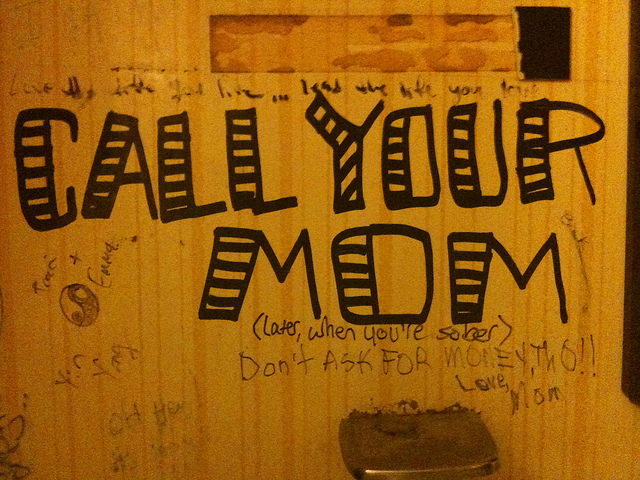
Taking A Stand On The Can

4999435769_d937a7a842_z

Julie Beck looks at latrinalia, or bathroom graffiti:

While it would be impossible to come up with a comprehensive unified theory of why people write poop jokes and names with hearts around them while they’re on the pot (other than the perhaps scientifically unsatisfying “Because it’s fun”), there are several factors that seem to be at play. One is that bathroom graffiti is a forum for anonymous, often-inappropriate expression, not unlike an Internet comments section, except with the added bonus of creating something tangible that exists in the real world. Plus, as Matthews notes, “It’s still illegal. It’s deviant, but it’s a low-cost deviant thing to do.” There’s a low likelihood of getting caught, and it’s usually something that can be washed off, or painted over.

Toilet graffiti also offers an interesting contrast to the way people typically behave in the bathroom. The unspoken rules of keeping to oneself, not making eye contact, and avoiding talking to strangers, all contribute to a sometimes-tense environment with the goal of shifting focus away from what’s actually happening behind stall doors. But the graffiti on the stall doors does not ignore it one bit. It crudely acknowledges and pokes fun at what we all go to the bathroom to do, and flouts the politeness surrounding it as well.

(Photo by Flickr user liquidsunshine49)

A Child’s Uncertain Identity

Erin Siegal McIntyre tells the gripping story of a child caught between two sets of parents, Timothy and Jennifer Monahan of Missouri, who adopted her from Guatemala, and Loyda Rodríguez and Dayner Hernández, who say she was abducted from their home when she was a toddler. Though Guatemalan officials have ordered that the girl, known as Karen to her American parents, be returned to her Guatemalan family, she remains in the US. From McIntyre’s recounting of the legal quagmires surrounding the case:

The Monahans made it clear that they didn’t believe the results of the DNA test that showed a match between Karen and Loyda Rodríguez. They implied that the little girl in their home wasn’t the same child whose DNA had been tested in 2007. In Guatemala, Jennifer Monahan said, “DNA is sort of viewed as a title, and we strongly feel that Karen isn’t property.” … [The Monahan’s lawyer Jared] Genser … declared that the Guatemalan court ruling had no jurisdiction in the US.

Yet the original issuance of Karen’s orphan immigrant visa, necessary to enter the US, and her American citizenship both depended on the authenticity of certain identifying documents—the same documents that had been voided by the Guatemalan judge. Essentially, US citizenship had been granted to a girl whose identity was in dispute.

When asked what they would do “if it is proven that Karen is Mrs. Rodríguez’s daughter,” Timothy Monahan answered, “It’s really very difficult to say.” He added that they’d been “trying to work with authorities all through this process.” But Guatemalan authorities said they’d never been contacted by the Monahans.

The same day the Monahans made their TV appearance, thousands of miles south, two women intimately involved in Karen’s adoption were sentenced in court for human trafficking, document fraud, and criminal enterprise related to the buying and selling of the child. [Guatemalan adoption lawyer Susana] Luarca’s nursery director and the lawyer who facilitated Karen’s adoption were both found guilty of all charges, and were sentenced, respectively, to sixteen and twenty-one years in prison.

Keep reading about the case here.