Are Colleges Failing Their Mentally Ill Students? Ctd

Rachel Aviv reports on a Princeton undergraduate asked to leave the school following a suicide attempt:

In balancing the rights of students against the need for safety and order, many universities require suicidal students to leave campus. At Yale, Brown, George Washington University, Hunter College, Northwestern, and several other schools, students have protested these policies, by initiating litigation, submitting complaints to the Department of Education’s Office of Civil Rights, or writing columns in campus newspapers.

W.P. retained a lawyer, Julia Graff, an attorney at the Bazelon Center for Mental Health Law, who said that she gets calls every month from students who were asked to withdraw after their universities became aware of their mental disorders. “Universities don’t seem to understand that mental-health disabilities are chronic illnesses, and it is not uncommon to have to be briefly hospitalized now and again,” she told me. “It doesn’t mean that you are not competent to be a student.”

Two weeks after being banned from his classes, W.P. appealed Princeton’s decision. In a long letter, he noted that the university prides itself on its diverse student body—he pointed out that his residential college called itself “a place where individuals could be accepted for who they are”—and students with mental disabilities, he wrote, contributed to that diversity. …

W.P.’s private psychiatrist, to whom he’d been referred by Princeton’s health center, submitted a letter that stated that W.P. did not pose a threat to himself. “An important aspect of W.P.’s recovery is a sense of purpose,” the psychiatrist wrote. “Requiring a leave of absence and excluding him from the university community at this time could be detrimental to his health and well-being.”

The appeal was denied.

Previous Dish on the topic here.

Quote For The Day

“In all my time studying fraternity rapes for my own essay, I didn’t come across a single report of anything like this. I did find reports of women who were raped by multiple men on one night—but those always involved incapacitation, either by alcohol or a drugged drink. And I did also find accounts of violent, push-down rape of the kind in the essay—but those were always by one member, not a bunch of members. (In fact, many of that kind—now that I think about it—were committed by non-members, or by visiting former members). But a planned gang rape, without alcohol or drugs, and keyed to initiation—I have never seen a case like that. Nor have I seen penetration with a foreign object—I’ve seen plenty of that committed by brothers to pledges as hazing, but I haven’t seen it in sexual assault cases. I’m sure it’s happened, but again—as part of a ritualized gang rape … Never anything like it,” – Caitlin Flanagan, author of the definitive piece on frat house culture, to Slate‘s Hanna Rosin and Allison Benedikt.

Getting Racists Fired, Ctd

tumblr_nfogyvQ3I61qadj07o3_500

Sam Biddle updates us on the troubling tumblr:

The premise of [Racists Getting Fired] is simple, and a perfectly representative product of 2014 Internet: send screenshots of people saying racist shit on Facebook or Twitter to their employers, get them canned, and thus end American racism, or something. This is foolproof until someone uses the formula to frame someone who didn’t actually say anything racist. Take Brianna Rivera, who apparently said some terrible things on Facebook. But according to the operators of the RGF Tumblr, this turned out to in fact not be Brianna Rivera at all, but her ex-boyfriend, who changed his Facebook profile to resemble hers.

Freddie comments:

As with carceral feminism, this kind of thing seems to stem from the presumption that good outcomes flow naturally from good intentions, which just isn’t how the world works. Honestly, it reminds me of nothing more than the whole Lena Dunham “sexual abuse” fiasco.

It was mind-blowing to me to see someone like Kevin Williamson so easily able to whip up an old fashioned sex panic among leftists. But it’s an inevitable result of associating the work of progressive politics with having a hair trigger, with demonizing those who ask us to be careful and restrained, and of treating overwhelming digital character assassination as a useful political tool.

Beyond the obvious ugliness of situations like this, the problem with a site like Racists Getting Fired is that it reinforces the notion that fighting racism is easy and fun. Look, we’re fighting racism! All it takes is some screencaps and a Tumblr account!

Meanwhile, a reader calls me out:

Last week you said you “love this approach” when the vile comments of misogynists get forwarded to their moms, but if someone calls Obama a stupid nigger on Twitter and I pass it along to his coworkers, I’m part of the PC identity police.  Aren’t these the same thing?

I think a simple recourse to an abusive boy’s mom is a sane, non-flaming way to get the abuse to stop. That’s all. Trying to get an adult fired is something much more serious.

Ugh

https://twitter.com/seanmdav/status/540231789936406528

https://twitter.com/ShaunKing/status/540237926844489728

Jeb’s Plan To Lose The Primary

Former Florida Gov. Jeb Bush Speaks To Long Island Association Event

These comments by Jeb Bush have attracted attention:

“I don’t know if I’d be a good candidate or a bad one,” Bush told an audience of CEOs at a conference sponsored by the Wall Street Journal. “I kinda know how a Republican can win, whether it’s me or somebody else — and it has to be much more uplifting, much more positive, much more wiling to be, ‘lose the primary to win the general’ without violating your principles. It’s not an easy task, to be honest with you.”

Larison questions Jeb’s strategy

The problem with this isn’t that a relative moderate can’t win the Republican nomination. In fact, it is rarely the case that the relative moderate hasn’t won. Jeb Bush’s mistake here is in thinking that a candidate can run what the article calls “an unapologetically pragmatic bid” and still prevail. Most conservative voters are used to being taken for granted during the general election, and they’re usually willing to play along provided that they think that the nominee shares their priorities. However, the would-be nominee has to convince them first that he is mostly on their side on major issues. If Jeb Bush thinks there are a lot of Republican voters hungering for bland “centrism” with a dynastic name attached to it, he is in for an unpleasant surprise.

S.V. Dáte wonders whether the GOP base will deny Jeb a shot at the nomination:

Of all the 2016 Republican names out there, Jeb Bush is uniquely positioned to make those connections with minority communities, particularly Latinos, while offering as conservative a policy agenda as can be imagined. He doesn’t have to make a production out of liking Hispanics—he for all intents and purposes is Hispanic. At the same time, his Florida record shows that he actually was the “severely conservative governor” that Mitt Romney told people he was.

And yet, because of the Republican activist base’s fixation with Common Core and illegal immigration, Jeb could find himself such a pariah in the early primary states that all the money and all the organization in the world cannot overcome it.

The far right doesn’t seem to be be taking Jeb seriously. Here’s Ace of Spades:

I wouldn’t worry too much about Jeb Bush. This is a vanity run. This is going nowhere. He will be laughed out of the race by South Carolina.

Powerline’s John Hinderaker also scoffs at Jeb:

Maybe Bush’s idea is that he can sneak through the primaries as the only moderate (or whatever he is) in a crowded field of conservatives. Well, why not? Look how well it worked for Jon Huntsman.

At the very least, Greg Sargent hopes a Jeb run will force the GOP to have a real debate over immigration:

Republicans know they are against Obama’s deportation relief, yet continue to dodge on what should be done with all these people instead. Should we deport them all? Republicanswon’tsay. Legalize them? Perhaps, but only at some unspecified point later, if we meet unspecified conditions. Which means they are farther than ever from engaging this issue’s core moral and policy dilemmas. A Bush candidacy would be interesting: Even as he’d be relentlessly criticized for selling out to Obama’s “amnesty,” perhaps the resulting debate might challenge that GOP non-engagement.

(Photo by Andy Jacobsohn/Getty Images)

Prepping For The Torture Report

CIA Report

I’m told we could finally have the definitive account (so far) of the Bush-Cheney torture program as soon as early next week. The Senators eventually had to cave to the Obama administration’s insistence on rendering large parts of the report unintelligible through redactions – or risk having the report buried for ever. That’s how hardball Obama was in protecting the war criminals he still employs. As a result, it will be very hard to follow how various CIA officials crafted, spun and lied about this barbarism over time. The result, ironically, is that the entire CIA is tarred with this brush, when so many in that agency did what they could to stop this brutal betrayal of this country’s core alleged values. But that is what Obama wanted: no actual accountability for any actual human being. When it comes to the gravest crimes, no perpetrator must be named, let alone punished. If you want one sign of how the CIA is a law unto itself, more powerful than any president, ponder Obama’s inaction over the last six years.

Dan Froomkin has a helpful guide today of what to look for in the report. I’d emphasize the following points.

It’s amazing that we managed even to get this. Obama has been determined, we now know, to protect the perpetrators of torture from the get-go, and to ensure that there was minimal transparency on such a vital issue. The Justice Department’s own investigation of some of the more astonishing acts of barbarity was, accordingly, a farce. The Durham report never interviewed a single victim of the torture, while finding that we should all move on, nothing to see here, etc. In fact, the only reason we have any transparency at all is because CIA honcho Jose Rodriguez destroyed the tapes of the waterboarding sessions in a brazen act of destroying potentially criminal evidence. When challenged on this, the CIA insisted that there was other evidence proving that the torture sessions were not, in fact, torture at all. And that’s how the Senate Committee started pulling at the threads.

We owe John McCain and Lindsay Graham some sincere thanks. I’ve had plenty to say about their unreconstructed neocon view of foreign policy, but on this core question of the rule of law and basic American principles, they have not wavered. They will give this report the bipartisan cover it needs, and which much of the GOP wants to deny it.

The report is very limited. What it details is drawn entirely from internal CIA documents, and nothing else. No one was interviewed – either torture victims or torturers or their enablers. GTMO is not in the report; the broader military is not in the report; only the CIA’s torture sessions in its own black sites are in the report – a tiny fraction of the vast apparatus of prisoner abuse that was set in motion by president Bush’s early and fateful decision to waive Geneva protections for terror suspects. So what we will read was just one small aspect of the barbarism this country inflicted on so many in its custody.

The report doesn’t assign any blame either. It does not prove who in the political branch authorized this or who should be held responsible for it. It will therefore disappoint many who want to see proof of, say, Cheney’s or Addington’s direct responsibility – or any form of actual accountability. What it will show, rather, is far more shocking evidence of far worse torture than we have previously been aware of (so I am told), and proof that the CIA knew that the program was ineffective.

This is what will have to do the work: the internal deliberations of the war criminals, in their own notes and documents, about both the scale of the barbarity and the astonishing deception about it that the CIA kept perpetrating. That deception was not only of the public, but also, it appears, of the political branch. We may well find out that Bush and Cheney didn’t fully know what was going on, either because Bush did not want to know or because they were consistently misled about it. In other words, it might even exonerate the political branch in some limited ways.

We must not fall victim to the drip-drip-drip nature of the revelations over the last decade of the torture program. It can inure us to the shock we once felt after Abu Ghraib first revealed the nature of the abuse. Here, for example, is what NRO’s Jonah Goldberg said in the wake of the Abu Ghraib revelations:

The damage this does to the image of America is huge. How do we look when we denounce Saddam’s torture chambers now? How many more American soldiers will be shot because of the ill will and outrage this generates? How do we claim to be champions of the rule of law?

Well, there is one way. This needs to be investigated and prosecuted. If there’s more to the story — whatever that could conceivably be — let’s find out. But if the story is as it appears, there has to be accountability, punishment and disclosure. Indeed, even if this turned out to be a prank, too much damage has already been done and someone needs to be punished. Under Saddam torturers were rewarded and promoted. In America they must be held to account.

But no one has been held to account, except, shamefully, for a few powerless individuals at the very bottom of the chain of command as scapegoats. If what we now know is far worse than Abu Ghraib, then it will be interesting to see what Jonah’s response will be.

The Dish, of course, will throw every resource we have at explicating the report. So stay tuned.

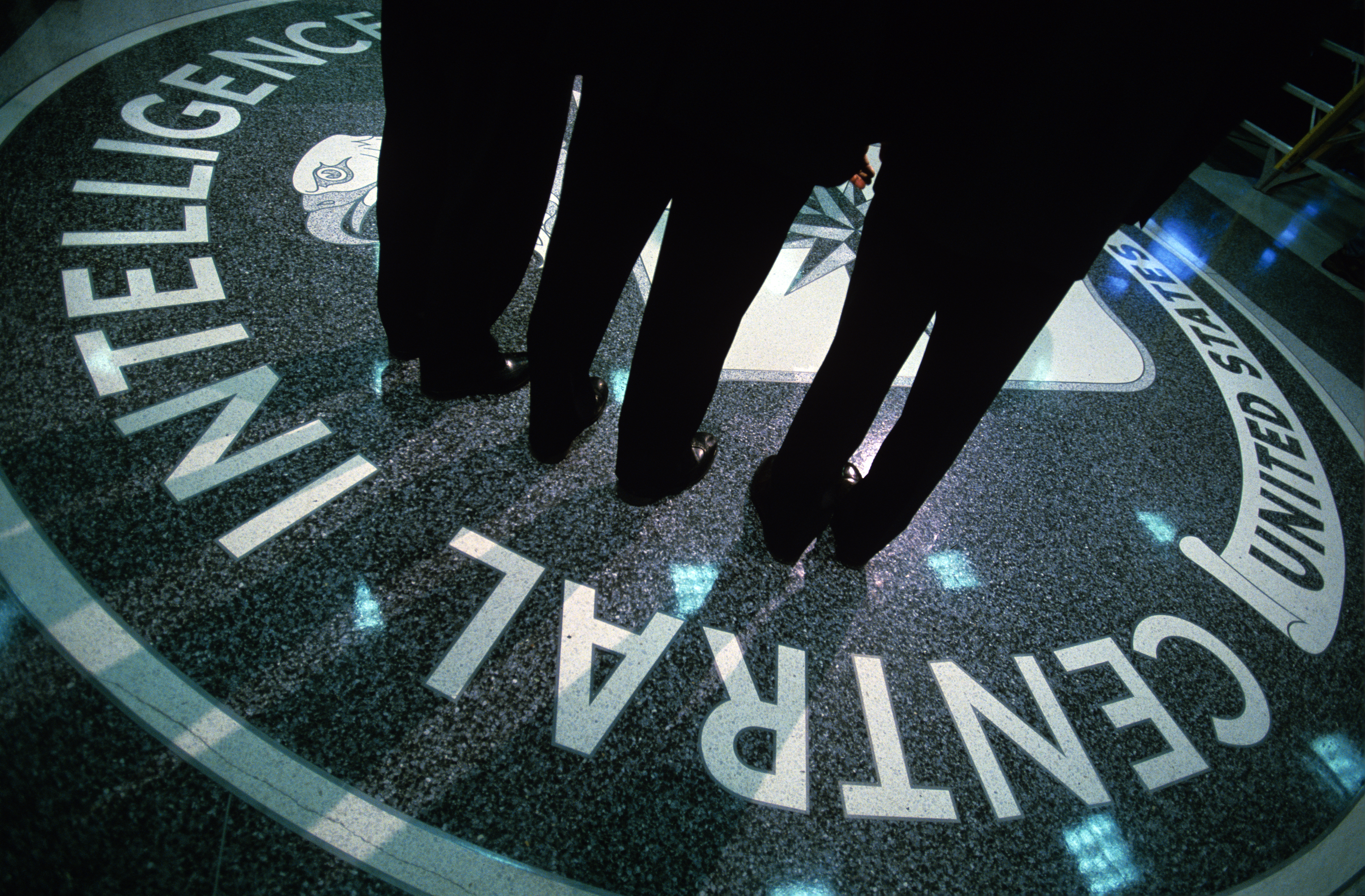
(Photo: The CIA symbol is shown on the floor of CIA Headquarters, July 9, 2004 at CIA headquarters in Langley, Virginia. By Charles Ommanney/Getty Images)

Britain Ties Up Pornographers In Red Tape

Mistresses And Fetishists Gather At Annual DomCon Convention

Christopher Hooton enumerates the sex acts recently banished from British porn:

The Audiovisual Media Services Regulations 2014 requires that video-on-demand (VoD) online porn now adhere to the same guidelines laid out for DVD sex shop-type porn by the British Board of Film Censors (BBFC). Seemingly arbitrarily deciding what is nice sex and what is not nice sex, the board’s ruling on ‘content that is not acceptable’ (p.23) effectively bans the following acts from being depicted by British pornography producers:

Spanking

Caning

Aggressive whipping

Penetration by any object “associated with violence”

Physical or verbal abuse (regardless of  if consensual)

Urolagnia (known as “water sports”)

Role-playing as non-adults

Physical restraint

Humiliation

Female ejaculation

Strangulation

Facesitting

Fisting

The final three listed fall under acts the BBFC views as potentially “life-endangering”.

Hooton adds that the amendment “seems to take issue with acts from which women more traditionally derive pleasure than men.” Erika Lust makes that point even more adamantly:

With this legislation, the UK is in danger of finding itself back in an age where porn is simply the boring, unrealistic, male fantasy of bimbos eagerly pleasing men as if it is their duty, where women are submissive and lack ownership of their sexuality. Women in the industry will now fear the loss of their livelihoods as well as their sexual independence.

Elizabeth Nolan Brown offers a more general objection:

Both regulations disproportionately affect smaller, independent porn producers and websites. As Vice’s Frankie Mullin points out, the new censorship rules will have less effect on large porn producers and mainstream sites, “which tend to favour the strip, blowjob, fuck, cum-all-over-a-woman’s-face formula, but the UK’s smaller, independent producers,” specifically fetish producers. These include people like Ms Tytania, who makes feminist-tinged dominatrix porn, and pretty much anybody else whose products deviate from normative sexual practices. The rules really are a crazy infringement on freedom of artistic expression, not solely a commercial setback for someone who runs subscription rough-sex sites (not that there’s anything wrong with that).

And Jessica Roy alludes to the wide range of acts that list left off:

The ban doesn’t mean U.K. porn connoisseurs can’t watch porn that includes stuff like spanking, but simply that porn filmed in the U.K. can’t include those acts. Sounds like U.K. freaks will have to settle for some good ol’ fashioned Japanese tentacle porn.

(Photo: A participant called SgChill is bound in rope at a dungeon party during the domination convention, DomConLA, in the early morning hours of May 11, 2013 in Los Angeles, California. By David McNew/Getty Images)

Carter In

To replace Hagel, the White House has reportedly picked Ashton Carter, a theoretical physicist and former Harvard prof who served as deputy defense secretary under both Hagel and Panetta. Andrew Prokop provides more context:

Carter has a great deal of mainstream and bipartisan credibility, and he’s clearly well-equipped to manage the Pentagon bureaucracy. But he’s not particularly known for strategic thinking about the Middle East, so his selection would likely indicate that the White House will continue to center its foreign policy development process in the National Security Council rather than the Cabinet.

Carter is respected by many on the right: he was unanimously confirmed by the Senate to be Panetta’s deputy in 2011, Sen. John McCain has called him “a hard-working, honest, and committed public servant,” and conservative commentator Jennifer Rubin wrote in 2013 that Carter’s appointment could “add some muscle to an administration that has too rarely backed up its rhetoric with action.”

This could give him a good chance at winning approval from the GOP-controlled Senate, and McCain’s Armed Services Committee, quickly next year. However, he may face some criticism from liberals for his hawkish leanings on certain issues — for instance, in 2006, he co-wrote an op-ed calling on the Bush administration to strike and destroy the long-range missile North Korea was then constructing.

McCain and other Republicans say they could see Carter as an ally of sorts, but they doubt the administration will grant him any more independence than his predecessors enjoyed:

McCain said he expected to work closely with Carter on issues that aren’t micromanaged by the White House, such as reforming the process by which the Pentagon develops and purchases weapons and cutting the Pentagon’s bloated civilian bureaucracy. On issues where the White House has taken a policy lead, such as the negotiations with Iran or the war in Syria, McCain predicted that even if he did cooperate with Carter, it would not make much of a difference. “He’s not going to have a say in it,” McCain said. “I certainly could work with him  — on Iran and Syria — but I guarantee that he would not have any influence on those decisions.”

That’s roughly Ed Morrissey’s take as well:

That makes sense on a political level, and perhaps an organizational level as well. It won’t help what really ails the Obama administration’s defense policy, though, which is that it’s being controlled by his inner circle rather than truly independent policymakers. Unlike George Bush’s decision to bring in Robert Gates in 2006, which helped change the strategy in Iraq and the approach to national-security policy, Carter’s appointment will mean the same incoherence that allowed the White House to float Johnson’s name last week as a trial balloon will continue. He won’t have the political clout to force an independent point of view within Obama’s inner circle, and Carter will just be another chess piece to sacrifice later when more failure results.

Loren Thompson calls Carter an inspired choice:

If cabinet members were picked purely on the basis of their resumes, Ash Carter would a compelling candidate for Secretary of Defense. The one facet of his credentials that does not come through in a resume or curriculum vitae, though, is that he is a smooth political operator — engaging, agreeable, and a good listener (which helps a lot on Capitol Hill). After decades of learning everything worth knowing about national defense, Carter usually finds himself the smartest person in the room and thus doesn’t have to strain to prove his expertise.

In other words, normal people tend to like Ash Carter — which is probably not something you could say about most defense wonks (or medieval history majors). That quality is very important in navigating Washington’s political culture, where relationships are crucial to success.

The Bloomberg View editors like Carter too:

He’s not on the right side of every procurement debate. He remains too fond of big-ticket items, such as the F-35 fighter, that need to be scaled back. He has been overly optimistic about the promise of saving money through smarter contracting. And in his stint as deputy secretary, he was timid about even minor, sensible changes in the biggest drain on military spending: the Tricare health plan and other benefits for veterans and their families.

On the plus side, Carter understands the importance of maintaining a robust nuclear arsenal, could play a strong role in shaping (and selling to Congress) a nuclear deal with Iran, and knows more about the reclusive and dangerous regime in North Korea than just about anyone outside the Hermit Kingdom.

Gopal Ratnam and colleagues look over what the new SecDef will have on his plate:

Carter will take charge of a Pentagon in the midst of an intensifying battle against the Islamic State. The administration has flatly ruled out the use of ground troops to fight the group in Syria and Iraq, but months of American and allied airstrikes have done little to weaken the militants or dislodge them from the vast areas of the two countries that they control. Carter will also have to figure out how to continue withdrawing U.S. troops from Afghanistan without allowing the Taliban to retake the country’s major cities amid a sharp spike of attacks inside Kabul. Russia’s continued aggression in Ukraine and Eastern Europe, as well as China’s assertive moves in its territorial waters, will also pose difficult and challenging questions for Carter and his staff.

The CDC vs Penises

The latest federal medical guidelines for circumcision are now out, and they emphatically want to return to the era in which infant boys are routinely subjected to the surgical removal of their foreskins – and even adolescent and adult men encouraged to cut their penises. A couple of things need to be emphasized, it seems to me. The core argument is about lowering the risk of HIV infection:

“The first thing it’s important to know is that male circumcision has been associated with a 50 to 60 percent reduction of H.I.V. transmission, as well as a reduction in sexually transmitted infections such as herpes, bacterial vaginosis and the human papilloma virus (H.P.V.), which causes penile and cervical cancer,” Dr. Jonathan Mermin, director of the CDC’s National Center for HIV/AIDS, told The New York Times.

The evidence for this is entirely with respect to heterosexual sex, and in sub-Saharan Africa, where, unlike in the US, heterosexual sex accounts for the vast majority of HIV infections. It refers, moreover, only to those cases where men are infected by HIV-positive women – a small fraction of the total HIV cases in the US. You wouldn’t know this from Mermin’s statement – which seems to me designed to scare parents with the HIV boogeyman, rather than present them with a clear sense of the tiny potential health benefits involved. (There’s no evidence that circumcision can reduce the chances of HIV infection in gay sex, which accounts for the big majority of US HIV infections.)

To flesh out its case, the CDC cites a statistic that estimates that 10 percent of HIV infections in men can be attributed to female-to-male transmission in the US. It’s worth reiterating that these statistics are estimates, not actual numbers. And the actual number of men estimated to be at risk from this kind of infection is a mere 4,000 a year. Around 2 million boys are born in the US every year. So the future risk of an infant boy getting infected with HIV by a woman, using the CDC’s own argument, is 0.2 percent, or two in a thousand baby boys. And remember, we cannot know that these men were infected by women – it’s an inference – and self-reporting on the matter is extremely unreliable.

We have some other circumstantial data with respect to HIV transmission and circumcision in the West. The AIDS epidemic was far worse in the US – with much higher rates of circumcision – than in Europe, where the infant mutilation was far less prevalent. We’ve also seen a major shift downward in circumcision rates in the US and no sudden upsurge in infection rates. Then there’s the simple fact that we now have a non-surgical preventative daily pill that prevents HIV infection, as well as condoms, providing a way for men to protect themselves from HIV without permanently scarring their dicks.

Somehow, none of this context is spelled out in the recommendations. Neither is any non-medical concern – such as not having your body permanently mutilated without your consent. The impact on sexual sensitivity is also unmentioned – because pleasure has no place in assessing mere medical costs and benefits. The reductions in the risk of getting herpes or HPV are also minimal. If I were to offer any recommendations for the final report on this, it would be for the real and minuscule potential medical benefits of circumcision to be spelled out more clearly, and the non-medical costs to be weighed at least in part. When the potential benefits of this are so marginal, the case for doing nothing – and doing no actual harm – seems to be a powerful one.

(Cropped sidebar image by Flickr user Shira Gal)